
Reading Comprehension Passages with Questions and Answers PDF: Complete Guide for All Grades
Master reading comprehension passages with questions and answers PDF. Free worksheets, grade-level tips & strategies for 2nd–5th grade. 📝

Finding the right reading comprehension passages with questions and answers PDF can transform the way students engage with written text. Whether you are a teacher assembling a classroom packet, a parent supporting homework practice, or a student preparing for a standardized reading comprehension test, having high-quality passages paired with well-constructed questions is the single most effective study tool available. Research from the National Reading Panel consistently shows that guided reading practice with immediate feedback accelerates skill growth faster than silent reading alone, making structured PDF worksheets an essential resource for learners at every grade level.
Good reading comprehension worksheets do far more than test whether a child remembered what they read. They train the brain to extract meaning actively — identifying main ideas, inferring author intent, evaluating evidence, and building vocabulary in context. These skills compound over time. A student who practices structured comprehension exercises three times per week in second grade will enter third grade with measurably stronger literal and inferential reading skills than peers who read without guided questioning. The academic research is clear: deliberate, questioned-guided reading practice is one of the highest-use academic interventions available to educators.
The grade-level range covered by quality reading comprehension materials spans from early elementary through high school and even adult literacy programs. For younger readers in second and third grade, passages are typically 100–200 words long, use familiar vocabulary, and focus on literal recall and basic sequence comprehension.
By fourth and fifth grade, passages grow to 300–500 words and begin introducing inferential questions that ask students to read between the lines. Middle and high school passages may exceed 800 words and demand critical analysis, argument evaluation, and synthesis across multiple texts — skills directly tested on the SAT, ACT, and state standardized exams.
One reason PDF format has become the dominant delivery method for reading comprehension materials is its universal accessibility. A PDF downloaded on a teacher's laptop renders identically on a school Chromebook, a tablet, or a printed page. Fonts, margins, question spacing, and answer lines remain consistent regardless of the device or printer. This reliability matters enormously in classroom settings where inconsistent formatting can confuse young readers or waste instructional time troubleshooting layout issues. Many districts have moved entirely to PDF-based reading packets because they eliminate formatting variability and can be easily shared via email or a school learning management system.
Choosing the right passage difficulty is critical and often underestimated. A passage that is too easy provides no cognitive challenge and builds no new skills. A passage that is far above a student's reading level creates frustration rather than learning.
Educators and reading specialists use the Lexile framework — a numerical scale ranging from below 200L for beginning readers to above 1600L for advanced texts — to match passage complexity to individual student ability. Most free PDF passage collections organize materials by Lexile range, grade band, or Flesch-Kincaid grade level, giving teachers a reliable way to differentiate instruction within a single classroom of mixed-ability learners.
Beyond grade-level appropriateness, the best reading comprehension passage collections cover a diverse range of text types and subject areas. Fiction passages expose students to narrative structure, character development, theme, and figurative language. Nonfiction passages build background knowledge in science, history, and social studies while teaching text features like headings, captions, and bold vocabulary. Poetry passages develop an ear for rhythm, imagery, and connotative meaning. Argument passages — increasingly common on state tests — require students to evaluate claims, identify evidence, and assess the strength of reasoning. A well-rounded PDF collection should include all four text types at each grade level.
The question formats within a reading comprehension passage PDF matter as much as the passages themselves. Multiple-choice questions are efficient for large-group assessment and are the dominant format on standardized tests, but they can reward guessing. Short-answer questions require students to locate and paraphrase specific evidence from the text, building both comprehension and writing skills simultaneously. Extended-response or constructed-response questions push students to integrate information across the entire passage and express analysis in their own words. The strongest PDF worksheets blend all three question types to give learners practice with every format they will encounter on real exams.
Reading Comprehension by the Numbers

Grade-Level Reading Comprehension Breakdown
Passages run 100–200 words on familiar topics like animals, seasons, and family. Questions focus on identifying who, what, where, and when. Students practice literal recall, sentence-level vocabulary, and simple sequencing with picture-supported or independent reading formats.
Passages extend to 200–350 words and introduce basic inference questions. Students begin identifying main idea versus supporting detail, understanding cause-and-effect relationships, and recognizing simple text structures like problem-solution and compare-contrast in short nonfiction pieces.
Passages reach 300–500 words covering science, history, and longer fiction. Questions include inferential reasoning, author's purpose, and vocabulary-in-context items. This grade level aligns with NAEP assessments and is often the first year students experience formal standardized reading comprehension testing.
Passages exceed 500 words and may include two related texts requiring synthesis. Students answer questions about theme, figurative language, point of view, and textual evidence. Extended-response prompts ask students to write multi-sentence answers supported by specific examples from the passage.
High school and test-prep passages mirror SAT, ACT, and AP exam formats. Texts are argumentative, literary, or paired informational. Questions test rhetorical analysis, evidence evaluation, and cross-text comparison. PDF collections at this level often include full answer explanations rather than just answer keys.
Understanding how to apply reading comprehension strategies is the difference between a student who passively absorbs words and one who actively constructs meaning. Researchers at Harvard's Laboratory for Visual Learning identified seven core strategies that expert readers use automatically but struggling readers must be explicitly taught: predicting, visualizing, questioning, clarifying, summarizing, making connections, and evaluating. When these strategies are embedded directly into the questions on a reading comprehension passage PDF, students internalize them through practice rather than memorizing abstract definitions. That is why the best worksheets are structured learning tools, not merely assessment instruments.
Predicting is the strategy that activates prior knowledge before reading begins. When a student looks at a passage title, scans a graphic or caption, and asks themselves what they already know about the topic, their brain creates mental frameworks — schemas — that help new information stick.
Well-designed reading comprehension for class 3 materials often include a brief pre-reading box where students write one prediction before they begin. Research shows that students who make predictions before reading recall significantly more information after reading than students who begin without any activation of prior knowledge. This simple addition adds minimal time but delivers measurable gains.
Visualizing is particularly powerful for narrative passages. When readers create mental images of characters, settings, and events, they encode information in both linguistic and visual memory channels simultaneously, a phenomenon cognitive scientists call dual coding. Students who struggle to visualize often read words without comprehending meaning — they can decode fluently but cannot retell what happened. Visualizing practice can be as simple as asking students to stop after one paragraph, close their eyes for five seconds, and sketch or describe the mental image they formed. Over weeks, this habit becomes automatic and transfers to all reading contexts, including standardized tests.
The questioning strategy teaches students to generate their own why and how questions while reading, not just answer teacher-provided questions after the fact. When a student stops mid-passage and asks themselves, "Why did the author include this detail?" or "How does this connect to what I read in the first paragraph?" they are engaging in the same metacognitive monitoring that expert readers perform unconsciously.
Worksheets that include built-in stopping points with student-generated question prompts — often called guided reading response sheets — have been shown in controlled studies to increase comprehension scores by 15–25 percentile points compared to traditional read-then-answer formats.
Clarifying is the strategy that prevents students from reading past confusion. Many struggling readers plow through unfamiliar words or confusing sentences without stopping to resolve the confusion, arriving at the questions with only a vague impression of the passage. Teaching students to mark unfamiliar words, reread confusing sentences, and use context clues to approximate meaning builds the self-monitoring habits that characterize proficient readers. Passage PDFs that include margin vocabulary boxes, context clue prompts, and glossary definitions for Tier 2 and Tier 3 vocabulary give students the scaffolding they need to build this clarifying habit without becoming frustrated and disengaging.
Summarizing requires students to identify what is most important — a skill that is deceptively difficult. Students who have not been taught explicitly to summarize tend to retell every detail rather than distinguish main ideas from supporting details. The GIST strategy — writing a 20-word sentence that captures the most important idea — is a practical summarizing technique that works well for nonfiction passages at grades 3 through 8. For narrative passages, the Somebody-Wanted-But-So-Then frame helps students capture character motivation, conflict, and resolution in a structured format. Both techniques translate directly into stronger extended-response answers on standardized reading comprehension tests.
Making connections bridges the gap between what students read and what they already know from their own lives, from other texts they have read, or from the wider world. Text-to-self connections help students build empathy and personal engagement with passages. Text-to-text connections strengthen comparative analysis skills that become essential in upper-grade standardized testing, where paired-passage questions require students to identify how two authors treat the same topic differently.
Text-to-world connections develop background knowledge and help students evaluate the broader significance of what they read. All three types of connections deepen comprehension and improve retention of passage content long after the worksheet is complete.
Reading Comprehension Strategies by Text Type
Fiction passages test a student's ability to analyze narrative elements including character motivation, setting, theme, conflict, and point of view. When approaching a fiction passage on a reading comprehension test, students should first identify the narrator's perspective — first person, third person limited, or third person omniscient — because this determines what information is available and how reliable the narrator's account may be. Questions about theme require students to move beyond plot summary to identify the universal message the author communicates through character choices and story outcomes.
The most common fiction question types include character inference questions ("What does this action reveal about the character?"), figurative language identification (similes, metaphors, personification, and hyperbole), and mood or tone analysis. Students who practice with fiction passage PDFs regularly develop an instinct for author craft decisions — why a particular word was chosen, why a scene is included, how the structure of a story creates suspense or resolution. These skills transfer directly to literary analysis writing assignments and to the literature sections of state standardized reading comprehension assessments.
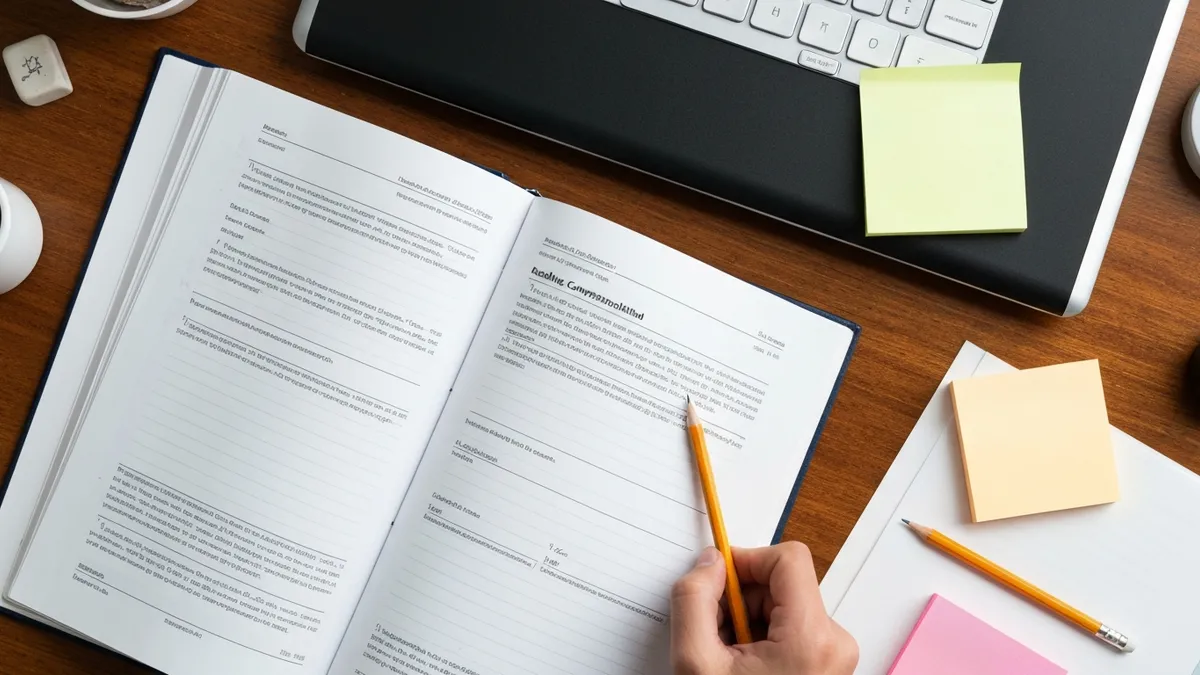
PDF Worksheets vs. Digital Reading Platforms: Which Is Better?
- +Print-and-go convenience — no login, no device, no internet required for classroom use
- +Consistent formatting across all devices and printers eliminates layout surprises
- +Students can annotate, underline, and write margin notes directly on paper
- +Eliminates screen distraction and encourages sustained focus on a single text
- +Easy to collect, grade, and return with written feedback from the teacher
- +Offline availability makes PDFs ideal for homework, travel, and low-tech environments
- −No automatic grading — teacher or student must check answers manually against a key
- −Cannot adapt difficulty in real time based on student performance the way adaptive apps do
- −Printing costs add up for high-volume classroom use across an entire school year
- −Static format cannot include audio read-aloud support for English Language Learners
- −No built-in progress tracking or data dashboard for monitoring student growth over time
- −Cannot hyperlink to definitions, multimedia, or supplemental background knowledge resources
Pros and Cons at a Glance
| Pros | Cons |
|---|---|
| Print-and-go convenience — no login, no device, no internet required for classroom use | No automatic grading — teacher or student must check answers manually against a key |
| Consistent formatting across all devices and printers eliminates layout surprises | Cannot adapt difficulty in real time based on student performance the way adaptive apps do |
| Students can annotate, underline, and write margin notes directly on paper | Printing costs add up for high-volume classroom use across an entire school year |
| Eliminates screen distraction and encourages sustained focus on a single text | Static format cannot include audio read-aloud support for English Language Learners |
| Easy to collect, grade, and return with written feedback from the teacher | No built-in progress tracking or data dashboard for monitoring student growth over time |
| Offline availability makes PDFs ideal for homework, travel, and low-tech environments | Cannot hyperlink to definitions, multimedia, or supplemental background knowledge resources |
Reading Comprehension Study Checklist: 10 Steps Before Test Day
- ✓Download and print at least 10 full-length reading comprehension passage PDFs at your target grade level.
- ✓Time yourself on each passage to simulate real test conditions — most standardized tests allow 60–90 seconds per question.
- ✓Review every wrong answer and identify whether the error was a misread, a vocabulary gap, or a reasoning mistake.
- ✓Practice at least one fiction passage, one nonfiction passage, and one paired passage set each week.
- ✓Study the seven core reading strategies — predicting, visualizing, questioning, clarifying, summarizing, connecting, and evaluating.
- ✓Build a personal vocabulary log of unfamiliar words encountered in practice passages and review it weekly.
- ✓Complete at least two full timed mock reading comprehension tests under exam conditions before test day.
- ✓Practice writing extended-response answers using textual evidence with the phrase "According to the passage..." to anchor citations.
- ✓Read a variety of text types — news articles, short stories, science summaries — outside of formal worksheet practice to build fluency.
- ✓Get a full night of sleep the night before the test and review your vocabulary log one final time that morning.
The 20-Minute Daily Reading Rule
Students who read for just 20 minutes per day encounter approximately 1.8 million words per year — compared to only 8,000 words for students who read less than 1 minute daily. That massive vocabulary and background knowledge gap compounds across grade levels and is the single strongest predictor of performance on reading comprehension tests in grades 4 through 8. Structured PDF passage practice counts toward those 20 minutes and adds the guided questioning that accelerates skill development beyond what free reading alone can achieve.
Improving reading comprehension scores requires a systematic approach that addresses the three root causes of low performance: limited vocabulary, weak background knowledge, and underdeveloped reading strategies. Students who score below the 40th percentile on reading comprehension assessments almost universally share at least two of these three deficits, and improving scores sustainably requires directly addressing all three rather than drilling practice questions without understanding why errors occur. A targeted intervention plan built around high-quality passage PDFs can be structured to address vocabulary, build knowledge, and practice strategies simultaneously within each reading session.
Vocabulary development is the most direct lever for improving comprehension scores, particularly for English Language Learners and students from low-income households who may have had less exposure to academic language before formal schooling. Tier 2 words — sophisticated general-academic vocabulary like "analyze," "contrast," "significant," and "elaborate" — appear constantly in reading comprehension question stems and can confuse students who know what a passage says but cannot decode what the question is asking them to do. Teaching these academic task words explicitly, separate from passage-specific vocabulary, gives students the metacognitive language they need to process comprehension questions accurately and efficiently.
Background knowledge plays a surprising role in reading comprehension that is often overlooked by educators focused on skills instruction. E.D. Hirsch's extensive research demonstrated that two readers with identical decoding fluency and vocabulary knowledge can score dramatically differently on the same passage if one has background knowledge about the topic and the other does not.
A student who has never learned about the water cycle will struggle to make inferences in a science passage about evaporation even if they can read every word fluently. This is why reading comprehension practice packets that cover a wide range of science, history, geography, and social studies topics build both comprehension skills and the content knowledge that fuels future comprehension.
The role of reading fluency — the ability to read accurately, at an appropriate rate, and with proper expression — is often underestimated in comprehension instruction. Students who read very slowly expend so much cognitive energy on decoding individual words that they have little mental capacity left for constructing meaning.
Research from Timothy Rasinski's work on fluency shows that students reading below 100 words per minute in third grade are at significant risk for comprehension difficulties regardless of strategy instruction. Fluency-building activities like repeated reading of familiar short passages, partner reading, and reader's theater can dramatically increase words-per-minute rates and free up cognitive capacity for comprehension processing.
Formative assessment — the regular, low-stakes checking of student understanding during instruction rather than only at the end of a unit — is a critical component of effective comprehension instruction. When teachers review completed passage PDFs within 24 hours and use error patterns to inform the next day's instruction, students benefit from immediate corrective feedback while the passage is still fresh in memory.
Research on spaced practice and interleaved retrieval shows that regular, distributed comprehension practice — three sessions of 20 minutes spread across the week — produces stronger long-term retention than a single 60-minute session, even when total practice time is identical.
Technology can complement PDF-based comprehension practice when used strategically. Text-to-speech tools allow students to hear a passage read aloud while following along visually, which supports ELL students and students with dyslexia who may struggle with decoding but demonstrate strong comprehension when the decoding barrier is removed. Digital annotation tools let students highlight, comment, and organize thinking on PDF versions of passages without paper. However, the fundamental cognitive work of reading comprehension — building mental models, generating inferences, evaluating evidence — cannot be outsourced to technology and must be practiced deliberately and consistently by the student.
Parent involvement significantly amplifies the effectiveness of comprehension practice, particularly at the elementary level. Research from Johns Hopkins University shows that students whose parents ask comprehension questions during shared reading at home score an average of 15 points higher on reading assessments than students whose home reading is entirely independent. Parents do not need specialized training to be effective reading partners — simply asking three questions after reading a passage together ("What was this mainly about?", "What surprised you?", and "What questions do you still have?") activates the same metacognitive processing that explicit comprehension instruction builds in the classroom setting.

Many students read a passage once, then immediately attempt the questions — and lose significant points as a result. Research on test-taking behavior shows that students who re-read at least one paragraph before answering each question score an average of 12% higher than students who answer from memory alone. Train yourself to return to the passage for every question, even when you feel confident in your memory of the text. The passage is always there; use it.
Test-day performance on reading comprehension sections depends not just on preparation but on strategic execution during the exam itself. Students who have practiced extensively with passage PDFs sometimes underperform on actual tests because they apply their practice habits inefficiently under time pressure. Understanding exactly how to allocate time, approach different question types, and manage comprehension errors during a timed exam is a distinct skill that must be practiced explicitly — ideally by completing several full-length timed mock tests before the actual exam date arrives.
Time management is the first critical test-day skill. Most standardized reading comprehension sections allocate between 45 seconds and 90 seconds per question, including time for reading the passage. A practical approach for a 45-minute section with 40 questions is to spend no more than 3–4 minutes reading each passage and then aim to answer each question within 60–75 seconds.
Students should watch the time at the halfway point of the section and adjust their pace if they are significantly behind or significantly ahead. Spending 8 minutes on a single passage leaves insufficient time for later passages and often reflects over-reading rather than genuine comprehension difficulty.
Question-triage strategy — deciding which questions to answer first within a passage — can meaningfully improve scores for students who find some question types harder than others. For students who find inference questions significantly harder than literal recall questions, answering all the literal detail questions first and then returning to inference questions uses time more efficiently. For students who find vocabulary-in-context questions easiest, starting with those questions can build confidence and momentum before tackling more demanding analysis questions. The key is to have a consistent personal strategy rather than approaching each question type randomly.
Eliminating wrong answers on multiple-choice reading comprehension questions is one of the most powerful score-improvement strategies available. Research on standardized test design shows that distractor answers — the wrong choices — are specifically designed to appeal to students who misread the question, relied too heavily on outside knowledge rather than passage text, or confused a detail from one part of the passage with a different part. Training students to look for the two or three obviously wrong answers before selecting the best remaining option consistently raises multiple-choice accuracy, even on questions where the student is uncertain of the correct answer.
Students preparing for 4th grade reading comprehension and above should understand the critical difference between an answer that is merely plausible and one that is directly supported by textual evidence. Standardized test questions almost always have one provably correct answer — one that can be pointed to in the passage — and three distractors that are either too broad, too narrow, contradicted by the passage, or based on information not in the passage.
Training students to ask "Where exactly in the passage does it say this?" for every multiple-choice option they consider builds the evidence-based reasoning habit that separates high scorers from average scorers on reading comprehension assessments.
Extended-response and short-answer questions require a different strategic approach than multiple-choice. For short-answer questions, students should identify the exact sentence or sentences in the passage that answer the question, paraphrase the evidence in their own words, and connect it explicitly back to the question using transition phrases. Generic answers that restate the question without providing specific passage evidence receive minimal or no credit on most scoring rubrics. Teaching students the RACE framework — Restate the question, Answer it, Cite evidence, Explain the evidence — gives them a repeatable structure for writing evidence-based short answers efficiently under timed conditions.
Post-test reflection is the step most students skip but that consistently separates students who improve across multiple test attempts from those who plateau. After completing a reading comprehension practice test, students should spend at least as much time reviewing wrong answers as they spent taking the test.
For each incorrect answer, the review process should identify the specific reason for the error: Was the correct answer in the passage and the student misread it? Was it an inference the student missed? Was it a vocabulary word in the question stem that confused the student? Categorizing errors reveals patterns — and patterns reveal which specific skills to target in the next week of practice to produce the greatest score improvement.
Building a daily reading comprehension practice routine is the most reliable path to sustained improvement, and the structure of that routine matters almost as much as the time invested. The most effective practice sessions follow a consistent four-part format: pre-reading activation (one minute of previewing the passage title, headings, and first sentence), active reading with annotation (underlining main ideas and circling key vocabulary), answering questions with textual evidence, and reviewing the answer key with written notes on any errors. This structured approach transforms a passive worksheet into a deliberate learning session that builds metacognitive habits with every repetition.
For students who struggle with 2nd grade reading comprehension specifically, the most important intervention is building phonemic awareness and sight word fluency alongside comprehension practice. Second graders who cannot yet decode fluently cannot focus cognitive resources on meaning construction, so comprehension worksheet practice alone is insufficient. Pairing passage practice with daily oral reading — where an adult listens and provides immediate decoding support — accelerates the transition from effortful decoding to automatic word recognition, which unlocks the cognitive capacity needed for genuine comprehension development.
Teachers assembling reading comprehension passage PDF collections for classroom use should prioritize three quality indicators above all others: passage authenticity, question alignment, and answer explanation quality. Authentic passages — texts drawn from real books, magazines, scientific reports, and historical documents rather than artificially simplified passages written specifically for testing — expose students to the vocabulary and syntax patterns they will encounter in real-world reading.
Question alignment means every question is answerable from the passage text alone, without requiring outside knowledge. Answer explanation quality separates great worksheets from mediocre ones — the best PDFs explain not just what the correct answer is but why each distractor is wrong, transforming a graded worksheet into a teaching tool.
Differentiation within a single classroom is one of the most practical advantages of PDF passage collections. A teacher can assign the same passage topic at three different Lexile levels — one version for below-grade-level readers, one for on-level readers, and one for advanced readers — allowing every student to engage with the same science or history content while reading text at their optimal challenge level.
This approach, known as tiered reading, maintains classroom community around shared topics while providing the individualized challenge that drives growth. Many free online passage databases allow teachers to filter by both topic and Lexile level, making differentiation practical without requiring significant additional planning time.
The transition from elementary to middle school reading comprehension is one of the most challenging academic transitions students face, largely because the volume and complexity of text required suddenly increases while explicit reading instruction simultaneously decreases. Students who relied on teacher-scaffolded reading in elementary school often struggle when expected to read independently for extended periods across multiple content areas simultaneously.
Middle school reading comprehension practice should include not just literary and informational passages but also discipline-specific texts from science, social studies, and mathematics — the kinds of dense, technical reading that students encounter daily across their class schedules in grades 6 through 8.
For adults preparing for professional licensing exams, college entrance assessments, or workplace reading comprehension evaluations, the fundamental skills are the same as those taught in elementary school — but the passage complexity, vocabulary demands, and question sophistication are dramatically higher. Adult readers often find that their biggest comprehension challenge is not understanding individual words or sentences but integrating information across a long, complex passage to answer synthesis questions. Deliberate practice with high-Lexile passage PDFs — including legal texts, scientific abstracts, and literary criticism — builds the reading stamina and analytical habits that professional-level comprehension tests require.
Consistency is the most undervalued element of reading comprehension improvement. Students and adult learners who practice for 20 minutes daily outperform those who practice for 2 hours once a week, even though weekly practice involves significantly more total time. The brain consolidates reading skills during sleep and strengthens neural pathways through repeated activation across multiple sessions — a phenomenon called spaced learning. Building a sustainable daily reading habit, even if the sessions are short, is a more reliable predictor of long-term comprehension improvement than any single intensive study session or preparation sprint in the final days before a test.
Sample Reading Comprehension Practice Questions
Try these questions from our free Reading Comprehension practice tests. The correct answer and an explanation follow each question.
Grasslands and forests are both terrestrial biomes that support a wide variety of life. Grasslands are characterized by vast open areas of grasses with few trees and are typically found in areas with moderate rainfall. Forests, however, are dense with trees and receive significantly more precipitation.
- A. Both biomes are dense with trees and receive heavy precipitation
- B. Grasslands receive more rainfall than forests
- C. Both support diverse life, but grasslands have few trees with moderate rain while forests are tree-dense with more precipitation
- D. Forests and grasslands receive identical amounts of rainfall and have the same plant life
Answer: C. Both support diverse life, but grasslands have few trees with moderate rain while forests are tree-dense with more precipitation
'However' signals the contrast between grasslands' openness and moderate rain versus forests' tree density and higher precipitation.
Butterflies and moths are both insects with four wings and scaly bodies. Butterflies are generally active during the day and rest with their wings folded upright. Moths, on the other hand, are mostly nocturnal and rest with their wings spread flat.
- A. Butterflies are nocturnal while moths are active during the day
- B. Both insects share four wings and scaly bodies, but differ in when they are active and how they rest
- C. Moths fold their wings upright when resting just like butterflies
- D. Butterflies and moths belong to completely different insect orders
Answer: B. Both insects share four wings and scaly bodies, but differ in when they are active and how they rest
'On the other hand' signals the contrast: butterflies are daytime and fold wings up; moths are nocturnal and spread wings flat.
A passage explains that a student can read words accurately but struggles to understand what she has read. She can pronounce complex vocabulary but cannot summarize a paragraph or answer questions about its content. What type of reading difficulty does this describe?
- A. A fluency disorder
- B. A reading comprehension disorder
- C. A phonological processing disorder
- D. A visual tracking disorder
Answer: B. A reading comprehension disorder
The disconnect between accurate word reading and poor understanding is the defining feature of a reading comprehension disorder — the mechanics work but meaning does not register.
An email reads: 'Thank you for your interest in the position. While we were impressed with your qualifications, we have decided to move forward with another candidate. We will keep your resume on file for future opportunities.' What can you logically conclude?
- A. The recipient got the job
- B. The recipient was not selected for this particular position
- C. The company is going out of business
- D. The recipient's qualifications were inadequate
Answer: B. The recipient was not selected for this particular position
The phrase 'decided to move forward with another candidate' is a standard rejection, meaning the recipient was not chosen for this specific position despite having good qualifications.
Reading Comprehension Questions and Answers

Reading Comprehension Skills: Complete Guide to Strategies, Practice & Improvement
Reading Comprehension Practice Test PDF 2026: Free Questions
Reading Comprehension Strategies 2026: 12 Tips to Read & Understand Faster

How to Improve Reading Comprehension 2026: Proven Methods for All Ages
Reading Comprehension Test
About the Author

Educational Psychologist & Academic Test Preparation Expert
Columbia University Teachers CollegeDr. Lisa Patel holds a Doctorate in Education from Columbia University Teachers College and has spent 17 years researching standardized test design and academic assessment. She has developed preparation programs for SAT, ACT, GRE, LSAT, UCAT, and numerous professional licensing exams, helping students of all backgrounds achieve their target scores.