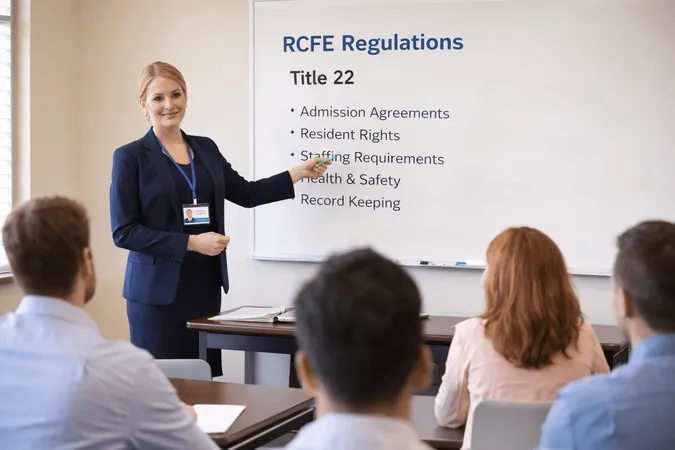
RCFE Conference Guide: What Administrators Need to Know for Exam Success
RCFE practice test prep meets conference insights. Learn how events, training & the RCFE administrator exam connect. ✅ Free resources included.

The RCFE practice test is the single most reliable predictor of whether a California residential care facility administrator will pass their licensing exam on the first attempt, and professional conferences play a surprisingly powerful role in helping candidates prepare.
Each year, thousands of prospective and current RCFE administrators gather at statewide and regional conferences to absorb regulatory updates, swap best practices, and receive hands-on training from Community Care Licensing Division representatives. If you are approaching your RCFE exam, understanding how to extract maximum value from these events — and combining that knowledge with rigorous self-study — can dramatically improve your score and reduce costly retakes.
Professional conferences for residential care facilities for the elderly are not simply networking events. They are curated educational experiences that directly address the content domains tested on the RCFE administrator exam. Sessions typically cover Title 22 regulatory compliance, medication management protocols, dementia care standards, emergency preparedness requirements, and admission and discharge procedures — all of which appear in substantial proportions on the licensing examination. Attending even one well-organized conference before your test date can expose you to real-world scenarios and regulatory clarifications that no textbook fully captures.
California's Department of Social Services oversees the Community Care Licensing Division, which periodically hosts or co-sponsors training events in partnership with industry associations such as the California Assisted Living Association (CALA) and the California Association of Health Facilities (CAHF). These organizations publish annual conference schedules months in advance, making it straightforward for candidates to plan attendance alongside their formal Initial Certification Training Program coursework. If you have not yet enrolled in pre-licensure training, exploring an rcfe administrator practice test free resource can help you gauge your readiness before committing to a full study schedule.
One of the most underrated benefits of RCFE conferences is the access they provide to retired and active licensing analysts. These individuals review actual deficiency citations, walk through common survey violations, and explain the nuanced language of regulations that frequently trips up exam candidates. When a licensing analyst explains the difference between a Type A and Type B citation in a live Q&A session, that information sticks far more effectively than reading the same distinction in a study guide. Administrators who attend these sessions consistently report feeling more confident when they encounter regulatory-interpretation questions on the RCFE test exam.
Conference workshops on dementia care and services are especially valuable for exam preparation because this subject area carries significant weight on the licensing examination. California regulations require that all RCFE administrators demonstrate competency in memory care protocols, including understanding behavioral symptoms, appropriate non-pharmacological interventions, and mandatory reporting requirements for residents with cognitive impairment. Workshop instructors frequently share case studies drawn from actual facilities, giving candidates a concrete framework for applying abstract regulatory language to realistic situations — exactly the kind of application tested in scenario-based exam questions.
Emergency and disaster preparedness is another conference staple that maps directly onto RCFE exam content. California's history of wildfires, earthquakes, and public health emergencies has made emergency planning a central focus for licensing authorities. Conference sessions on this topic typically walk participants through the required components of a facility emergency plan, the timelines for notifying residents and responsible parties, and the documentation that surveyors will request during an unannounced inspection. Candidates who attend these workshops often find that multiple exam questions become immediately recognizable because they have seen nearly identical scenarios presented by subject-matter experts in a live setting.
Combining conference attendance with structured practice testing is the gold-standard approach for RCFE exam preparation. Conferences build conceptual understanding and regulatory fluency, while practice tests reveal specific knowledge gaps and help you develop the pacing and test-taking strategies needed to complete the exam within the allotted time. The most successful candidates treat conferences not as a substitute for study but as an amplifier — a way to make every hour of subsequent reading and practice-question work more productive and targeted.
RCFE Conferences & Exam Prep by the Numbers

Core Conference Topic Areas That Appear on the RCFE Exam
Conferences dedicate significant time to California Code of Regulations Title 22 updates. Sessions clarify recent amendments, survey focus areas, and compliance timelines — all directly tested on the RCFE administrator exam.
Workshops on medication administration, storage, documentation, and the role of physicians and pharmacists are conference staples. These topics represent a major content domain on the RCFE licensing examination.
Memory care protocols, behavioral intervention strategies, and mandatory reporting for cognitively impaired residents are covered extensively at conferences and heavily weighted on the RCFE test.
California's disaster history drives robust conference programming on emergency plans, evacuation procedures, resident notification timelines, and required documentation for licensing surveys.
Sessions on intake assessments, admission agreements, transfer protocols, and discharge procedures help candidates master one of the most procedurally detailed sections of the RCFE exam.
Understanding how RCFE conferences connect to the actual content of the RCFE administrator exam is essential for making the most of your attendance. The state licensing exam draws questions from a defined set of content domains that closely mirror the training and professional development curriculum delivered at industry conferences. This alignment is not coincidental — both the exam and the conferences are ultimately anchored to Title 22 of the California Code of Regulations, the foundational legal framework governing all residential care facilities for the elderly in the state.
The RCFE administrator exam tests candidates across multiple domains, including general administration, resident care, nutrition and food service, health-related services, physical plant requirements, and emergency preparedness. Conference workshops are typically organized along similar thematic lines, which means a disciplined conference attendee can walk away with concentrated, practical exposure to nearly every topic area that will appear on the examination. The key is to approach each session with the exam in mind — taking notes on regulatory citations, specific timelines, required documentation, and the distinctions between different levels of care.
Many conference presenters are former or current Community Care Licensing analysts who bring firsthand knowledge of how surveyors interpret and apply regulations in the field. This insider perspective is invaluable for exam preparation because licensing exam questions are often written to reflect the kinds of compliance judgments that surveyors make during actual facility inspections. When you hear an analyst explain why a particular documentation practice leads to a citation, you are gaining exactly the kind of applied regulatory knowledge that separates passing scores from failing ones on the RCFE exam.
One strategic approach is to attend conferences specifically focused on subjects where your RCFE administrator practice test scores are weakest. If your practice results show gaps in medication management or physical plant requirements, seek out conference workshops that address those areas in depth. Many California RCFE conferences publish their session agendas weeks or months in advance, giving you time to cross-reference the program against your practice test performance data and choose sessions that deliver the highest return on your study investment.
The community aspect of RCFE conferences also provides an often-overlooked study resource: peer learning from other administrators and candidates. Study groups formed at conferences have helped countless candidates pass their RCFE exams by providing accountability, shared notes, and a sounding board for working through difficult regulatory concepts. Connecting with other candidates at a conference can transform a solitary, sometimes overwhelming study process into a collaborative effort with built-in support. Understanding rcfe license cost and continuing education requirements is another topic these peer networks address with useful, firsthand perspective.
Digital resources produced or recommended at conferences — including California DSS guidance documents, updated facility checklists, and compliance tools — also serve as excellent supplementary study materials. Conference exhibitors often include publishers, training providers, and legal consultants who offer free or discounted resources to attendees. Gathering these materials during a conference and integrating them into your exam prep routine can fill knowledge gaps that standard textbooks and online courses sometimes leave behind, particularly in fast-evolving areas such as memory care requirements and infection control protocols.
Post-conference review is a crucial step that many candidates overlook. Within 48 hours of attending each session, revisit your notes, identify three to five regulatory concepts that were new or surprising to you, and look up the corresponding Title 22 sections. Then take a practice quiz targeting those exact concepts. This closed-loop review process — conference learning, note consolidation, regulatory verification, and immediate practice testing — is the most effective way to convert conference attendance into measurable exam score improvements. Treat each conference not as an endpoint but as a catalyst that accelerates and sharpens your ongoing exam preparation.
RCFE Administrator Exam: Study Strategies That Work
Taking an RCFE administrator practice test under timed, exam-like conditions is the single most evidence-backed preparation strategy available. Research on test-enhanced learning consistently shows that retrieving information through practice questions produces stronger, more durable memory than re-reading study materials. Aim to complete at least three to four full-length practice sessions, reviewing every incorrect answer by locating the relevant Title 22 section and reading the primary regulation — not just the explanation.
Spacing your practice tests across several weeks rather than cramming them into the days before the exam is equally important. Distributed practice gives your brain time to consolidate knowledge between sessions, which leads to better retention during the actual RCFE exam. Track your scores by topic domain after each session so you can identify declining areas early and redirect study time before your exam date arrives.

RCFE Conferences for Exam Prep: Benefits and Limitations
- +Direct access to Community Care Licensing analysts who clarify real regulatory interpretations
- +Exposure to real facility case studies that mirror scenario-based exam questions
- +Comprehensive coverage of multiple exam content domains in a condensed time period
- +Networking opportunities with peers who share exam prep strategies and resources
- +Free or low-cost regulatory documents and compliance tools distributed by exhibitors
- +CEU credits that count toward both initial certification and ongoing renewal requirements
- −Conference schedules may not align with your exam date or study timeline
- −Travel and registration costs can add several hundred dollars to your overall preparation budget
- −Large conferences cover broad topics and may spend limited time on your specific weak areas
- −Passive listening at sessions is less effective than active retrieval through practice testing
- −Conference information reflects the presenter's interpretation, which may occasionally differ from exam-question wording
- −Virtual conference formats reduce networking effectiveness and can be harder to engage with deeply
RCFE Exam Preparation Checklist: Before, During, and After the Conference
- ✓Complete your 80-hour Initial Certification Training Program before attending any professional conference.
- ✓Review your most recent RCFE administrator practice test results and identify your three weakest topic domains.
- ✓Register for conference sessions that directly address your identified knowledge gaps.
- ✓Download the current California Title 22 RCFE regulations and bookmark the sections covered in your chosen sessions.
- ✓Prepare five to ten targeted questions for licensing analysts and session presenters before the conference begins.
- ✓Take structured notes during each session, flagging any regulatory citations or compliance timelines mentioned.
- ✓Collect all handouts, resource lists, and DSS guidance documents distributed by presenters or exhibitors.
- ✓Within 48 hours of the conference, review your notes and look up every regulatory citation mentioned.
- ✓Take a targeted practice quiz covering the conference topics within 72 hours to reinforce new knowledge.
- ✓Schedule at least two additional full-length RCFE administrator practice tests in the weeks following the conference.
Conference Attendance Boosts First-Time Pass Rates
Administrators who combine formal Initial Certification Training with at least one professional RCFE conference session report significantly higher confidence entering the licensing exam. Conferences expose candidates to the applied regulatory thinking — case studies, survey scenarios, and compliance judgment calls — that makes the difference between a passing score and a costly retake. Plan conference attendance at least six weeks before your exam date to allow time for post-conference practice testing.
Maximizing your RCFE conference experience requires preparation that begins well before you arrive at the venue. The most productive conference attendees approach each event with a clear learning agenda — a list of specific regulatory questions they want answered, content domains they want to deepen, and professional contacts they want to make. Without this intentional framework, it is easy to drift from session to session accumulating general impressions without gaining the targeted, exam-relevant knowledge that justifies the time and expense of attendance.
Start by auditing your existing knowledge base using a comprehensive RCFE administrator practice test. The detailed score breakdowns that quality practice platforms provide are a roadmap for your conference agenda. If your scores in medication management are strong but your emergency preparedness scores lag behind, prioritize those workshops accordingly. Many California RCFE conferences offer concurrent tracks on different topics, so a clear sense of your priorities ensures you make the right choices when sessions overlap.
During conference sessions, adopt an active listening strategy rather than passively absorbing information. This means writing down specific regulatory section numbers when presenters cite them, noting the exact language used to describe compliance thresholds or required documentation, and flagging any content that seems likely to appear as a scenario-based question. Experienced exam candidates report that the most testable conference material tends to cluster around numerical thresholds — staffing ratios, medication storage temperatures, emergency drill frequencies — and procedural timelines such as how many days an administrator has to notify DSS of a reportable incident.
Networking at RCFE conferences is not just a professional nicety — it is a strategic exam-prep activity. Study groups formed at conferences have a measurably higher completion rate than those organized through online forums because the shared conference experience creates a common knowledge base and a sense of mutual investment. When you study with peers who attended the same sessions, your discussions are immediately grounded in concrete regulatory examples rather than abstract summaries, which accelerates understanding and retention for every member of the group.
Technology can amplify your conference experience in powerful ways. Many conference presenters now share digital slide decks, regulatory reference documents, and resource links via QR codes or conference apps. Capturing these resources during the event means you have a ready-made supplementary study library that you can work through in the weeks leading up to your exam. Annotating these digital materials with your handwritten notes from each session creates a personalized study resource that is far more targeted and memorable than any generic study guide.
After the conference, the single most important step is to translate your experiential learning back into the formal exam preparation framework. This means returning to your RCFE administrator practice tests with fresh eyes, looking for questions that connect to conference content, and using your new regulatory knowledge to analyze both correct and incorrect answer choices more deeply. Many candidates find that a post-conference practice session reveals a notable score improvement in the areas covered by workshops they attended — concrete evidence that conference learning is transferring into exam-ready knowledge.
Long-term career planning is another dimension of RCFE conference value that exam candidates sometimes overlook. Understanding the professional community you are entering — the key advocacy organizations, the regulatory trends, the emerging care standards — helps you contextualize the knowledge you are building for the exam within the broader arc of a fulfilling administrative career. Administrators who engage early with the professional community through conferences tend to stay current with regulatory changes more consistently throughout their careers, which reduces compliance risk and supports the high-quality resident care outcomes that are the ultimate purpose of the RCFE licensing system.

While RCFE conferences provide invaluable regulatory context and applied learning, they are not a substitute for the mandatory 80-hour Initial Certification Training Program or for structured practice testing. California DSS requires documented completion of an approved training program before you can sit for the RCFE administrator exam. Confirm that any conference hours you attend are approved for CEU credit by a recognized provider, as unapproved sessions will not count toward your licensure requirements.
The final weeks before your RCFE administrator exam are the most high-stakes period of your entire preparation journey, and the strategies you apply during this window will have an outsized impact on your outcome. This is not the time to introduce entirely new study materials or attend conferences on unfamiliar topics. Instead, your energy should focus on consolidating and refining the knowledge you have built through months of training, conference attendance, and practice testing — and on developing the mental stamina and test-taking discipline that the exam demands.
A structured review schedule for the final three to four weeks should alternate between full-length practice tests and targeted review sessions on your weakest content domains. Take a full practice exam at the beginning of the final month to establish your baseline, then use the results to design a week-by-week review plan.
Spend the first two weeks addressing your identified gaps through focused reading and short quiz sets. In the third week, take another full practice exam and compare your performance to the baseline. Use the final week for light review, confidence-building practice on your strongest topics, and logistical preparation for exam day.
Sleep, nutrition, and physical activity are not peripheral concerns during exam preparation — they are central to cognitive performance. Research consistently shows that sleep consolidation is critical for memory formation, meaning that the knowledge you acquire during your study sessions only becomes fully retrievable after adequate sleep. Candidates who sacrifice sleep to cram in the final days before the RCFE exam often find that their performance on test day falls below their practice test scores, precisely because their brains have not had time to consolidate recent learning. Protect your sleep schedule as rigorously as you protect your study schedule.
If you have access to a rcfe test exam resource with video explanations, use it strategically in the final weeks. Video walkthroughs of complex regulatory scenarios — particularly those involving medication management, resident rights conflicts, or emergency response decisions — can clarify the reasoning behind correct answers in ways that text explanations sometimes cannot. Watching an expert work through a difficult question out loud activates a different cognitive pathway than reading an explanation, and many candidates find that video review in the final week solidifies their understanding of topics that have remained fuzzy throughout their preparation.
On the day before the exam, avoid taking full-length practice tests or engaging in intense new study. Instead, do a brief, light review of your top ten most important regulatory concepts — the ones that appear most frequently on practice questions and carry the most weight in exam scoring. Organize your exam-day logistics: confirm the testing center location and arrival time, prepare any required identification documents, and plan a meal schedule that will keep your energy stable throughout the three-hour examination without causing the cognitive sluggishness that comes from overeating before a high-stakes cognitive task.
Test-day strategy matters more than most candidates realize. The RCFE administrator exam is designed to be completed within the allotted time by candidates who have prepared thoroughly, but poor time management can undermine even well-prepared examinees. Plan to spend no more than 90 seconds on each question during your first pass through the exam. Flag any question that requires more than a minute of analysis and return to it after completing the items you can answer confidently. This approach ensures that you accumulate points on your strongest material before spending additional time on more challenging questions.
After the exam, regardless of the outcome, take time to reflect on your preparation process. If you passed, identify which preparation strategies — conferences, practice testing, peer study, regulatory reading — contributed most to your success and document them for future professional development.
If a retake is needed, review the California DSS retake policies and timelines, analyze your performance by content domain, and design a targeted remediation plan that addresses the specific areas where your knowledge fell short. Many candidates who do not pass on the first attempt ultimately go on to earn their rcfe test with a stronger second-attempt score, precisely because the first examination experience revealed exactly where their preparation needed to go deeper.
Practical preparation tips for the RCFE exam go beyond simply accumulating study hours — they require a strategic approach to how those hours are organized and what cognitive outcomes you are targeting in each study session. The most effective RCFE candidates treat exam preparation like a professional project, with defined milestones, measurable outcomes, and regular self-assessment checkpoints. This project-management mindset is especially useful for candidates who are balancing exam preparation with existing work responsibilities or caregiving obligations.
One practical strategy that consistently pays dividends is building a personal regulatory reference sheet organized by content domain. As you work through practice tests, conference notes, and regulatory reading, compile a one-page summary for each major topic area — medication management, resident rights, emergency preparedness, physical plant requirements — that captures the most frequently tested thresholds, timelines, and procedural requirements. Reviewing these reference sheets in the final days before the exam is far more efficient than re-reading entire regulatory sections and helps ensure that high-priority information is at the front of your mind when you sit down to test.
Scenario-based questions require a specific analytical framework that differs from straightforward recall questions. When you encounter a scenario on the RCFE administrator exam, train yourself to identify the regulatory context first — which Title 22 section applies to this situation? — before evaluating the answer choices. Many incorrect answers are plausible-sounding but violate a specific procedural requirement or fail to account for a regulatory timeline. Candidates who approach every scenario question by identifying the applicable regulation first consistently outperform those who rely on general judgment or intuition.
Vocabulary precision is another underappreciated aspect of RCFE exam success. Regulatory language uses specific terms — "immediately," "within 24 hours," "as soon as practicable," "without delay" — that carry precise legal meanings and often determine the correct answer in time-sensitive compliance scenarios. Building familiarity with these terms through careful regulatory reading and targeted practice questions is essential preparation that no amount of general study can replace. Pay particular attention to the distinctions between what administrators are required to do versus what they are merely permitted to do, as this distinction drives many of the most challenging exam questions.
The physical environment in which you study also affects preparation quality in ways that are easy to overlook. Simulating exam conditions during at least two or three of your practice sessions — same time of day as your scheduled exam, no access to reference materials, strict time limits, minimal distractions — prepares your nervous system for the experience of performing under pressure. Candidates who have never practiced under realistic exam conditions often experience a performance gap on test day that reflects anxiety and unfamiliarity with the testing environment rather than insufficient knowledge.
Financial planning for the RCFE exam process is practical knowledge that every candidate should have early in their preparation. Understanding the full cost structure — training program fees, exam registration, retake fees if needed, and ongoing continuing education costs — helps you budget appropriately and avoid financial stress during the preparation period. Many candidates are surprised to discover that the costs extend well beyond the initial training program, making early financial planning an important component of a comprehensive preparation strategy.
Ultimately, the path to RCFE administrator licensure is about more than passing a single exam — it is about becoming the kind of knowledgeable, compliant, and resident-centered administrator that California's regulatory system is designed to produce.
Every practice question you answer, every conference session you attend, and every regulatory section you read is building the professional foundation that will serve you, your staff, and your residents for the entirety of your administrative career. Approach the RCFE exam not as an obstacle to overcome but as the gateway to meaningful, impactful work in one of the most important sectors of California's eldercare system.
RCFE Questions and Answers
About the Author
Educational Psychologist & Academic Test Preparation Expert
Columbia University Teachers CollegeDr. Lisa Patel holds a Doctorate in Education from Columbia University Teachers College and has spent 17 years researching standardized test design and academic assessment. She has developed preparation programs for SAT, ACT, GRE, LSAT, UCAT, and numerous professional licensing exams, helping students of all backgrounds achieve their target scores.