
PSI Real Estate Exam: Complete Guide to Passing in 2026 September
Master the PSI real estate exam with our complete 2026 September guide. Formats, pass rates, prep tips & free practice tests. 🏆 Start studying today!
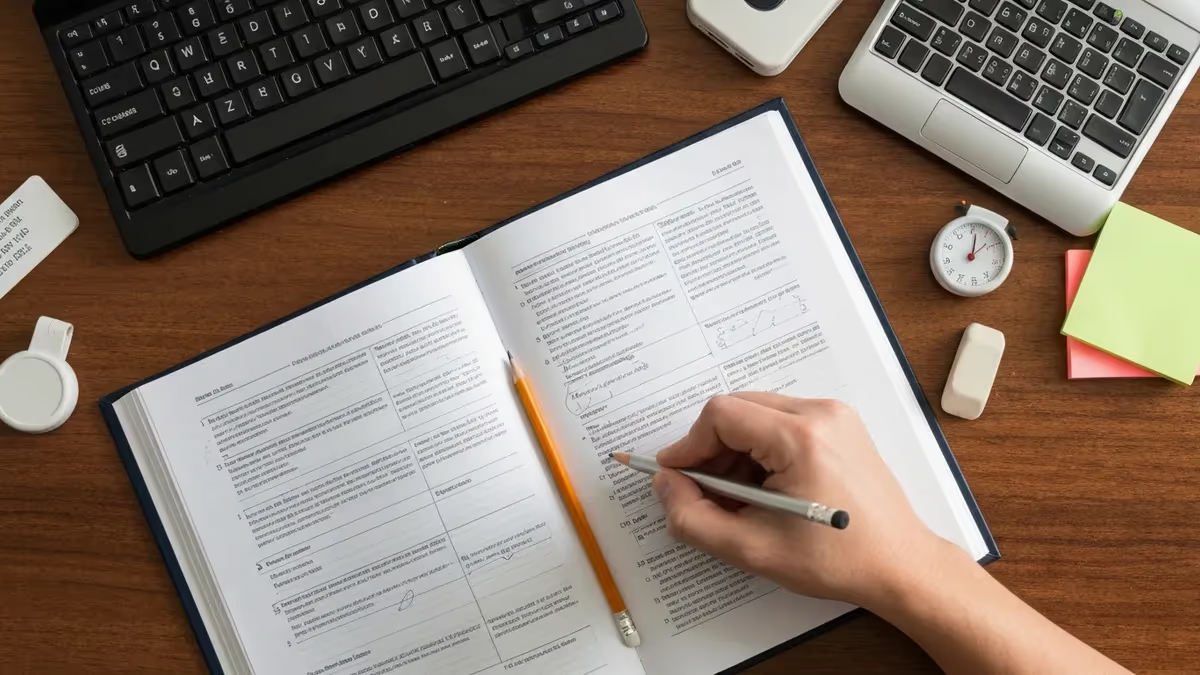
The PSI real estate exam is one of the most important milestones on your path to becoming a licensed real estate agent or broker in the United States. Administered by PSI Exams, the nation's leading provider of professional licensing tests, this exam evaluates your knowledge of real estate principles, practices, contracts, finance, and state-specific regulations. Thousands of candidates sit for PSI exams every year, and understanding what to expect before test day can make all the difference between walking out with a passing score and having to reschedule.
PSI Exams operates a network of PSI testing centers across every state, offering both in-person proctored and remote online proctored sessions. Whether you are pursuing a salesperson license or a broker upgrade, the structure and content of the exam are carefully designed to reflect real-world scenarios you will encounter throughout your career. Many candidates mistakenly assume the exam is straightforward, but the combination of national and state-specific portions creates a rigorous challenge that demands genuine preparation.
One question candidates frequently ask is how PSI compares to other professional licensing bodies. While organizations like Omega Psi Phi and Kappa Alpha Psi are well-known Greek-letter fraternities with their own membership processes, PSI here stands for a completely different entity — a testing and assessment company that manages licensing exams for real estate, insurance, financial services, and other regulated professions. Confusing these is surprisingly common in online searches, so understanding the distinction is important when researching your exam.
The exam covers a wide range of subject areas, including property ownership, land use controls, valuation, financing, agency relationships, contracts, and federal and state laws. The national portion tests concepts that apply across all states, while the state-specific portion covers your jurisdiction's unique rules, disclosure requirements, license law, and commission regulations. Performing well on both portions is essential because most states require separate passing scores for each section rather than a combined overall score.
Preparation is everything when it comes to real estate licensing exams. Successful candidates typically spend eight to twelve weeks studying, combining textbook review, video instruction, and timed practice tests that mirror the actual PSI exam environment. Practice tests are particularly valuable because they help you build familiarity with the question format, identify weak subject areas, and develop the pacing skills needed to complete all questions within the allotted time without rushing or second-guessing yourself.
Understanding pressure conversion concepts like bar to psi, kPa to psi, and MPa to psi is irrelevant to real estate licensing, but it illustrates a broader point about the importance of context-specific knowledge. In real estate, the equivalent domain-specific knowledge includes understanding mortgage amortization, capitalization rates, appraisal methods, and the legal nuances of agency disclosure. Mastering these concepts thoroughly, rather than skimming the surface, is what separates first-time passers from repeat test-takers.
This comprehensive guide walks you through everything you need to know about the PSI real estate exam, from the exam format and scoring to effective study strategies and test-day logistics. Whether you are just beginning your exam preparation or reviewing for a retake, the information here will help you approach the exam with confidence, clarity, and the practical knowledge you need to achieve a passing score and launch your real estate career.
PSI Real Estate Exam by the Numbers

PSI Real Estate Exam Format
| Section | Questions | Time | Weight | Notes |
|---|---|---|---|---|
| National Portion | 80 | 150 min | 62% | Covers universal real estate principles |
| State-Specific Portion | 40 | 60 min | 31% | State law, license requirements |
| Pretest (Unscored) | 10 | Included | N/A | Embedded; not counted toward score |
| Total | 130 | 3.5 hours | 100% |
Understanding what topics appear on the PSI real estate exam is the foundation of any effective study plan. The national portion of the exam is divided into several content domains, each carrying a specific percentage of the total scored questions. Property ownership and land use controls typically account for around 15 percent of national questions, covering concepts like freehold estates, leasehold estates, easements, encumbrances, zoning laws, eminent domain, and environmental regulations. A solid grasp of how these legal interests affect property rights is essential for passing this section confidently.
Valuation and market analysis is another major national domain, generally representing 14 to 17 percent of questions. You will need to understand the three primary approaches to value — the sales comparison approach, the cost approach, and the income approach — as well as key appraisal terms like depreciation, capitalization rate, gross rent multiplier, and comparative market analysis. Real-world examples, such as calculating the value of an income-producing property using its net operating income and cap rate, frequently appear in exam questions and require genuine calculation skills rather than just memorization.
Financing is one of the most formula-heavy sections of the PSI exam. Candidates must understand different mortgage types, including conventional, FHA, VA, and USDA loans, as well as concepts like points, annual percentage rate, loan-to-value ratios, debt-to-income ratios, and amortization. The PSI testing center environment offers a calculator for most state exams, but knowing how to set up the calculation correctly is still your responsibility. Practicing with real numbers — for instance, calculating monthly payments on a 30-year fixed mortgage at 7 percent — builds the mathematical fluency you need under pressure.
Agency relationships and contracts make up another critical category. Questions in this domain test your understanding of fiduciary duties, listing agreements, buyer representation agreements, dual agency disclosure, and the elements required for a valid contract — including offer, acceptance, consideration, legal purpose, and competent parties. Many candidates lose points in this area because they confuse similar-sounding agency concepts, such as the difference between a general agent, special agent, and universal agent. Clear, precise understanding of each term is necessary to select correct answers consistently.
Federal and state laws appear throughout both the national and state-specific portions. The national portion includes fair housing law, including protected classes under the Fair Housing Act of 1968 and its amendments, as well as Americans with Disabilities Act requirements for commercial properties. The state-specific portion covers your jurisdiction's license law, disciplinary procedures, continuing education requirements, and specific disclosure obligations such as lead-based paint disclosures, seller's property disclosure forms, and agency disclosure statements.
Practice and property management questions test knowledge of landlord-tenant law, lease types, property management agreements, and the responsibilities of a property manager acting as a fiduciary for a property owner. These questions often present scenario-based situations requiring you to apply legal principles to real-world circumstances, which is why reading and analyzing full practice scenarios — not just memorizing definitions — is the most effective preparation strategy for this portion of the exam.
The PSI testing center provides a structured, distraction-free environment where every candidate sits at an individual workstation with a computer terminal. Scratch paper or an erasable notepad is typically provided, and an on-screen calculator is available for most states. Understanding the testing environment in advance reduces anxiety on exam day and allows you to focus entirely on demonstrating your knowledge rather than adapting to an unfamiliar setting. Candidates who have visited a PSI testing center before their scheduled exam date often report feeling significantly more comfortable during the actual test.
PSI Exams: Study Strategies by Topic Area
Mastering the national portion of the PSI real estate exam requires a systematic approach to the eight main content domains. Start by taking a diagnostic practice test to identify which areas — property ownership, valuation, financing, contracts, agency, or federal law — need the most attention. Allocate study time proportionally, spending more hours on domains with higher question counts and those where your diagnostic score was lowest. Flashcards work well for vocabulary, but scenario-based questions from reputable practice tests are essential for developing the analytical reasoning the national exam demands.
Focus especially on math-heavy topics like mortgage calculations, proration, commission calculations, and depreciation. Many candidates are surprised by the number of calculation problems on the national portion. Practice at least five to ten math problems daily during your final two weeks of preparation, working without reference materials to simulate real exam conditions. Review mistakes carefully — understanding why an answer is wrong is more valuable than simply memorizing the correct one, because PSI regularly varies the numbers in similar question types to prevent rote memorization from substituting for genuine comprehension.

PSI Real Estate Exam: Advantages and Challenges
- +PSI testing centers are widely available nationwide with flexible scheduling options
- +Remote online proctoring allows candidates to test from home in many states
- +The exam uses scenario-based questions that reflect real professional situations
- +Immediate score reporting means you know your result the same day
- +The structured dual-portion format allows separate passing on each section
- +A wide library of official PSI practice materials is available through the candidate portal
- −Pass rates hover around 54 to 70 percent, meaning many candidates need multiple attempts
- −State-specific content varies significantly, requiring jurisdiction-specific study materials
- −Math-heavy sections catch many candidates off guard despite strong conceptual knowledge
- −Exam fees apply for each attempt, making retakes a financial consideration
- −The testing environment can feel high-pressure, especially for first-time test-takers
- −Some states require both portions to be passed on the same day, with no partial credit carried over
PSI Real Estate Exam Day Checklist
- ✓Confirm your appointment time and PSI testing center address at least 48 hours before exam day
- ✓Bring two forms of valid government-issued ID with matching names and signatures
- ✓Arrive at the testing center at least 30 minutes early to complete check-in procedures
- ✓Leave all personal items including phones, watches, and notes in your vehicle or a provided locker
- ✓Review your state's candidate handbook the evening before to recall prohibited items and policies
- ✓Get a full night of sleep — fatigue significantly impairs recall and analytical reasoning
- ✓Eat a balanced meal before the exam to maintain concentration throughout the full test duration
- ✓Use the provided scratch paper or notepad to jot down formulas immediately after the exam begins
- ✓Flag difficult questions and return to them rather than spending excess time on any single item
- ✓Trust your preparation — avoid changing answers unless you have a specific reason based on re-reading

First-Time Pass Rates Improve Dramatically with Practice Tests
Research consistently shows that candidates who complete five or more full-length timed practice tests before their PSI real estate exam pass at rates 20 to 30 percentage points higher than those who study only from textbooks. Timed simulation builds both knowledge and the mental stamina needed to perform under real exam conditions for three or more hours.
Scoring on the PSI real estate exam follows a scaled scoring model rather than a simple percentage of correct answers. PSI uses psychometric techniques to ensure that the difficulty level of one exam administration is comparable to another, so a score of 75 on one test version represents the same level of knowledge as a 75 on a different version, even if the specific questions differ. Most states require a minimum scaled score of 70 to 75 to pass each portion of the exam, but you should verify your state's specific passing score threshold in the official candidate handbook.
The pass rate for the PSI real estate exam varies by state and by license type, but national averages for first-time candidates typically fall between 54 and 70 percent for the salesperson exam. Broker exams, which test more advanced concepts including office management, supervising associates, trust account procedures, and advanced finance topics, generally have lower first-time pass rates because the content is more complex and the candidate pool is expected to demonstrate a higher level of professional expertise.
When candidates fail one or both portions of the PSI real estate exam, retake rules vary significantly by state. Some states allow you to retake the failed portion immediately after a 24-hour waiting period, while others require a longer cooling-off period or mandate additional education before a third or fourth attempt.
A handful of states limit the total number of attempts within a specific time frame — for example, requiring a candidate to restart the pre-license education process if they fail the exam three times within 12 months. Understanding your state's retake policy before your first attempt helps you plan intelligently.
The financial cost of the PSI real estate exam includes the initial exam fee, any retake fees, and the cost of pre-license education, study materials, and application processing fees. Exam fees for the PSI real estate exam range from approximately 36 dollars in some states to over 100 dollars in others, with most states clustering around 50 to 80 dollars per attempt. When you factor in pre-license course costs and the value of your time, investing in high-quality study materials upfront is almost always more economical than paying for multiple retakes.
Your score report will be provided to you immediately upon completing the exam at the PSI testing center. The report will show whether you passed or failed each portion, along with a breakdown of your performance by content area. Reviewing this diagnostic feedback — even if you passed — helps you identify knowledge gaps that may affect your professional competence in the field. Candidates who fail receive particularly useful guidance from this breakdown, as it pinpoints exactly which content domains need additional study before a retake.
Many candidates wonder how the PSI real estate exam compares to the exams used in states administered by other testing vendors, such as Pearson VUE or AMP. The fundamental content and difficulty levels are broadly similar because all real estate licensing exams must comply with the content outlines established by each state's real estate commission. However, the user interface, question phrasing style, and testing center environment differ between vendors, which is one reason why practicing with PSI-specific materials rather than generic real estate study tools is recommended for candidates scheduled to test with PSI.
Ultimately, passing the PSI real estate exam on your first attempt is absolutely achievable with the right preparation strategy. Candidates who combine structured coursework, daily reading of key concepts, regular timed practice tests, and thorough review of incorrect answers consistently outperform those who rely on passive study techniques like re-reading textbook chapters without active recall. The investment you make in rigorous preparation pays dividends not just on exam day but throughout your entire real estate career, where the knowledge tested by the exam will form the foundation of every transaction you manage.
Most states require you to submit your license application and receive approval before scheduling your PSI real estate exam. Submitting your application too late can delay your exam date by weeks. Check your state real estate commission's website for current processing times, which can range from 3 to 21 business days, especially during peak enrollment periods in spring and fall.
After passing the PSI real estate exam, your next steps depend on your state's specific activation process. In most jurisdictions, passing the exam does not automatically grant you a license — you must also submit your license application with the required fee, complete a background check, and affiliate with a licensed real estate broker before your salesperson license can be activated. Some states allow you to hold an inactive license without broker affiliation, but you cannot legally practice real estate or earn commissions until your license is active and associated with a sponsoring brokerage.
The timeline from passing the PSI exam to having an active license in hand varies widely by state. In some states, the commission processes applications within a few business days and issues licenses electronically. In others, processing can take four to six weeks, particularly if the background check reveals items that require manual review.
Plan your exam date with this timeline in mind, especially if you have clients or business commitments that depend on your licensure date. Scheduling your PSI exam too close to a planned start date without accounting for application processing time is one of the most common logistical mistakes new agents make.
Continuing education requirements begin as soon as your license is issued. Most states require newly licensed salespersons to complete a post-licensing education course — typically 30 to 45 hours — within the first one to two years of licensure. This is separate from the ongoing continuing education required at each renewal cycle, which typically runs every two years and requires 12 to 24 hours of approved coursework covering topics like ethics, legal updates, and specialty subjects. PSI itself does not administer continuing education, but your state real estate commission's website lists approved providers.
For candidates interested in eventually upgrading to a broker license, understanding the pathway early helps you make strategic career decisions. Most states require a salesperson to work under a licensed broker for a minimum of two to three years and accumulate a specific number of real estate transactions before qualifying to sit for the broker exam.
The broker version of the PSI real estate exam covers all salesperson content plus additional topics including brokerage management, trust account record-keeping, supervising licensees, and advanced real estate law. Beginning to study these advanced topics during your salesperson career, rather than starting from scratch when you apply for the broker exam, significantly reduces preparation time.
Networking and mentorship are underrated tools for new agents navigating their post-exam career. Joining your local Association of Realtors chapter gives you access to the Multiple Listing Service, professional development resources, and a network of experienced agents willing to share practical knowledge that no exam can fully capture. Many first-year agents report that their most valuable learning came from shadowing experienced colleagues, attending open houses, and participating in transaction coordination from the earliest days of their careers, long before they felt fully confident working independently.
The PSI real estate exam is a threshold test — it certifies minimum competency rather than predicting long-term success. Agents who build on that foundation through continuous learning, strong client relationships, and disciplined business practices consistently outperform those who view passing the exam as the finish line rather than the starting gun. Treat your license as the beginning of your professional education, and commit to learning something new from every transaction, every client interaction, and every market shift you observe throughout your career.
Resources available to you after passing include your state association's professional development programs, NAR's online learning portal, and platforms offering specialized courses in commercial real estate, property management, buyer representation, and luxury marketing. Many agents find that earning a designation like the Accredited Buyer's Representative or Seller Representative Specialist credential opens new business opportunities and builds credibility with discerning clients. Planning your continuing education path intentionally from day one sets you on a trajectory for a productive and sustainable real estate career.
Practical preparation for the PSI real estate exam goes beyond reading textbooks and memorizing vocabulary. The most effective candidates treat their study period like a structured training program, setting specific daily and weekly goals, tracking their practice test scores over time, and adjusting their study plan based on the data those scores provide. If your practice test performance in financing questions is consistently below 60 percent, for example, that is a clear signal to spend more time on mortgage math, loan types, and truth-in-lending disclosures rather than continuing to review topics where you are already scoring 80 percent or higher.
Time management during the actual exam is a skill that must be developed through practice, not improvised on test day. Many candidates discover during their first full-length timed practice test that they are either rushing through questions without reading them carefully or spending too long on difficult items and running out of time at the end.
Identifying your specific time management weakness early in your preparation allows you to work on it deliberately — for example, by setting a timer for 90 seconds per question during practice sessions and committing to moving on when the timer expires, even if you have not finished analyzing every answer choice.
Creating a final review schedule for the last two weeks before your PSI exam date is one of the highest-leverage activities you can do. During this period, shift away from learning new content and focus instead on consolidating what you already know.
Review your personal flashcard deck daily, work through at least one full-length practice test every two days under strict timed conditions, and spend 20 to 30 minutes each morning reading through your notes on the content areas where you have made the most errors. This concentrated final phase of preparation is when most candidates see their practice scores jump by five to ten points.
On the morning of your exam, avoid trying to cram new information. Your brain needs time to consolidate what it has learned, and introducing unfamiliar concepts the morning of the exam is more likely to create confusion than improve your score. Instead, spend 20 to 30 minutes lightly reviewing a summary of key formulas and legal definitions, then shift your focus to physical and mental readiness — eating a nutritious meal, staying hydrated, and arriving at the PSI testing center early enough to complete check-in without feeling rushed.
During the exam itself, approach each question systematically by first reading the full question stem before looking at the answer choices. Many PSI exam questions are designed to test whether you can distinguish between plausible-sounding answers, and reading the choices before the question can cause you to anchor on a distractor rather than thinking independently about what the question is actually asking.
After reading the stem, form a tentative answer in your mind before scanning the choices, then select the one that best matches your thinking. This technique reduces the influence of well-written distractors and leverages the knowledge you have worked hard to build.
Candidates who find themselves struggling with anxiety on PSI exam day benefit from simple grounding techniques practiced in advance. Slow, deliberate breathing — inhaling for four counts, holding for four, exhaling for four — activates the parasympathetic nervous system and reduces the physiological symptoms of stress within seconds. Practicing this technique during your study sessions, particularly during timed practice tests when pressure is deliberately simulated, makes it a reliable tool you can deploy automatically on exam day without conscious effort or distraction from the task at hand.
Remember that every question on the PSI real estate exam has one best answer, and that best answer is always based on the principles of real estate law and practice as they are taught in your state's approved pre-license curriculum. When in doubt, lean toward the answer that protects the client's interest, follows the most conservative legal interpretation, and aligns with the fiduciary duties of a licensed agent. These principles consistently point toward correct answers across a wide range of question types and content domains, making them a reliable tie-breaker when two answer choices seem equally plausible.
PSI Questions and Answers


About the Author

Educational Psychologist & Academic Test Preparation Expert
Columbia University Teachers CollegeDr. Lisa Patel holds a Doctorate in Education from Columbia University Teachers College and has spent 17 years researching standardized test design and academic assessment. She has developed preparation programs for SAT, ACT, GRE, LSAT, UCAT, and numerous professional licensing exams, helping students of all backgrounds achieve their target scores.