
Best Book Editing and Proofreading Services Guide 2026 September
🆕 Pass the Best Book Editing and Proofreading exam with confidence. Practice questions with detailed explanations and instant feedback on every answer.
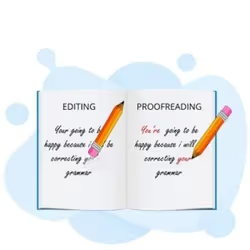
What Book Editing and Proofreading Services Actually Do
There's a lot of confusion about what editing and proofreading mean — even among professional writers. If you're hiring someone to work on your manuscript, understanding the difference matters. It affects what you need, who you hire, and what you pay.
Developmental editing addresses the big picture: structure, pacing, character development, argument logic. If your book has structural problems, no amount of line editing will fix them. A developmental editor evaluates whether your book works at the concept and architecture level.
Copy editing works at the sentence and paragraph level. Clarity, consistency, sentence structure, word choice, grammar, and style guide adherence. Most traditionally published books go through two rounds of copy editing. This is where your manuscript actually gets transformed into clean, publication-ready prose.
Proofreading is the final step — a careful read for typos, inconsistencies, formatting errors, and anything that slipped through editing. Proofreading happens after typesetting or final layout. It's not a substitute for copy editing; it's the last quality check before printing or publishing.
Many authors conflate copy editing and proofreading. They're distinct services at different stages of the publishing process. Hiring a proofreader when you need a copy editor means your book will have clean typos on top of unclear, inconsistent prose.
When Do You Need Each Type of Service?
Think of the editing stages as a funnel. You start broad and get progressively more precise:
- Developmental editing — after your first complete draft, before you've revised substantially
- Copy editing — after revisions are complete; you're happy with the structure and content
- Proofreading — after the final formatted version; immediately before publishing or printing
Self-publishing authors often try to skip developmental and copy editing to save money. It's one of the most reliable ways to publish a book that doesn't sell. Readers notice craft problems — even when they can't articulate exactly what's wrong.
Pro Tip: Focus your Proofreading & Editing study time on areas where you score lowest. Most exam questions test application of knowledge, not memorization.
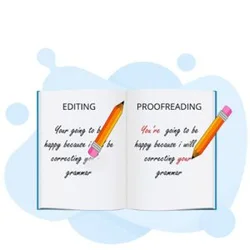
What Good Book Editing Services Include
When you're evaluating editing services, there are a few things that distinguish reliable professionals from the rest.
Sample Edits
Any reputable book editor will provide a sample edit before you commit to a full project — typically 5-10 pages. This shows you their editing style, whether they understand your genre, and whether their feedback is the kind you can actually use. If a service won't do a sample edit, walk away.
Clear Scope and Deliverables
A good editing contract specifies exactly what's included: which type of editing, how many rounds, what format the edits are delivered in (Track Changes in Word is standard), and the timeline. Ambiguous contracts lead to scope creep and disappointment on both sides.
Genre Experience
An editor who specializes in literary fiction may not be the best choice for a commercial thriller or a business book. Genre conventions are real — pacing expectations, chapter length norms, dialogue conventions vary significantly. Look for editors with demonstrable experience in your specific genre or nonfiction category.
Pricing: What to Expect
Book editing pricing varies widely. Here's a realistic range for professional services in the US market:
- Developmental editing: $0.03–$0.09 per word (a 90,000-word novel = $2,700–$8,100)
- Copy editing: $0.02–$0.05 per word ($1,800–$4,500 for 90k words)
- Proofreading: $0.01–$0.03 per word ($900–$2,700 for 90k words)
These are professional rates. Services charging dramatically less are often using inexperienced editors, AI tools without adequate human oversight, or outsourcing internationally. That's not always wrong — but go in with eyes open about the tradeoffs.
Beware of per-page pricing from large service marketplaces. The definition of 'page' varies, the quality is inconsistent, and the editorial relationship is typically impersonal.
Finding a Book Editor
The best book editors don't advertise heavily — they get work through referrals and professional networks. Places to look:
- Editorial Freelancers Association (EFA) — searchable directory of professional freelance editors with credentials
- Reedsy — curated marketplace of vetted book editors with sample portfolios; more expensive but pre-screened
- Author forums and writing communities — recommendations from authors who've published in your genre
- Your genre's professional organization — SFWA, RWA, MWA, AWP all maintain editorial resources
Don't hire your first choice without vetting. Get at least two or three quotes. Do sample edits with multiple candidates. The editor-author relationship is collaborative and sometimes months-long — compatibility matters, not just credentials.
Proofreading & Editing: Pros and Cons
- +Proofreading & Editing credential is recognized by employers and industry professionals
- +Higher earning potential compared to non-credentialed peers
- +Expanded career opportunities and professional advancement
- +Structured learning path builds comprehensive knowledge
- +Professional development that stays current with industry standards
- −Preparation requires significant time and study commitment
- −Associated costs for exams, materials, and renewal fees
- −Continuing education needed to maintain credentials
- −Competition for advanced positions can be challenging
- −Requirements and standards may vary by state or region

Building Your Own Proofreading Skills
Whether you're a writer who wants to catch more of your own errors before sending to an editor, or someone pursuing a career in editorial work, proofreading is a learnable skill — not just a talent you either have or don't.
The biggest thing most new proofreaders struggle with is seeing what's actually on the page instead of what they expect to be there. Your brain autocorrects as it reads. That's useful for reading speed, terrible for proofreading. Techniques like reading aloud, reading backward sentence by sentence, and increasing font size all force slower, more deliberate reading.
Learn proofreading marks and symbols — they're still used in professional publishing and demonstrate you know the editorial conventions. The Chicago Manual of Style and the Associated Press Stylebook are the two dominant style guides in US publishing; knowing which one applies to your context is fundamental.
Practice regularly. Use the proofreading tests here to build accuracy and speed. Track which error types you miss most consistently — repeated errors are patterns, and patterns can be addressed systematically. The editors who command the highest rates are the ones who catch not just typos, but inconsistencies, style guide deviations, and factual errors that other editors miss.
About the Author

Educational Psychologist & Academic Test Preparation Expert
Columbia University Teachers CollegeDr. Lisa Patel holds a Doctorate in Education from Columbia University Teachers College and has spent 17 years researching standardized test design and academic assessment. She has developed preparation programs for SAT, ACT, GRE, LSAT, UCAT, and numerous professional licensing exams, helping students of all backgrounds achieve their target scores.