
Prometric Testing Sites 2026 October: What to Expect Inside
⏳ Inside a Prometric testing site: check-in, palm scan, cubicle workstation, rules, accessibility, and what to bring on test day.
Prometric Testing Sites 2026: What to Expect Inside
Walking into a Prometric testing site for the first time can feel intimidating. The rooms are quiet, the rules are strict, and the security checks run tighter than airport screening. But once you know what happens at the door, what the cubicle looks like, and what you can and cannot bring with you, the whole experience becomes predictable. This guide walks you through every step inside a Prometric center so nothing on test day catches you off guard.
Prometric operates roughly 8,000 testing sites globally, with more than 500 across the United States and 50+ locations in every major metro area. Sites fall into two types: Prometric-owned centers (about 30% of the network) and Prometric-Approved Test Centers (PATCs), which are independent locations contracted with Prometric. PATCs include community colleges, training centers, business parks, and occasionally hotels converted during high-volume exam windows.
Regardless of which site you book, the layout follows a standardized template. You will check in at a desk, store your belongings in a locker, complete a biometric palm vein scan, get your photo taken, and then be escorted to a numbered cubicle inside the testing room. Proctors watch every station through one-way glass and surveillance cameras. The whole flow is engineered for security, consistency, and a frustration-free experience if you arrive prepared.
If you are still booking, see our guide on Prometric exam scheduling for date selection and confirmation steps. Already booked and prepping? Keep reading. This article covers arrival procedures, what is inside the cubicle, rules and prohibited items, restroom break protocol, accessibility accommodations, technical glitch handling, and the differences between an in-center exam and the at-home ProProctor alternative.
By the end you will know exactly what 30 minutes before your test should look like, what the proctor will and will not say, and what to do if something goes wrong with the computer mid-exam. Treat this as your dress rehearsal before walking through the door.
Two more things worth knowing upfront. First, every site is audited by Prometric's corporate compliance team, including surprise audits, so consistency from one PATC to another is genuinely tight. Second, the rules feel harsh because they protect the integrity of the score. Boards and licensing bodies trust Prometric exactly because nothing slips through. The locker procedure, the palm vein scan, the laminated note-board, the constant proctor monitoring — every step exists for the same reason.
Most candidates leave their first Prometric exam saying the same thing: the test itself was hard, but the room and the procedures stopped being scary within ten minutes. That is the goal of this guide. By the time you walk in, the choreography is familiar, and your mental energy is fully on the questions, not on the room.
Prometric Testing Sites by the Numbers
Quick stats on the Prometric network and what to expect on test day.

Inside Center / Accessibility / Rules / Tech Issues
Check-in desk — The first stop. A Prometric staff member verifies your appointment, asks for two forms of ID, and prints a confirmation slip. Expect a brief queue if you arrive close to your slot time.
Locker room — Every belonging except your IDs goes into a small locker. Phones, watches, wallets, keys, snacks, jackets, hats, and water bottles all stay outside the testing room. You keep the locker key with you.
Biometric station — A palm vein scanner reads the unique pattern of veins inside your hand. The scan is captured at check-in and re-verified every time you enter or leave the testing room, including after restroom breaks.
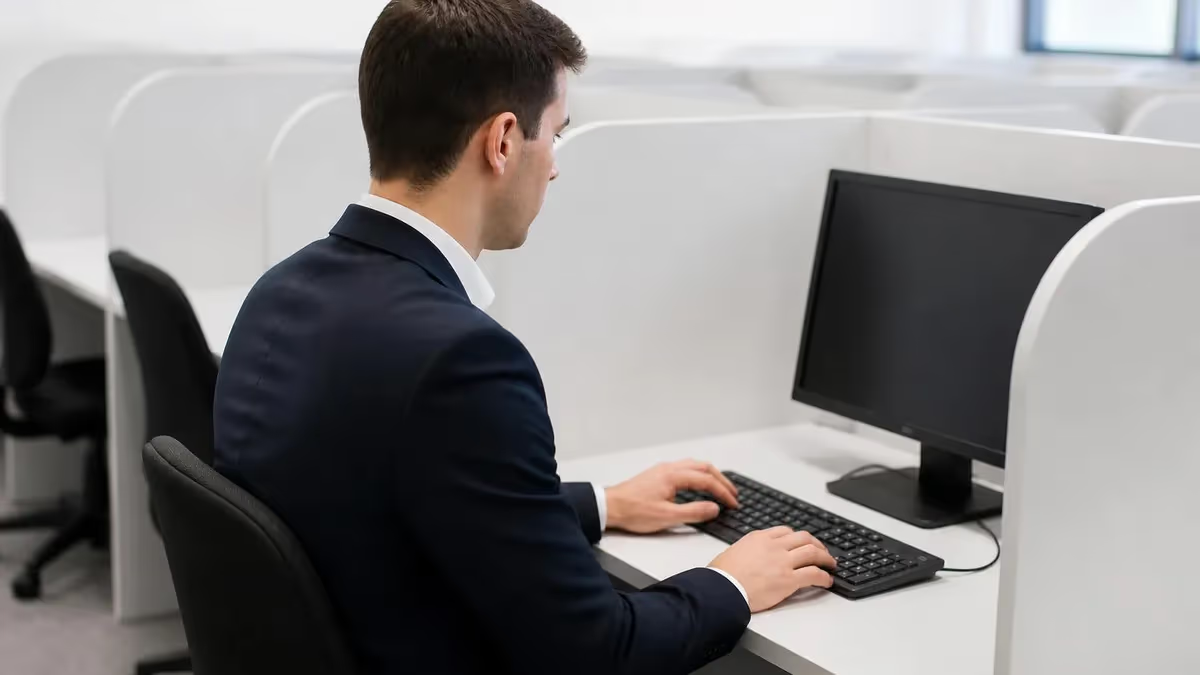
Testing room — Rows of cubicles separated by partitions. Each station has a 19-24 inch monitor, keyboard, mouse, and headphones if your exam includes audio. Proctors monitor every station from a control desk.
Restroom & waiting area — A separate quiet zone with chairs near the entrance. Restrooms are inside the secure area, with palm-scan re-entry on the way back.
5 Things to Know About Prometric Testing Sites
Every Prometric site has the same five zones: check-in desk, locker room, biometric station, testing room with cubicles, and a waiting area. Once you know the flow, every site feels familiar.
- Zones: 5 standardized areas
- Cubicle size: 4-6 ft wide x 4 ft deep
- Monitor size: 19-24 inch displays
Prometric replaced fingerprints with palm vein scanning in 2015. The pattern of veins inside your palm is harder to spoof than fingerprints and reads through dirt, lotion, and minor cuts.
- Error rate: 1 in 100 million
- Scan time: Under 2 seconds
- Re-scan: Every room re-entry
You need a primary government photo ID plus a secondary ID with your signature. Names must match your appointment exactly. Mismatched names mean you are turned away.
- Primary ID: Passport, license, military ID
- Secondary ID: Credit card, library card with signature
- Name match: Must match appointment exactly
Math exams give you an on-screen calculator. You cannot bring your own. Note-taking happens on a provided laminated board with a dry-erase marker. Everything stays in the room when you leave.
- Calculator: On-screen, exam-specific
- Notes: Laminated board + marker
- Materials: Cannot leave room with notes
About 70% of US Prometric locations are Prometric-Approved Test Centers (PATCs) — independent sites contracted to deliver Prometric exams under the same standards. The remaining 30% are Prometric-owned.
- Owned centers: ~30% of network
- PATCs: ~70%, same standards
- Examples: Colleges, training centers
Test Day Timeline: 30 Minutes Early to Test Start
30 Minutes Before
Check-In and ID Verification
Locker and Pat-Down
Biometric and Photo
Escort to Cubicle
Exam Starts

If a proctor catches you with a phone, smartwatch, or notes inside the testing room, the consequences are immediate and serious:
- Exam terminated on the spot — your score is voided.
- Fee forfeited — no refund or reschedule.
- 6-12 month testing ban in many cases, depending on the sponsor.
- Sponsor notified — your certifying board reviews the incident and may bar you from future attempts.
The cameras and proctor desks see every cubicle. Do not bring anything you cannot put in the locker. When in doubt, leave it in the car.
Test Day Morning Checklist
- ✓Two valid IDs ready — primary photo + secondary with signature
- ✓Confirmation email printed or saved to phone
- ✓Leave phones, smartwatches, and fitness trackers in the car
- ✓Wear plain pocket-free clothing, layered for 68-72°F room temp
- ✓Light meal 2 hours before — caffeine in moderation
- ✓Arrive 30 minutes early to avoid traffic and parking delays
- ✓Bring locker key holder — small zip pocket or wristband
- ✓Know your exam fee and sponsor name if proctor asks
- ✓Review one practice question only — heavy cramming hurts performance
- ✓Bathroom break right before walking in — proctor breaks cost test time
In-Center vs ProProctor At-Home
Prometric offers two delivery formats for many exams. Pick the format that matches your testing style.
- +Distraction-free environment with strict quiet rules
- +Provided computer, monitor, and tools — no tech failures on your end
- +Live proctor on-site for immediate technical support
- +No internet bandwidth issues to worry about
- +Familiar exam environment for retakers
- +Better fit for high-stakes professional licensing exams
- −Take the exam from your own home or office
- −No commute, parking, or 30-minute arrival buffer needed
- −More flexible scheduling including evenings and weekends
- −Comfortable in your own chair and clothing
- −No locker procedure or pat-down
- −Some exams not available in ProProctor format — check your sponsor first
Pros and Cons at a Glance
| Pros | Cons |
|---|---|
| Distraction-free environment with strict quiet rules | Take the exam from your own home or office |
| Provided computer, monitor, and tools — no tech failures on your end | More flexible scheduling including evenings and weekends |
| Live proctor on-site for immediate technical support | Comfortable in your own chair and clothing |
| No internet bandwidth issues to worry about | No locker procedure or pat-down |
| Familiar exam environment for retakers | Some exams not available in ProProctor format — check your sponsor first |
Inside the Testing Room: What the Cubicle Looks Like
The testing room itself is purpose-built for focus. Lighting is even and diffuse, with no glare across the screens. Temperature usually sits between 68 and 72 degrees Fahrenheit, which feels cool if you are sitting still for several hours. Layered clothing is your friend, though some sites prohibit zip-up jackets inside the room.
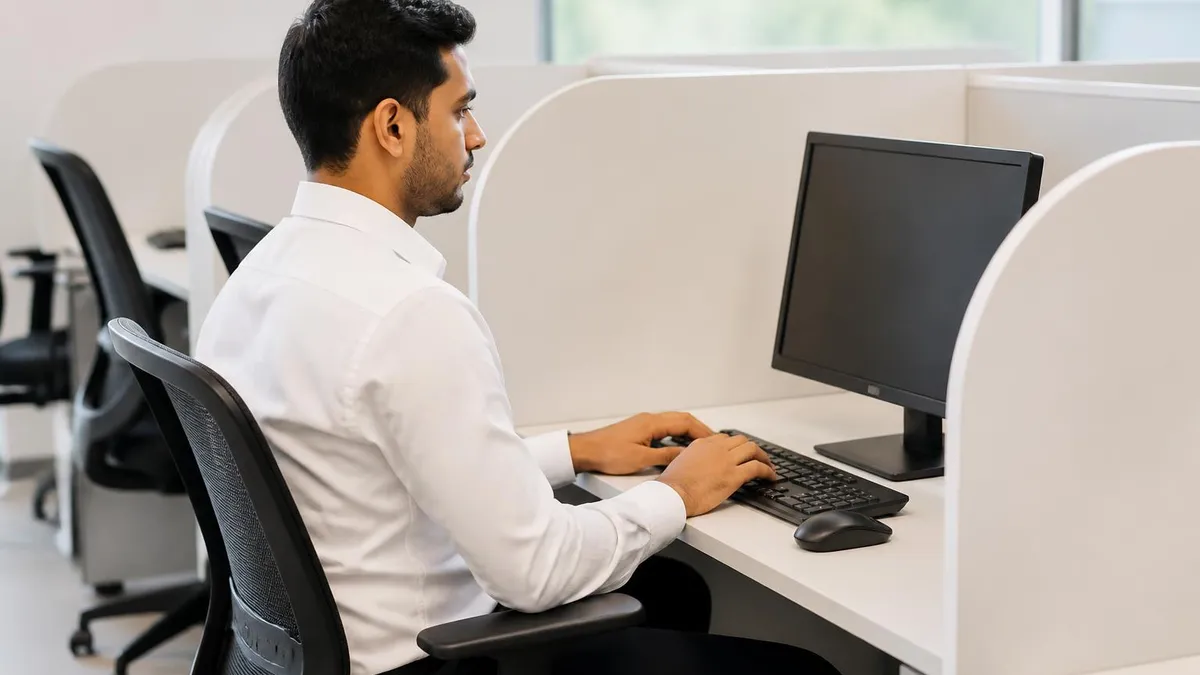
Your assigned cubicle workstation measures roughly 4 to 6 feet wide by 4 feet deep, with partitions on three sides for privacy. The monitor is a 19 to 24 inch flat-screen display, color calibrated for readability. The keyboard and mouse are standard wired peripherals with no shortcut keys remapped. Some exams provide noise-canceling headphones for audio sections such as language exams or simulations.
You will find a small laminated note-board and a fresh dry-erase marker on the desk. This is your scratch paper for the duration of the exam. Do not write on the desk, the partitions, or your hand. The note-board gets collected and wiped at the end. If you run out of writing space, raise your hand and a proctor brings a fresh board.
The chair is adjustable in height and tilt at most centers, though backrests vary. If you have back issues, ask at check-in whether an ergonomic cushion is available. Most sites keep a few stashed at the front desk for candidates who request one. The desk surface itself is flat and unbranded — no posters, no signage, no distractions. Even the wall behind the row of cubicles is usually a single muted color.
What You Cannot Have at the Desk
The list of prohibited items is long but consistent across all sites. Phones, smartwatches, fitness trackers, calculators, food, drinks, gum, jackets, hats, sunglasses, scarves, and any hair accessory that could conceal a device are all banned. Some centers also restrict jewelry beyond a wedding ring and small earrings. The proctor inspects your pockets and hair before you enter the room.
If you wear glasses, the proctor may briefly inspect them for hidden cameras. This sounds extreme but it has happened. Hearing aids are allowed but you must declare them at check-in so they are not mistaken for prohibited devices. For more on what counts as acceptable contact options on test day, see our Prometric phone number guide.
Wedding rings and small stud earrings are usually fine. Larger watches, even non-smart ones, are not — Prometric assumes any wrist device could be a recording tool. Religious head coverings are permitted and not removed, but the proctor may briefly check the brim for hidden devices. Long hair tied back is recommended so the cameras have a clear view of your face throughout.
Restroom Breaks: Allowed but Costly
Bathroom breaks are permitted during the exam but the clock keeps ticking. You raise your hand, a proctor escorts you to the door, you scan your palm out, use the restroom, scan your palm back in, and return to your seat. The whole process takes 4 to 7 minutes typically. On exams with tight time limits, this is significant. Plan your fluid intake accordingly.
You cannot access your locker during a break. Your phone, snacks, and water all stay locked away until the exam is fully submitted. The only exception is for diabetic candidates or others with medical needs documented through an accommodations request to the sponsor. Even then, you bring approved snacks in a clear bag pre-cleared at check-in, not stored in the locker.
Site Differences: Owned vs Approved Centers

Inside the Testing Room - Quick Recap
- ✓Cubicle: 4-6 ft wide x 4 ft deep with partitions on three sides
- ✓Monitor: 19-24 inch flat-screen, color calibrated for clarity
- ✓Note-board: laminated, dry-erase marker provided — no paper
- ✓Temperature: 68-72°F — wear breathable layered clothing
- ✓Chair: adjustable height, ergonomic cushions on request
- ✓No personal items at the desk — everything stays in your locker
About 30 percent of Prometric testing sites are owned and operated directly by Prometric. These are the largest, highest-volume centers usually located in major metropolitan areas. The remaining 70 percent are Prometric-Approved Test Centers (PATCs) run by partners such as community colleges, vocational training centers, corporate offices, and occasionally hotel conference rooms during high-volume exam windows.
The standards are identical between owned and PATC sites. Same palm vein scanners, same partition cubicles, same prohibited items list, same proctor protocols. The only meaningful differences you might notice are parking, seating in the waiting area, and how the front desk handles check-in. PATC reviews online can be mixed because the venues vary.
If you have a choice of nearby sites, read recent reviews first. You can find your closest center by visiting prometric.com, selecting your exam program, and entering your ZIP code. The site returns a sorted list with addresses, distance, and amenities. Pick the one with the best recent reviews even if it is slightly further away.
Some PATCs operate inside a school or hospital that is otherwise busy with non-testing activity. Parking can be harder at these sites, and the route from the door to the testing room is sometimes confusing. If your PATC is inside a larger building, leave 10 extra minutes for wayfinding. Owned Prometric centers tend to have dedicated entrances, plenty of parking, and clear signage from the parking lot.
Cleanliness and COVID Protocols
Prometric audits every site regularly for cleanliness. Workstations are wiped down between candidates. Sanitizer and disinfecting wipes are available in the waiting area. Mask policies vary by site and local regulation — most centers no longer require masks but you can wear one if you prefer. Some sites still cap capacity below pre-pandemic levels, so booking earlier slots gives you better availability. See Prometric availability for current slot patterns.
Accommodations and Accessibility in Detail
If you have a disability or medical condition that affects how you take an exam, request accommodations through your sponsor at least 6 to 8 weeks before the test date. Common accommodations include extended time of 1.5x or 2x, separate testing rooms, large-print displays, screen readers, sign language interpreters, breaks not counted against test time, and approved snacks for medical needs.
Prometric does not approve accommodations directly — your sponsor does. Once approved, your accommodation appears on your appointment record and the testing site staff applies it on test day. Bring a copy of your approval letter just in case. For visually impaired candidates, JAWS and ZoomText are available at all owned sites and most PATCs. For mobility needs, ramps, accessible parking, and adjustable-height desks are standard.
Common mistakes to avoid: do not assume Prometric will accommodate something on the day without prior approval; do not bring extra items because of a disability without prior clearance; and do not skip the documentation step thinking the proctor can verify it on the fly. Everything goes through the sponsor and arrives at the site in your appointment record. Show up, present your IDs, and the accommodation is already in place.
The ProProctor At-Home Alternative
Many Prometric exams now offer ProProctor, an at-home delivery format using your laptop and webcam. The rules are similar to in-center but applied through remote monitoring. You complete a room scan before starting, the proctor watches via webcam throughout, and your microphone stays open the entire session. Eligibility varies by exam — not every program supports ProProctor, so confirm with your sponsor first.
ProProctor advantages include skipping the commute, scheduling outside normal business hours, and testing in a familiar environment. The downside is responsibility for your own technology. If your internet drops mid-exam, you risk losing time or having to reschedule. For the highest-stakes professional exams, most candidates still prefer in-center because the equipment is provided and supported. To see what other practice options exist before your real exam day, browse our cna prometric practice test resources.
Prometric Proctor and Security Quick Facts
Run the room, check IDs, escort restroom breaks, handle tech issues. Cannot give content help or extend time.
- Authority: Site operations only
- Logs: Daily incident report
Ceiling-mounted, wide-angle, real-time stream to corporate monitoring team for surprise audits.
- Angles: 2+ per cubicle
- Recording: Continuous + audio
Proctors are audited on rule adherence — they will not bend rules for any candidate, no matter how small the request.
- Penalty: Termination of proctor
- Audits: Surprise + scheduled
Picking the Right Site for You
If multiple Prometric sites are in your area, the choice often comes down to reviews and parking, not the exam experience itself. Read Google reviews for each site filtered by the past 12 months. Look for repeated complaints about technical issues, rude staff, or long check-in queues.
Those issues tend to be center-specific, not Prometric-wide. A well-reviewed PATC is often a better choice than a busy owned center where you might wait an extra 20 minutes at check-in. Also factor in how easy parking is, whether the building is on a busy road, and how close you can park to the entrance.
The Proctor Role and What They Actually Do
Proctors are the staff members who run the testing room. They check you in, verify your IDs, run the biometric scan, escort you to your cubicle, monitor the room during the exam, handle restroom breaks, and respond to raised hands. They are not test administrators — they cannot answer questions about content, give hints, or extend your time without authorization from a supervisor.
What proctors will do is help with technical issues, escort you out for breaks, replace your laminated note-board if you fill it, and report incidents to Prometric corporate. They write a daily log of every incident, however minor. If something unusual happens during your session, ask the proctor to document it before you leave the building.
What proctors will not do is bend the rules. Do not ask for an extra minute on the clock, do not ask to bring water in, do not ask to step outside without the full palm-scan procedure. Their compliance with the rulebook is audited and tied to their employment. A proctor who breaks rules for one candidate can be fired, so they do not.
Security Cameras and Real-Time Monitoring
Every Prometric testing room has multiple ceiling-mounted cameras covering every cubicle from at least two angles. The video feeds record continuously and stream to Prometric's central monitoring team. If a suspicious behavior pattern is flagged, a corporate auditor can review the footage in real time and alert the on-site proctor.
The cameras are wide-angle, color, and high-resolution enough to read text on a paper note-board from 20 feet away. They are not hidden — you can see them from your cubicle. The visibility is deliberate. Knowing you are being watched reduces the temptation to cheat far more effectively than catching cheating after the fact.
Audio is also recorded throughout the session. A single microphone covers the room and picks up any whispered exchange between cubicles. If you have a question, raise your hand silently. Do not whisper to your neighbor — the microphone will catch it, the camera will catch you turning your head, and your session may end abruptly.
Practice Before Walking In
Even with all the procedural knowledge in this guide, the biggest factor on test day is your readiness for the questions themselves. Doing 3-5 practice tests in the week before your exam is the single best preparation. The familiarity reduces anxiety, builds stamina for the time limit, and uncovers the gaps in your study plan while there is still time to fix them.
Spend 90 minutes on each practice session, simulate the real exam pace, and review every wrong answer afterward. Doing this through a quiet practice question set with worked answers is much more useful than re-reading study notes. The goal is to make the real exam feel like the fifth time you have sat down at a Prometric workstation, not the first.
Some test-takers expect a relaxed library-style atmosphere. Prometric is the opposite — every detail is engineered for security and standardization. You will not find:
- Internet access of any kind on the test computer
- Permission to bring your own notes, books, or formulas
- Casual conversation with the proctor during the exam
- Snacks or coffee at the desk
- A relaxed clothing or hair policy
- Permission to leave the room without re-scanning your palm
The trade-off for these strict rules is a fair, well-audited exam environment. Every candidate at every site gets the same conditions, which is exactly what high-stakes certifying boards want.
Sample Prometric Test Practice Questions
Try these questions from our free Prometric Test practice tests. The correct answer and an explanation follow each question.
What type of monitoring system is used inside Prometric testing rooms during live exams?
- A. Only human proctors conducting periodic walk-throughs
- B. Audio and video surveillance cameras recording continuously
- C. Periodic manual check-ins by staff every 30 minutes
- D. No active monitoring inside the room once testing begins
Answer: B. Audio and video surveillance cameras recording continuously
Prometric employs continuous audio and video surveillance cameras inside testing rooms to monitor all candidates throughout the duration of their exam.
What should you bring to a Prometric testing center on exam day?
- A. Any form of ID
- B. Two forms of valid, unexpired government-issued identification
- C. Your study materials for last-minute review
- D. A friend for moral support
Answer: B. Two forms of valid, unexpired government-issued identification
Prometric requires two forms of valid, unexpired government-issued ID to verify your identity before allowing you to take the exam.
What is Computer Adaptive Testing (CAT) used in some Prometric exams?
- A. A test where the computer reads questions aloud
- B. A testing method where question difficulty adjusts based on the test-taker's performance
- C. A test that only uses cat-related images
- D. A test administered by a computer technician
Answer: B. A testing method where question difficulty adjusts based on the test-taker's performance
CAT adjusts the difficulty of questions based on how you answer. Correct answers lead to harder questions, while incorrect answers lead to easier ones, efficiently measuring your ability level.
What is the best approach for managing test anxiety immediately before entering the Prometric testing room?
- A. Review as many notes as possible in the waiting area
- B. Practice slow, deep breathing to activate the parasympathetic nervous system
- C. Discuss difficult topics with other candidates in the lobby
- D. Consume a caffeinated energy drink for heightened alertness
Answer: B. Practice slow, deep breathing to activate the parasympathetic nervous system
Slow, diaphragmatic breathing lowers cortisol and heart rate, reducing anxiety and improving focus before high-stakes testing.
Prometric Questions and Answers



About the Author

Educational Psychologist & Academic Test Preparation Expert
Columbia University Teachers CollegeDr. Lisa Patel holds a Doctorate in Education from Columbia University Teachers College and has spent 17 years researching standardized test design and academic assessment. She has developed preparation programs for SAT, ACT, GRE, LSAT, UCAT, and numerous professional licensing exams, helping students of all backgrounds achieve their target scores.