
Private Investigator License Florida: Complete 2026 October Guide to Class C, CC, and M Licensing Requirements
Complete guide to private investigator license florida requirements, Class C/CC/M licensing, costs, bonds, exam prep, and salary expectations for 2026 October. 🎓
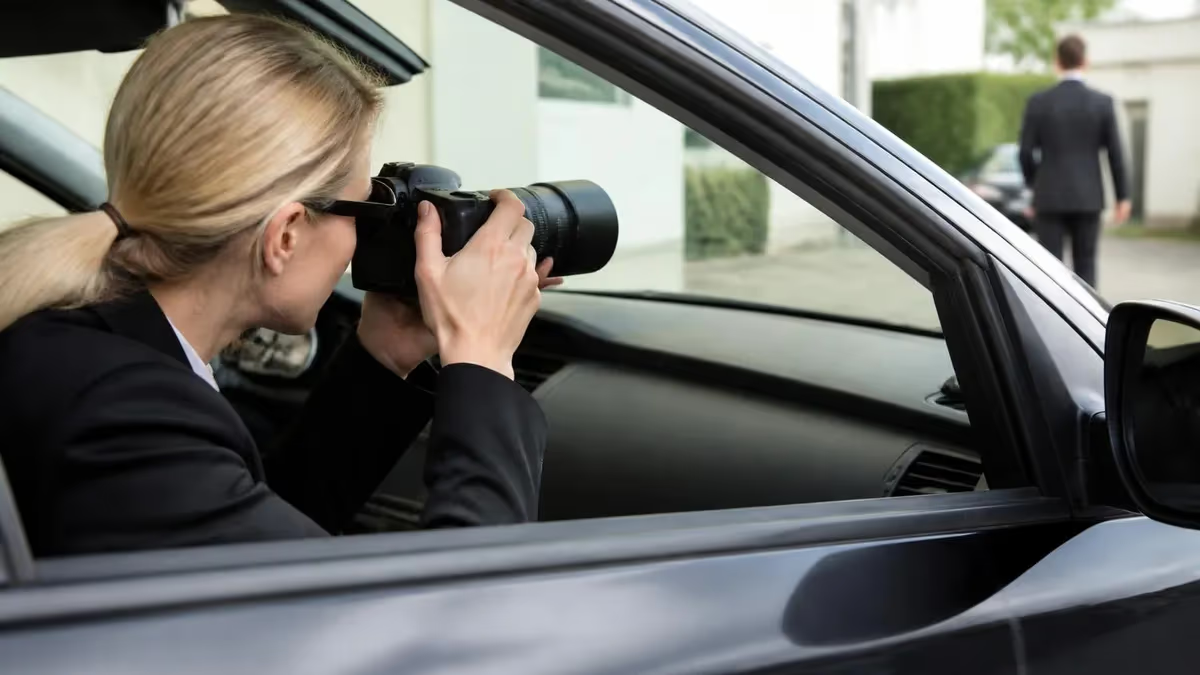
Earning a private investigator license florida residents recognize as the gold standard of the trade requires patience, paperwork, and a clear understanding of the three-tier credential system administered by the Florida Department of Agriculture and Consumer Services, Division of Licensing. Whether you searched for a private investigator near me after seeing a billboard or you have spent years thinking about a second career, Florida offers one of the most structured and lucrative PI environments in the United States, with more than 14,000 active licensees as of 2025.
Florida differs from most states because it issues three separate investigator credentials rather than one universal license. The Class CC is an intern license held for at least two years before progressing. The Class C is the full investigator license, the credential most candidates ultimately want. The Class M license authorizes someone to manage a private investigative agency. Each tier carries its own application fee, fingerprint requirement, training threshold, and renewal cycle that you must track carefully.
The state requires applicants to complete a minimum of 40 hours of professional training covering Florida Statutes Chapter 493, criminal and civil law fundamentals, surveillance technique, interview methodology, evidence handling, and report writing. After training, the candidate must accumulate 4,000 hours of supervised investigative experience, roughly two years of full-time work, before applying for the Class C license that allows independent operation across all 67 counties.
Costs add up faster than newcomers expect. Application fees, fingerprint processing, the surety bond, professional liability insurance, training tuition, and continuing education total between $1,200 and $2,800 before you earn your first dollar. Many candidates underestimate the bond requirement and arrive at the Tallahassee office without proof of coverage, which automatically delays issuance by four to eight weeks while documents are corrected and resubmitted through the MyFloridaLicense portal.
The reward justifies the climb. Licensed Florida investigators bill between $75 and $250 per hour for surveillance and skip tracing, with corporate fraud and intellectual property specialists commanding $300 or more. The median annual income for full-time Class C holders sits near $58,000, and agency owners holding the Class M credential routinely report six-figure revenue after their third operating year, particularly in Miami-Dade, Orlando, and Tampa Bay metropolitan markets.
This guide walks through every component of Florida licensing in the order you will encounter it: eligibility, training, the application packet, the bond, the experience hours, exam preparation, fee schedules, renewal, reciprocity with other states, and the practical realities of running an investigative practice once your wallet card arrives in the mail. Bookmark this page because the Florida statutes and administrative codes update each legislative session and the fee schedule was last revised in October 2024.
By the end of this guide you will know exactly what forms to file, which boxes to check, where applicants typically stumble, and how to position yourself to earn the highest possible income with your new credential. The path is demanding but predictable, and the candidates who treat it as a structured project rather than a bureaucratic obstacle course almost always finish on schedule.
Free Private Investigator Exam Study Tools
Interactive Private Investigator Exam resources on PracticeTestGeeks, free to start:
- Private Investigator Exam practice test — 200+ questions with instant scoring and answer explanations
- Private Investigator Exam flashcards — review key terms and concepts card by card
- Private Investigator Exam study guide — topic-by-topic overview of what the exam covers
- Private Investigator Exam cheat sheet — one-page printable summary for last-minute review
Florida PI Licensing by the Numbers
Key Facts at a Glance
| Item | Value | Details |
|---|---|---|
| Class C Application Fee | $75 | Plus $42 fingerprint processing |
| Required Experience | 4,000 hrs | Roughly 2 years full time |
| License Renewal Cycle | 2 yrs | Plus 14 CE hours |

Florida Private Investigator License Tiers Explained
Entry-level credential for new investigators working under a sponsoring Class C or MA. Valid two years, costs $75, and requires the 40-hour course. Most candidates spend the full two years accumulating experience before moving up.
The full independent investigator credential allowing solo work, contract assignments, and statewide operation. Requires 4,000 hours documented experience, $75 application fee, fingerprinting, and Form FDACS-16013 with proof of training completion.
Authorizes an individual to own and manage a private investigative agency. Requires existing Class C status plus additional vetting, $75 fee, agency license filing, and a $300,000 commercial general liability policy on record.
The business-entity license issued to a firm rather than an individual. Application costs $300 for the initial year and ties the company to a designated Class MA. Mandatory before advertising investigative services to Florida consumers.
Optional add-on permitting armed investigative work. Requires 28 hours of firearm training, range qualification every 12 months, and an additional $112 fee. Roughly one-third of Florida Class C holders also carry the Class G credential.
Eligibility for a Florida private investigator license begins with three foundational requirements: you must be at least 18 years old, possess a high school diploma or equivalent, and be a United States citizen or legal permanent resident with documentation in MyFloridaLicense. Applicants with a felony conviction, certain misdemeanors involving dishonesty, or active probation status face automatic denial unless they secure a formal restoration of civil rights from the Florida Office of Executive Clemency, a process that typically takes 18 to 36 months.
Mental health and substance abuse history can also become a factor during background review. The Division of Licensing requires disclosure of any adjudication of incompetency or commitment to a mental institution within the previous five years. Investigators learning how to become a private investigator often overlook these self-disclosure items and trigger a denial that could have been a routine waiver. Honesty on the front end almost always produces a better outcome than discovery during the FDLE fingerprint return.
The 40-hour intern training course must be completed at a state-approved school listed on the Department of Agriculture website. Course curriculum covers Florida Statutes 493.6101 through 493.6126, surveillance law, civil discovery procedure, courtroom testimony, ethics, report writing, photographic evidence, vehicle tracking restrictions, and the boundaries of pretexting under the Gramm-Leach-Bliley Act. The course concludes with a written examination that you must pass to receive the certificate required for your application packet.
Once you hold a Class CC intern license, the 4,000-hour experience clock begins ticking. Hours must be earned under direct supervision of a Class C or MA license holder who agrees in writing to sponsor your work. Eligible activities include surveillance, witness interviews, background checks, locate work, asset searches, courthouse research, and field investigation. Administrative work, sales calls, secretarial duties, and unpaid shadowing do not count toward the requirement and frequently get rejected during audit.
Sponsors must complete Form FDACS-16016 verifying your hours every time you switch agencies or sponsoring investigators, and they must retain time-keeping records that the state can inspect. Some interns shortcut the process by working multiple part-time sponsorships simultaneously, which is legal but requires careful logging because the Division of Licensing will not accept overlapping hours from two sources. Keep a daily journal noting client matter, supervising investigator, hours, and a brief description of the activity performed.
Military veterans, retired law enforcement officers, and licensed attorneys can receive partial credit for prior experience. A four-year military intelligence background can satisfy up to 50 percent of the experience requirement, and a sworn law enforcement career with documented investigative duties can substitute the full 4,000 hours. Veterans should submit DD-214 forms, military occupational specialty documentation, and supervisor letters as part of the original Class C packet to claim these credits.
Out-of-state experience also counts if it was performed under a comparable license in a reciprocal jurisdiction. Florida currently honors hours documented under licensed investigative work in Georgia, North Carolina, South Carolina, Tennessee, and several other Southeastern states. Bring a certified license history letter from the originating state along with affidavits from former supervisors to ensure smooth verification during application review.
Private Investigator Practice Test Questions
Prepare for the Private Investigator Exam exam with our free practice test modules. Each quiz covers key topics to help you pass on your first try.
Private Investigator Assessment
Private Investigator Exam Questions covering Assessment. Master Private Investigator Test concepts for certification prep.
Private Investigator Exam Guide
Free Private Investigator Practice Test featuring Exam Guide. Improve your Private Investigator Exam score with mock test prep.
Private Investigator MCQ
Private Investigator Mock Exam on MCQ. Private Investigator Study Guide questions to pass on your first try.
Private Investigator Practice Exam
Private Investigator Test Prep for Practice Exam. Practice Private Investigator Quiz questions and boost your score.
Private Investigator
Private Investigator Questions and Answers on Private Investigator. Free Private Investigator practice for exam readiness.
Private Investigator Trivia
Private Investigator Mock Test covering Trivia. Online Private Investigator Test practice with instant feedback.
Private Investigator Exam Evidence & Docum...
Free Private Investigator Quiz on Exam Evidence & Documentation. Private Investigator Exam prep questions with detailed explanations.
Private Investigator Exam Interview & Skip...
Private Investigator Practice Questions for Exam Interview & Skip Tracing. Build confidence for your Private Investigator certification exam.
Class CC vs Class C vs Class M Private Investigator License Comparison
The Class CC intern license is the mandatory entry point for anyone without prior law enforcement experience. The application requires a completed 40-hour course certificate, fingerprint card, two passport photos, the FDACS-16013 form, and a $75 fee. Approval typically arrives within 90 days, and once issued the wallet card permits supervised investigative work under any Class C or MA sponsor anywhere in Florida.
Interns cannot solicit business directly, sign contracts in their own name, or operate without supervision. Surveillance reports, witness statements, and final case summaries must be reviewed and signed by the sponsoring investigator. Most interns earn between $14 and $22 per hour during this phase, accumulating field time toward the 4,000-hour threshold while learning practical investigative technique that the textbook simply cannot teach.
Pros and Cons of Pursuing a Florida Private Investigator License
- +Three-tier system creates a clear, predictable career ladder from intern to agency owner
- +High statewide demand for surveillance, fraud, and family law investigation work
- +Florida licenses are respected nationally and ease reciprocity with several neighboring states
- +Class C holders bill $75 to $250 per hour once established with steady clients
- +Strong corporate and insurance fraud markets in Miami, Orlando, Tampa, and Jacksonville
- +Veterans and former law enforcement receive substantial experience credit toward the 4,000 hours
- +Online MyFloridaLicense portal simplifies renewal and continuing education tracking
- −4,000-hour experience requirement delays full independence by approximately two years
- −Initial out-of-pocket costs of $1,200 to $2,800 before earning the first investigative dollar
- −Felony conviction history requires lengthy clemency process before any application
- −Class M agency licensing demands $300,000 liability coverage and detailed business plans
- −Continuing education and biennial renewal create ongoing administrative overhead
- −Disqualifications for misdemeanors involving dishonesty often surprise otherwise strong candidates
- −Sponsoring investigators can become a bottleneck if they leave the industry mid-internship

Florida Private Investigator License Application Checklist
- ✓Confirm you are 18 or older, a citizen or legal permanent resident, and free of disqualifying convictions
- ✓Complete an approved 40-hour intern training course and retain the original certificate of completion
- ✓Schedule electronic fingerprinting through an FDLE-authorized Livescan provider and pay the $42 processing fee
- ✓Obtain two recent passport-style color photographs meeting FDACS specifications for size and background
- ✓Download Form FDACS-16013 from the MyFloridaLicense portal and complete every field, including residence history
- ✓Secure your $25,000 surety bond from a state-licensed insurer before submission, not after
- ✓Identify a sponsoring Class C or MA investigator and obtain a signed sponsorship affidavit on Form FDACS-16016
- ✓Document the $75 application fee via certified check, money order, or electronic portal payment
- ✓Submit DD-214 or law enforcement service records if claiming experience-hour credit toward 4,000 hours
- ✓Maintain a daily activity log for every supervised assignment to prove your hours during eventual audit
- ✓Track all continuing education hours after issuance to meet the 14-hour biennial renewal requirement
- ✓Renew at least 30 days before expiration to avoid the lapse penalty and re-application requirement
The Bond Confusion That Delays Half of All Applications
Approximately half of all rejected Florida PI applications fail because applicants confuse the $25,000 surety bond with professional liability insurance. They are not the same. The bond protects clients from financial wrongdoing, while the liability policy protects the investigator from negligence claims. You need both, and you must list the bond company's NAIC number on Form FDACS-16013. Apply for the bond two weeks before submitting your application packet.
Florida private investigator salary data tells a more nuanced story than most career articles suggest. The Bureau of Labor Statistics lists the national private detectives and investigators salary median near $52,120, but Florida-licensed Class C holders consistently report higher figures because the state's corporate, real estate, and insurance fraud markets pay premium rates. Tampa, Miami-Dade, and Orlando investigators routinely report annual earnings between $58,000 and $95,000 once their client roster matures past the third operating year.
Hourly billing varies sharply by case type. Basic surveillance and skip tracing range from $75 to $125 per hour, while domestic infidelity assignments and child custody investigations bill between $95 and $175 per hour because of the emotional complexity and after-hours work required. Corporate fraud, intellectual property theft, and high-asset divorce cases reach $200 to $300 per hour, particularly when investigators hold advanced credentials in forensic accounting, computer forensics, or fraud examination.
The question of how much does a private investigator cost from the client's perspective frames retainer expectations. Most Florida PIs require a $1,500 to $5,000 retainer at engagement, with detailed invoicing every 14 days against the deposit. Larger corporate matters command $10,000 retainers and milestone billing tied to investigative phases such as background development, surveillance windows, deposition preparation, and final report delivery. Transparency about cost up front prevents the disputes that occasionally bleed into Florida Division of Licensing complaints.
Class M agency owners report substantially higher annual gross revenue because they use subcontractor investigators on each case. A solo Class C investigator can realistically bill 1,200 to 1,500 hours per year given administrative overhead and unbillable marketing time. An agency owner with three to five contracted investigators bills 4,000 to 7,000 collective hours, generating $400,000 to $800,000 gross revenue and net owner compensation of $150,000 to $250,000 in healthy markets.
Specialty practice areas pull the highest rates in Florida. Insurance fraud investigators working for SIU departments often earn $65,000 to $85,000 in salaried positions with full benefits, plus annual bonuses tied to recovery percentages. Maritime and yacht investigation, concentrated in Miami and Fort Lauderdale, bills $150 to $250 per hour given the specialized knowledge of Coast Guard regulations, vessel documentation, and international maritime law required to perform the work credibly.
Geographic differences also matter. South Florida investigators bill 15 to 25 percent above the state average because of corporate density, international client demand, and the higher cost of living. Panhandle and rural Central Florida markets bill closer to the state average, but operating expenses are lower, so net profitability often matches or exceeds Miami-Dade after accounting for office rent, professional liability premiums, and vehicle costs that scale with case volume.
Finally, ancillary revenue streams add meaningful income for established investigators. Expert witness testimony pays $250 to $500 per hour including preparation time. Continuing education instruction at approved schools pays $50 to $125 per teaching hour. Background-check subscription services and pre-employment screening contracts produce recurring revenue that smooths the income volatility of pure case-by-case investigation work, an advantage many seasoned investigators only recognize after their fifth or sixth operating year.
Florida Class C and CC licenses expire exactly two years from issuance and require 14 hours of approved continuing education plus a $75 renewal fee. If you let your license lapse beyond 180 days, you must restart the application process from scratch, including the 40-hour training course. Set calendar reminders 90, 60, and 30 days before expiration. The Division of Licensing does not send late-renewal courtesy notices via mail.
Renewal and continuing education form the second half of a Florida PI career, and managing them well separates investigators who stay licensed for decades from those who quietly lose their credential through preventable lapses. Every Class C and CC license expires exactly 24 months from issuance, regardless of when you accept your first case. The renewal fee is $75, the application uses Form FDACS-16013-R, and you must certify completion of 14 hours of approved continuing education on subjects including Florida law updates, ethics, and investigative technique.
Reciprocity with other states matters more than most newcomers realize. Florida holds limited reciprocity arrangements with Georgia, North Carolina, Tennessee, and Virginia, which means experienced investigators relocating from those states can sometimes skip the intern phase entirely and apply directly for a Class C credential. The Division of Licensing will request a certified license history from the originating state, supervisor affidavits, and proof that the candidate operated in good standing for at least three years before relocating.
Common application mistakes derail otherwise strong candidates. The most frequent error is submitting incomplete sponsorship documentation, where a sponsoring Class C signs the affidavit but fails to attach their own current license copy. The second most common error involves the surety bond, where applicants submit a quote rather than a bound, active policy. The third frequent error is missing photographs that do not meet the 2-inch by 2-inch passport specification or use a colored background instead of the required white or off-white.
Finding a sponsoring investigator can become the single hardest part of the journey. Established Class C holders often resist sponsoring interns because the paperwork increases their administrative burden and any negligence by the intern can expose the sponsor to vicarious liability. Network through the Florida Association of Licensed Investigators, the National Association of Legal Investigators, and local PI meetups in your region. Offer to work the first 200 hours unpaid in exchange for sponsorship, then transition to a market hourly rate once you have proven reliability.
Records retention obligations continue long after a case closes. Florida investigators must retain case files for at least two years after final report delivery, including original surveillance video, photographs, witness statements, and billing records. The Division of Licensing can audit these records during any open complaint investigation, and missing files have led to license suspensions even when the underlying investigation was performed competently. Cloud storage with redundant backups solves this problem for most modern investigators.
The Florida investigator community celebrates milestones in unexpected ways, and learning the unofficial calendar pays dividends. National private investigator number recognition, agency anniversaries, and FALI annual conferences offer networking opportunities that produce client referrals. Investigators who treat the profession as a relationship-driven enterprise rather than a transactional service consistently outperform investigators who rely only on online advertising and SEO leads, particularly during slower market quarters.
Finally, plan your exit strategy from day one. The Class M designation positions you to sell an agency to another investigator at the end of your career, capturing the brand goodwill, recurring contracts, and client database you built over decades. Sole practitioners who never advance to Class M frequently retire with no transferable asset value because their book of business dies with their license. Building the agency credential early, even before you need it, multiplies your career-ending payout meaningfully.
If you want the full picture, the private investigator license florida guide walks through it step by step.
Practical preparation for your Florida private investigator license should begin 60 to 90 days before you submit the application packet, not on the day you decide to start. Build a written timeline working backwards from your target license-issuance date, allowing 90 days for state processing, 30 days for fingerprint return, 14 days for bond binding, and at least 21 days to complete the 40-hour training course at a state-approved school. This gives you a realistic four-month preparation window before your first billable assignment.
Select your training school carefully because not all 40-hour courses prepare candidates equally for the realities of investigative work. Look for schools whose instructors hold active Class C or MA licenses and who include practical exercises such as mock surveillance, simulated witness interviews, and report-writing critique. Online-only courses meet the legal minimum but leave most graduates underprepared for the operational decisions that arise during their first month of supervised fieldwork as an intern.
Invest in your fundamental equipment before your first case. A reliable digital camera with telephoto capability, a discreet video recorder, a vehicle that does not draw attention, basic counter-surveillance gear, a laptop with encrypted storage, and a professional report-writing template are non-negotiable. New investigators routinely waste $2,000 to $4,000 on flashy gadgets that look impressive but rarely produce evidence courts will accept. Buy the boring, reliable equipment first and upgrade after your first 25 successful cases.
Develop a personal compliance checklist for every assignment. Confirm client identity, verify the legitimacy of the investigative request, document the engagement letter, identify the legal basis for any surveillance, confirm jurisdictional boundaries, and review applicable Florida statutes before deploying to the field. Investigators who deploy without this pre-flight discipline eventually run into pretexting violations, stalking-by-proxy allegations, or trespass complaints that jeopardize the license they worked years to earn.
Insurance coverage deserves more attention than the bond. The $25,000 surety bond satisfies a statutory requirement but offers minimal personal protection. A $1,000,000 professional liability policy, often costing $600 to $1,200 annually for a solo investigator, covers defense costs when a target sues for invasion of privacy, defamation, or negligent investigation. Add a $500,000 commercial general liability policy for office premises and vehicle operations to round out the coverage stack that experienced Florida agencies consider table stakes.
Marketing your services begins the moment your Class C card arrives. Build a one-page professional website with your license number prominently displayed, register on Google Business Profile, join the FALI member directory, and develop relationships with three to five family law attorneys, two insurance defense firms, and one or two corporate fraud counsel offices in your region. Attorney-referred work is the most profitable and least price-sensitive category of Florida investigative practice, particularly for new Class C holders without an established reputation.
Track your metrics from the first month. Hours billed, hours unbilled, average hourly realization, client acquisition cost, repeat client rate, and case profitability by type. Investigators who measure their practice grow it predictably. Investigators who simply react to incoming inquiries plateau quickly. A simple spreadsheet updated weekly during your first two years of practice will reveal which case types pay best in your specific Florida market and which clients consume time without producing referrals or repeat business worth your continued engagement.
Sample Private Investigator Exam Practice Questions
Try these questions from our free Private Investigator Exam practice tests. The correct answer and an explanation follow each question.
What must private detectives maintain in their work?
- A. Unauthorized access to private data
- B. Collaboration and teamwork
- C. Confidentiality and legal/ethical standards
- D. Transparency and public disclosure
Answer: C. Confidentiality and legal/ethical standards
Private detectives handle sensitive and confidential information, making it imperative for them to maintain strict confidentiality regarding their clients and investigations. Furthermore, they must always adhere to legal and ethical standards to ensure their evidence is admissible, their methods are lawful, and they uphold the integrity of their profession. Breaching these standards can lead to legal repercussions and loss of credibility.
What is one of the key roles of private detectives?
- A. Conducting specialized investigations
- B. Maintaining confidentiality
- C. Resolving complex issues
- D. Assisting in legal proceedings
Answer: A. Conducting specialized investigations
While private detectives do maintain confidentiality, resolve issues, and assist in legal proceedings, their overarching and most fundamental role is conducting specialized investigations. They are experts in gathering information, evidence, and facts for a wide array of specific cases, from corporate espionage to personal matters, using various investigative techniques. This specialized investigative capacity is their core function.
What is 'skip tracing' in private investigation?
- A. Following a subject on foot without being noticed
- B. Locating a person who has left without providing a forwarding address
- C. Tracing the origin of an anonymous tip
- D. Documenting a subject's daily routine
Answer: B. Locating a person who has left without providing a forwarding address
Skip tracing is the process of locating a person who has 'skipped' town or cannot be found through normal means, often using public records, databases, and interviews.
A PI license is generally issued by which government authority?
- A. The Federal Bureau of Investigation (FBI)
- B. The state government through its licensing board or regulatory agency
- C. The American Association of Private Investigators
- D. County courts on a case-by-case basis
Answer: B. The state government through its licensing board or regulatory agency
PI licensing is regulated at the state level, with each state establishing its own requirements and licensing authority.
Private Investigator Questions and Answers

Private Investigation: Industry Overview, Types of Investigators, Skills, Tools, Income, and Career Paths
Private Investigator Test
Private Investigator Day: History, Significance and How to Celebrate

Private Investigator Services
Private Investigator Rates: Complete 2026 Guide to PI Fees, Hourly Charges, Retainers, and What You'll Actually Pay
About the Author

Educational Psychologist & Academic Test Preparation Expert
Columbia University Teachers CollegeDr. Lisa Patel holds a Doctorate in Education from Columbia University Teachers College and has spent 17 years researching standardized test design and academic assessment. She has developed preparation programs for SAT, ACT, GRE, LSAT, UCAT, and numerous professional licensing exams, helping students of all backgrounds achieve their target scores.