
PiCAT ASVAB Guide: Army Navy Military Test Prep 2026 September
✅ PiCAT asvab army navy military — at-home ASVAB version, free practice tests, AFQT scoring, and prep for army navy air force marines candidates.
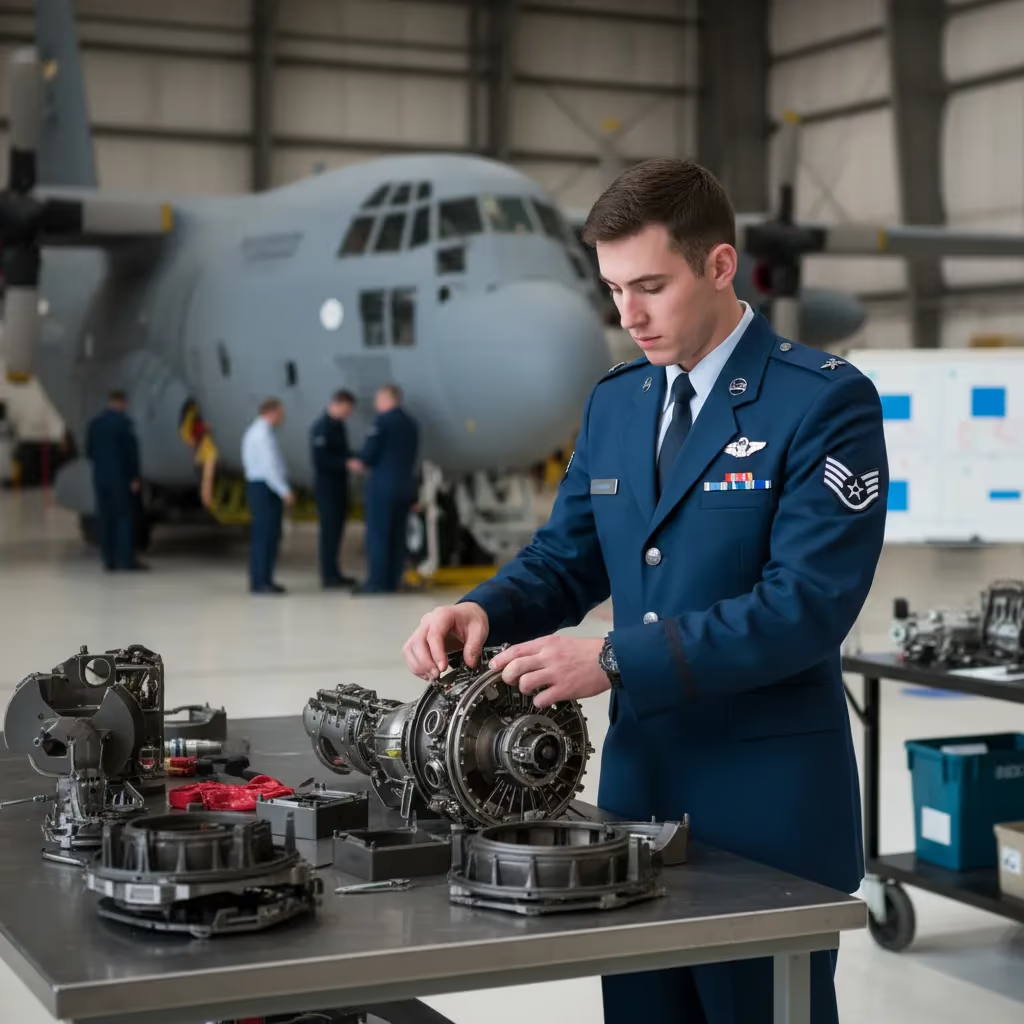
If you're researching picat asvab army navy military options, you're discovering one of the lesser-known but highly convenient pathways to military enlistment screening. The PiCAT (Pending Internet Computerized Adaptive Test) is the take-home version of the ASVAB that allows recruits to complete the cognitive portion of military enlistment screening from home.
Active military recruiters in Army, Navy, Marines, Air Force, and Space Force can authorize PiCAT testing for qualified candidates, eliminating the need for an immediate trip to MEPS for the standard CAT-ASVAB. A focused asvab practice test routine remains essential whether you're testing via PiCAT or traditional CAT-ASVAB at MEPS — the content covered is identical. The asvab exam itself is the same regardless of delivery format.
The PiCAT eliminates several friction points of traditional CAT-ASVAB testing: no MEPS travel for the cognitive portion, flexible scheduling around work and family obligations, and the ability to take your time without the high-pressure feel of in-person testing. After completing PiCAT remotely, you'll still visit MEPS for medical clearance and a brief verification test (typically 25-50 questions) confirming your PiCAT scores accurately reflect your abilities. The verification test is much shorter than the full CAT-ASVAB.
This guide covers the PiCAT process, scoring equivalence with traditional ASVAB, prep strategy specifically for at-home testing, the verification test at MEPS, and how PiCAT scores translate to enlistment qualification across all U.S. military branches.
PiCAT ASVAB by the Numbers
A focused asvab approach for PiCAT candidates should account for the at-home format. The asvab test content tested is identical to the traditional CAT-ASVAB — same 10 subtests covering general science, arithmetic reasoning, word knowledge, paragraph comprehension, mathematics knowledge, electronics information, auto and shop information, mechanical comprehension, assembling objects, and verbal expression. The PiCAT differs in delivery format (home computer vs MEPS station) and timing (untimed vs strict per-subtest limits), but the underlying assessment is the same. Recruiters typically authorize PiCAT for candidates they've pre-qualified through prescreening conversations.
To take the PiCAT, your military recruiter creates an authorization in the testing system, sends you a unique access code, and you complete the test on your home computer within 30 days. Plan to take it during your peak focus hours when you can dedicate 3-4 uninterrupted hours. The untimed format means you can take longer if needed for individual subtests, but most candidates complete the full PiCAT in roughly the same timeframe as a CAT-ASVAB session.
If you're considering enlistment but not ready for MEPS scheduling logistics, PiCAT offers a low-friction first step in the qualification process.
Many recruiters track active PiCAT candidates closely throughout the 30-day window. Prompt MEPS scheduling after PiCAT completion strengthens your relationship with your recruiter and accelerates contract negotiation timing.
A solid asvab test prep approach for PiCAT candidates emphasizes the same content as traditional CAT-ASVAB prep. Your asvab scores from PiCAT carry the same enlistment validity as CAT-ASVAB scores, qualifying you for branch-specific minimums (Army 31, Marines 32, Navy 35, Air Force 36, Space Force 36, Coast Guard 40). The Army has historically used PiCAT most extensively for recruiting; Navy, Air Force, Marines, and Coast Guard also accept PiCAT in recruitment workflows.
Confirm your specific branch's PiCAT acceptance with your recruiter before scheduling. The PiCAT also doesn't replace the army combat fitness test — Army recruits still face ACFT during basic combat training regardless of how they took the ASVAB.
The PiCAT's untimed format offers strategic advantages. You can pace yourself through challenging subtests without the time pressure that compromises accuracy on the CAT-ASVAB. However, the trade-off is the verification test at MEPS — if your PiCAT scores significantly exceed your verification test performance, you'll need to complete a full CAT-ASVAB. Honest performance during PiCAT (no outside help, calm focus) ensures the verification test confirms your scores rather than triggering retest.
Don't try to use unauthorized assistance during PiCAT — it backfires on the verification test and triggers retest requirements.
Build a list of target MOS or rating options before MEPS. Knowing line score requirements for your top three job choices puts you in the strongest possible position to lock in the assignment you want during contract negotiation, regardless of how you took the ASVAB.
ASVAB Practice Test Questions
Prepare for the ASVAB - Armed Services Vocational Aptitude Battery exam with our free practice test modules. Each quiz covers key topics to help you pass on your first try.
ASVAB Arithmetic Reasoning Test
ASVAB Exam Questions covering Arithmetic Reasoning Test. Master ASVAB Test concepts for certification prep.
ASVAB Arithmetic Reasoning Word Problems
Free ASVAB Practice Test featuring Arithmetic Reasoning Word Problems. Improve your ASVAB Exam score with mock test prep.
ASVAB Assembling Objects Test
ASVAB Mock Exam on Assembling Objects Test. ASVAB Study Guide questions to pass on your first try.
ASVAB Automotive Information Test
ASVAB Test Prep for Automotive Information Test. Practice ASVAB Quiz questions and boost your score.
ASVAB Electronics Fundamentals and Circuits
ASVAB Questions and Answers on Electronics Fundamentals and Circuits. Free ASVAB practice for exam readiness.
ASVAB Electronics Practice Test
ASVAB Mock Test covering Electronics Practice Test. Online ASVAB Test practice with instant feedback.
ASVAB Electronics Practice Test 1
Free ASVAB Quiz on Electronics Practice Test 1. ASVAB Exam prep questions with detailed explanations.
ASVAB General Science Biology and Ecology
ASVAB Practice Questions for General Science Biology and Ecology. Build confidence for your ASVAB certification exam.
ASVAB General Science Practice Test
ASVAB Test Online for General Science Practice Test. Free practice with instant results and feedback.
ASVAB General Science Practice Test 1
ASVAB Study Material on General Science Practice Test 1. Prepare effectively with real exam-style questions.
ASVAB Mathematics Knowledge Test
Free ASVAB Test covering Mathematics Knowledge Test. Practice and track your ASVAB exam readiness.
ASVAB Mechanical Comprehension Principles
ASVAB Exam Questions covering Mechanical Comprehension Principles. Master ASVAB Test concepts for certification prep.
ASVAB Mechanical Comprehension Test
Free ASVAB Practice Test featuring Mechanical Comprehension Test. Improve your ASVAB Exam score with mock test prep.
ASVAB Paragraph Comprehension and Inference
ASVAB Mock Exam on Paragraph Comprehension and Inference. ASVAB Study Guide questions to pass on your first try.
ASVAB Paragraph Comprehension Test
ASVAB Test Prep for Paragraph Comprehension Test. Practice ASVAB Quiz questions and boost your score.
PiCAT vs CAT-ASVAB
PiCAT is the at-home version administered through the official PiCAT website with recruiter-issued access code. Untimed format allows you to pace yourself. Take from your home computer within 30 days of recruiter authorization. After completion, schedule a MEPS visit for medical clearance and a brief verification test (25-50 questions) confirming your PiCAT scores accurately reflect your abilities. The PiCAT is computer-adaptive like CAT-ASVAB, adjusting question difficulty based on your responses.
A focused test asvab practice test routine prepares PiCAT candidates the same way it prepares CAT-ASVAB candidates — same content, same prep books, same practice question sources. A solid asvab study guide covers all 10 subtests systematically. Books like Kaplan's ASVAB Prep Plus, Barron's ASVAB, and Princeton Review's ASVAB Prep all calibrate to current ASVAB content and apply equally to PiCAT and CAT-ASVAB candidates. Combine a quality study guide with weekly practice tests during a 6-8 week prep window for the most reliable score results regardless of which test format you'll take.
PiCAT specifically benefits from the at-home untimed format if you tend to perform better without time pressure. Some candidates with test anxiety find PiCAT significantly more comfortable than CAT-ASVAB. Others prefer CAT-ASVAB's structured time limits because the discipline keeps them focused. Discuss format preference with your recruiter — both are valid pathways.
If you're a working adult balancing prep with employment and family obligations, PiCAT's flexible scheduling can be a major advantage compared to coordinating MEPS travel logistics.
If your PiCAT scores significantly exceed expectations from your practice tests, that's a green flag — your prep paid off. Just make sure verification testing confirms the higher scores so they become your official record.
4 PiCAT Test Prep Strategies
Don't take PiCAT casually because it's at home. Treat it with the same seriousness as MEPS-administered CAT-ASVAB. Set up a quiet testing environment, eliminate distractions, and approach each subtest with focus. Casual PiCAT approaches produce scores that don't survive MEPS verification testing.
Take 2-3 full ASVAB practice tests before scheduling your PiCAT to ensure you're prepared. PiCAT scoring follows the same scaled scoring as CAT-ASVAB, so practice score predictions translate directly. Don't take PiCAT cold expecting to score above your practice average — outcomes typically match practice performance closely.
Don't use outside help (people, internet, books) during PiCAT. The verification test at MEPS catches inflated PiCAT scores. If verification scores significantly differ from PiCAT, you'll need to complete a full CAT-ASVAB at MEPS — losing the convenience advantage. Honest performance produces clean verification.
PiCAT replaces only the cognitive testing portion of enlistment processing — you still visit MEPS for medical clearance, contract negotiation, and the verification test. Schedule your MEPS visit within 30 days of completing PiCAT to maintain score validity. Coordinate with your recruiter for the most efficient MEPS scheduling.
A book like asvab scores reference combined with asvab for dummies as introductory prep works well for PiCAT candidates. The Dummies series covers content clearly with practice questions; pair it with a tougher prep book for higher-difficulty practice. Both formats produce similar PiCAT readiness. Beyond the cognitive portion (PiCAT or CAT-ASVAB), Army recruits also need to prepare physically for the army fitness test (now ACFT, the Army Combat Fitness Test). Failing the ACFT during basic combat training delays graduation; passing it streamlines your training timeline.
The ACFT scores six events 0-100 each (600 total): three-rep max deadlift, standing power throw, hand-release push-ups, sprint-drag-carry, plank, two-mile run. Combat MOS slots require ACFT 420+ (70 per event); special operations require 540+. Strength training matters more than pure cardio — the test rewards functional power, not just running endurance. Train 8-12 weeks before basic to develop both strength and aerobic capacity.
PiCAT handles your cognitive qualification; ACFT prep handles your physical qualification. Run both prep tracks in parallel for the strongest qualification position.
Some recruits use PiCAT strategically as a low-stakes initial assessment before committing to enlistment. The at-home format eliminates the perceived high-pressure feel of MEPS testing for candidates still deciding whether military service fits their goals.
PiCAT vs CAT-ASVAB: Pros and Cons
- +PiCAT eliminates immediate MEPS travel for cognitive testing
- +Untimed format reduces test anxiety for some candidates
- +Flexible scheduling around work and family obligations
- +Same scoring validity as traditional CAT-ASVAB at MEPS
- +Reduces total time required at MEPS during enlistment processing
- +Recruiters often have better visibility into test progression
- −Verification test at MEPS catches inflated PiCAT scores from unauthorized help
- −Untimed format can produce procrastination on difficult subtests
- −30-day validity window requires MEPS scheduling coordination
- −Not all branches/regions have equal PiCAT availability
- −Honest mistake on verification test can trigger full CAT-ASVAB requirement
- −Self-administered format requires personal discipline to maintain test conditions
A consistent practice asvab test habit reveals your weak subtests fast — same diagnostic value for PiCAT candidates as for CAT-ASVAB candidates. Take a full diagnostic before opening any prep books. The score breakdown tells you exactly where to spend study hours. The army pt test (now ACFT) requires parallel physical preparation. Six events scored 0-100 each (600 total): deadlift, standing power throw, hand-release push-ups, sprint-drag-carry, plank, and 2-mile run. Train 8-12 weeks before basic combat training to develop both strength and aerobic capacity. Strength training translates directly to ACFT events; pure cardio doesn't deliver the same returns.
Your physical and academic prep should run on the same calendar. Schedule ASVAB study (whether for PiCAT or CAT-ASVAB) in the morning when mental focus peaks; do ACFT prep in the evening or before work. Splitting cognitive and physical training across the day prevents burnout in either area. Most recruits who succeed at MEPS and beyond treated both academic and physical preparation as parallel tracks rather than sequential.
Discipline in both prep tracks compounds during basic training where intense ACFT and clinical work together test sustained performance.
Track your weekly practice scores in a simple spreadsheet — date, AFQT score, individual subtest scores. Watching the upward trend across weeks builds the confidence you need on actual test day, whether PiCAT or CAT-ASVAB.
PiCAT ASVAB Prep Checklist
- ✓Discuss PiCAT eligibility with your military recruiter (Army, Navy, AF, USMC, USCG)
- ✓Take 2-3 full ASVAB practice tests to establish baseline AFQT and subtest scores
- ✓Identify weak subtests and allocate 60% of study time to those areas
- ✓Complete 6-8 weeks of structured study covering all 10 ASVAB subtests
- ✓Set up quiet testing environment for PiCAT — eliminate distractions
- ✓Take PiCAT honestly — no outside help during testing
- ✓Complete PiCAT within 30-day validity window
- ✓Schedule MEPS visit for medical clearance and verification test
- ✓Bring photo ID and registration confirmation to your MEPS appointment
- ✓Begin ACFT physical training 8-12 weeks before Army basic combat training
The asvab score range spans 1-99 (percentile-based AFQT) — same range whether you take PiCAT or CAT-ASVAB. Most recruits cluster between 30-60. AFQT below 31 is below floor for any branch; 31-49 qualifies for entry-level Army or Marines roles; 50-65 opens most general jobs; 65-85 unlocks technical and skilled specialties; 85-99 qualifies for elite programs and highest signing bonuses.
A weekly test asvab practice test session reveals where your score trajectory is heading — flat scores mean change your approach; rising scores mean stay the course. A practice asvab session weekly throughout your prep window builds the consistency PiCAT and CAT-ASVAB both reward.
Don't underestimate how much MEPS contract negotiation hinges on your specific line score breakdown. Bring it printed regardless of whether you took PiCAT or CAT-ASVAB. Recruiters work toward branch quotas and may try to fill needed slots, but informed recruits can push back constructively when offered jobs below their qualifications. The contract you sign at MEPS shapes your entire enlistment.
Treat MEPS contract negotiation as the high-stakes event it is — strong ASVAB scores combined with informed negotiation produce the best enlistment outcomes.
Don't let PiCAT's untimed format encourage procrastination on difficult subtests. Set personal time targets per subtest based on real CAT-ASVAB pacing — this maintains the skills you need for verification test performance even though PiCAT itself doesn't enforce time limits.
Honest PiCAT Performance Survives Verification
After completing PiCAT, you'll take a brief verification test (typically 25-50 questions) at MEPS to confirm your scores accurately reflect your abilities. If verification scores closely match PiCAT performance, your PiCAT becomes your official ASVAB record. If verification scores significantly differ from PiCAT (suggesting unauthorized assistance during PiCAT), you'll need to complete a full CAT-ASVAB at MEPS — losing the convenience advantage of the at-home format. Honest PiCAT performance with no outside help produces clean verification every time.
The army aft — colloquial shorthand for the Army Combat Fitness Test (ACFT) — applies to all Army recruits regardless of whether they took PiCAT or CAT-ASVAB. Failing the ACFT during basic combat training can delay graduation; failing as an active-duty soldier triggers a remediation plan with a 90-day window to retake.
Civilian recruits who train for ACFT before basic give themselves a major advantage — soldiers who arrive at basic already meeting ACFT standards adjust to demanding training pace much faster than those still building baseline fitness. An asvab practice test air force routine is similar to other branches but adds emphasis on the Mechanical and Electronic composites for maintenance and avionics AFSCs.
Air Force Combat Controller (1Z3X1) and Pararescue (1T2X1) candidates spend 12-24 months in initial training pipelines after qualifying. Both require AFQT 50+ alongside the most physically demanding screening tests in any branch. Washout rates exceed 80% during initial selection. Successful candidates emerge with elite skill credentials and the highest specialty pay rates the Air Force offers.
If you're aiming for Air Force special tactics, treat your prep like a year-long commitment, not a 6-week sprint.
Build a clear pre-PiCAT routine — sleep early, hydrate, eat a real meal, set up a quiet workspace, and approach the test with the same focus you'd give MEPS-administered CAT-ASVAB. Casual approaches produce inflated PiCAT scores that fail verification testing.
PiCAT works best for self-disciplined candidates comfortable with self-administered testing. If you struggle with motivation in unstructured environments, PiCAT's flexibility can backfire — easy to procrastinate, easy to lose focus, easy to take longer than necessary. Some candidates perform better with the structured time limits of CAT-ASVAB at MEPS. Discuss format preference with your recruiter rather than defaulting to PiCAT just because it eliminates immediate MEPS travel. Match the format to your test-taking strengths.
An asvab test sample online session is one of the easiest first steps for any prospective recruit considering PiCAT or CAT-ASVAB. Free practice tests cover all 10 subtests at no cost — use one as a diagnostic before opening any prep books. The diagnostic score tells you exactly which subtests need the most study time. Most recruits underestimate Word Knowledge and Mechanical Comprehension as study targets, then lose points there on the real test.
Diagnostic-driven prep prevents this mistake regardless of test delivery format. What is the asvab test exactly? It's the Armed Services Vocational Aptitude Battery — a multiple-choice exam developed by the Department of Defense, used since 1968 to determine military enlistment eligibility and job placement.
The ASVAB is taken by over 1 million people annually across all U.S. military branches plus the Career Exploration Program for high school students. PiCAT is a relatively newer at-home delivery option used primarily for active recruits processing toward enlistment. Both PiCAT and CAT-ASVAB versions cover the same content with slight format differences in question delivery and timing.
The version you take depends on your recruiter's authorization and your branch's PiCAT acceptance — both produce identical official ASVAB scores when verified properly.
Plan recertification CE credits across the 3-year cycle rather than scrambling in the final months. Consistent professional development throughout your military career compounds across decades of post-service civilian opportunities.
If you're wondering how many questions are on the asvab, the answer depends on version. The CAT-ASVAB has 145 questions across 10 subtests in roughly 90 minutes. The paper-and-pencil version has 225 questions across 9 subtests over about 3 hours. PiCAT follows the CAT-ASVAB structure (computer-adaptive, 145 questions across 10 subtests) but is delivered at home with untimed format.
Most MEPS centers administer CAT-ASVAB or accept PiCAT; the paper version is rarely used today. The army fitness test aft (ACFT) complements your ASVAB qualification by ensuring you can complete training successfully — combat MOS slots specifically require strong ACFT performance to graduate basic combat training.
PiCAT plus verification test at MEPS provides a streamlined enlistment pathway that minimizes total MEPS time. Recruits who prefer to handle the cognitive testing in their home environment and consolidate the MEPS visit to medical clearance and contract negotiation often appreciate this format. Discuss with your recruiter whether PiCAT fits your specific situation and timeline preferences.
Both PiCAT and CAT-ASVAB are valid pathways — the right choice depends on your test-taking style, schedule flexibility, and your recruiter's branch-specific acceptance.
Schedule your prep, take the test, and walk into MEPS confident on test day.
ASVAB Questions and Answers
About the Author
Retired Military Officer & Armed Forces Test Preparation Specialist
United States Army War CollegeColonel Steven Harris (Ret.) served 28 years in the US Army, earning a Master of Arts in Military Science from the Army War College and a Bachelor of Science in Criminal Justice. He has coached thousands of military enlistment and officer candidate program applicants through the ASVAB, AFQT, AFCT, OAR, and officer selection assessment processes across all military branches.
Join the Discussion
Connect with other students preparing for this exam. Share tips, ask questions, and get advice from people who have been there.
View discussion (5 replies)