
OUPV Practice Test: Pass Your USCG Captain's License Exam in 2026 October
Pass your OUPV captains license exam with free practice tests. 🎯 Real questions, detailed answers, and study tips for the USCG OUPV six pack license.
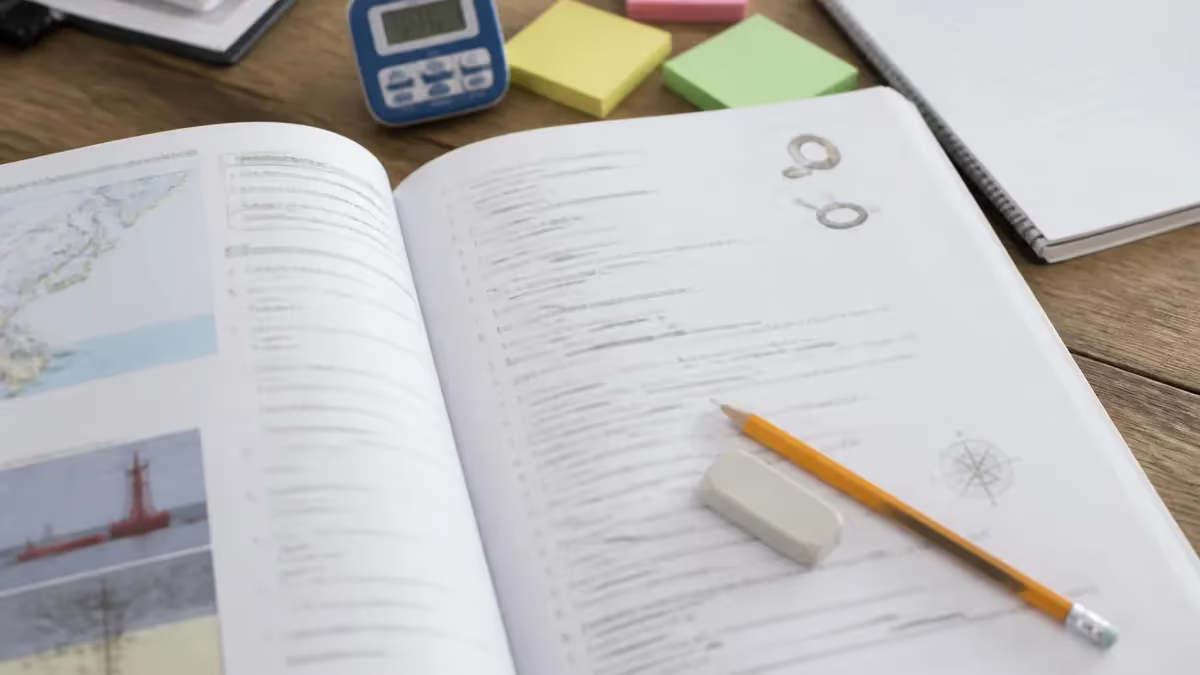
The uscg oupv exam is the gateway to earning your captain's license, and smart preparation with a focused OUPV practice test is the single most effective strategy to pass on your first attempt. The United States Coast Guard administers this exam through PROMETRIC testing centers nationwide, and candidates who walk in without rigorous practice face a real risk of failure. This guide gives you everything you need — from understanding the exam structure to working through realistic practice questions — so you can approach test day with full confidence.
The OUPV, or Operator of Uninspected Passenger Vessel, credential is one of the most sought-after maritime licenses in the United States. Commonly called the "six-pack" license because it authorizes you to carry up to six paying passengers, the OUPV captains license opens the door to charter fishing, sailing instruction, eco-tours, water taxi operations, and dozens of other commercial on-water businesses. Passing the USCG exam is required before you can work professionally as a licensed captain, and that exam tests knowledge across multiple technical domains.
Many candidates underestimate the breadth of material covered on the OUPV exam. The test covers rules of the road, chart plotting and piloting, deck safety, marine weather, emergency procedures, and general seamanship — a combination that demands systematic study rather than casual review. Using an OUPV practice test that mirrors the actual exam format helps you identify weak areas early, measure your progress over time, and build the mental stamina needed to work through a multi-hour testing session without losing focus.
One of the most common mistakes aspiring captains make is relying solely on the captain's license course materials without ever testing themselves under realistic exam conditions. Practice questions force active recall, which research consistently shows produces far better long-term retention than passive reading or re-watching video lessons. When you answer a question, check the rationale, and then review the underlying rule or chart technique, you are building durable knowledge — not just short-term memorization that fades before exam day.
The OUPV exam contains 120 questions drawn from a large question bank maintained by the National Maritime Center. Those questions are organized into specific knowledge areas, and the Coast Guard requires a minimum score of 70 percent to pass each section. That threshold sounds manageable, but because each knowledge area is scored independently, you cannot compensate for a weak section by acing another. Targeted practice by subject area is therefore essential — you need to reach 70 percent in every domain, not just on average.
Our free OUPV practice tests are built to match the exact style and difficulty of real USCG exam questions. Each quiz covers a distinct subject area, features detailed answer explanations drawn from authoritative sources like Chapman Piloting, the COLREGS, and USCG reference materials, and tracks your progress session by session. Whether you are just starting your study plan or in the final week before your exam date, working through these practice sets will sharpen your knowledge and reduce test-day anxiety.
Before diving into the study plan, it is worth understanding the full path to licensure so you can appreciate why the exam component matters so much. Earning your OUPV six pack captain's license requires meeting sea service requirements, completing a first aid and CPR course, passing a physical and drug screening, and completing the written USCG exam. The written exam is the component most candidates find most challenging, which is exactly why dedicated OUPV practice test sessions should be the cornerstone of your preparation strategy.
OUPV Captain's License by the Numbers
Key Facts at a Glance
| Item | Value | Details |
|---|---|---|
| Exam Questions | 120 | Across all knowledge areas |
| Minimum Pass Score | 70% | Required per section |
| Time to Complete | 3–4 hrs | Proctored at PROMETRIC |
| License Validity | 5 Years | Renewal required every 5 years |

OUPV Exam Format & Structure
| Section | Questions | Time | Weight | Notes |
|---|---|---|---|---|
| Rules of the Road (COLREGS & Inland) | 30 | ~45 min | 25% | Must pass independently at 70% |
| Chart Plotting & Navigation | 30 | ~60 min | 25% | Requires parallel ruler & dividers |
| Deck General & Safety | 30 | ~45 min | 25% | Covers equipment, regulations |
| Marine Weather, Tides & Currents | 30 | ~30 min | 25% | Includes tide table interpretation |
| Total | 120 | 3–4 hours | 100% |
Understanding what the oupv license exam actually tests is the foundation of an effective study plan. The USCG OUPV written exam draws from a publicly available question bank, but with over 800 questions in the pool and only 120 appearing on any given test, you cannot simply memorize every question. Instead, you need to deeply understand the underlying principles — rules, charts, weather patterns, and safety regulations — so you can answer any variation of a concept that appears on your specific exam.
The Rules of the Road section covers the International Regulations for Preventing Collisions at Sea (COLREGS) and the corresponding Inland Navigation Rules. This section tests your knowledge of vessel light configurations, sound signals, right-of-way rules, and definitions of vessel types.
Many candidates find Rules of the Road conceptually straightforward but trip up on edge cases — for example, the precise hierarchy of stand-on and give-way vessels when a sailing vessel, a vessel restricted in its ability to maneuver, and a vessel not under command are all present in the same area. Practice tests in this area train you to recognize the visual patterns in question stems that signal which rule applies.
Chart Plotting and Navigation is consistently rated the most challenging section by first-time test takers. This section requires you to use nautical chart tools — specifically a parallel ruler or course plotter, dividers, and a magnetic compass rose — to calculate courses, distances, bearings, and positions. On the actual USCG exam, you are given a paper chart and must physically plot solutions. The good news is that chart plotting is entirely learnable through repetition. Our practice questions walk you through step-by-step solutions so you understand not just the answer but the precise plotting technique that produced it.
Deck General and Safety covers the equipment, procedures, and regulations that apply to operating a small passenger vessel. This includes knowledge of lifesaving equipment (life rings, EPIRBs, flares, life rafts), firefighting systems, vessel documentation requirements, load line regulations, and the specific requirements for uninspected passenger vessels under 46 CFR Part 26. Candidates who have extensive on-water experience often do well in this section naturally, but there are always regulatory details — like the exact number of flares required for day versus night signaling — that require deliberate study.
Marine Weather, Tides, and Currents tests your ability to read NOAA weather forecasts, interpret tide tables and current tables, understand weather system development (fronts, isobars, fog formation), and apply that knowledge to safe voyage planning. This section rewards candidates who spend time working through actual tide table problems rather than just reading about them.
The USCG exam commonly presents a tide table excerpt and asks you to determine the height of water at a specific time or the time of a specific tide stage — skills that come naturally with practice but feel confusing when encountered for the first time under test conditions.
Emergency Procedures and Drills round out the knowledge domains tested on the OUPV exam. This subject area covers man-overboard recovery procedures, fire response protocols, vessel grounding procedures, distress signal protocols, and the legal obligations of a licensed captain when an accident or emergency occurs. Understanding the captain's legal responsibilities — including when and how to file a marine casualty report with the Coast Guard — is tested regularly and catches unprepared candidates off guard. Studying this material through scenario-based practice questions is especially effective.
The practical implication of this multi-domain structure is that your study plan must allocate time proportionally to your actual proficiency in each area. Taking a diagnostic OUPV practice test at the start of your preparation — before you have studied anything — gives you an honest baseline.
Many candidates are surprised to find they perform well on weather and safety questions (areas where common sense helps) but struggle significantly with chart plotting and the technical specifics of Rules of the Road. That honest self-assessment, early in the process, allows you to invest your study hours where they will have the greatest impact on your final score.
OUPV Study Strategies by Topic
Mastering the COLREGS and Inland Rules requires understanding the hierarchy of vessel types and the specific visual and auditory signals each must display. Begin by memorizing the basic categories — vessels not under command, vessels restricted in maneuverability, vessels constrained by draft, fishing vessels, sailing vessels, and power-driven vessels — and their priority order when crossing situations arise. Flashcards work exceptionally well here because you are essentially learning a set of conditional rules with clear triggers and outcomes.
Once you understand the underlying hierarchy, focus on light configurations for different vessel types and sizes. The USCG exam regularly presents diagrams or descriptions of light arrangements and asks you to identify the vessel type. Work through practice questions that describe a light pattern — for example, a vessel showing a white stern light, green starboard light, and red port light — and practice instantly identifying it as a power-driven vessel underway. Timed practice sessions build the rapid recognition skills you need to move efficiently through this section on exam day.
Online OUPV Practice Tests vs. Classroom Courses
- +Available 24/7 — study on your schedule, not a fixed class schedule
- +Instant feedback on every answer with detailed rationale explanations
- +Track your progress by subject area to identify and target weak spots
- +Cost-effective — quality free practice tests are widely available online
- +Simulate real exam pacing with timed quiz sessions to build test stamina
- +Access from any device — desktop, tablet, or smartphone while on the water
- −No live instructor to answer conceptual questions in real time
- −Self-discipline required — easy to skip sessions without accountability
- −Chart plotting practice still requires physical tools and printed charts
- −Some free practice tests use outdated questions not matching current exam format
- −No hands-on demonstrations of equipment covered in deck safety sections
- −Networking opportunities with other aspiring captains are limited online
OUPV Exam Prep Checklist: Everything Before Test Day
- ✓Complete a full diagnostic OUPV practice test and score each knowledge area separately.
- ✓Gather required tools: parallel ruler or course plotter, dividers, and a pencil.
- ✓Study the COLREGS light configurations for at least 10 vessel types using flashcards.
- ✓Work through 30 nautical chart plotting problems using a training chart.
- ✓Review the USCG Tide Table reference and practice 20 interpolation problems.
- ✓Memorize the Beaufort Scale and associated wave heights and weather conditions.
- ✓Study 46 CFR Part 26 requirements specific to uninspected passenger vessels.
- ✓Complete at least one full-length timed 120-question OUPV practice exam under realistic conditions.
- ✓Review marine casualty reporting requirements and the captain's legal obligations.
- ✓Confirm your PROMETRIC appointment, required ID documents, and allowed exam materials.
- ✓Rest well the night before and arrive at the testing center 30 minutes early.
You Must Pass Every Section Independently
The USCG OUPV exam does not average your scores across sections — you must score at least 70 percent in each knowledge area independently. A score of 95 percent in Marine Weather cannot compensate for a 65 percent in Chart Plotting. This means your weakest subject, not your average, determines whether you pass. Identify your weakest section early, focus extra practice sessions there, and confirm you can consistently score 75 percent or above before your exam date.
Passing the USCG OUPV exam on your first attempt is entirely achievable with the right preparation strategy, and the candidates who succeed most consistently share a few key habits. The first is consistency over intensity — studying for 45 minutes every day for six weeks produces far better results than cramming for eight hours the weekend before the exam. The human brain consolidates new information during sleep, which means distributed practice across many days allows each concept to move from short-term to long-term memory in a way that weekend cramming simply cannot replicate.
The second success habit is active testing rather than passive review. Reading your study materials is useful, but it creates an illusion of mastery — material feels familiar when you read it, but familiarity is not the same as ability to recall under pressure. Every time you sit down to study, lead with an OUPV practice test session before reviewing the material.
Answer 20 to 30 questions cold, review the ones you missed, and then read the underlying rules or techniques for those missed items. This testing-first approach is called retrieval practice, and it is the most evidence-supported learning technique available for exam preparation.
The third habit is deliberate error analysis. When you miss a question, do not simply note the correct answer and move on. Instead, ask yourself: Did I misread the question? Did I know the rule but apply it incorrectly? Did I not know the underlying concept at all? Each of those failure modes requires a different response.
Misreading questions is fixed by slowing down and underlining key words. Applying rules incorrectly requires more practice problems using that rule. Not knowing the concept requires going back to your reference materials and building a mental model from scratch before attempting more practice questions on that topic.
Many candidates ask how long it takes to prepare for the OUPV exam. The honest answer depends on your starting point. Someone with 10 years of recreational boating experience and a strong understanding of Rules of the Road may need as little as four to six weeks of focused study.
A candidate with limited on-water experience should plan for eight to twelve weeks. The common thread for both groups is the need to treat chart plotting as a separate skill that demands its own dedicated practice — it is the area most correlated with exam failure among candidates who otherwise feel well-prepared.
Scheduling your PROMETRIC appointment at least two weeks in advance is strongly recommended. PROMETRIC testing centers can fill up quickly in coastal markets — cities like Miami, Seattle, Boston, and San Diego see particularly high demand from aspiring captains. Booking your appointment gives you a concrete exam date to work backward from, which is psychologically valuable for maintaining study momentum. It also means you will not face a situation where you feel ready but cannot get an appointment for another six weeks.
On exam day, the testing center will provide scratch paper and allow you to bring your marine plotting tools (parallel ruler, dividers, and protractor). You will not be allowed to bring reference books, but USCG-approved reference tables including tide tables are provided. The exam is computer-administered, with each question displayed individually on screen. You can flag questions you are uncertain about and return to them after completing the rest of the section — a feature that experienced test-takers use strategically to maximize their use of available time.
After passing the written exam, your PROMETRIC test results are submitted electronically to the National Maritime Center, which processes your full application package — including sea service documentation, medical certificate, and course completion certificates — before issuing your OUPV credential. Processing times at the NMC typically range from four to eight weeks, though candidates who submit complete, error-free applications often receive their credentials faster. The credential, once issued, is valid for five years and is renewable through the USCG renewal process.
Passing the USCG written exam is only one component of the OUPV license application. Your sea service logbook must document at least 360 days on the water, including 90 days in the near-coastal zone if you are seeking a near-coastal route. Incomplete sea service documentation is the leading cause of application delays at the National Maritime Center, so ensure your logbook is signed, dated, and fully organized before submitting your package.
Once you hold your OUPV six pack captain's license, the credential comes with ongoing obligations — most importantly, renewal every five years. The oupv six pack captain's license renewal process requires demonstrating ongoing sea service (a minimum of 360 days on the water within the five-year period), completing an approved first aid and CPR refresher course, and submitting a renewal application to the National Maritime Center.
Many captains are surprised to learn that renewal also requires passing a Rules of the Road exam if their sea service has been insufficient during the five-year period — another reason why maintaining an active boating schedule throughout your licensure period is important.
The renewal application process has become increasingly streamlined through the Mariner Credentialing Program Portal (MCPP), the USCG's online application system. Mariners can now submit renewal applications, upload supporting documents, and track application status entirely online. However, the system still requires original or certified copies of certain documents — particularly drug testing records and medical certificates — which must be mailed or submitted in person in some cases. Starting your renewal process at least six months before your credential's expiration date gives you sufficient buffer to address any documentation gaps without risking a lapse in licensure.
The practical benefits of holding an active OUPV credential extend well beyond the ability to charge for passenger trips. Licensed captains are prioritized for employment in the maritime recreation industry — fishing charter operations, sailing schools, eco-tour companies, and water taxi services all specifically recruit USCG-licensed operators. The credential also carries weight in the insurance market: vessel owners who hire licensed captains typically qualify for lower commercial liability premiums than those who operate with unlicensed crew. Understanding the commercial value of your license reinforces why preparing thoroughly for the exam is worth the investment of time and effort.
Many new captains use the OUPV license as a stepping stone toward higher USCG credentials. The most common progression is from OUPV to a 25-Ton or 50-Ton Master credential, which allows you to operate larger inspected vessels with more passengers.
The upgrade path typically requires additional sea service documentation and additional written exam sections — but candidates who prepared well for the OUPV exam find that the disciplined study habits they developed carry directly into their upgrade preparation. The knowledge domains overlap significantly, and chart plotting and Rules of the Road proficiency built for the OUPV exam remains relevant at every higher credential level.
Charter business owners who hold the OUPV credential frequently report that the license changes how they approach safety planning on every trip. The process of studying for the exam — particularly the emergency procedures and marine weather sections — instills habits of pre-departure planning, weather monitoring, and passenger safety briefings that become automatic over time. The exam is not just a regulatory hurdle; it is a structured curriculum designed to produce captains who can handle the full range of situations that arise when carrying paying passengers on navigable waters.
For captains planning to operate in near-coastal waters (within 100 miles of a baseline), the OUPV near-coastal endorsement requires additional sea service documentation in those specific waters. Candidates applying for the near-coastal route who studied exclusively for the inland rivers route may find that some exam questions — particularly those related to ocean swells, offshore weather patterns, and deepwater navigation — require additional preparation. Our practice tests cover both inland and near-coastal material, helping you ensure you are prepared for whichever route designation applies to your intended area of operation.
The professional community around the OUPV credential is active and supportive. Captain's associations, boating safety organizations, and maritime training programs throughout the United States offer ongoing education, networking opportunities, and practical skills refreshers that help licensed captains continue growing throughout their careers. Taking your preparation seriously from the very beginning — starting with a rigorous OUPV practice test regimen — sets the tone for the kind of professional commitment that defines the most successful licensed captains in the industry.
The final weeks of OUPV exam preparation should shift from broad content review to exam simulation. By the time you are two weeks out from your test date, you should have covered all subject areas at least once and should be scoring consistently above 75 percent on section-specific practice tests. At that point, the most valuable preparation activity is taking full-length 120-question practice exams under timed conditions that mirror the actual testing environment. Sit at a desk, put your phone away, set a timer, and work through the entire exam without pausing — just as you will on test day.
Time management during the actual exam is more important than many candidates realize. With 120 questions and approximately three to four hours available, you have roughly 90 seconds per question on average. Chart plotting questions will legitimately take three to five minutes each, which means you need to move through the conceptual questions — Rules of the Road, weather, emergency procedures — in under 60 seconds each to maintain pace. Practicing this time discipline during your preparation sessions trains you to make confident decisions under time pressure rather than second-guessing yourself and losing valuable minutes.
In the final 48 hours before your exam, resist the urge to cram new material. Your brain needs consolidation time, not additional input overload. Instead, do a light review of any topic where you still feel uncertain, confirm your exam appointment details and testing center location, gather your ID and plotting tools, and get a full night of sleep. Candidates who arrive well-rested, with their tools prepared and their logistics handled, consistently outperform candidates who stayed up cramming the night before — the research on sleep and exam performance is unambiguous on this point.
On exam day, use the first few minutes to orient yourself to the interface at the PROMETRIC center. Testing coordinators will give you a brief orientation before you begin. Take that time seriously — understanding how to flag questions, navigate between them, and submit sections will save you confusion during the exam itself.
When you encounter a difficult question, flag it, make your best educated guess, and move on. Never leave a question blank; a guess has a 25 percent chance of being correct while a blank guarantees zero points. Return to flagged questions with fresh eyes after completing the rest of the section.
Mental preparation is as important as content preparation for a multi-hour high-stakes exam. Anxiety is normal, but unmanaged anxiety impairs the cognitive processes you need most — working memory, pattern recognition, and careful reasoning. Simple techniques like slow diaphragmatic breathing before entering the testing room and positive self-talk during difficult sections have measurable effects on performance. Remind yourself that you have put in the work, you know the material, and that the exam is simply an opportunity to demonstrate what you have already learned through weeks of disciplined preparation.
After you complete the exam, PROMETRIC will provide an unofficial score report before you leave the testing center. If you pass — and thorough preparation with quality OUPV practice tests gives you an excellent chance of doing so — take a moment to acknowledge the work you put in. The OUPV credential represents a meaningful professional achievement.
If you need to retake a section, the unofficial report will identify which sections require retesting, and you can schedule a retake immediately. Most candidates who need a retake pass on their second attempt because they now know exactly which subject area to target with additional focused study.
The journey from aspiring captain to licensed OUPV operator is entirely within reach for anyone willing to prepare systematically and thoroughly. Our free OUPV practice tests, organized by subject area and built to match the real exam, are the most practical tool available for that preparation.
Start with a diagnostic test today, build your study schedule around your results, and work through the subject-area quizzes consistently until you are scoring above 75 percent in every section. Your captain's license is waiting — and the work you put in now will pay dividends every day you spend on the water as a licensed professional captain.
Sample OUPV - Operator Uninspected Passenger Vessel Practice Questions
Try these questions from our free OUPV - Operator Uninspected Passenger Vessel practice tests. The correct answer and an explanation follow each question.
What is the minimum age requirement to obtain an OUPV license from the USCG?
- A. 18 years old
- B. 16 years old
- C. 21 years old
- D. 25 years old
Answer: A. 18 years old
The USCG requires OUPV applicants to be at least 18 years of age at the time of application.
You plot a course of 120° True from your last known position. The variation is 12° West and your compass has a deviation of 4° East. What is the correct compass course (PSC) to steer?
- A. 112°
- B. 128°
- C. 136°
- D. 124°
Answer: B. 128°
To find the Compass course from a True course, you must correct for both variation and deviation. A common mnemonic is "True Virgins Make Dull Company, Add Whiskey" (True, Variation, Magnetic, Deviation, Compass, Add West). When going from True to Compass, you add Westerly variation and subtract Easterly variation. Then, you add Westerly deviation and subtract Easterly deviation. In this case: True (120°) + Variation (12°W) = Magnetic (132°). Magnetic (132°) - Deviation (4°E) = Compass (128°).
How often must an OUPV license be renewed?
- A. Every 10 years
- B. Every 5 years
- C. Every year
- D. It never expires
Answer: B. Every 5 years
OUPV licenses must be renewed every 5 years, requiring proof of sea service, physical exam, drug test, and completion of any required refresher courses.
While operating an OUPV, a passenger falls overboard. Which of the following actions should be your IMMEDIATE priority after ensuring the propellers are clear of the person?
- A. Notify the Coast Guard via VHF radio.
- B. Administer first aid to the person.
- C. Throw a life ring or other throwable PFD to the person.
- D. Note the vessel's position in the logbook.
Answer: C. Throw a life ring or other throwable PFD to the person.
The immediate priority in a man overboard situation is to establish flotation for the person in the water and maintain visual contact. Throwing a Type IV throwable device, like a life ring, provides immediate buoyancy and a visible target to keep in sight while maneuvering the vessel for recovery.
Take the full OUPV - Operator Uninspected Passenger Vessel practice test
OUPV Questions and Answers
About the Author

Educational Psychologist & Academic Test Preparation Expert
Columbia University Teachers CollegeDr. Lisa Patel holds a Doctorate in Education from Columbia University Teachers College and has spent 17 years researching standardized test design and academic assessment. She has developed preparation programs for SAT, ACT, GRE, LSAT, UCAT, and numerous professional licensing exams, helping students of all backgrounds achieve their target scores.
Join the Discussion
Connect with other students preparing for this exam. Share tips, ask questions, and get advice from people who have been there.
View discussion (9 replies)