
OPOTA Online: Ohio Peace Officer Training Academy E-Learning Guide 2026 October
OPOTA Online portal, CPT requirements, course catalog, 💯 registration, and tips for Ohio peace officers completing 24 hours of yearly training.
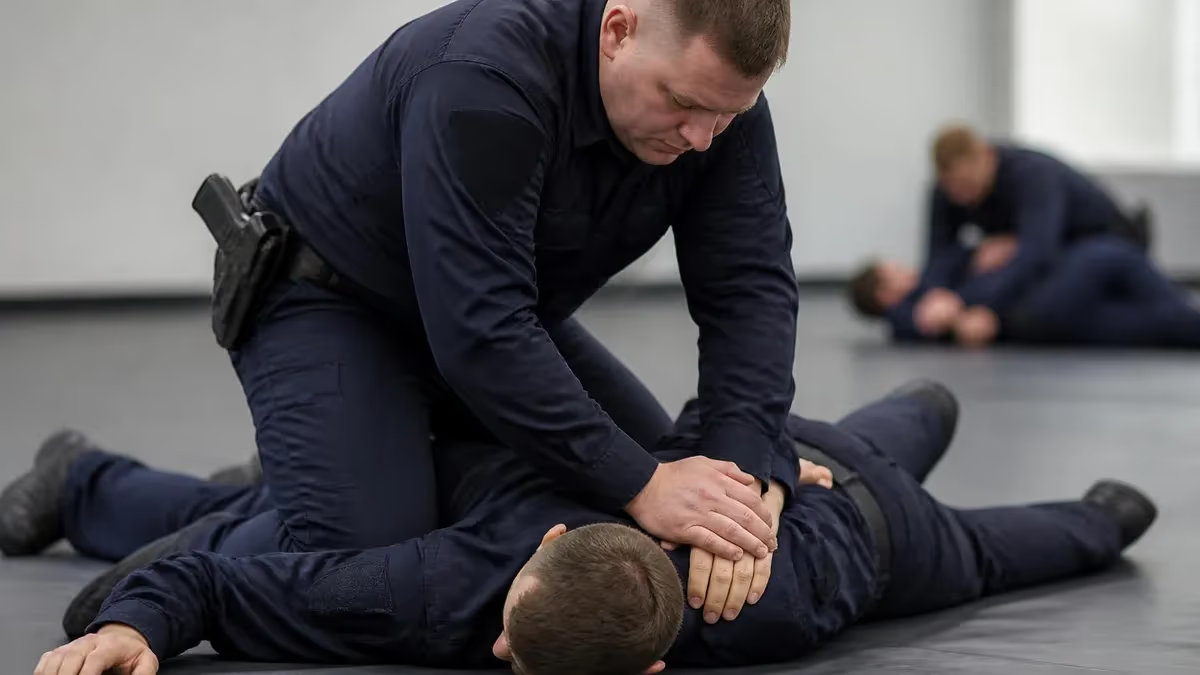
Ohio peace officers know the routine well. Each year the calendar flips, the badge stays, and the state requires fresh proof that every certified officer keeps current with use-of-force law, firearms safety, community engagement standards, and a long list of other skill areas. OPOTA Online is the digital backbone that makes those hours possible without forcing every deputy, trooper, and corrections officer to drive across the state for classroom seats.
If you've ever logged in at opota.ohioattorneygeneral.gov after a midnight shift, you already know the system isn't always intuitive. Course catalogs change, CPT mandates shift each year, and registration windows for live academies fill quickly.
This guide walks through everything: how the online portal works, what the 24-hour continuing professional training rule actually requires, which courses count, and how to manage your OPOTA card across multiple agencies. You'll also get a few honest notes on what the platform does well and where it still frustrates officers in the field.
Whether you're a new recruit working through basic peace officer training or a 20-year veteran knocking out yearly hours, the goal here is simple. Make OPOTA Online less of a maze, and give you the answers you'd otherwise have to dig through PDFs and email chains to find.
The platform has matured significantly since its early days, and most officers who learn its quirks end up appreciating the flexibility it offers. The rest develop strong opinions about why it could be better. Both groups make valid points. The Ohio Attorney General's office, which oversees OPOTA through the Ohio Peace Officer Training Commission, treats the online system as a primary delivery channel now, not a backup option.
Free Ohio Peace Officer Training Academy Study Tools
Interactive Ohio Peace Officer Training Academy resources on PracticeTestGeeks, free to start:
- Ohio Peace Officer Training Academy flashcards — review key terms and concepts card by card
- Ohio Peace Officer Training Academy study guide — topic-by-topic overview of what the exam covers
- Ohio Peace Officer Training Academy cheat sheet — one-page printable summary for last-minute review

OPOTA Online by the Numbers
Those numbers tell a quick story. Ohio leans heavily on its online infrastructure because the alternative, dragging tens of thousands of officers into physical classrooms, simply doesn't scale. The Attorney General's office expanded the e-learning library aggressively after 2020, and the catalog now covers everything from mandatory CPT topics to optional electives on de-escalation, mental health response, and emerging investigative techniques.
Still, completing 24 hours a year sounds easy until you're juggling court appearances, shift rotations, and a household. Most officers chip away at hours in 30-to-60-minute chunks during downtime. The portal saves your progress, which helps, though more than a few people have lost work to browser timeouts. Save often. Refresh rarely.
The 33,000-plus certified officer figure includes municipal police, sheriff's deputies, state troopers, corrections officers, park rangers, and various specialized agencies. Each population uses OPOTA Online slightly differently. A state trooper's training plan looks nothing like a small-town village officer's. The platform accommodates both, which is impressive when you stop to think about it.
That diversity also explains some of the system's quirks. A user interface designed to serve a one-officer township department and a 1,500-officer metropolitan agency at the same time inevitably feels overbuilt to small users and underbuilt to large ones. Most complaints about OPOTA Online trace back to that core tension. Knowing it exists helps set realistic expectations before you log in for the first time.
Quick Login Reference
The OPOTA Online portal sits at opota.ohioattorneygeneral.gov. Use the credentials issued by your agency's Training Officer, not your personal email. If you've switched departments, your old login may still work but transcripts can split across two profiles. Contact OPOTA support before that becomes a CPT-deadline emergency. Verify your contact email at the start of each calendar year so password reset links reach an inbox you actually monitor.
Login is where most problems start. The portal authenticates against an OPOTA-issued identifier tied to your peace officer certification number. Your agency Training Officer (sometimes called the TO or Agency Administrator) creates the account when you're hired or sworn in. If they didn't, or if the previous TO left without transferring credentials, you'll need to call the OPOTA Help Desk directly. Self-registration isn't an option for sworn personnel.
Password resets work the same way for civilians or sworn officers. The reset link goes to whatever email is on file, usually your agency address. That's a problem if you've moved departments and your old account points at an inbox you can no longer access. Plan ahead. Verify your contact email at the start of each calendar year, before CPT deadline pressure builds.
Mobile access exists but it's clunky. The course player relies on Flash-era video frameworks in some legacy modules, and not everything renders cleanly on a phone. A laptop or desktop with a reliable connection is still the safest bet for completing a course in one sitting. Some newer modules have been rebuilt with modern HTML5 video and work fine on tablets. But you can't tell which version a course uses until you've launched it.
Two-factor authentication has been rolled out for newer accounts and is being expanded. Keep your phone number current in your OPOTA profile so you don't get locked out at the worst possible time. Browser choice also matters more than it should. Chrome and Edge tend to handle the older video players best. Firefox sometimes works fine and sometimes stalls mid-module. Safari on iOS struggles with anything not rebuilt in HTML5.
Types of OPOTA Training Hours
Each year the Attorney General's Advisory Group sets required topics. Recent mandates have included community engagement, use of force, and crisis intervention. These are non-negotiable hours within the 24-hour total. The list is published in late fall for the following calendar year, so check the OPOTA website in November or December.
After mandatory topics, your agency picks the rest. Some departments require firearms refreshers, others lean into legal updates or report writing. Check your TO's annual training plan early in January to avoid surprises in December. Larger agencies often publish a full-year calendar with deadlines for each module.
OPOTA Online hosts dozens of optional courses. They don't always count toward CPT, but they're useful for promotion boards, specialty assignments, or staying sharp on emerging tactics like digital evidence or behavioral health response. Many electives also satisfy specialty-unit refresher requirements.
Some courses, especially firearms qualification and defensive tactics, still require in-person attendance at a regional academy. Online learning supplements but doesn't replace these hands-on requirements for every certified Ohio peace officer. Travel reimbursement varies by agency, so confirm before you book.

The split between mandatory, agency-selected, and optional hours catches new officers off guard. You might finish 24 hours of OPOTA Online courses and still fail your annual CPT audit because you skipped a required topic. The Attorney General typically publishes the mandatory list in late fall for the following calendar year. Print it. Tape it to your locker if you have to.
Use-of-force training has been a fixture for years and won't go away. Community engagement was added after 2020 reforms and remains heavily weighted. Crisis intervention and de-escalation hours have grown each year, reflecting the state's broader push to standardize how officers respond to behavioral health calls. Expect that trend to continue.
Worth noting: some mandatory topics are split into multiple required modules rather than a single longer course. A four-hour use-of-force requirement might translate to two separate two-hour modules with different scenario focuses. The transcript treats each as a distinct completion, so missing one of the two leaves you short even if the total time looks right at a glance.
Specialty officers face an extra layer. School resource officers, K-9 handlers, crisis negotiators, and SWAT operators have additional CPT mandates layered on top of the standard 24 hours. Those specialty hours have their own course tracks within OPOTA Online and their own deadlines. Missing a specialty requirement can pull an officer off a unit assignment even if their general CPT is current. Talk to your unit commander about which extra modules apply.
Finally, instructors and field training officers carry the heaviest training load of all. Maintaining an instructor credential typically requires both the standard 24 hours plus annual instructor-development modules and periodic methods-of-instruction refreshers. Many veteran instructors front-load these in the first quarter to keep December calm.
OPOTA Training Format Options
Self-paced modules accessed through the OPOTA Online portal. Most run 1-2 hours and include video, reading, and a short assessment at the end. Completion auto-records to your transcript. Best for officers who prefer to control pace and complete training around shift rotations or after hours. Most CPT mandatory topics offer an e-learning version, making this the workhorse format for the majority of Ohio peace officers each year. The catalog refreshes regularly with new modules covering recent case law and policy changes.
Choosing between formats comes down to schedule and learning style. E-learning works for officers who prefer to control pace. Live webinars are better for topics where questions are useful, like a new appellate court ruling on traffic stops. Regional academy classes are mandatory for hands-on skills nobody pretends a screen can teach.
Roll-call briefings are the underappreciated option. A well-run agency uses them to convert routine shift starts into documented training time. Five briefings at 20 minutes each adds up to nearly two CPT hours without anyone giving up a day off. The catch is documentation. Your TO has to upload completion records correctly, and that's where many agencies fall behind.
For larger departments, a hybrid approach usually works best. Schedule the mandatory live webinars early in the year, layer in roll-call briefings throughout, and reserve self-paced e-learning for the gaps between bigger commitments. Smaller agencies without dedicated training staff often default to all-online completion, which is fine but puts more pressure on individual officers to stay organized.
The CPT year runs January 1 through December 31. Hours completed in January 2027 do NOT count for 2026. If your transcript shows 22 hours on December 30, you have two days to finish or you'll face suspension review. Don't gamble on portal uptime that final week. Year-end traffic regularly slows the system and occasionally produces failed submissions that have to be corrected manually.
Quizzing yourself between modules is one of the better ways to retain material. The OPOTA Online platform includes built-in assessments at the end of each course, but those tests are designed to confirm you sat through the module, not to challenge you. For real preparation, especially around legal updates or use-of-force scenarios, supplement with practice questions that mirror how the material gets tested under pressure.
Now let's get practical. Registration for OPOTA Online courses isn't always obvious, particularly when you're toggling between self-paced electives and scheduled live sessions. The checklist below walks through what every officer should verify at the start of each CPT year. Treat it as a recurring annual habit, not a one-time setup. Agencies change subscription tiers, contact emails shift, and the catalog itself rotates content.
A 15-minute audit each January saves hours of trouble each December. If your agency uses a payroll-linked training tracker on top of OPOTA's own system, double-check that both records match. Mismatches between agency-level tracking and the state's official transcript are a frequent source of last-minute panic, and they're almost always cleaner to resolve when the year is still young.

OPOTA Online Annual Checklist
- ✓Confirm your OPOTA Online login works in the first week of January
- ✓Verify the email address on file matches your current agency address
- ✓Print or save the current year's mandatory CPT topics list
- ✓Review your transcript and check that prior-year hours posted correctly
- ✓Register for any required live webinars early, before they fill
- ✓Coordinate with your TO on agency-selected training hours
- ✓Schedule firearms qualification and EVOC sessions through regional academies
- ✓Set quarterly check-ins to track CPT progress instead of cramming in December
- ✓Keep digital copies of completion certificates for at least three years
- ✓Update your contact information if you transfer agencies mid-year
- ✓Confirm any specialty unit certifications (SRO, K-9, SWAT) have current refresher hours logged
- ✓Cross-check your agency payroll training tracker against your OPOTA transcript for discrepancies
- ✓Email yourself a PDF copy of your OPOTA transcript at the end of every quarter
- ✓Sign up for OPOTA email notifications so you don't miss new mandatory topic announcements
- ✓Plan instructor and FTO refresher modules early if you hold those credentials
The transcript verification step matters more than most officers realize. Course completions occasionally fail to post, especially when a session times out or when an agency switches its OPOTA Online subscription tier. A missing two-hour module discovered in November is fixable. The same problem found on December 28 means scrambling for a supervisor signature and a manual override that may not arrive in time.
Coordination with your TO is equally important. Agencies vary wildly in how proactively they manage CPT compliance. Some run monthly reports and flag officers who are behind. Others wait until the state sends a warning letter. Don't assume your department is the first kind. Even within well-organized departments, individual responsibility for tracking your own hours never disappears.
One specific habit pays off year after year: download a PDF copy of your transcript at the end of every quarter and email it to yourself. If something goes sideways with the portal, or if you transfer agencies mid-year, that personal archive becomes evidence you can hand directly to OPOTA without depending on anyone else's records.
OPOTA Online Pros and Cons
- +24/7 access lets officers complete training around shift schedules
- +Course catalog covers virtually every CPT topic Ohio requires
- +Automatic transcript tracking eliminates most paperwork
- +Free for sworn officers (your agency's subscription covers it)
- +Regular content updates reflect new case law and policy changes
- −Older modules feel dated and don't always work well on mobile
- −Portal occasionally times out during longer sessions, losing progress
- −Live webinar slots fill within hours for popular topics
- −Transcript errors require manual fixes through your Training Officer
- −Login system can split records when officers change agencies
Pros and Cons at a Glance
| Pros | Cons |
|---|---|
| Course catalog covers virtually every CPT topic Ohio requires | Older modules feel dated and don't always work well on mobile |
| Automatic transcript tracking eliminates most paperwork | Portal occasionally times out during longer sessions, losing progress |
| Free for sworn officers (your agency's subscription covers it) | Live webinar slots fill within hours for popular topics |
| Regular content updates reflect new case law and policy changes | Transcript errors require manual fixes through your Training Officer |
No platform is perfect, and OPOTA Online wears its history. The state built it during an earlier era of web technology and has steadily modernized rather than rebuilding from scratch. The result is a system that works well enough for the majority of users but still trips people up in predictable ways. Knowing those quirks in advance saves hours of frustration later.
The big advantage remains access. Before OPOTA Online matured, officers had to travel for nearly every CPT hour. Small departments without a nearby regional academy carried huge logistical burdens. Now even a one-officer township department can keep its certifications current without the chief driving across two counties for a four-hour class.
One more practical area to cover: your OPOTA card and what happens when you change agencies or take an extended leave. The OPOTA card is your physical proof of certification, and it travels with you, not with the agency that hired you. If you separate from a department, your certification stays valid as long as you complete CPT each year. Lapses trigger a review by the Ohio Peace Officer Training Commission, and reinstatement isn't automatic.
Officers on military deployment, extended medical leave, or family leave can request CPT extensions, but the paperwork has to be submitted before the deadline passes. Retroactive waivers are difficult. Replacement cards are available through OPOTA if yours is lost or damaged. Submit the request through your agency's TO and expect a few weeks for processing.
Beyond CPT, OPOTA Online also serves as a record-keeping hub for specialty certifications. Keep instructor credentials, field training officer designations, and specialty endorsements current the same way you keep your basic certification current.
Closing thought. OPOTA Online isn't going anywhere, and it's likely to grow more central to Ohio peace officer training, not less. The Attorney General's office continues to expand the catalog, push more mandatory hours into structured topics, and tighten transcript audits. Officers who treat the portal as a year-round tool rather than a December problem end up with fewer surprises, cleaner certifications, and more time to focus on the actual work of policing.
Bookmark the portal. Save your transcript every quarter. Talk to your TO before deadlines, not after. The system rewards officers who plan ahead, and it punishes the ones who don't. Same as the job itself.
One last suggestion that more veteran officers should pass along to newer ones: look at the optional electives even if they don't count toward your 24 hours. Specialty topics on interview techniques, digital evidence handling, gang awareness, and behavioral health response don't always satisfy CPT, but they expand the range of assignments you're qualified to handle.
Finally, build relationships with your agency's TO and, if your department is large enough, your regional academy coordinator. These are the people who can fast-track a transcript correction or slot you into a late-year webinar. Most are happy to help officers who treat the training process seriously. They have less patience for the ones who only show up in panic mode every December.
OPOTA Online won't make any officer a better cop on its own. The system delivers hours, not wisdom. What it does well is remove the logistical excuses that used to keep officers from accessing standardized, current training. Used intentionally, the portal becomes a steady drumbeat of professional development that compounds over a career. Used reactively, it becomes a December scramble that wastes weekends and tests certifications. Choose the first version. Your future self, your department, and the public you serve in Ohio will all be glad you did. The badge stays. The training is what keeps it shining.
If you want more targeted practice, the opota practice test page covers the same material with additional questions and explanations.
Sample Ohio Peace Officer Training Academy Practice Questions
Try these questions from our free Ohio Peace Officer Training Academy practice tests. The correct answer and an explanation follow each question.
An officer initiates a traffic stop. Upon approach, the officer observes the driver making furtive movements, appearing to reach under the seat. Based on OPOTA training regarding officer safety during traffic stops, what is the most appropriate immediate action for the officer to take?
- A. Immediately draw their firearm and order the driver to show their hands.
- B. Use the PA system to order the driver to place their hands on the steering wheel before approaching further.
- C. Disregard the movement as it is common for drivers to be nervous and retrieve their documents.
- D. Shine a flashlight into the driver's eyes to disorient them before proceeding.
Answer: B. Use the PA system to order the driver to place their hands on the steering wheel before approaching further.
OPOTA training emphasizes maintaining a position of advantage and using verbal commands to de-escalate and control a situation before escalating force. Using the PA system allows the officer to give clear commands from a safe distance, assess the driver's compliance, and determine the nature of the threat before closing the distance to the vehicle.
An Ohio peace officer conducts a traffic stop for a minor moving violation. During the stop, the officer develops a reasonable suspicion that the driver is armed and dangerous. According to Terry v. Ohio, what is the officer legally permitted to do?
- A. Conduct a full search of the vehicle's trunk and glove compartment.
- B. Arrest the driver immediately for a concealed weapon violation.
- C. Conduct a pat-down search of the driver's outer clothing for weapons.
- D. Seize the vehicle and hold it until a search warrant can be obtained.
Answer: C. Conduct a pat-down search of the driver's outer clothing for weapons.
The landmark Supreme Court case Terry v. Ohio established that if an officer has a reasonable, articulable suspicion that a person they have lawfully stopped is armed and dangerous, the officer may conduct a limited pat-down search (or 'frisk') of the person's outer clothing to discover weapons. This is for the officer's safety and is not a full search for evidence.
Which aspect is included in OPOTA’s training standards for basic peace officer training?
- A. Optional participation in advanced tactical simulations
- B. Comprehensive curriculum including criminal law, firearms training, and physical fitness
- C. Exclusive focus on community policing strategies
- D. Limited training on legal and ethical standards
Answer: B. Comprehensive curriculum including criminal law, firearms training, and physical fitness
OPOTA's training standards for basic peace officers are designed to create well-rounded and highly capable law enforcement professionals. This comprehensive curriculum includes critical subjects such as criminal law, which provides the legal framework for policing, intensive firearms training for safe and effective weapon use, and physical fitness to ensure officers can meet the demanding physical requirements of the job. These elements are fundamental to effective policing.
According to the duty to intervene, what is an Ohio peace officer required to do when witnessing another officer using excessive force?
- A. Wait until the incident is over and then report it to a supervisor
- B. Intervene to stop the excessive force and report the incident
- C. Allow the officer to use discretion in applying force
- D. Document the incident but take no immediate action
Answer: B. Intervene to stop the excessive force and report the incident
The duty to intervene requires officers to actively stop misconduct by fellow officers and report the incident through proper channels.
Take the full Ohio Peace Officer Training Academy practice test
OPOTA Questions and Answers
About the Author

Educational Psychologist & Academic Test Preparation Expert
Columbia University Teachers CollegeDr. Lisa Patel holds a Doctorate in Education from Columbia University Teachers College and has spent 17 years researching standardized test design and academic assessment. She has developed preparation programs for SAT, ACT, GRE, LSAT, UCAT, and numerous professional licensing exams, helping students of all backgrounds achieve their target scores.
Join the Discussion
Connect with other students preparing for this exam. Share tips, ask questions, and get advice from people who have been there.
View discussion (7 replies)