
OAR Test — Complete Guide 2026 September
Free OAR practice test with questions and answer explanations. Prepare for the 2026 September exam with instant scoring. 🟢

What Is the OAR Test?
The OAR (Officer Aptitude Rating) is a component of the ASTB-E (Aviation Selection Test Battery, Edition 5) — the standardized test battery used to evaluate candidates for US Navy officer commissioning programs. The OAR specifically measures the cognitive aptitude required for Navy officer roles (excluding aviation-specific scores), making it the primary selection measure for most Navy Officer Candidate School (OCS) applicants who are not pursuing aviation billets.
Who takes the OAR:
- Navy OCS applicants (non-aviation)
- Navy Officer Programs such as NROTC scholarship candidates
- Candidates for Direct Commission Officer (DCO) programs
- Marine Corps officer candidates may also take the ASTB-E
Key facts:
- The OAR is a subset of the ASTB-E battery (you take the full ASTB-E)
- Computer-adaptive format — questions adjust in difficulty based on your responses
- Three sections contribute to the OAR composite: Math Skills, Reading Skills, Mechanical Comprehension
- Scale: 20–80, with most competitive candidates scoring 50+
Practice with our oar test preparation resources covering all three OAR sections in the computer-adaptive format.
OAR Test — Three Sections Explained
The OAR composite score is derived from three of the ASTB-E subtests:
1. Math Skills Test (MST):
Tests mathematical reasoning including algebra, arithmetic, number sequences, percentages and ratios, geometry basics, and applied math word problems. The MST is computer-adaptive — correct answers lead to harder questions, incorrect answers to easier ones. Your final score reflects both accuracy and the difficulty level of questions answered. Focus areas: solving equations, fraction and decimal operations, percentage change, distance/rate/time problems, and basic statistics.
2. Reading Comprehension Test (RCT):
Tests your ability to understand, analyze, and draw conclusions from written passages — including technical, scientific, and professional texts. Questions assess main idea identification, specific fact location, vocabulary in context, logical inference, and author's purpose. The CAT format means early questions set the difficulty trajectory — read carefully from the first question.
3. Mechanical Comprehension Test (MCT):
Tests knowledge of physical and mechanical principles: gears, pulleys, levers, fluid mechanics, electricity and circuits, pressure, and simple machines. Questions use diagrams and scenarios. This section is often the most challenging for candidates without a technical background — it requires both memorizing mechanical principles and applying them to novel visual scenarios.
For targeted section practice, use our oar test practice resources and our asvab practice test mechanical comprehension materials (same core physics concepts).
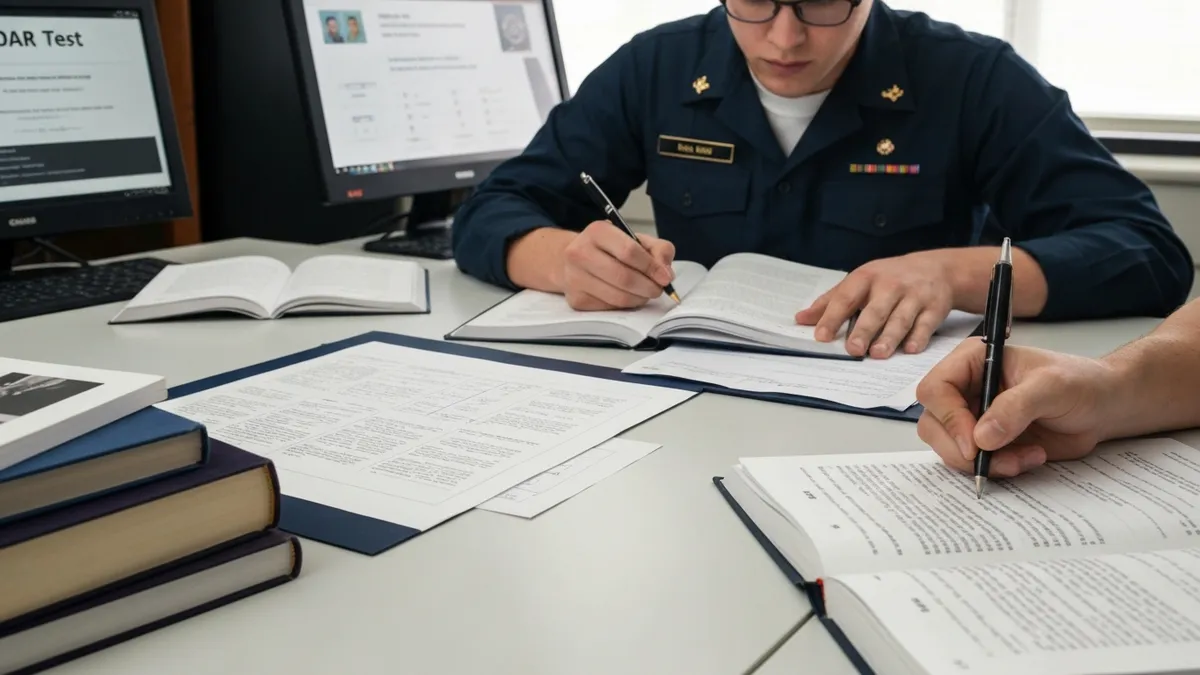
OAR Test Preparation Checklist
- ✓Study all three OAR sections: Math Skills, Reading Comprehension, and Mechanical Comprehension
- ✓Review algebra fundamentals: solving equations, word problems, percentages, ratios, and basic geometry
- ✓Practice reading comprehension with technical and scientific passages — answer only from what the passage states
- ✓Learn mechanical principles: gears (speed/torque relationships), pulleys, levers, pressure, Ohm's Law basics
- ✓Take computer-adaptive practice tests — early correct answers matter more in the CAT format
- ✓Because the best score (not most recent) is used, your first attempt score will stand — prepare thoroughly before testing
- ✓Study the ASTB-E official study guide published by the Navy — it outlines all tested content areas
- ✓Aim for consistent 60+ on practice tests before scheduling the actual ASTB-E
OAR Pros and Cons
- +OAR has a defined, publicly available content blueprint — candidates know exactly what to prepare for
- +Multiple preparation pathways (self-study, courses, coaching) accommodate different learning styles and schedules
- +A growing ecosystem of study resources means candidates at any budget level can access quality preparation materials
- +Clear score reporting allows candidates to identify specific strengths and weaknesses for targeted remediation
- +Professional recognition associated with strong performance provides tangible career and academic benefits
- −The scope of tested content requires substantial preparation time that competes with existing professional or academic commitments
- −No single resource covers the full content scope — candidates typically need multiple study tools for comprehensive preparation
- −Test anxiety and exam-day performance variability mean preparation effort does not always translate linearly to scores
- −Registration, preparation, and potential retake costs accumulate into a significant financial investment
- −Content and format can change between exam versions, making older preparation materials less reliable
Pros and Cons at a Glance
| Pros | Cons |
|---|---|
| OAR has a defined, publicly available content blueprint — candidates know exactly what to prepare for | The scope of tested content requires substantial preparation time that competes with existing professional or academic commitments |
| Multiple preparation pathways (self-study, courses, coaching) accommodate different learning styles and schedules | No single resource covers the full content scope — candidates typically need multiple study tools for comprehensive preparation |
| A growing ecosystem of study resources means candidates at any budget level can access quality preparation materials | Test anxiety and exam-day performance variability mean preparation effort does not always translate linearly to scores |
| Clear score reporting allows candidates to identify specific strengths and weaknesses for targeted remediation | Registration, preparation, and potential retake costs accumulate into a significant financial investment |
| Professional recognition associated with strong performance provides tangible career and academic benefits | Content and format can change between exam versions, making older preparation materials less reliable |
OAR Test Questions and Answers
More Military Officer Test Resources



About the Author

Educational Psychologist & Academic Test Preparation Expert
Columbia University Teachers CollegeDr. Lisa Patel holds a Doctorate in Education from Columbia University Teachers College and has spent 17 years researching standardized test design and academic assessment. She has developed preparation programs for SAT, ACT, GRE, LSAT, UCAT, and numerous professional licensing exams, helping students of all backgrounds achieve their target scores.
Join the Discussion
Connect with other students preparing for this exam. Share tips, ask questions, and get advice from people who have been there.
View discussion (8 replies)