
National Telemetry Association: CRAT Certification Complete Guide 2026
National Telemetry Association issues the CRAT credential. 🎓 Learn eligibility, the 100-question exam, passing standard, salary, renewal, and CCT vs RDCS.
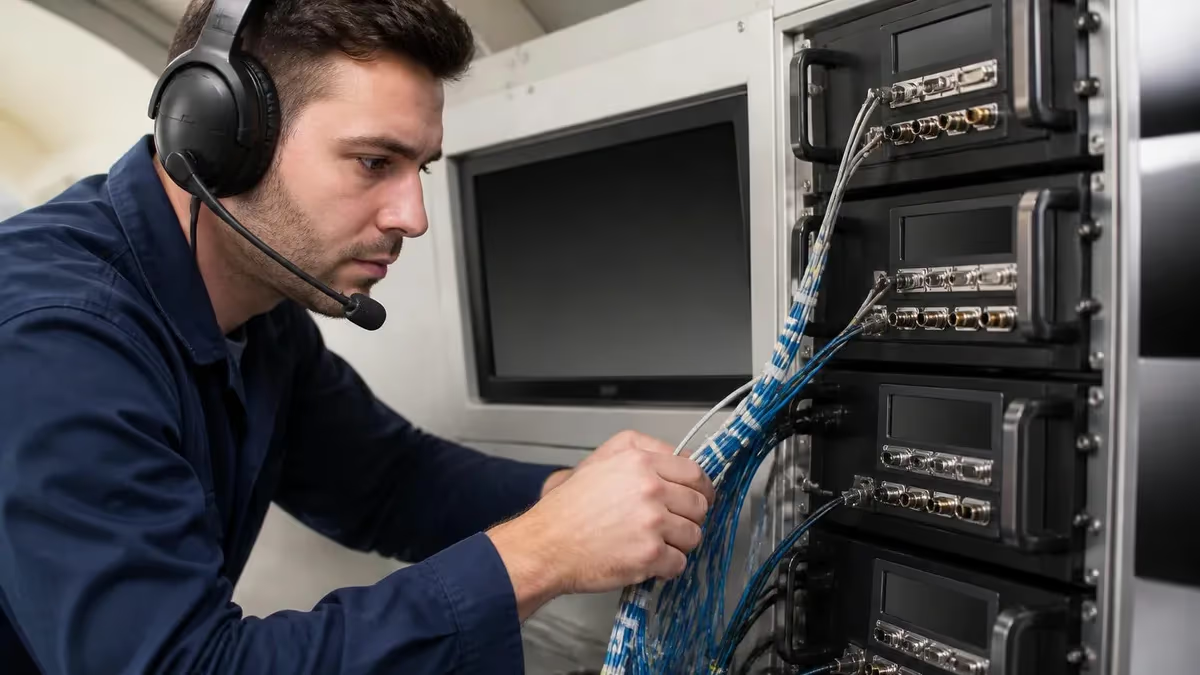
The National Telemetry Association (NTA) is the nonprofit body that develops and administers the Certified Rhythm Analysis Technician (CRAT) credential in the United States. Practice with the free NTA - National Telemetry Association practice test on PracticeTestGeeks (7 questions with answer explanations).
If you have ever sat at a central monitoring station inside a hospital telemetry unit, watching banks of waveforms tick across a screen and waiting for the one that does not belong, the work you were doing is exactly what the CRAT credential is built around.
The NTA exists because that work — reading cardiac rhythms on a live monitor and getting the call right before a nurse arrives — needs a verifiable standard. Hospitals want to know that the person staring at the screen can tell a benign sinus arrhythmia from a run of ventricular tachycardia. They want it confirmed by a third party rather than a self-attested skill list. The NTA fills that gap with a single national exam.
This guide walks through the agency in plain language. You will see what the NTA does, how the CRAT certification works, who qualifies to sit for the test, what the 100-question computer-based exam actually covers, how to keep the credential active across the four-year cycle, and how a CRAT compares with adjacent credentials like the CCT, the CMT, and the RDCS.
You will also find a realistic salary range, the clinical settings where CRATs work most often, and a practical view of the career pathway after you pass. By the end you will know whether the CRAT is the right credential for the role you are aiming at, and what your study plan should look like before exam day.
Free NTA - National Telemetry Association Study Tools
Interactive NTA - National Telemetry Association resources on PracticeTestGeeks, free to start:
- NTA - National Telemetry Association flashcards — review key terms and concepts card by card
- NTA - National Telemetry Association study guide — topic-by-topic overview of what the exam covers
- NTA - National Telemetry Association cheat sheet — one-page printable summary for last-minute review

NTA CRAT at a Glance
- The NTA National Telemetry certification exam has a time limit of 180 minutes. (National Telemetry Association (NTA), Dearborn, Michigan)
- Candidates must score 80% or higher to pass the NTA National Telemetry certification exam. (National Telemetry Association (NTA), Dearborn, Michigan)
- The NTA Full Course costs $529 and includes two attempts at the National Telemetry Exam and two attempts at the National EKG Exam. (National Telemetry Association (NTA), Dearborn, Michigan)
- The NTA National Telemetry Certification exam-only package costs $159 and includes one attempt at the National Telemetry Exam. (National Telemetry Association (NTA), Dearborn, Michigan)
- NTA telemetry certifications are valid for two years from the date the candidate passes the exam. (National Telemetry Association (NTA), Dearborn, Michigan)
- NTA courses and the National Telemetry Exam are taken 100% online at the candidate's own pace, with no fixed exam schedule. (National Telemetry Association (NTA), Dearborn, Michigan)
- The NTA Full Course requires no prior experience, while the NTA's other telemetry certification packages recommend prior healthcare work experience. (National Telemetry Association (NTA), Dearborn, Michigan)
Facts verified Oct 17, 2026 against National Telemetry Association (NTA), Dearborn, Michigan. Dates that have passed are removed automatically.
NTA Exam at a Glance
| Item | Detail | Official source |
|---|---|---|
| Time limit | 180 minutes (3 hours) | National Telemetry Association (NTA), Dearborn, Michigan |
| Passing score | 80% or higher | National Telemetry Association (NTA), Dearborn, Michigan |
| Exam fee (Full Course (National Telemetry + National EKG Certification)) | $529 (course + 2 Telemetry and 2 EKG exam attempts) | National Telemetry Association (NTA), Dearborn, Michigan |
| Exam fee (National Telemetry Certification Exam Only) | $159 (1 exam attempt) | National Telemetry Association (NTA), Dearborn, Michigan |
| Exam fee (National Telemetry Certification + Telemetry Course) | $249 (course + 2 exam attempts) | National Telemetry Association (NTA), Dearborn, Michigan |
| Validity | 2 years from the date you pass | National Telemetry Association (NTA), Dearborn, Michigan |
| Delivery | 100% online, self-paced | National Telemetry Association (NTA), Dearborn, Michigan |
| Eligibility | No experience required for the Full Course; prior healthcare experience recommended for other packages | National Telemetry Association (NTA), Dearborn, Michigan |
| Testing window | First attempt within 6 months of course enrollment | National Telemetry Association (NTA), Dearborn, Michigan |
Facts verified Oct 17, 2026 against National Telemetry Association (NTA), Dearborn, Michigan. Dates that have passed are removed automatically.
The National Telemetry Association is an independent certifying body, not a government agency. Its mission is narrow on purpose: certify that a candidate can interpret cardiac rhythms accurately under the conditions a real monitor tech faces every shift.
The NTA does not run a school. It does not own a hospital. It writes the exam, sets the passing standard, holds the question bank, and issues the certificate when a candidate clears the bar.
That focus matters. Many adjacent organizations bundle telemetry knowledge into broader cardiovascular technologist credentials, which sounds like a plus until you realize it forces candidates to study echocardiography, stress testing, or invasive cardiology content that has nothing to do with the daily job of a monitor tech.
The CRAT exam stays in its lane. It tests rhythm interpretation, lead placement, and the foundational anatomy and physiology a tech needs to make sense of what they are seeing on screen.
The NTA also keeps the credential affordable compared with the broader cardiovascular certifications. Total cost of entry — application, exam fee, the optional study materials some candidates buy — usually comes in under what a single semester of community college tuition runs.
For employers in step-down and progressive care units, that combination of focused scope plus reasonable price is exactly what they want when they hire monitor techs in volume.
NTA = National Telemetry Association. The nonprofit that develops and administers the CRAT (Certified Rhythm Analysis Technician) credential in the United States. The CRAT confirms the holder can interpret cardiac rhythms accurately at a hospital telemetry monitoring station.
CRAT stands for Certified Rhythm Analysis Technician. The credential confirms that the holder can analyze a live or recorded cardiac rhythm strip, identify the underlying rhythm, recognize ectopy and dangerous arrhythmias, and communicate findings accurately to the clinical team.
The job title that most often pairs with the CRAT is monitor technician or telemetry technician, sometimes shortened to tele tech on the unit. In some hospitals you will also see CRAT holders working as cardiac monitor technicians, ECG technicians, or EKG monitor technicians, depending on local naming. The credential is portable across all those titles.
A CRAT does not place the leads on the patient in every hospital — that task is sometimes done by a CNA, a tele tech with extra training, or the bedside nurse — but the credential covers lead placement knowledge in case the role requires it. The test assumes you know which electrode goes where, why limb-lead reversal changes the rhythm picture, and how to troubleshoot a noisy or flatline trace before calling the patient's nurse.
Holding the CRAT also tells a hospital that you understand the boundary of the role. A monitor tech does not diagnose. The CRAT exam teaches you to describe a rhythm accurately and escalate to the right clinician fast, not to interpret a 12-lead in the way a cardiologist would.
How the NTA CRAT Pathway Is Built
High school diploma or GED plus one of three pathways: completion of a recognized telemetry or dysrhythmia course, documented clinical experience monitoring cardiac rhythms, or a training verification letter from a licensed clinician. No prior nursing license or degree required.
100 multiple-choice questions delivered through a national testing center network with two hours allowed. Items are criterion-referenced, no penalty for guessing, and score reports including a domain breakdown are returned the moment the exam ends.
Four domains: basic cardiac anatomy and physiology, rhythm interpretation across atrial, junctional, ventricular, and AV-block families, lead placement and artifact recognition, and a smaller bucket on documentation, communication, and scope of practice.
Certification is good for four years from pass date. Renewal uses 24 contact hours of continuing education across the cycle, with at least some hours focused on cardiac rhythm content. Lapsed certificates usually require a full retake rather than reinstatement.

The NTA keeps eligibility simple, which is one of the main reasons the CRAT has grown into a popular entry-level credential in hospital telemetry units.
A candidate must hold a high school diploma or equivalent (GED). That single floor opens the door to anyone who is willing to put in the study time. There is no requirement to hold an associate degree, a nursing license, or a prior healthcare certification before sitting for the exam.
Beyond the diploma, the candidate must meet at least one of three additional pathways. The first is completion of a recognized telemetry or basic dysrhythmia course, often offered by hospitals, community colleges, or online providers that the NTA has approved.
The second is documented clinical experience in cardiac rhythm monitoring, typically a year or more working as a monitor tech, ECG tech, or telemetry observer under supervision. The third is a letter of recommendation or training verification from a licensed clinician — a registered nurse, physician, or other approved healthcare professional — confirming that the candidate has the skills to take the exam.
The flexibility of those three pathways is deliberate. A nursing assistant who has spent two years watching monitors on a step-down unit can sit for the test using their work experience. A new graduate of a telemetry course at a community college can use their certificate of completion. Anyone moving from a related role, like an ECG technician or a paramedic in training, can usually find a route that fits.
Exam Content Domains Side by Side
Chambers, valves, great vessels, and the conduction pathway from sinoatrial node through atrioventricular node, bundle of His, bundle branches, and Purkinje fibers. The link between the electrical signal on the monitor and the mechanical contraction that follows it. Why a widened QRS suggests ventricular origin, why an absent P wave matters, and how the autonomic nervous system can shift heart rate up or down without changing the underlying rhythm.
The CRAT examination is a single computer-based test delivered through a national network of testing centers. Most candidates sit it at a Pearson VUE, PSI, or Castle Worldwide center near their home, though the NTA also offers an online proctored option for candidates in areas without a convenient testing center.
The exam consists of 100 multiple-choice questions, and candidates have two hours to complete it. That works out to about 72 seconds per question, which is comfortable for the question style: most items present a short clinical stem, sometimes with an attached rhythm strip image, followed by four answer choices.
There is no penalty for guessing. Every blank answer is graded as wrong, so candidates who run short on time should bubble in a best guess on every remaining question before the clock hits zero.
Each question is scored either correct or incorrect. The exam is criterion-referenced, meaning the passing standard is a fixed number of correct answers rather than a percentile against other test-takers. The NTA does not publish the exact raw cut score because the question bank is regularly refreshed, but candidates who score around 75 percent on practice tests are usually well positioned to pass.
Score reports are delivered immediately after the test ends. A pass shows up as a clear PASS notice on the screen along with a content-area breakdown. A fail shows the same domain breakdown so the candidate can see which sections to focus on before a retake.
The CRAT is criterion-referenced. The passing standard is a fixed number of correct answers, not a percentile against other test-takers. The NTA does not publish the exact raw cut score because the question bank is refreshed regularly, but candidates scoring around 75 percent on full-length practice tests are usually well positioned to pass on the first attempt.
The exam blueprint is published on the NTA website and is the single most useful document a candidate can print and tape to the wall during prep. It tells you exactly what proportion of the 100 questions will come from each content area, so you can match your study hours to the weight of each section.
The first domain is basic cardiac anatomy and physiology. Expect questions on the chambers of the heart, the conduction system from sinoatrial node through Purkinje fibers, blood flow through the great vessels, and the link between the electrical signal and the mechanical contraction it produces. You do not need cardiologist-level depth, but you do need to know why a wide QRS suggests ventricular origin and why a P wave that disappears is a problem.
The second and largest domain is rhythm interpretation. This is where most of the exam lives. You will see strips and be asked to identify sinus rhythms with and without ectopy, atrial rhythms including atrial fibrillation, flutter, multifocal atrial tachycardia, and supraventricular tachycardia, junctional rhythms, ventricular rhythms including PVCs, ventricular tachycardia, ventricular fibrillation, asystole, and idioventricular rhythms, plus the family of atrioventricular blocks from first-degree through complete heart block.
The third domain covers lead placement and waveform basics. You will be tested on the standard 5-lead and 12-lead electrode positions, common artifact patterns, and how to recognize and correct lead reversal or signal interference before the noise gets misread as a real arrhythmia.
The fourth domain is a smaller bucket of professional practice items: documentation standards, communication with the nursing team, basic infection prevention around telemetry equipment, and the limits of the monitor-tech scope of practice.
Most candidates pass the CRAT exam on their first attempt when they put in roughly 80 to 120 hours of focused study spread over six to ten weeks. That figure assumes a candidate is starting with limited prior exposure to rhythm interpretation. People who already work as monitor techs and just need to formalize their skills often need less.
The two highest-use activities during prep are reading rhythm strips and doing practice questions. Reading strips on their own teaches pattern recognition, and there is no shortcut for it. Many candidates print or save a couple of hundred strips and work through them in batches, naming each rhythm in under fifteen seconds before checking the answer.
Practice questions then translate that pattern recognition into the multiple-choice format the actual exam uses. They also expose gaps in foundational knowledge — a question that asks why first-degree AV block is generally benign is testing the conduction system, not strip-reading.
Be careful about study materials that promise the exam in two weekends. The CRAT is not difficult by the standards of medical certification, but it does require comfort with the full sweep of dysrhythmias and the underlying physiology. Cramming usually shows up as confusion between rhythms that look superficially similar, like multifocal atrial tachycardia versus atrial fibrillation, or accelerated idioventricular rhythm versus slow ventricular tachycardia. Time spent on those edge cases pays off heavily on test day.

Eight-Week CRAT Study Checklist
- ✓Print the NTA exam blueprint and tape it to the wall — match your weekly study hours to the weight of each content domain
- ✓Memorize the conduction pathway from SA node to Purkinje fibers and sketch the heart with conduction labels from memory once a week
- ✓Identify normal sinus rhythm, sinus bradycardia, sinus tachycardia, and sinus arrhythmia on sight in under fifteen seconds per strip
- ✓Drill the atrial rhythm family including atrial fibrillation, atrial flutter, SVT, MAT, and PACs until you can name each without hesitation
- ✓Drill the ventricular rhythm family — PVCs, VT, VF, asystole, idioventricular — and practice distinguishing slow VT from accelerated idioventricular rhythm
- ✓Learn the AV block ladder from first-degree to Mobitz I, Mobitz II, and complete heart block, paying special attention to PR interval and dropped beat patterns
- ✓Review the standard 5-lead and 12-lead electrode placement and the typical signal artifacts you will see when an electrode is loose or reversed
- ✓Take at least two full-length 100-question timed practice tests in exam-like conditions, ideally at the same time of day as your real exam slot
- ✓Review every missed practice question in detail rather than just rerunning the test — understanding why the wrong answer was wrong is what raises scores
- ✓Schedule a rest day before the exam, confirm your testing center address and ID requirements, and pack water, snacks, and a sweater for the test room
Certification is good for four years from the date you pass the exam. The NTA does not require an automatic retest at the end of the cycle. Instead, certificants renew through continuing education units (CEUs) documented across the four-year period.
The current renewal rule is 24 contact hours of continuing education across the four years, with at least some of those hours focused on cardiac rhythm interpretation or related cardiovascular topics. CEUs can come from in-service trainings, conference sessions, accredited online courses, or refresher modules offered through the NTA itself.
Renewal is straightforward when you keep a running log. Many CRATs print a one-page CEU tracker and drop the certificate of completion from every training onto the same folder. When the four-year mark approaches, the renewal application is largely a matter of attaching that folder, paying the renewal fee, and confirming there have been no relevant professional misconduct findings during the cycle.
Letting the certificate lapse is recoverable but inconvenient. The NTA usually requires lapsed CRATs to sit the full exam again rather than going through a shortened reinstatement track, so the recommendation is to schedule a calendar reminder twelve months and three months before expiration to gather CEUs and submit the renewal on time.
CRAT as an Entry-Level Cardiac Credential
- +Eligibility floor is forgiving — high school diploma plus a single completed telemetry course or documented monitor experience opens the door to the exam
- +Exam scope stays tightly focused on rhythm interpretation, lead placement, and the supporting anatomy, so study time is not wasted on out-of-scope cardiology
- +Total cost of entry — application, exam, and study materials — usually comes in under one community college semester, making the credential broadly accessible
- +Recognized by hospitals nationwide as a hiring signal for monitor tech, telemetry tech, and ECG tech roles in step-down, ICU, and emergency department settings
- +Four-year renewal through 24 CEUs is straightforward to plan around and keeps current monitor techs in the habit of refreshing rhythm interpretation skills
- −Salary range tops out below the broader cardiovascular technologist credentials like the CCT, RCS, or RDCS, so career growth often means stacking additional certifications
- −Some smaller hospitals accept a basic dysrhythmia course or internal competency check instead of a national credential, which softens the hiring bonus the CRAT offers
- −The credential does not certify lead placement skills in every setting — some employers still require a separate ECG technician competency on top of the CRAT
- −Lapsed certificates usually require a full retake rather than a shorter reinstatement track, so renewal deadlines need careful calendar tracking across the four-year cycle
- −Public name recognition is lower than nursing or sonography credentials, which can make explaining the role to family, friends, or recruiters outside the cardiac unit harder
CRAT-credentialed monitor techs work primarily in three settings inside a hospital. The most common is the telemetry unit or step-down floor, where patients who do not need full intensive care but do need continuous cardiac monitoring are admitted.
A telemetry unit usually has a central monitoring station with screens showing six to twelve patients at a time. The monitor tech sits at that station, watches for rhythm changes, and pages the bedside nurse the moment something concerning shows up. Hospitals also pool monitor techs across units, with one central technician watching patients spread across multiple floors over a secured wireless network.
The second common setting is the intensive care unit (ICU). Larger ICUs sometimes employ dedicated monitor techs who watch a central station, freeing the ICU nurses to focus on bedside care. Smaller ICUs are more likely to have the nurses watch their own patients' monitors directly, but the option is there.
The third setting is the emergency department (ED). EDs that run high cardiac volume often have a monitor tech assigned to chest pain rooms or to the cardiac observation area, where rapid identification of arrhythmias drives treatment decisions in real time.
Outside the hospital, you will also see CRATs in cardiac diagnostic centers, Holter monitor analysis labs reviewing 24- and 48-hour ambulatory recordings, and in remote telemetry monitoring companies that contract with smaller hospitals to provide overnight monitoring coverage from a central operations center.
Pay for CRAT-credentialed monitor techs varies by region, by setting, and by years of experience, but the recent national range is roughly $36,000 to $58,000 a year for a full-time position, with the median sitting near the middle of that range.
Urban academic medical centers, union hospitals, and night and weekend differentials all push the upper end of the range. Rural community hospitals and outpatient cardiac diagnostic centers usually sit closer to the lower end. Travel monitor tech contracts, which run thirteen weeks at a time and require frequent relocation, occasionally pay well above the top of the range, especially during nursing shortages when hospitals are competing hard for staff.
The credential by itself does not include a clinical promotion path inside a single role, but it does open the door to several adjacent careers that build on the same foundation. Many CRATs eventually move into the CCT (Certified Cardiographic Technician) credential, which adds Holter monitoring and stress testing to the rhythm-reading skill set.
Others pursue the CMT (Certified Medical Transcriptionist) or one of the cardiovascular sonographer credentials like the RDCS (Registered Diagnostic Cardiac Sonographer), both of which generally require additional formal training but build on the cardiac anatomy knowledge a CRAT already has.
Some CRATs use the credential as a stepping stone into nursing school. They keep the monitor-tech job while completing prerequisites, then transition into an RN role on the same telemetry floor once they finish the program. The pattern is common enough that many hospitals actively recruit CRATs into their tuition-assistance pipelines.
Picking the right credential depends on what you actually want to do on the floor. The CRAT is the cleanest match for a candidate whose goal is rhythm monitoring inside a hospital telemetry unit, ICU, or ED. It is the cheapest and fastest path to a recognized credential, the eligibility rules are forgiving, and the exam stays tightly focused on the daily work.
The CCT from Cardiovascular Credentialing International covers the same rhythm content the CRAT does and adds Holter monitor analysis, stress testing protocols, and pharmacologic stress reactions. Candidates who already work in a cardiac diagnostic clinic that handles those procedures often choose the CCT instead of the CRAT, because it lines up better with their actual scope of practice.
The RDCS from the American Registry for Diagnostic Medical Sonography is a different animal. It tests cardiac ultrasound skills — echocardiography — which requires a formal sonography program and clinical hours behind a probe. It is not a substitute for a monitor-tech credential and usually pays significantly more, but it is also a much bigger time and money investment.
The CMT credentials are more often associated with medical transcription rather than cardiac monitoring. They share little overlap with CRAT content and only matter to candidates whose career goal sits closer to medical records than to bedside cardiology.
For most candidates eyeing an entry-level cardiac monitor role, the CRAT is the right starting point. It signals competence to employers, sticks to a manageable exam blueprint, and stacks cleanly with later credentials if a candidate decides to expand into Holter monitoring, stress testing, or sonography down the line.
A practical study plan for the CRAT exam looks something like this for a candidate with limited prior monitor-tech experience.
Spend the first two weeks on cardiac anatomy and the conduction system, drawing the heart from memory at least once and labeling the chambers, valves, great vessels, and pacemaker hierarchy. Move into normal sinus rhythm and its variants — sinus bradycardia, sinus tachycardia, sinus arrhythmia — and make sure you can identify each at a glance.
Spend weeks three and four on atrial rhythms, including premature atrial contractions, atrial fibrillation, atrial flutter, supraventricular tachycardia, and multifocal atrial tachycardia. Add junctional rhythms, including junctional escape and accelerated junctional rhythms, before moving on.
Weeks five and six cover ventricular rhythms — PVCs in their various flavors, idioventricular rhythm, ventricular tachycardia, ventricular fibrillation, asystole — and the family of AV blocks from first-degree through complete heart block. Weeks seven and eight tighten everything up with mixed practice tests, lead placement review, and review of any domain where practice scores are weak.
Build in at least two simulated full-length 100-question practice tests under timed conditions before exam day, ideally taken in the morning if your real exam is scheduled in the morning. The aim is not just content review but also pacing — most candidates who fail on time were not slow at any single question, they were slow by ten or fifteen seconds across many questions and ran out of clock in the final stretch.
Finally, remember that exam day works best when sleep, hydration, and a familiar breakfast are protected. There is no advantage to cramming the night before. Reading a single difficult rhythm under fatigue and second-guessing yourself into the wrong answer is a real risk that good rest eliminates.
Sample NTA - National Telemetry Association Practice Questions
Try these questions from our free NTA - National Telemetry Association practice tests. The correct answer and an explanation follow each question.
The refractory period of the cardiac cycle is important in telemetry because stimulation during this phase can:
- A. Cause sinus bradycardia
- B. Trigger a life-threatening arrhythmia (R-on-T phenomenon)
- C. Lengthen the PR interval
- D. Slow AV nodal conduction
Answer: B. Trigger a life-threatening arrhythmia (R-on-T phenomenon)
A stimulus falling on the vulnerable T wave (R-on-T) can precipitate ventricular tachycardia or fibrillation.
What is the typical transmission range of most hospital telemetry systems?
- A. Only within the same room (under 20 feet)
- B. Approximately 300–1000 feet depending on the system
- C. Unlimited range throughout the facility
- D. No more than 10 feet
Answer: B. Approximately 300–1000 feet depending on the system
Most hospital telemetry systems are designed with a 300–1000 foot range, sufficient to cover a typical inpatient nursing unit.
What is the primary function of a telemetry transmitter?
- A. Records ECG data to paper
- B. Wirelessly transmits cardiac signals to a central monitor
- C. Provides electrical stimulation to the heart
- D. Measures blood pressure
Answer: B. Wirelessly transmits cardiac signals to a central monitor
A telemetry transmitter wirelessly sends the patient's cardiac electrical signals to a central monitoring station for continuous surveillance.
What does a slowly wandering baseline on a telemetry strip most commonly indicate?
- A. Ventricular fibrillation
- B. Poor electrode contact or patient respiratory movement
- C. Atrial flutter
- D. Normal sinus rhythm variation
Answer: B. Poor electrode contact or patient respiratory movement
A wandering baseline is caused by poor electrode adhesion, patient movement, or respiratory motion shifting the baseline up and down slowly.
Take the full NTA - National Telemetry Association practice test
NTA Questions and Answers
How this page was made: written with AI tools and published by Nathan Beja, founder of Practice Test Geeks, who is responsible for its content. Exam facts are checked against the official sources listed below. Not reviewed by a subject-matter expert. Editorial policy
Sources & references
Exam facts on this page (fees, format, dates, passing scores) are checked against these official sources; the date is our last check. Editorial policy
- nationaltelemetryassociation.org — Test delivery, eligibility, retake policy, test dates, score validity, passing score, time limit · verified Oct 2026