
MR SOPA in NRP: The Complete Guide to Ventilation Corrective Steps
Master MR SOPA in NRP with this complete training guide. Learn each corrective step, when to apply them, and how to ace your NRP exam. ✏️
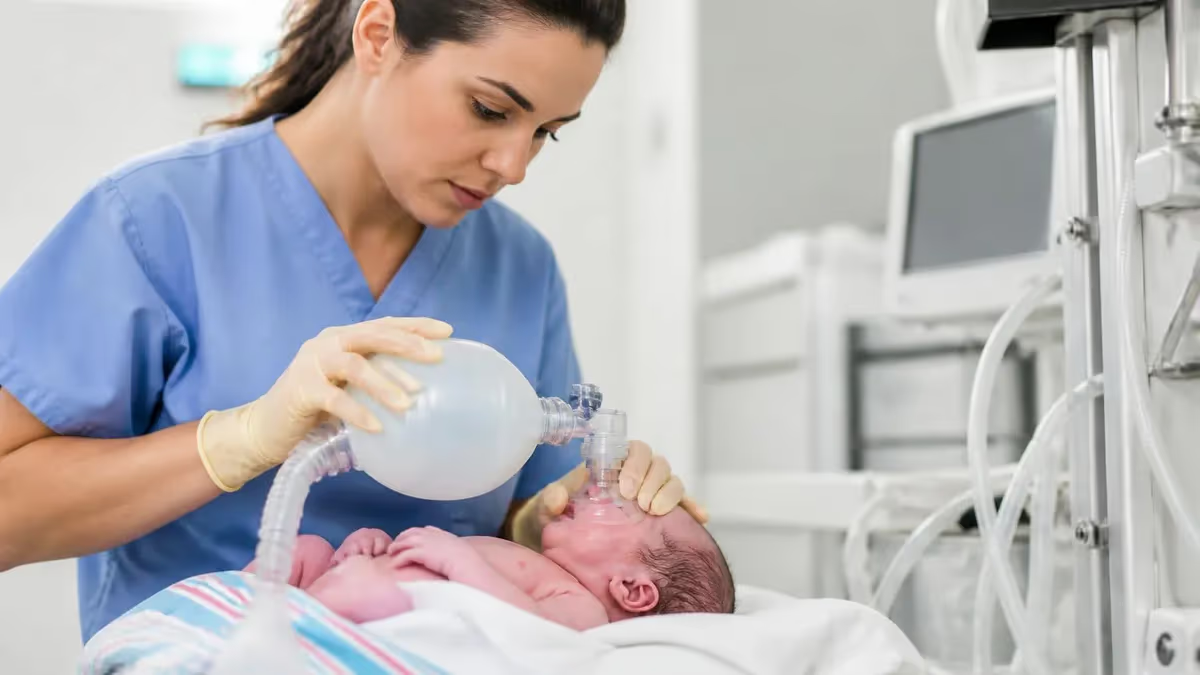
MR SOPA is one of the most critical mnemonics in the Neonatal Resuscitation Program, and every provider who works in a delivery room setting needs to understand exactly how and when to apply it. The acronym stands for Mask adjustment, Reposition the airway, Suction the mouth and nose, Open the mouth, Pressure increase, and Alternative airway — six sequential corrective steps used when positive pressure ventilation is not achieving effective chest rise in a newborn. Mastering nrp mr sopa is essential not only for passing your certification exam but for delivering safe, effective resuscitation at the bedside.
When a newly born infant does not breathe spontaneously or has a heart rate below 100 beats per minute, positive pressure ventilation (PPV) is initiated. The goal of PPV is to achieve adequate chest rise and improved heart rate. However, a common clinical challenge is that PPV may not be working as intended, and the provider must recognize this quickly and systematically correct the problem. MR SOPA provides that systematic framework, guiding the team through each potential cause of ineffective ventilation before escalating to more invasive interventions.
The sequence of MR SOPA is intentionally ordered from the least invasive to the most invasive corrective step. Mask adjustment comes first because a poorly sealed mask is the single most common reason PPV fails to deliver adequate pressure to the lungs.
A simple repositioning of the mask on the face — ensuring the rim sits over the bridge of the nose and the chin, forming an airtight seal — often resolves the problem immediately. Providers are taught to use the E-C grip technique, where the thumb and index finger form a C around the mask while the remaining fingers lift the jaw forward into the mask.
Repositioning the airway addresses the second most common cause of ineffective PPV: a neck that is either hyperflexed or hyperextended. In a supine newborn, the relatively large occiput can cause the neck to flex forward, closing the airway. Placing a small towel roll beneath the shoulders helps bring the head into a neutral sniffing position, which aligns the pharyngeal, laryngeal, and tracheal axes for optimal airflow. This step is frequently underestimated but can dramatically improve ventilation effectiveness without any additional equipment.
Suctioning the mouth and nose follows repositioning, targeting secretions that may be obstructing the airway. Amniotic fluid, blood, or meconium can accumulate in the oropharynx and prevent air from reaching the lungs even when mask seal and positioning are correct. A bulb syringe or mechanical suction at a pressure no greater than 100 mmHg is used to clear the airway, always suctioning the mouth before the nose to prevent aspiration of nasal contents if the infant gasps. This step should be brief and efficient — prolonged suctioning can cause vagal bradycardia.
Opening the mouth is the fourth step and is used when the infant's lips and tongue are pressed together, creating a functional obstruction. By gently depressing the lower jaw with a finger while maintaining the mask seal, the provider allows air to enter without resistance from closed lips. This step is often combined with the mouth-open technique for mask ventilation, where a small amount of pressure on the chin keeps the mouth slightly ajar during positive pressure breaths. It is a subtle but important step that many providers overlook during high-stress resuscitations.
Pressure increase and Alternative airway complete the mnemonic by escalating the intervention level. If all five preceding steps have been applied and chest rise is still absent, increasing the peak inspiratory pressure — in increments of 5 to 10 cm H₂O — may be required to inflate stiff or fluid-filled lungs.
If even increased pressure fails, the provider must move to an alternative airway such as an endotracheal tube or laryngeal mask, which bypasses upper airway obstruction entirely and ensures direct lung inflation. Understanding this logical progression is what makes MR SOPA such a powerful and memorable framework for neonatal resuscitation teams.
NRP MR SOPA by the Numbers
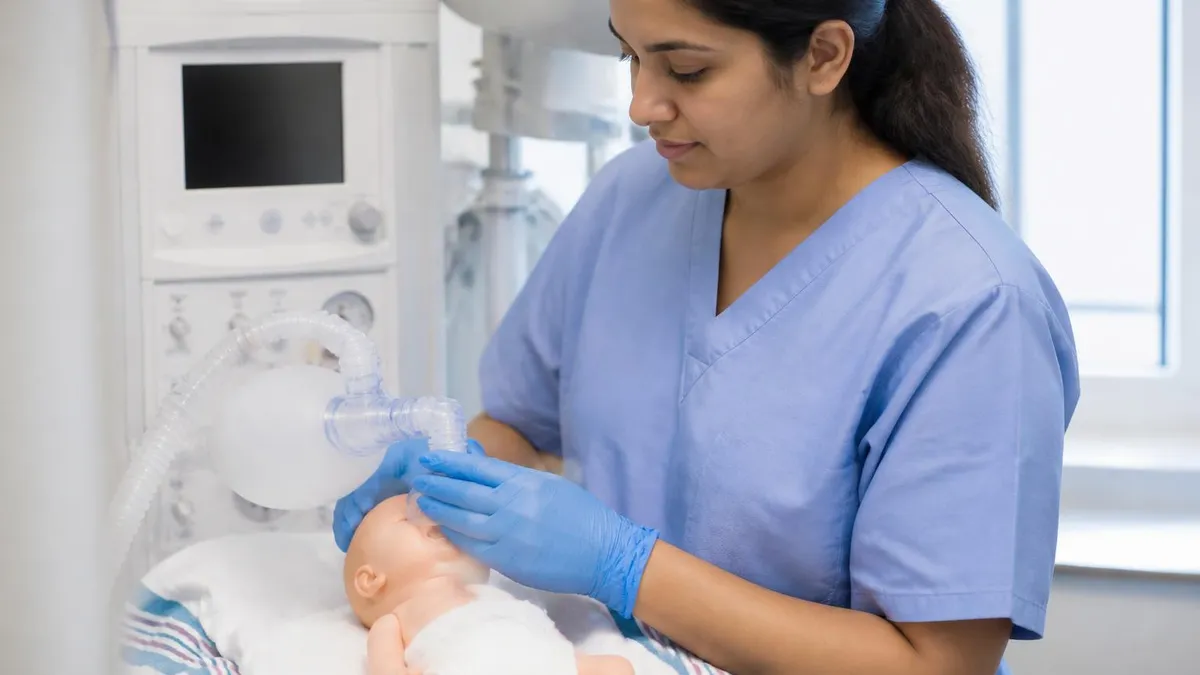
MR SOPA Step-by-Step: The Six Corrective Actions
M — Mask Adjustment
R — Reposition the Airway
S — Suction Mouth and Nose
O — Open the Mouth
P — Pressure Increase
A — Alternative Airway
Understanding when to initiate MR SOPA is just as important as knowing the individual steps. According to current NRP guidelines from the American Academy of Pediatrics, providers should evaluate chest rise within the first few breaths of PPV. If the chest is not rising, the resuscitation team should not continue ineffective ventilation — instead, they should pause and work through the MR SOPA sequence methodically. Ineffective PPV is not only useless but can lead to dangerous delays in oxygenation and increasing the risk of hypoxic injury to the newborn brain.
The typical trigger point for beginning MR SOPA evaluation is approximately 30 seconds of PPV without visible chest rise or improvement in heart rate. In practice, many experienced providers begin assessing mask fit and airway position within the very first two to three breaths. Speed matters enormously in neonatal resuscitation — a newborn's heart rate can drop precipitously if effective ventilation is delayed, and chest compressions become necessary once the heart rate falls below 60 beats per minute. Every second spent on ineffective PPV is a second that oxygenation is not being delivered.
The role of the second provider during MR SOPA cannot be overstated. While one team member delivers PPV and works through the corrective steps, a second provider should be monitoring the cardiac monitor, calling out the heart rate, and assessing for bilateral chest rise. Communication is formalized in NRP training: the provider delivering ventilation says each corrective step aloud as it is applied, and the team confirms whether chest rise has improved. This closed-loop communication structure reduces errors and ensures that steps are not skipped under pressure.
A key teaching point in NRP courses is that MR SOPA must be applied sequentially — not all at once. A common mistake made by less experienced providers is to immediately reach for suction or increase pressure without first checking mask fit. This is problematic for two reasons: first, it wastes time on steps that may not be necessary; second, skipping earlier steps means the actual cause of the problem may never be identified. The sequential nature of MR SOPA is designed to isolate variables so that the team can pinpoint the precise reason for ventilation failure.
It is also important to understand the relationship between MR SOPA and the PEEP valve in devices like the T-piece resuscitator. The T-piece resuscitator delivers a consistent peak inspiratory pressure and positive end-expiratory pressure (PEEP), which helps keep alveoli open between breaths. However, even with a T-piece, a poor mask seal will allow gas to escape, negating both PIP and PEEP. This is why mask adjustment remains the first MR SOPA step regardless of the device being used — the physics of gas delivery demand an airtight seal before any pressure setting can be effective.
Flow-inflating bags and self-inflating bags each have their own characteristics that affect how MR SOPA is applied. Self-inflating bags will fill on their own but cannot deliver PEEP without a PEEP valve accessory. Flow-inflating bags require a gas source and a good mask seal to inflate at all — making mask adjustment even more critical when this device is used. Providers must be comfortable with multiple types of ventilation equipment, because the device available at a given delivery may depend on hospital resources, and MR SOPA must be applied correctly regardless of the tool in hand.
Documentation of MR SOPA steps during an actual resuscitation event is an important but often overlooked practice. Resuscitation records should capture which corrective steps were needed, how the infant responded, and at what point ventilation became effective. This information is valuable not only for the medical record but for team debriefing and quality improvement. When an infant consistently requires specific corrective steps — for example, always needing suction due to meconium — that pattern should inform preparation at subsequent high-risk deliveries where similar challenges can be anticipated and addressed proactively.
NRP Practice Test Questions
Prepare for the NRP - Neonatal Resuscitation Program exam with our free practice test modules. Each quiz covers key topics to help you pass on your first try.
NRP Ethical Considerations
NRP Exam Questions covering Ethical Considerations. Master NRP Test concepts for certification prep.
NRP Medication Administration
Free NRP Practice Test featuring Medication Administration. Improve your NRP Exam score with mock test prep.
NRP Airway Management and Intubation
NRP Mock Exam on Airway Management and Intubation. NRP Study Guide questions to pass on your first try.
NRP Chest Compressions and Cardiac Resusci...
NRP Test Prep for Chest Compressions and Cardiac Resuscitation. Practice NRP Quiz questions and boost your score.
NRP Documentation and Family Communication
NRP Questions and Answers on Documentation and Family Communication. Free NRP practice for exam readiness.
NRP Ethical Considerations in Neonatal Res...
NRP Mock Test covering Ethical Considerations in Neonatal Resuscitation. Online NRP Test practice with instant feedback.
NRP Initial Assessment and Stabilization
Free NRP Quiz on Initial Assessment and Stabilization. NRP Exam prep questions with detailed explanations.
NRP Neonatal Physiology and Birth Transition
NRP Practice Questions for Neonatal Physiology and Birth Transition. Build confidence for your NRP certification exam.
NRP Oxygen Administration and Monitoring
NRP Test Online for Oxygen Administration and Monitoring. Free practice with instant results and feedback.
NRP Positive Pressure Ventilation
NRP Study Material on Positive Pressure Ventilation. Prepare effectively with real exam-style questions.
NRP Post-Resuscitation Care and NICU Stabi...
Free NRP Test covering Post-Resuscitation Care and NICU Stabilization. Practice and track your NRP exam readiness.
NRP Preterm Infant Resuscitation
NRP Exam Questions covering Preterm Infant Resuscitation. Master NRP Test concepts for certification prep.
NRP Special Resuscitation Circumstances
Free NRP Practice Test featuring Special Resuscitation Circumstances. Improve your NRP Exam score with mock test prep.
MR SOPA in NRP Simulation, Exams, and Clinical Practice
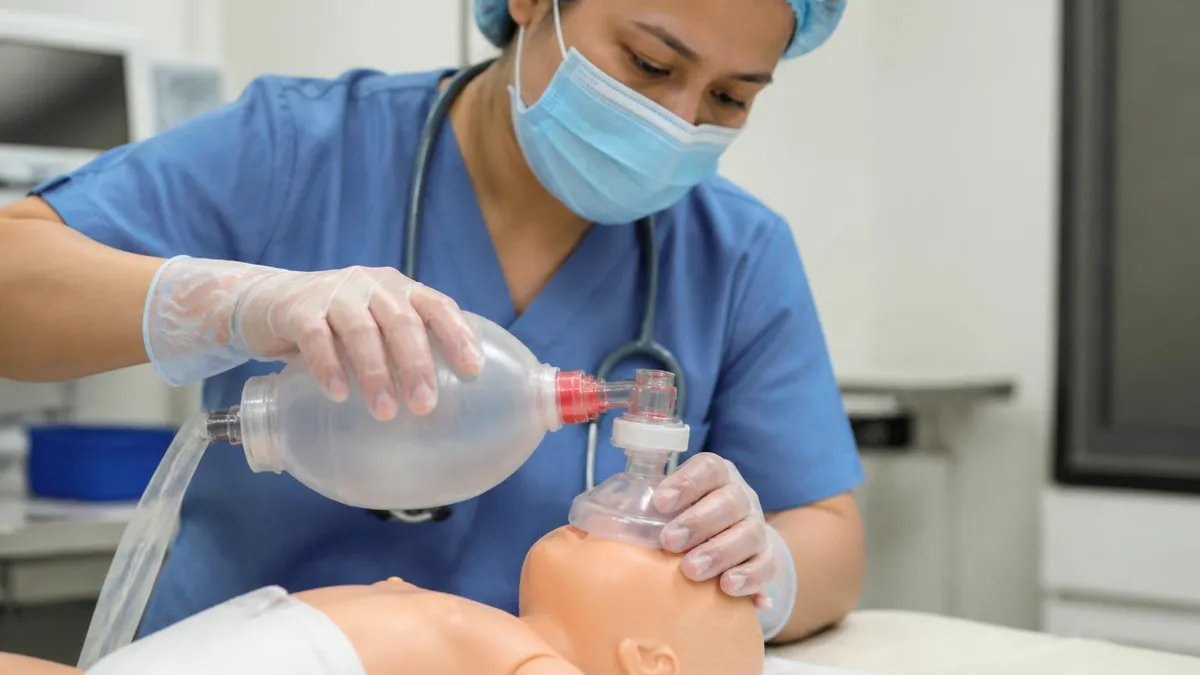
NRP simulation labs use high-fidelity newborn mannequins programmed to respond differently depending on how MR SOPA steps are applied. During simulated deliveries, instructors observe whether providers check mask seal before escalating to suction or pressure, and whether the team communicates each step aloud. Research consistently shows that teams who practice MR SOPA in simulation perform the steps faster and more accurately in real deliveries, reducing the time to effective ventilation by an average of 15 to 20 seconds compared to teams without simulation exposure.
Debriefing after simulation is where the deepest learning occurs. Instructors replay video footage of the simulation and point to specific moments where mask seal broke, where the airway was hyperextended, or where a step was skipped. Learners are asked to identify the clinical cues that should have triggered each corrective step. This reflective process builds the cognitive pattern recognition that allows experienced providers to apply MR SOPA almost instinctively during actual high-pressure deliveries, without needing to consciously recall each letter of the mnemonic.
Advantages and Limitations of the MR SOPA Framework
- +Provides a clear, memorable sequence that reduces cognitive load during high-stress resuscitations
- +Starts with the least invasive intervention first, minimizing unnecessary procedures
- +Sequential design helps isolate the specific cause of PPV failure systematically
- +Widely taught and standardized across all NRP-certifying institutions in the United States
- +Applicable regardless of the ventilation device being used — bag-mask or T-piece resuscitator
- +Supported by simulation research showing improved time-to-effective-ventilation outcomes
- −Does not address all possible causes of PPV failure — anatomical abnormalities may require immediate intubation
- −Can be applied too slowly by inexperienced providers who are not fluent with each step
- −The mnemonic does not specify timing — how long to attempt each step before moving on
- −Does not replace clinical judgment about when to bypass steps for clearly obstructed airways
- −Requires hands-on practice to execute correctly — memorizing letters alone is insufficient
- −Team communication during MR SOPA is critical but often not practiced in low-volume delivery settings
MR SOPA NRP Exam Prep Checklist
- ✓Memorize the MR SOPA mnemonic and what each letter stands for in sequence
- ✓Explain the clinical rationale for why mask adjustment is the first corrective step
- ✓Describe the neutral sniffing position and how to achieve it with a shoulder roll
- ✓State the correct suctioning sequence: mouth first, then nose, using ≤100 mmHg pressure
- ✓Demonstrate the open-mouth technique for maintaining airway patency during PPV
- ✓Know the incremental pressure increase range: 5–10 cm H₂O per adjustment
- ✓List two alternative airway options: endotracheal tube and laryngeal mask airway
- ✓Identify the heart rate threshold that triggers chest compressions: below 60 bpm
- ✓Practice closed-loop communication by calling out each MR SOPA step verbally
- ✓Complete at least two full simulation scenarios that require applying MR SOPA under time pressure
The Most Common PPV Failure Is a Mask Leak — Fix It First, Every Time
Studies of neonatal resuscitation show that mask leak accounts for the majority of PPV failures in the delivery room. Before reaching for suction, increasing pressure, or considering intubation, always check and correct the mask seal. This single step resolves inadequate chest rise in most cases and saves critical seconds during neonatal resuscitation.
One of the most important aspects of NRP training that relates directly to MR SOPA is learning to recognize the difference between absent chest rise and subtle or asymmetric chest rise. Bilateral chest rise — movement of both sides of the chest simultaneously — is the primary indicator that PPV is delivering air to both lungs.
A provider who is focused on the monitor or the clock may miss visual chest movement entirely, particularly in a vigorous resuscitation environment with multiple people around the warmer. This is why NRP recommends that a designated team member watch for chest rise while another delivers ventilation.
A common mistake that NRP instructors observe repeatedly is providers who complete MR SOPA steps too quickly, without pausing to assess whether the corrective action worked before moving to the next step. For example, a provider may adjust the mask and immediately move on to suctioning without delivering two to three test breaths to confirm whether the mask adjustment resolved the problem.
The correct practice is to deliver a breath or two after each corrective step and observe the chest before proceeding. This pause-and-assess habit is the difference between MR SOPA being a systematic diagnostic tool and being a rushed checklist that misses the root cause.
Another frequent error is applying the mask with excessive downward pressure in an attempt to improve the seal. Pressing the mask too hard onto the face can actually worsen the airway by pushing the infant's chin down and occluding the pharynx, particularly in very small or premature infants.
The correct technique uses the E-C grip with enough upward jaw lift to bring the face gently into the mask — not forcing the mask down onto the face. NRP instructors use the phrase pull the face into the mask rather than push the mask onto the face to help trainees internalize this critical distinction.
Suction-related errors in MR SOPA are also commonly seen during skills station evaluations. The most frequent mistakes are suctioning the nose before the mouth, applying suction for too long, and using excessive suction pressure. Suctioning the nose first risks causing the infant to gasp and aspirate any material sitting in the oropharynx, which is why the mouth always comes first. Prolonged suctioning stimulates the vagus nerve, which can further drop the already-compromised heart rate. NRP guidelines recommend limiting each suction attempt to no more than five seconds and watching the heart rate monitor throughout the procedure.
Providers must also understand the relationship between MR SOPA and the overall resuscitation algorithm. MR SOPA is not a standalone protocol — it sits within the broader NRP decision tree that begins with the initial assessment of the newborn. If a newborn has poor tone, absent respirations, and a heart rate below 100 bpm at birth, the team activates the resuscitation sequence immediately.
PPV is begun within the first minute, and if chest rise is absent, MR SOPA begins. If MR SOPA is completed and ventilation is still ineffective, the algorithm branches to alternative airway placement and, if heart rate is below 60 bpm, to chest compressions with coordinated PPV.
The concept of ventilation corrective steps is also deeply connected to the preparation that happens before delivery. A well-stocked resuscitation warmer with all equipment checked and ready allows MR SOPA to be executed without delays caused by searching for a bulb syringe or shoulder roll. NRP guidelines recommend completing a full equipment check before every delivery, including confirming suction equipment function, testing the bag-mask or T-piece resuscitator for leaks, and ensuring that intubation supplies are immediately accessible. Teams that complete thorough pre-delivery preparation consistently perform MR SOPA more efficiently than teams that have to improvise equipment during the resuscitation.
The skill of evaluating mask fit before beginning PPV — sometimes called pre-ventilation mask check — is an extension of MR SOPA thinking that some NRP programs now teach proactively. Rather than waiting for PPV to fail and then adjusting the mask, this approach involves testing the mask seal against the palm of the hand or the infant's face before the first breath is delivered.
While this adds a few seconds to initiation of PPV, it dramatically reduces the likelihood of needing mask adjustment as a corrective step and can improve the quality of the first breaths delivered to the newborn. It represents a shift from reactive to proactive application of MR SOPA principles.

Proceeding directly to endotracheal intubation without first completing MR SOPA steps is a recognized error in neonatal resuscitation. Intubation is time-consuming, requires specific skills, and carries its own risks. In most cases of ineffective PPV, mask adjustment or airway repositioning will resolve the problem within seconds. Always complete the MR SOPA sequence before moving to an alternative airway unless there is an obvious anatomical reason that makes mask ventilation impossible.
Understanding how MR SOPA fits into the broader landscape of NRP competencies helps providers prioritize their study time and skills practice. The NRP 7th edition, published by the American Academy of Pediatrics in conjunction with the American Heart Association, structures the certification curriculum around a series of core competencies that include initial assessment, PPV with corrective steps, chest compressions, medication administration, and special circumstances such as preterm birth and congenital anomalies. MR SOPA falls within the PPV competency domain, which is consistently the most heavily tested area on both the written and practical assessments.
For nurses, respiratory therapists, neonatologists, and obstetricians who work together in delivery room teams, MR SOPA represents a shared language that allows for rapid, coordinated action without lengthy verbal explanations. When a neonatologist says M during a resuscitation, every team member knows to check the mask seal. When she says R, the respiratory therapist immediately adjusts the shoulder roll. This shared vocabulary, built through standardized NRP training, is a cornerstone of effective team communication and is one of the primary reasons that NRP certification has become a universal requirement for delivery room personnel across the United States.
One nuanced aspect of MR SOPA that is sometimes not emphasized enough in initial training is the role of pressure monitoring during PPV. Modern T-piece resuscitators and pressure-limited flow-inflating bags include manometers that display the peak inspiratory pressure being delivered with each breath.
Providers should watch this gauge throughout PPV and during the pressure increase step of MR SOPA to ensure that pressure is being delivered accurately. A reading of zero on the manometer during a delivered breath — when pressure should be peaking at 20 to 25 cm H₂O for a term infant — is a clear sign of mask leak that confirms the need for Step M to be repeated.
Preterm infants present unique challenges when applying MR SOPA. Their smaller facial anatomy makes achieving an airtight mask seal considerably more difficult, and their lung compliance is significantly lower than that of term newborns, meaning that higher pressures may be needed at Step P to achieve adequate inflation.
At the same time, the fragility of preterm lung tissue makes excessive pressure dangerous, with the potential to cause pulmonary air leak syndromes. For this reason, the AAP recommends using a PEEP valve and a pressure-limited device when providing PPV to premature infants, and NRP training for providers in level III NICUs includes specific guidance on titrating MR SOPA pressure increases in the preterm population.
The alternative airway step — the A in MR SOPA — deserves particular attention because it represents a significant escalation in the complexity and invasiveness of the resuscitation. Endotracheal intubation requires training, practice, and confidence with laryngoscopy technique, and the window for successful intubation during neonatal resuscitation is narrow. NRP guidelines recommend that intubation attempts be limited to 30 seconds, and that if the attempt is unsuccessful, the provider should return to mask ventilation while preparing for another attempt or transitioning to a laryngeal mask. Providers who perform intubation infrequently should practice regularly using simulation mannequins to maintain their skills.
Laryngeal mask airways (LMAs) have emerged as an important alternative airway option in NRP, particularly for providers who are not proficient with endotracheal intubation. The AAP added LMA as an acceptable alternative airway in the NRP curriculum, recognizing that in many community hospitals and international settings, intubation skills may not be readily available.
LMAs can be placed quickly, do not require laryngoscopy, and can provide effective ventilation in infants weighing 2,000 grams or more. However, they cannot be used for tracheal medication administration and do not provide the same degree of airway protection as an endotracheal tube, making familiarity with their indications and limitations an essential part of MR SOPA training.
Integrating MR SOPA into a comprehensive NRP study plan means reviewing not just the mnemonic itself but the equipment used to deliver PPV, the physiological principles underlying neonatal lung adaptation at birth, and the team dynamics that determine whether corrective steps are applied quickly and correctly. Candidates preparing for NRP certification should review each component of MR SOPA in the context of case scenarios, practice communicating the steps aloud, and use simulation or mannequin practice to build the muscle memory needed for confident performance under real resuscitation conditions.
Practical preparation for NRP certification should be structured around the competency areas that appear most frequently on both the written exam and the skills station assessment. MR SOPA is virtually guaranteed to appear on the written exam in some form, typically as a scenario-based question describing a newborn receiving PPV without chest rise and asking candidates to identify the first or next appropriate step.
The key to answering these questions correctly is to always think sequentially — the answer choices will often include both correct and incorrect steps, and selecting the wrong one usually reflects a misunderstanding of the order in which corrective steps should be applied.
For skills station preparation, practicing MR SOPA with a partner is far more effective than solo review. Have your partner act as the monitor-watcher and heart-rate caller while you work through the steps on a mannequin, verbalizing each action aloud as you perform it. This mirrors the real resuscitation environment and builds both technical skill and communication habit simultaneously.
Most NRP skills station evaluators give credit for correct technique and communication — a provider who performs each step correctly but silently will often receive lower marks than one who narrates the steps and receives confirmation from the team, because closed-loop communication is itself an evaluated competency.
Time management during the skills station is another critical factor. Providers who spend too long on any single MR SOPA step — for example, repeatedly repositioning the mask without progressing to suction — may run out of time in the scenario and be assessed as having escalated late.
NRP training recommends spending no more than 10 to 15 seconds on each corrective step before assessing response and moving on if improvement is not seen. This pace requires genuine automation of the steps through repetitive practice, which is why NRP instructors consistently emphasize that reading about MR SOPA is necessary but not sufficient preparation for the skills station evaluation.
Beyond certification, the value of internalizing MR SOPA extends throughout a provider's career in any setting where newborns might need resuscitation. Pediatric emergency nurses, transport teams, and general practitioners in rural settings may encounter a newborn requiring PPV without the full NRP team present. In these moments, having MR SOPA as an automatic mental framework — rather than a half-remembered acronym — can mean the difference between effective resuscitation and a critical delay. This is why NRP requires renewal every two years: the science of neonatal resuscitation evolves, and regular retraining keeps corrective-step skills fresh and current.
Study groups are one of the most effective learning formats for NRP preparation, particularly for MR SOPA content. When multiple providers practice together, they can rotate roles — one delivering ventilation and calling MR SOPA steps, one watching for chest rise, one monitoring the clock — and then debrief together on what they observed and what could be improved.
This collaborative practice accelerates learning by providing multiple perspectives on each scenario and exposing participants to the communication patterns of experienced colleagues. Many hospitals that have formal NRP study programs see significantly higher first-time pass rates on both the written and skills station assessments compared to institutions that rely on self-study alone.
Online practice tests and question banks focused specifically on PPV and corrective ventilation steps are an excellent complement to simulation training. These resources allow candidates to work through dozens of MR SOPA scenarios in a low-stakes environment, identify knowledge gaps, and review rationales for each answer.
The most effective practice tests include detailed explanations for both correct and incorrect answer choices, helping candidates understand not just what the right answer is but why the wrong answers are wrong — a level of understanding that is particularly important for the nuanced scenario questions that appear on the NRP written exam and that require application rather than simple recall.
Finally, providers should remember that NRP training is not the end of their MR SOPA education — it is the beginning. The delivery room is a high-acuity environment where conditions change rapidly and where even experienced providers encounter novel situations that require adaptation of standard protocols.
Engaging in regular case review, attending neonatal resuscitation grand rounds, and participating in multidisciplinary simulation drills all contribute to ongoing competency in MR SOPA and the broader NRP skill set. The commitment to continuous learning in neonatal resuscitation is ultimately a commitment to the safety and outcomes of the most vulnerable patients in any healthcare system.
NRP Questions and Answers



About the Author

Educational Psychologist & Academic Test Preparation Expert
Columbia University Teachers CollegeDr. Lisa Patel holds a Doctorate in Education from Columbia University Teachers College and has spent 17 years researching standardized test design and academic assessment. She has developed preparation programs for SAT, ACT, GRE, LSAT, UCAT, and numerous professional licensing exams, helping students of all backgrounds achieve their target scores.