
NPLQ Complete Guide 2026 September — National Pool Lifeguard Qualification
Pass the NPLQ Complete Guide 2026 September exam with confidence. Practice questions with detailed explanations and instant feedback on every answer. 🆕

What Is the NPLQ?
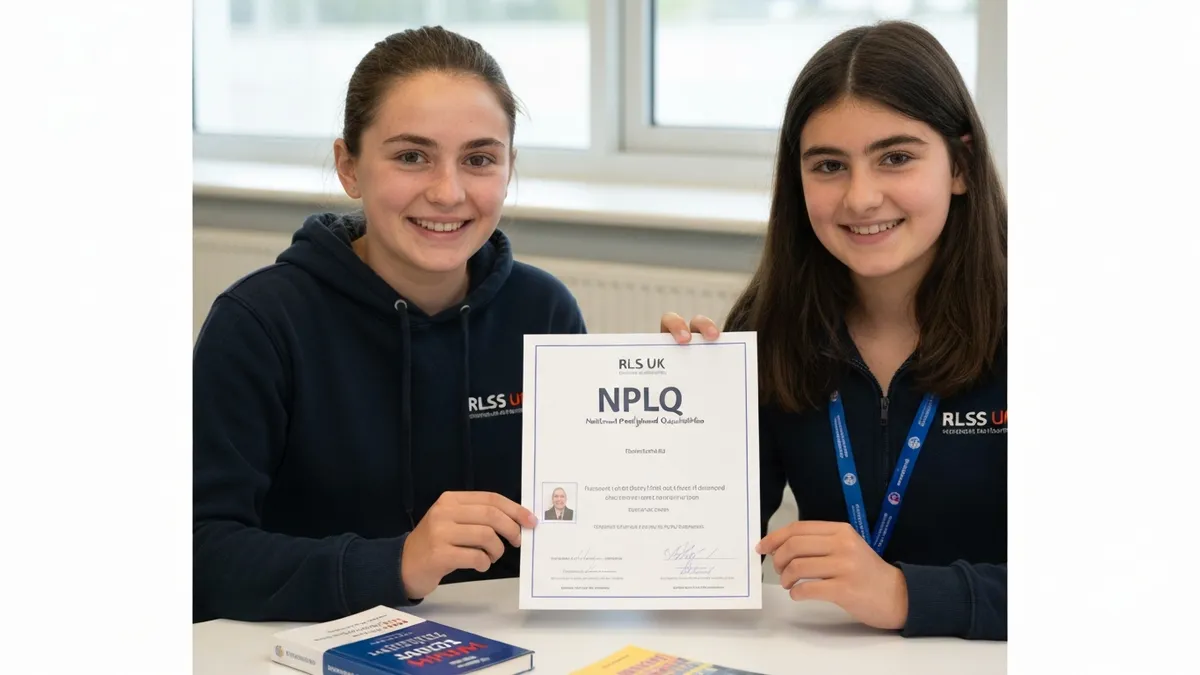
The NPLQ — full name National Pool Lifeguard Qualification — is issued by RLSS UK (Royal Life Saving Society United Kingdom) and is recognised across the UK as the benchmark qualification for employed pool lifeguards. Without it, you cannot legally work as a lifeguard in most UK public leisure facilities.
The qualification covers water rescue, pool supervision, emergency response, CPR (cardiopulmonary resuscitation), first aid, and the use of rescue equipment. It is designed for people working at supervised public pools — not open water environments, which require a separate lifeguard qualification. Passing the nplq signals to employers that you can identify hazards, manage an aquatic emergency, and lead a rescue safely and efficiently.
The NPLQ is also called the National Pool Lifeguard Qualification NPLQ in official documents, and informal references may call it the "nplq lifeguard" or "pool lifeguard qualification." All of these terms refer to the same RLSS UK award.
Eligibility Requirements
To enrol on an nplq qualification course, candidates must meet the following minimum requirements set by RLSS UK:
- Age: You must be at least 16 years old on the first day of the course.
- Swimming ability: You must pass a timed pre-course swim assessment (see the Swim Test section below).
- English language: Sufficient literacy to read written examination questions and instructions.
- Physical fitness: You must be able to perform sustained rescue activity in the water and on poolside. There is no formal medical requirement, but instructors may ask candidates to confirm they have no conditions that would prevent safe participation.
No formal lifeguarding experience is required before taking the NPLQ for the first time. The course starts from the basics and builds up to full rescue competency. However, regular swimming practice before your course start date will significantly improve your chances of passing the swim test on the first attempt.

Course Structure
The NPLQ is delivered through an approved RLSS UK training centre. The standard course runs over approximately 32 hours of contact time, often spread across four or five consecutive days or split across weekends. The course is divided into three distinct elements:
1. Theory (Knowledge Component)
The theory section covers pool safety legislation, supervision strategies, hazard identification, emergency action plans, and the responsibilities of an employed lifeguard. Content is delivered through instruction, discussion, and self-study. A written multiple-choice examination tests this knowledge at the end of the theory component.
2. Practical Rescue Skills
Candidates learn and are assessed on a series of water rescue techniques including reaching rescues, throwing rescues, wading rescues, and swimming rescues using rescue tubes and boards. Scenarios test decision-making, speed of entry, victim approach, and extraction technique. Spinal injury management and the team rescue procedure are also assessed.
3. First Aid and CPR
The NPLQ includes a first aid component covering primary and secondary surveys, adult and child CPR, the use of automated external defibrillators (AEDs), management of unconscious casualties, choking response, and basic wound care. Candidates are assessed on both CPR quality and response protocol. For more on preparing your knowledge, use the nplq test resources on this site to drill scenario-based questions before your assessment.
If you want more targeted practice, the rlss nplq mock exam page covers the same material with additional questions and explanations.
The NPLQ Exam
The NPLQ assessment has three components that must all be passed independently — failing one means failing the full qualification, regardless of your performance in the others.
Written Theory Examination
The theory exam is a multiple-choice paper covering pool supervision principles, legislation, emergency procedures, and casualty management. Questions draw directly from the NPLQ course content. Candidates who attempt nplq exam questions and answers in advance consistently find the written paper easier to manage under time pressure.
Practical Rescue Assessment
The practical assessment is observed by an RLSS UK qualified assessor. Candidates are tested on a series of rescue scenarios including: a swimming rescue with rescue tube, a spinal injury management scenario, a team rescue, and a minimum of one additional rescue from the reach/throw/wade options. Assessment criteria include response time, technique, victim control, and communication with a fellow lifeguard.
First Aid and CPR Assessment
Candidates must demonstrate adult CPR to a minimum compression-to-ventilation ratio, show correct AED pad placement and use, and respond appropriately to at least two first aid scenarios. Compression depth, rate, and recoil are measured. Poor hand position or inadequate compression depth are common reasons for failing this component on a first attempt.
NPLQ Theory Test — Key Topics to Study
- ✓Pool safety supervision: bather ratios, patron observation, scanning techniques
- ✓RLSS UK lifeguard responsibilities and duty of care under UK law
- ✓Emergency action plan (EAP) procedures and communication protocols
- ✓Water rescue classifications: reaching, throwing, wading, and swimming rescues
- ✓Spinal injury recognition and management in the aquatic environment
- ✓Adult and child CPR ratios and AED use in a pool setting
- ✓Hazard identification and risk assessment at swimming pools
- ✓NPLQ 9th edition updates — changes from previous editions
- ✓Pool design features: depth markings, slopes, wave machines, and leisure water
NPLQ Swim Test
The nplq swim test is a non-negotiable pre-requisite. Candidates must complete 400 metres continuously using any stroke in under 8 minutes, followed immediately by retrieving a 2.5 kg brick from the pool floor at a depth of 1.5 m and exiting the pool unaided — all within the same timed session at most centres.
The swim test is usually conducted on the first day of the course. Candidates who fail it cannot continue and will not receive a refund in most cases. Prepare seriously: if you are not comfortable swimming 400 m in 7 minutes or less in training, you need more pool time before booking.
Improving your swim fitness also directly improves your practical rescue performance. Fatigue during a rescue scenario is one of the most common assessor concerns for candidates who are borderline swimmers.
NPLQ: Employer-Funded vs Self-Funded
- +Course fee covered — no out-of-pocket cost
- +Employer arranges course dates and venue
- +Paid while training in many leisure sector roles
- +Often includes renewal funding every 2 years
- +Stronger job security — employer invested in your qualification
- −You must find and pay for the course independently (£150–£350)
- −Flexibility to choose your own course dates and location
- −Useful if you want the qualification before applying for jobs
- −Renewal costs are your own responsibility
- −Demonstrates initiative to prospective employers
Cost and Training Centres
NPLQ course fees vary between approved RLSS UK training centres. Typical costs for a first-time NPLQ course range from £150 to £350. Higher prices are common in London and major cities; more affordable options are often available at local authority leisure centres that run their own RLSS-approved programmes.
Many large leisure operators — including GLL (Better Leisure), Everyone Active, Fusion Lifestyle, and local council pools — fund NPLQ training directly for new hires or prospective staff. If you are applying for a poolside role, it is always worth asking at interview whether the employer will fund the qualification, particularly if you are a strong swimmer with no prior lifeguarding experience.
Renewal courses (every 2 years) are shorter — typically 2 days — and cost between £100 and £200 at most centres.
How to Pass the NPLQ
The NPLQ pass rate for first-time candidates who are well-prepared is high, but there are consistent failure points. Understanding where candidates go wrong helps you avoid the same mistakes.
Swim test failures are the most common course dropout reason. Candidates underestimate the 400 m in 8 minutes standard. Build your swim fitness to where you can comfortably complete 400 m in 6.5–7 minutes, leaving margin on test day.
CPR quality failures are the second most common cause of NPLQ failure. Compression depth must reach 5–6 cm on an adult manikin. Many candidates compress too shallowly. Practice on a CPR manikin if possible before the course, or at minimum watch video demonstrations of correct depth and rate (100–120 compressions per minute).
Practical rescue errors usually involve hesitation, poor entry technique, or losing contact with the casualty during tow. Instructors want to see confident, rapid decision-making — hesitating at the pool edge before a rescue scenario is heavily penalised.
Use nplq mock test questions to embed the theory before you arrive on course. The written exam is the most predictable element and should be your lowest-risk component if you prepare properly.
Renewal and Requalification
The NPLQ is valid for 2 years from the date of issue. Before expiry, you must complete one of the following:
- NPLQ Renewal: A 2-day refresher course at an approved centre, typically costing £100–£200. You must hold a valid (in-date) NPLQ to take the renewal course.
- NPLQ Requalification: If your NPLQ has already expired, you must complete a full requalification course rather than a renewal. The course content is similar to the original qualification but focuses on refreshing lapsed skills. Cost is closer to a full course fee.
RLSS UK recommends booking your renewal at least 3 months before your certificate expires to avoid gaps in your employment eligibility. Many employers track expiry dates and will suspend poolside duties if your NPLQ lapses. Review nplq past papers before your renewal to refresh the theory component efficiently.
NPLQ Questions and Answers
About the Author

Registered Dietitian & Fitness Certification Coach
University of FloridaAmanda Foster holds a Master of Science in Kinesiology from the University of Florida and is a Registered Dietitian and NASM Certified Personal Trainer. She has helped over 1,000 fitness professionals prepare for their ACE, NASM, ACSM, and specialty nutrition certifications, specializing in evidence-based exercise science and macro nutrition coaching methodology.