
NFPA 96: Commercial Kitchen Ventilation and Fire Protection Standard
NFPA 96 sets the rules for grease ducts, hoods, and fire suppression in commercial kitchens. 📗 Learn what inspectors check and how to stay compliant.
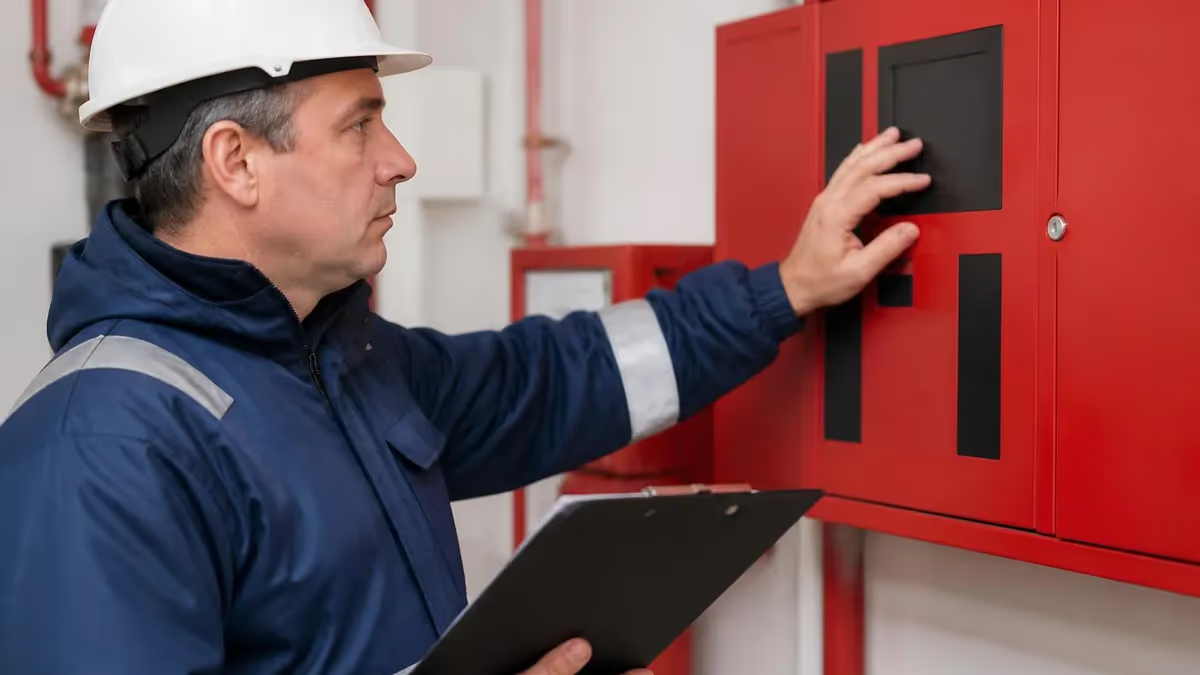
NFPA 96 is the standard that keeps commercial kitchens from burning down. It covers everything that happens above your cooking line, from the hood that catches grease vapor to the duct that carries it out of the building to the fan on the roof. If you operate a restaurant, run a corporate cafeteria, manage a hospital food service, or inspect any of those facilities, this is the document your authority having jurisdiction will hand you when something goes wrong.
The official title is Standard for Ventilation Control and Fire Protection of Commercial Cooking Operations. It was first issued in 1961, and the current edition gets revised every three years through the NFPA consensus process. Each new edition tightens a few details, adds clarity around emerging cooking technologies, and reflects what investigators learned from the previous cycle of kitchen fires.
This guide walks you through the entire scope of the standard in plain English. We will look at what equipment falls under NFPA 96, how often things need to be cleaned and inspected, what fire suppression has to do, and where the most common citations land during health and fire inspections. By the end you will know exactly why your exhaust hood gets steam-cleaned every quarter and what the inspector is looking at when they pull a panel off your duct.
NFPA 96 by the Numbers
Why does this standard exist? Because grease fires inside ductwork are catastrophic. A buildup of cooking residue inside a hot exhaust duct is essentially a fuse waiting for the right flame from below. When that fuse lights, the fire travels through concealed spaces, jumps to the roof, drops onto wood framing, and turns a kitchen incident into a structural loss in under an hour.
The National Fire Protection Association tracks restaurant fires every year and the data tells the same story repeatedly. Most started in cooking equipment. Most spread through ventilation. Most could have been contained if the grease load had been managed and the suppression system had fired correctly.
NFPA 96 attacks the problem from three angles at once. First, it engineers the ventilation system so flammable vapors and grease are captured at the source and carried away through a fire-rated path. Second, it requires routine cleaning so the fuel load inside that path stays low. Third, it mandates an automatic suppression system that drops chemical agent into the cooking surface, ducts, and plenum the moment heat rises past a fixed temperature. Each layer fails sometimes. The combination almost never does, which is why a properly maintained NFPA 96 system has a remarkable safety record.
The standard applies to any commercial cooking operation that produces grease-laden vapors. That includes restaurants of every size, school cafeterias, hospital kitchens, casino food courts, hotel banquet kitchens, food trucks, ghost kitchens, prison food services, military mess halls, and corporate dining facilities. It does not apply to residential cooking. A single-family kitchen is regulated by the building code, not by NFPA 96.
What Triggers the Standard
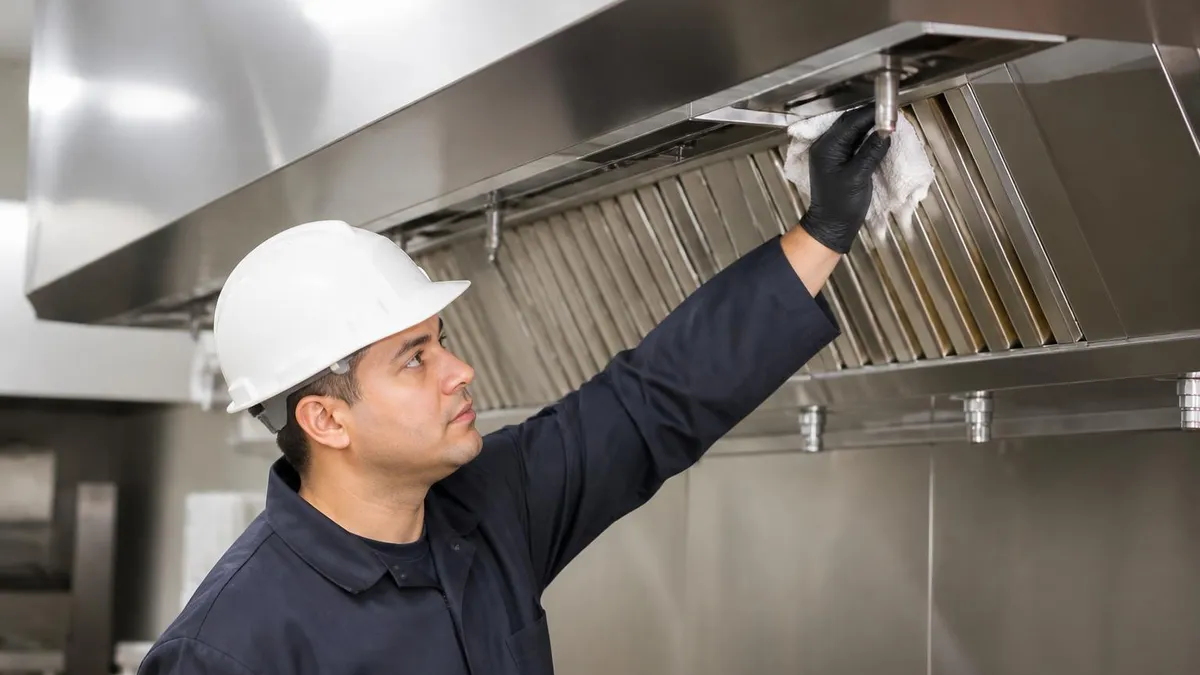
If you produce grease-laden vapors from any commercial cooking process, NFPA 96 applies in full. The trigger is not the size of the kitchen or the type of fuel. It is the vapor. A small electric panini press that produces no grease vapor is exempt. A single open flame char-broiler in a 12-seat diner falls under the entire standard, including hood, duct, suppression, and cleaning requirements.
The exhaust hood is the first piece of the system. Its job is to capture grease droplets, steam, smoke, and combustion products at the cooking line before they spread into the dining room or build up on ceiling structure. A Type I hood is the one NFPA 96 cares about. Type I means rated for grease and smoke.
Type II hoods handle steam and heat from dishwashers, ovens, and warmers that do not produce grease vapor. Mixing the two up is a common citation - a pizza oven over a Type II hood looks fine until the first grease fire teaches the owner an expensive lesson.
Inside every Type I hood you will find a set of removable filters. Most modern installations use baffle filters made of stainless steel. Hot vapor hits the angled baffles, grease droplets condense out, and the airflow continues up into the duct. The grease drains down into a collection trough at the bottom of the filter bank. Mesh filters are no longer permitted under current editions because they are too easy to ignite. If your kitchen still has mesh filters, that is an open citation waiting to be written.
Hoods must overhang the cooking appliances by a specific dimension - typically six inches on all open sides, though the exact number depends on hood style and cooking equipment classification. They must be installed with a clear path for grease to drain. The connection between the hood and the duct must be liquid-tight and grease-tight.
Welded joints are required. Sheet metal screws and tape are not acceptable. A pinhole in that seam is enough to let grease accumulate in the wall cavity behind the hood, which is exactly the kind of concealed fuel load that turns a fire into a disaster.
Core Components Under NFPA 96
Stainless steel or other approved material with grease filters and a continuous gutter. Required wherever grease-laden vapors are produced.
Welded, liquid-tight, sloped back toward the hood. Must run with continuous access panels for cleaning. Penetrations through walls and floors require fire-rated enclosure.
Upblast roof-mounted fan with hinged base for service. Belt-driven or direct-drive. Must remain operational during cooking and during a fire suppression discharge.
UL 300 listed wet chemical system protecting cooking surfaces, plenum, and duct. Activated automatically by fusible link or detection wire.
Replacement air for what the exhaust pulls out. Required to prevent negative pressure that starves the building and reverses chimney draft.
Fuel and electric shutoffs that automatically secure cooking equipment when the suppression system fires. Manual pull station within reach of exit path.
The grease duct is the most dangerous part of the system. Air leaving the hood enters the duct already loaded with vapor that did not condense at the filter. As the duct cools the vapor settles on interior walls as a sticky brown film. Over weeks and months that film thickens. The flash point of cooking grease is roughly 600 degrees Fahrenheit.
The autoignition temperature drops once the film has been heated and cooled repeatedly. A flare-up at the cooking surface that pushes flame even briefly into the duct can ignite that buildup, and once it starts inside the duct it is nearly impossible to reach without specialized equipment.
NFPA 96 demands the duct be built as a sealed steel tunnel. Minimum thickness is 16 gauge for carbon steel and 18 gauge for stainless. Every joint must be welded continuously. Slope the duct back toward the hood so any grease that liquefies during cooking runs back into the collection point rather than pooling at a low spot. Access panels for cleaning must be installed at every change of direction and at intervals not exceeding twelve feet on straight runs. Each access panel must close grease-tight and remain accessible without disassembling other building systems.
Where the duct passes through fire-rated construction, it must be enclosed in a continuous shaft of at least equivalent fire resistance, or wrapped with a listed fire-rated duct wrap material. The two approaches handle the same problem differently. A traditional gypsum shaft is bulkier but easier to inspect. A wrap is tighter but more vulnerable to damage from contractors who do not understand what they are looking at. Both are acceptable under NFPA 96 if installed to the manufacturer's listing.
Cleaning Frequency by Cooking Volume
Standard cooking volume. Burger restaurants, family dining, most casual chains. The full exhaust system including hood, duct, and fan must be inspected and cleaned at least every three months. This is the default frequency under NFPA 96 Annex when no other schedule applies.
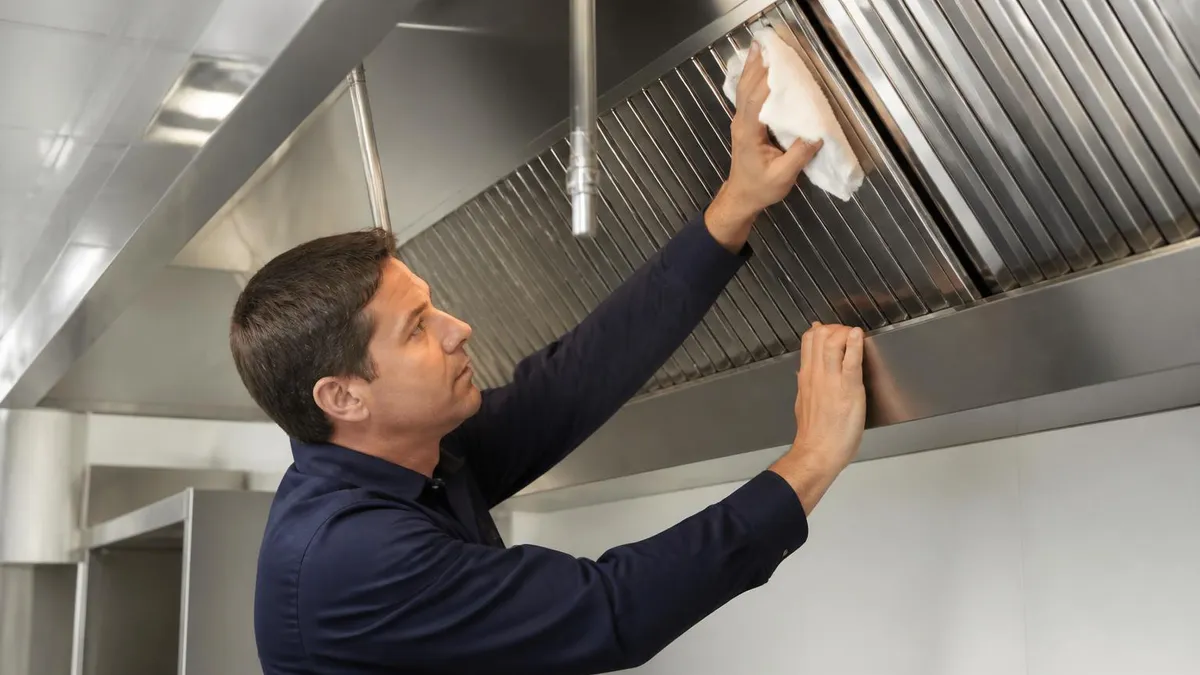
Fan placement matters. NFPA 96 strongly prefers an upblast fan mounted on the roof at the terminal end of the duct. The fan must be hinged so the service technician can flip it open and reach the lower side of the impeller where grease collects. A small drip pan sits beneath the fan to catch grease that liquefies in the heat of operation. Some jurisdictions require additional grease containment around the fan curb so any overflow is captured before it reaches the roof membrane.
Sidewall discharge is permitted only under specific conditions and only with engineered design. Terminating a kitchen exhaust at a wall louver is generally discouraged because it puts the grease plume close to building openings, pedestrians, and combustible siding. If you ever see a grease-stained wall outside a strip mall restaurant, that is what an undersized or improperly placed sidewall discharge looks like.
Distance to property lines, building openings, and air intakes is carefully specified. A grease exhaust outlet must be at least ten feet from a property line, ten feet from a fresh air intake, three feet above the roof surface, and ten feet from any operable opening into the building. The exact numbers vary slightly by edition and there are minor exceptions, but the principle is constant. Hot grease vapor does not belong near anything that can burn, breathe, or smell it.
Missing access panels in the duct. Filters installed upside down or with mesh screens still in place. Cleaning intervals exceeded by months or years. Suppression system tags out of date. Manual pull station blocked by storage. Fuel shutoff valves that no longer function when the system tests. Inadequate clearance from combustible construction at the duct penetration. Each of these can shut a kitchen down on the spot or trigger a re-inspection fee that costs more than the original repair would have.
Fire suppression is the dramatic part of NFPA 96 and the part most operators interact with directly. The standard requires a UL 300 listed wet chemical system. Wet chemical works by spraying a potassium-based solution onto the cooking surface where it reacts with hot grease to form a soapy foam blanket. The foam smothers the flame and cools the surface below reignition temperature. Older dry chemical systems were replaced industry-wide after testing showed they did not extinguish modern vegetable-oil fires reliably. If your kitchen still has a dry chemical system installed before 1994, it must be upgraded.
The system has fixed nozzles aimed at each piece of cooking equipment. A fryer gets one or two dedicated nozzles. A char-broiler gets its own. A range with multiple burners gets coverage from a nozzle suited to its hazard area. Above the equipment, additional nozzles protect the plenum inside the hood. Inside the duct, at least one nozzle is positioned in the lower section to suppress fire traveling upward.
Activation happens automatically through a detection line strung above the cooking surfaces. Fusible links at intervals along the line are calibrated to melt at around 360 degrees Fahrenheit. When one melts the line releases tension, a spring fires the actuator, and the chemical agent discharges. Simultaneously the system trips the gas valve, kills electric power to cooking equipment, and energizes the building fire alarm. A manual pull station near the kitchen exit gives staff a way to fire the system on demand if they see fire before the link melts.
Owner and Manager Monthly Walkthrough
- ✓Verify the most recent cleaning tag is dated within the required interval
- ✓Confirm the suppression system inspection tag is current within six months
- ✓Check that all filters are present, installed correctly, and free of holes
- ✓Look for grease accumulation on the inside lip of the hood overhang
- ✓Confirm the manual pull station is clearly marked and free from obstruction
- ✓Test that the kitchen exit path is clear from the cooking line to the door
- ✓Inspect the fan service hatch on the roof for grease overflow or roof damage
- ✓Verify makeup air units are running whenever the exhaust hood is on
- ✓Check that fuel shutoff valves and electric disconnects are accessible and labeled
- ✓Photograph any deficiencies and assign a written corrective action with a deadline
Inspection and testing of the suppression system happens every six months. A licensed service company runs through a checklist that includes verifying nozzle position, confirming detection link condition, testing manual pull operation, inspecting the agent tank pressure, checking the gas valve closure, and confirming the connection to the fire alarm panel.
After service the technician hangs a metal or paper tag on the system with the date, the company name, and a check showing whether the system passed. If you see a tag more than six months old, the system is technically out of compliance and the local fire marshal can write it up.
Every twelve years the agent tank must be hydrostatically tested. That requirement catches a lot of operators by surprise because the tank looks identical to a brand new one even when it is internally corroded. The service company refills the tank with water under pressure to confirm it will not rupture during a discharge. Failed tanks are replaced. Operators sometimes try to argue with the rule, but it is a life safety requirement and there is no waiver process.
Cleaning of the hood, duct, and fan is performed by a separate trade. NFPA 96 calls these companies kitchen exhaust cleaners, and most jurisdictions require the technicians to hold a state or municipal license. After cleaning, the cleaner must produce a sticker on the hood showing the date of service, the name of the company, and the name of the technician.
They must also leave behind a written report describing the condition of the system before cleaning and noting any deficiencies that need correction. That report is your evidence in front of the fire marshal that the system was professionally maintained.
NFPA 96 Compliance Pros and Cons
- +Reduces commercial kitchen fire incidents and protects life safety
- +Insurance premiums drop measurably for fully compliant operations
- +Clear written record protects owners in the event of an incident
- +Routine cleaning extends equipment life and improves air quality
- +Standardized rules make multi-location operations easier to manage
- +Compliance is recognized across nearly every US jurisdiction
- −Cleaning, inspection, and testing add ongoing operating costs
- −Initial installation of a UL 300 system is a significant capital expense
- −Documentation requirements demand consistent record-keeping discipline
- −Some older buildings require expensive retrofits to bring ducts into compliance
- −Edition changes can require updates that operators were not budgeting for
- −Inspectors interpret the standard differently across jurisdictions
Pros and Cons at a Glance
| Pros | Cons |
|---|---|
| Reduces commercial kitchen fire incidents and protects life safety | Cleaning, inspection, and testing add ongoing operating costs |
| Insurance premiums drop measurably for fully compliant operations | Documentation requirements demand consistent record-keeping discipline |
| Clear written record protects owners in the event of an incident | Some older buildings require expensive retrofits to bring ducts into compliance |
| Routine cleaning extends equipment life and improves air quality | Edition changes can require updates that operators were not budgeting for |
| Standardized rules make multi-location operations easier to manage | Inspectors interpret the standard differently across jurisdictions |
What does this all cost? Installation of a new Type I hood with welded duct, UL 300 suppression, makeup air, and roof-mounted fan typically runs between 25,000 and 80,000 dollars for a typical restaurant.
Annual operating costs add up too. Quarterly cleaning runs roughly 400 to 900 dollars per visit. Semiannual suppression inspection adds another 200 to 400 dollars per visit. Filter replacement and occasional component repair round out the budget. Solid fuel cooking like a wood-fired pizza oven adds monthly cleaning costs and may require additional spark arrestors and chimney protection.
The cost of non-compliance is steeper. A kitchen fire that escapes containment averages 23,000 dollars in direct damage, but loss-of-business shutdowns and total structural losses regularly exceed several hundred thousand dollars. Insurance carriers will not pay claims if the suppression system was out of inspection or the duct was clogged with neglected grease.
Typical Cost Breakdown for a Commercial Kitchen
25,000 to 80,000 dollars depending on duct length, building complexity, and local labor rates. Includes hood, welded duct, fan, and makeup air.
6,000 to 15,000 dollars for design, equipment, and installation. Annual inspection at 200 to 400 dollars. Tank hydro-test every twelve years.
400 to 900 dollars per visit. Frequency from monthly to annual depending on cooking volume. Includes hood, duct, fan, and rooftop containment.
30 to 80 dollars per stainless baffle filter. Lifespan typically two to five years with proper cleaning. Replace immediately if damaged or warped.
23,000 dollars average direct damage. Six-figure losses common when fire escapes containment. Closure days during repair often exceed the repair bill itself.
Premium reductions of 5 to 15 percent for documented compliance. Denied claims common after non-compliance discovery. Some carriers require inspection reports at renewal.
Solid fuel cooking deserves special attention because it sits at the high end of risk under NFPA 96. Wood, charcoal, mesquite, and pellet-fired cooking equipment generate sparks and embers that travel up the duct as live combustion products. Standard hood and duct construction is not sufficient.
Chapter 14 of the standard adds requirements like spark arrestors at the duct termination, water-cooled or insulated duct construction, separate ash containers, separate fuel storage with clearance to combustibles, and monthly cleaning regardless of volume.
Mobile food operations - food trucks, trailers, carts - fall under NFPA 96 the same as any brick-and-mortar restaurant. Same hood, same duct, same suppression, same cleaning intervals scaled to the cooking surface. The challenge is keeping the system operational on a moving vehicle with limited space.
Solid Fuel Cooking Extra Requirements
- ✓Install a spark arrestor at the duct termination point
- ✓Use water-cooled or insulated duct construction along the entire run
- ✓Provide a separate ash container with metal lid and approved storage location
- ✓Store fuel with documented clearance to combustibles and an approved cover
- ✓Schedule cleaning at least monthly regardless of cooking volume
- ✓Confirm suppression nozzles are specifically rated for solid fuel hazards
- ✓Train staff on ember-handling, ash disposal, and overnight fire-watch procedures
- ✓Maintain a written hot-work permit policy for any maintenance on hot ducts
Sample NFPA - National Fire Protection Association Practice Questions
Try these questions from our free NFPA - National Fire Protection Association practice tests. The correct answer and an explanation follow each question.
Under NFPA 10, what type of extinguisher is best suited for a Class K kitchen fire involving cooking oils?
- A. ABC dry chemical
- B. CO2
- C. Wet chemical
- D. Halon
Answer: C. Wet chemical
NFPA 10 recognizes wet chemical extinguishers as the most effective agent for Class K fires involving cooking oils and fats.
According to NFPA 30, what is required when a leak is detected in an underground storage tank system?
- A. Continue operation and monitor daily
- B. Immediately stop use and notify the regulatory authority
- C. Reduce fill level to below the leak point
- D. Install additional leak sensors and retest in 30 days
Answer: B. Immediately stop use and notify the regulatory authority
NFPA 30 requires that the system be immediately taken out of service and the appropriate regulatory authority be notified when a tank leak is detected.
Under NFPA 25, what is the required inspection frequency for internal inspection of steel dry pipe and preaction system piping?
- A. Every 3 years
- B. Every 5 years
- C. Every 10 years
- D. Every 15 years
Answer: B. Every 5 years
NFPA 25 requires an internal inspection of dry pipe and preaction system piping every 5 years to check for obstructions.
Which NFPA 704 health rating indicates 'extreme danger' where serious injury is likely from short exposure?
- A. 1
- B. 2
- C. 3
- D. 4
Answer: C. 3
A health rating of 3 indicates short exposure could cause serious temporary or residual injury, requiring full protective equipment for emergency responders.
Take the full NFPA - National Fire Protection Association practice test
NFPA Questions and Answers
NFPA 96 is not the kind of standard you skim once and file away. The kitchen environment is dynamic. Equipment gets moved. Menus change. Volume swings with the season. Staff turns over. Each of these can quietly push a previously compliant operation out of compliance unless someone is actively watching. Owners who treat the standard as a living checklist - reviewed monthly, audited quarterly, and refreshed annually - run kitchens that stay safe and stay open.
Inspectors are not the enemy. The good ones will walk through the kitchen with you, point out borderline issues before they become citations, and explain why a particular detail matters. Build a relationship with your local fire marshal. Invite them in for a walk-through before your formal inspection. Most welcome that kind of engagement because it makes their job easier and tends to produce safer kitchens in their district.
If you are studying for a fire inspector exam, a fire protection certification, or a culinary management program that covers life safety, the structure of NFPA 96 is exactly the kind of material that shows up on test day. The standard is logical once you map it onto the physical system: capture the vapor at the hood, contain it inside the duct, exhaust it through the fan, suppress any fire automatically, and clean the whole path on a defined schedule. That is the standard in one sentence. Everything else is detail.
Pair that mental model with practice questions on hood overhang, duct slope, cleaning intervals, UL 300 requirements, and clearance distances, and you will recall the specifics quickly under exam pressure. Real kitchens reward the same understanding. The operator who knows why a baffle filter is angled the way it is can spot a wrong installation in a glance. The technician who understands what a fusible link is rated for can troubleshoot a false discharge without guessing.
Lastly, write everything down. Cleaning logs, inspection reports, training rosters, repair receipts, and photographs all become evidence in front of an inspector or an insurance adjuster. Keep them in a single binder or a single shared folder accessible to whoever is on duty during an inspection. That binder is your insurance policy against citations, downtime, and disputed claims. It also turns NFPA 96 from an annoying obligation into a structured operating system that runs in the background while you focus on the food.
About the Author

Certified Safety Professional & OSHA Compliance Expert
Indiana University of Pennsylvania Safety SciencesDr. William Foster holds a PhD in Safety Science from Indiana University of Pennsylvania and is a Certified Safety Professional (CSP) and Certified Hazardous Materials Manager. With 20 years of occupational health and safety management experience across construction, manufacturing, and chemical industries, he coaches safety professionals through OSHA certification, CSP, CHST, and safety management licensing programs.
Join the Discussion
Connect with other students preparing for this exam. Share tips, ask questions, and get advice from people who have been there.
View discussion (8 replies)