
NFPA 70B Practice Test and Study Guide 2026 September
Master NFPA 70B requirements with this complete guide to electrical equipment maintenance, ✅ inspection schedules, and compliance practices.
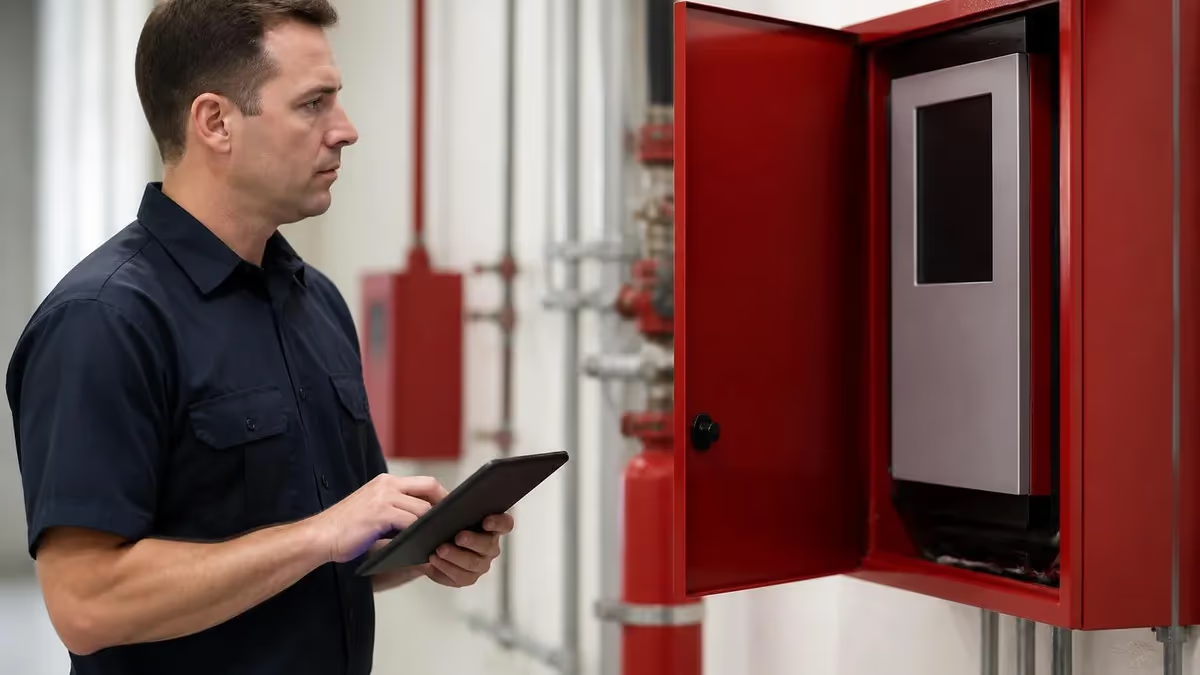
NFPA 70B is the Standard for Electrical Equipment Maintenance, published by the National Fire Protection Association. For decades it lived as a recommended practice, a document that facility managers leaned on but never had to follow.
That changed in 2023 when the NFPA elevated it from a guide to an actual standard, which means "shall" replaced "should" across hundreds of pages. The shift matters because electrical maintenance is no longer optional language inside contracts or building codes that reference NFPA documents.
You can't skim the requirements and pick what looks easy. The standard now expects documented programs, written procedures, and qualified personnel doing real inspection work on a defined schedule.
If you manage a facility, run an electrical contracting business, or sit for a journeyman or master electrician exam, NFPA 70B will appear in your work. Insurance underwriters reference it. OSHA cites it as a recognized industry consensus standard.
Owners and operators of large electrical systems use it when negotiating service agreements. Even residential electricians sometimes brush up against 70B when working on multi-unit buildings or commercial properties tied to a maintenance plan.
This guide walks through what NFPA 70B actually requires, how the maintenance frequency tables work, where the 2023 edition broke from older practice, and which questions show up on certification exams that include this material. Studying for an exam? You're going to see questions on maintenance intervals, inspection categories, condition assessments, and the role of the qualified person.
The standard isn't long compared to NFPA 70 (the National Electrical Code), but it's dense in places. We'll keep the explanations grounded in what you'll actually use on the job and on the test.
NFPA 70B at a Glance
The numbers above tell you where 70B sits in the NFPA family. It's been around since 1968, which means generations of electricians have used it. But the 2023 elevation is the big story.
Before 2023, 70B was a recommended practice, a document labeled with "NFPA 70B" and treated as guidance. Now it carries the same weight as other NFPA standards, the kind authorities having jurisdiction can adopt and enforce.
The three-year revision cycle means the next edition lands in 2026, with proposals already being processed through the public input phase. Why the change? Electrical fires, equipment failures, and arc flash incidents kept happening in facilities that had no maintenance program at all.
The NFPA technical committee decided guidance wasn't getting through. Making it a standard creates a measurable bar. Either you have a documented maintenance program that matches the requirements, or you don't. Insurance and legal teams find that black-and-white easier to work with than "should consider performing."
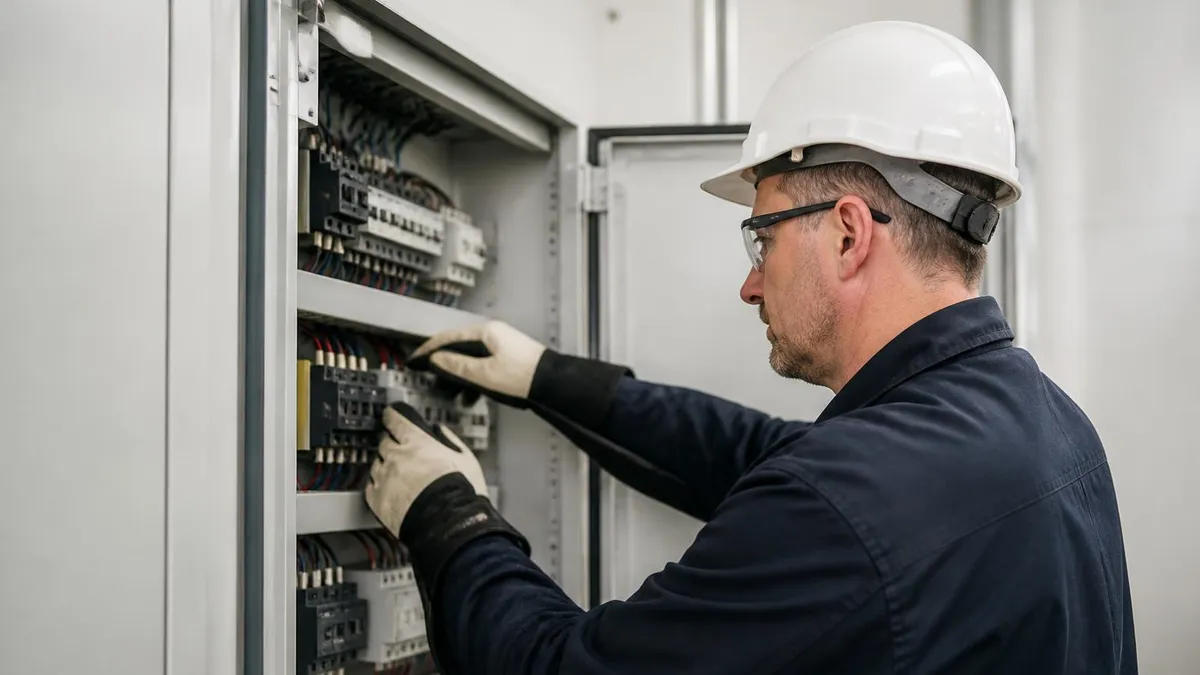
NFPA 70B is referenced by NFPA 70E (the electrical safety standard) for maintenance requirements. If your facility follows 70E for arc flash protection, you're already obligated to maintain equipment per 70B.
Skipping maintenance can void arc flash incident energy calculations and expose your team to higher risk than your PPE is rated for. This isn't theoretical, it's how incident energy math actually works in practice.
This connection between 70E and 70B is one of the most tested concepts on electrical safety exams. NFPA 70E (Standard for Electrical Safety in the Workplace) tells you how to work safely on energized equipment. It covers arc flash, shock protection, PPE, and the energized electrical work permit process.
But 70E assumes the equipment you're working on is in a known, maintained condition. That assumption only holds if someone followed 70B.
Here's the practical chain: 70E requires arc flash incident energy calculations. Those calculations use overcurrent protective device clearing times. Clearing times depend on the breaker or fuse actually operating as designed.
A breaker that hasn't been exercised in fifteen years may not trip in the time the calculation assumes. That mismatch raises the actual incident energy above what the worker's PPE is rated for. Following 70B keeps the calculation valid.
Ignoring 70B doesn't just put equipment at risk, it puts the math behind worker safety at risk too. For exam questions, remember this relationship. If a question asks why an electrical maintenance program supports worker safety, the answer ties back to the validity of arc flash studies and the reliability of overcurrent protection. It's not just about preventing equipment damage.
Core Sections of NFPA 70B
Administration, definitions, references, and the structure of an Electrical Maintenance Program (EMP). These foundation chapters establish scope, terminology, and the program-level requirements every facility must meet regardless of equipment type or industry.
Personnel qualifications, condition assessment methodology, maintenance procedures, and equipment categories. This section bridges the program framework to actual hands-on work, defining who does what and how decisions get made.
Specific equipment types: transformers, switchgear, motors, batteries, lighting, grounding systems, cables, and protective devices. Each chapter includes maintenance frequency tables, test procedures, and acceptance criteria for that equipment family.
Specialized topics including renewable energy systems, energy storage, medical equipment, harmonic mitigation devices, and testing methods. Newer chapters reflect emerging technology areas added in recent editions of the standard.
The chapter structure looks intimidating, and it is the first time you open the standard. But once you understand the flow, navigation gets easier. The first four chapters are about the program itself, who's responsible, what records you keep, and how you write procedures.
The next four cover the people doing the work and the methodology they use. Then you have fourteen chapters covering specific equipment, and finally nine chapters on specialized systems and testing.
For most exam questions, you'll focus on the first eight chapters and on the maintenance frequency tables in the equipment chapters. Examiners love asking about inspection intervals because they're specific, measurable, and easy to test.
"How often shall a 480V switchgear be inspected under normal conditions?" is the kind of question that has a single correct answer from a table in the standard. One thing worth pointing out: the equipment chapters aren't independent.
A motor control center pulls in requirements from the switchgear chapter, the motor chapter, and the cable chapter. Cross-references run throughout the document. When studying, get comfortable jumping between chapters rather than reading linearly.
Maintenance Intervals by Equipment Type
Dry-type and liquid-filled transformers require visual inspection at intervals based on condition and environment. Routine inspection ranges from 1 to 3 years for typical installations operating under normal conditions. Liquid sampling on oil-filled units often runs annually for critical service, with dissolved gas analysis used to detect internal arcing, overheating, or insulation breakdown before failure occurs. Thermographic scanning is recommended at least annually for energized inspection, focusing on bushings, tap changers, and cooling fin connections. Larger power transformers above 2500 kVA typically warrant more comprehensive testing including power factor measurement, turns ratio testing, and core insulation resistance on a 3 to 5 year cycle.
These intervals are the heart of any electrical maintenance program and the heart of any exam question on 70B. The standard provides Tables that match equipment type to inspection frequency, with adjustments based on operating conditions.
Conditions are categorized roughly as ideal, normal, and severe. A motor in a clean, climate-controlled pump house operates under ideal conditions and can stretch intervals. The same motor in a foundry with conductive dust, heat, and vibration operates under severe conditions and needs more frequent attention.
The 2023 edition introduced a Condition-Based Maintenance (CBM) approach as an alternative to time-based intervals. CBM uses continuous or periodic data, such as vibration monitoring, online partial discharge detection, or thermal imaging, to determine when maintenance is actually needed.
A facility that invests in monitoring infrastructure can use CBM to extend intervals on equipment that's clearly healthy, while accelerating intervals on equipment trending toward failure. Both approaches are recognized in the standard. Pick whichever fits your operation and document it.
For test questions, default to the table values unless the question specifies a condition assessment was completed. The phrase "under normal service conditions" usually points to the standard interval. Phrases like "continuous duty in a harsh environment" or "following a major event such as a fault" point to shorter intervals.

NFPA 70B is not just for industrial facilities. The 2023 standard explicitly covers commercial buildings, healthcare, data centers, and any facility with electrical equipment requiring maintenance.
Many facility managers assume residential and light commercial are exempt. They're not, although the depth of program required scales with the size and criticality of the installation.
This misconception comes up often in continuing education and on certification exams. The standard is written to apply broadly. A small office building still has a service entrance, a panelboard, and likely some HVAC controls. All of that falls within the scope.
The difference is what your written program looks like. A 5,000 square foot office isn't expected to maintain the same documentation depth as a hospital. But it is expected to have some form of inspection routine, some record of what was done, and some assurance that equipment is in working order.
What this means for compliance is straightforward. If you're a property manager, facility director, or building owner, you need to read 70B and decide how it applies to your operation. The standard doesn't dictate program depth, it dictates that a program exists, is documented, and is followed. The scale is yours to set within reason.
Where exam questions trip up candidates is on the scope statements in Chapter 1. The standard applies to electrical equipment in industrial, commercial, multi-residential, agricultural, institutional, and educational facilities.
Single-family dwellings are generally outside scope unless they include equipment beyond typical residential service. Memorize that scope language. It's a common multiple-choice trap.
Electrical Maintenance Program (EMP) Requirements
- ✓Written program document signed by management
- ✓Designated qualified person responsible for the program
- ✓Equipment inventory with identification system
- ✓Inspection and maintenance procedures for each equipment type
- ✓Frequency schedule based on condition or time intervals
- ✓Documentation system for inspections, tests, and repairs
- ✓Personnel training and qualification records
- ✓Performance metrics and program review process
The Electrical Maintenance Program is the structural backbone of compliance with 70B. Without a written program, you cannot demonstrate that maintenance happens systematically. Auditors, insurance inspectors, and authorities having jurisdiction will ask for the document first.
Equipment that's been maintained without documentation is, for practical purposes, equipment that hasn't been maintained. You can't prove what you did.
The eight items in the checklist above are the minimum elements. Some operations build far more elaborate programs with risk assessments, criticality ranking, and integration with computerized maintenance management systems (CMMS).
Others keep it lean with spreadsheets and paper logs. Both can be compliant if the basics are in place. The key requirement is that the program is followed consistently, not that it's elaborate.
On exams, expect questions that test your understanding of who does what. The qualified person isn't necessarily the technician turning the wrench. The qualified person identifies the qualified workers, sets procedures, and oversees the program.
They may also do the work themselves on smaller operations. Larger facilities separate these roles. The standard accepts both arrangements as long as the structure is documented.
Time-Based vs Condition-Based Maintenance
- +Simple to schedule and document
- +Predictable budget and labor needs
- +Works without monitoring infrastructure
- +Easy to audit against fixed intervals
- +Aligns with traditional maintenance practice
- −May over-maintain healthy equipment
- −May under-maintain equipment in degraded condition
- −Doesn't catch issues between scheduled visits
- −Same labor cost regardless of equipment condition
- −Doesn't leverage modern sensor technology
Choosing between time-based and condition-based maintenance is one of the strategic decisions every facility makes once they adopt 70B. Most operations end up with a hybrid. Critical equipment with monitoring instrumentation runs on CBM.
Less critical equipment, or equipment without practical monitoring, runs on time-based intervals. The standard accommodates this hybrid approach explicitly.
What drives the choice is usually equipment criticality and the cost of monitoring relative to the cost of failure. A data center with a 480V switchgear feeding tier-IV computing infrastructure has every reason to install permanent partial discharge sensors and run CBM.
The cost of an unplanned outage dwarfs the cost of the monitoring system. A small light industrial shop with a single service panel doesn't need that complexity. Time-based inspection works fine because the equipment is simple and the consequences of failure are limited.
Test questions on this topic typically present a scenario and ask which approach fits best. Read for clues: monitoring already installed, critical service, large equipment, complex protection schemes. Those favor CBM.
Simple service, limited budget, small facility favor time-based. The standard doesn't prefer one over the other. It just requires that whichever you choose is documented and followed.
One important detail. The standard recommends that even a CBM program include periodic physical inspections. Sensors fail. Software glitches. A human walking through the electrical room once a quarter catches things that no algorithm will. Don't let CBM eliminate human eyes on the equipment.
Many facilities discover that combining the two methods gives them confidence without overspending on instrumentation. Build the hybrid that fits your operation, document it in your EMP, and revisit the decision when equipment changes or criticality shifts.
Learn more in our guide on NFPA Practice Test PDF (Free Printable 2026). Learn more in our guide on NFPA 70E: Electrical Safety Standard Guide for the Workplace. Learn more in our guide on nfpa 70 national electrical code. Learn more in our guide on nfpa 101 free access. Learn more in our guide on nfpa 72 free access.

One topic that comes up in continuing education classes and on the more advanced certification exams is the relationship between 70B and the maintenance requirements written into equipment manufacturer documentation. The standard explicitly defers to manufacturer recommendations in many cases, particularly for specialized equipment like medium-voltage switchgear, large rotating machinery, and battery systems.
What that means in practice is that you can't just follow the 70B tables and ignore what the equipment vendor says. If the manufacturer specifies a six-month inspection on a vacuum circuit breaker, and 70B suggests annual, the manufacturer's interval typically wins because it's more conservative. Always check both sources before setting your intervals.
Another nuance worth understanding is the role of insurance carrier requirements. FM Global, AXA XL, Zurich, and other carriers that specialize in industrial property risk write their own maintenance guidance, often called "loss prevention data sheets." These documents reference 70B and 70E, but they sometimes go further with specific testing intervals, specific instruments, and specific reporting formats.
If your facility carries coverage from one of these carriers, expect their loss prevention engineer to ask for documentation that meets both NFPA standards and their own data sheets. Treating insurance requirements as a layer on top of 70B keeps you from getting surprised at the next site survey.
What Records to Retain Under NFPA 70B
- ✓Inspection reports with date, equipment ID, and inspector
- ✓Test results: insulation resistance, contact resistance, thermography
- ✓Repair work orders and parts replaced
- ✓Calibration records for test instruments
- ✓Personnel training and qualification documentation
- ✓Annual program review minutes signed by management
- ✓Manufacturer service bulletins and field notices
- ✓Insurance carrier loss prevention reports
Records retention is another area exam writers focus on. NFPA 70B doesn't dictate a specific retention period, but it requires that records be available to demonstrate the program is being followed. Common practice is to retain records for the life of the equipment, which can be 30 to 40 years for large transformers and switchgear.
Practically, that means digital records are usually the answer. Paper records from 25 years ago are often lost, illegible, or in storage that nobody can access. A CMMS or document management system with proper backup keeps the records discoverable when an auditor or attorney asks. Some facilities also implement annual program review meetings where management signs off on the program's effectiveness, which satisfies both internal governance and 70B's requirement for management involvement.
For test-takers, remember that 70B is a program standard first and a technical reference second. The questions often probe whether you understand that maintenance without documentation doesn't satisfy the standard, no matter how good the actual work was. Write it down, store it where you can find it, and have someone review it periodically.
NFPA Questions and Answers
CBM vs Time-Based: Industry Adoption
NFPA 70B has shifted from background reading to a real compliance document, and the 2023 edition is going to drive changes across facilities for years. If you're studying for an electrician exam, expect questions on maintenance intervals, the connection to 70E, and the structure of an electrical maintenance program.
If you're managing a facility, take the time to read at least the first eight chapters and the equipment chapters that apply to what you operate. The standard is dense, but it's organized logically once you spend a few hours with it.
The biggest practical takeaway is that documentation is the difference between compliance and exposure. Equipment can be in perfect working order, but without records proving it, you can't demonstrate that to anyone who asks.
Build the documentation habit. Train your team to record what they did, when, and what they found. That habit alone closes most of the gap between informal maintenance and a defensible 70B program.
Keep at it, work through practice questions to lock in the maintenance intervals, and you'll have the material covered well before exam day. The exam writers want to see that you understand the program structure, not just memorized numbers, so think about why the intervals exist and what risk they address.
About the Author

Certified Safety Professional & OSHA Compliance Expert
Indiana University of Pennsylvania Safety SciencesDr. William Foster holds a PhD in Safety Science from Indiana University of Pennsylvania and is a Certified Safety Professional (CSP) and Certified Hazardous Materials Manager. With 20 years of occupational health and safety management experience across construction, manufacturing, and chemical industries, he coaches safety professionals through OSHA certification, CSP, CHST, and safety management licensing programs.
Join the Discussion
Connect with other students preparing for this exam. Share tips, ask questions, and get advice from people who have been there.
View discussion (8 replies)