
Accelerated Nursing Programs Without Entrance Exam: What You Need to Know
🎯 Skip the nursing entrance exam or ace it — learn which programs waive it, how the NLN NEX works, and how to prep fast.
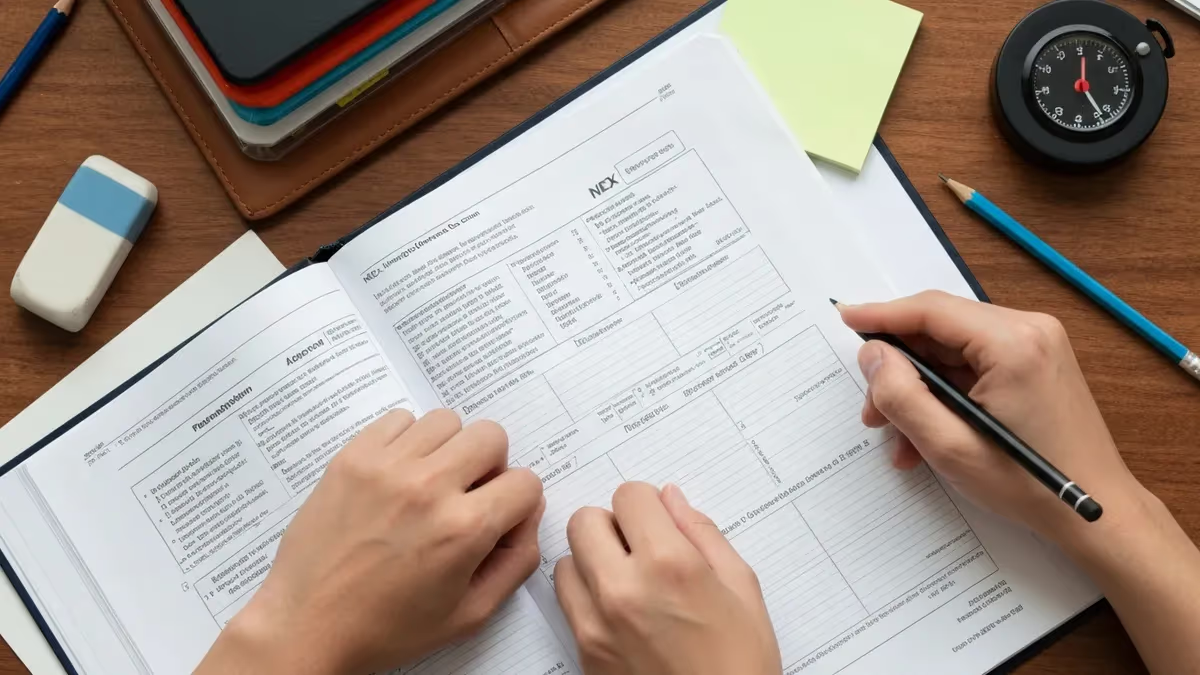
If you have been searching for accelerated nursing programs without entrance exam requirements, you are not alone. Thousands of prospective nursing students every year wonder whether they can bypass the standard nursing entrance exam and still gain admission to a reputable program. The short answer is: some programs do waive or eliminate the traditional nursing entrance examination, but understanding when, why, and what it means for your career trajectory is essential before you make any enrollment decisions based on that fact alone.
The nursing entrance exam — most commonly the NLN NEX (Nurse Entrance Exam), the TEAS, or the HESI — exists because nursing programs are academically rigorous and clinically demanding. Schools use these standardized tests to predict which applicants are likely to succeed in coursework covering anatomy, physiology, pharmacology, and critical thinking. When a program removes this requirement, it often substitutes other indicators such as a minimum GPA, prerequisite science grades, letters of recommendation, or a personal interview to ensure academic readiness.
Accelerated BSN and ADN programs that skip the nursing entrance exam tend to fall into two broad categories. The first group includes newer or expanding programs that are actively trying to grow enrollment and have decided that cumulative GPA is a sufficient predictor of success. The second group includes programs with alternative admissions models — competency-based, portfolio-based, or cohort-based — where a single standardized test score is considered less meaningful than demonstrated coursework performance over time.
Before celebrating the absence of a nursing school entrance exam, prospective students should investigate the program's NCLEX first-time pass rate. This single metric reveals whether graduates of exam-free programs are actually prepared for licensure. A program that skips the nursing entrance test but posts an NCLEX pass rate below 80% may be setting students up for expensive retakes and delayed careers. Always request the most recent pass rate data, ideally broken down by cohort year, before committing to any program.
It is also worth noting that "no entrance exam" does not always mean "easier to get in." Many competitive programs that waive the nursing program entrance test replace it with stricter GPA cutoffs — sometimes 3.2 or higher in prerequisite science courses. Others require a demonstrated track record in college-level biology, chemistry, and statistics before even reviewing an application. The absence of the exam changes the format of admissions, not necessarily the difficulty.
For students who are weighing their options, understanding the full landscape of the kaplan nursing entrance exam and its NLN counterpart gives important context. Knowing the structure, scoring, and content of standard exams helps you evaluate whether a program's alternative criteria are genuinely comparable, or whether you are trading a known benchmark for an opaque process. This article walks through every dimension of that decision so you can apply strategically.
Whether you choose a program that requires the nursing entrance examination or one that has eliminated it, preparation matters enormously. The academic content tested on entrance exams — math, science, reading comprehension, and critical thinking — is the same content you will face in your nursing courses. Students who build a solid foundation in these areas before matriculating, regardless of whether a test is required, consistently report smoother first semesters and higher confidence in clinical rotations.
Nursing Entrance Exam by the Numbers

Types of Nursing Programs and Their Admissions Requirements
Associate Degree in Nursing programs at community colleges that have replaced standardized entrance tests with minimum GPA requirements (typically 2.75–3.0) and prerequisite course completion in biology, chemistry, and English composition.
Second-degree programs for students who already hold a bachelor's in another field. Many waive the nursing entrance examination because applicants have demonstrated college-level academic success, though science GPA thresholds are often stringent.
Transition programs for Licensed Practical Nurses moving toward RN licensure. Prior clinical experience and an active LPN license often substitute for a formal nursing school entrance exam in these bridge pathways.
Distance-learning programs from regionally accredited universities that admit based on cumulative GPA, professional references, and personal statements rather than a standardized nursing entrance test score.
The majority of nursing programs still require the NLN NEX, TEAS, or HESI. These programs use composite scores, section minimums, and percentile rankings alongside GPA to rank and admit applicants.
Understanding what the NLN NEX actually tests is valuable whether or not the program you are applying to requires it. The nursing entrance examination is built around four primary content domains: mathematics, science, reading comprehension, and written English. Each domain reflects skills that nursing students use daily — from calculating medication dosages in math, to interpreting research articles in reading, to documenting patient care in writing. Knowing the structure of the exam helps you evaluate whether your academic background aligns with nursing program expectations.
The mathematics section of the nursing entrance exam covers arithmetic operations, fractions, decimals, percentages, ratios, and basic algebra. Many students underestimate this section because it sounds elementary, but the application of these skills under timed conditions — and later in clinical settings when calculating IV drip rates or pediatric weight-based dosing — requires both accuracy and speed. Nursing programs that waive the exam often expect applicants to demonstrate equivalent competency through a statistics or college algebra prerequisite course with a grade of B or higher.
The science section is arguably the most challenging component of the nursing program entrance test. It spans human anatomy and physiology, biology, chemistry, and physics. Questions probe conceptual understanding rather than rote memorization — you might be asked to explain why a patient with congestive heart failure retains fluid, or to identify the product of a specific chemical reaction. Programs that eliminate the science entrance test often substitute a rigorous screen: a B or better in both Anatomy and Physiology I and II is a common requirement for exam-free admissions.
Reading comprehension on the nursing entrance examination assesses your ability to extract main ideas from dense clinical or scientific passages, infer meaning from context, and evaluate the logical structure of an argument. This skill becomes critical when reading nursing research, interpreting physician orders, and navigating policy documents in clinical environments. Schools that skip the formal exam still expect incoming students to read at a college level, and many screen for this through required English composition coursework.
The written English section tests grammar, sentence structure, punctuation, and vocabulary. Accurate documentation is a patient safety issue in nursing — a misplaced decimal or ambiguous sentence in a clinical note can have serious consequences. For this reason, programs that waive the nursing entrance exam frequently require a demonstrated grade in freshman English composition, and some include a writing sample as part of the alternative application process. A review resource like the kaplan admission test nursing entrance guide can help you frame a compelling written component for programs using portfolio-based admissions.
Beyond the four tested domains, many nursing entrance exams include a learning styles or study habits inventory. While this portion is rarely scored or used as an admissions filter, it gives programs insight into how incoming students approach academic challenges. Some schools use this data to pair students with tutoring resources preemptively, which can be especially important in accelerated cohort models where the pace of instruction leaves little room for catching up once you fall behind.
Regardless of whether your target program requires a formal nursing entrance examination or has replaced it with alternative criteria, building your knowledge in all four content areas before your first semester pays dividends. The coursework you will encounter in any accredited nursing program assumes competence in these foundations. Students who invest time in math fluency, science literacy, reading stamina, and clear writing consistently report less stress during the program's most demanding clinical semesters — and they perform better on the NCLEX when licensure time arrives.
Nursing Entrance Exam: Kaplan, NLN, and TEAS Compared
The NLN NEX (Nurse Entrance Exam) is developed by the National League for Nursing and is widely used by community college ADN programs and some BSN programs. It measures competency across math, science, reading comprehension, and written English through approximately 140 scored items administered over three hours. Composite scores are reported as percentiles, allowing programs to rank applicants against a national norm group rather than using a raw pass-fail cutoff.
Programs that accept the NLN NEX typically set a minimum composite percentile — often the 40th to 60th percentile — as a baseline threshold. Competitive programs at high-demand schools may require the 75th percentile or above. Because scoring is norm-referenced, even strong absolute performance can fall short if the national testing pool performs at a high level that year. This variability makes consistent prep with a nursing entrance examination practice resource essential for understanding where you stand.

Pros and Cons of Nursing Programs Without an Entrance Exam
- +Reduces application barriers for non-traditional students with strong GPAs but test anxiety
- +Speeds up the application timeline — no waiting for exam registration windows or score reporting delays
- +Allows career-changers with relevant science backgrounds to leverage existing academic credentials
- +Eliminates the cost of entrance exam registration fees, which typically range from $50 to $115 per attempt
- +Can benefit students from under-resourced backgrounds who lack access to expensive test prep courses
- +Some exam-free programs use holistic admissions that credit work experience and community service
- −May indicate the program has lower selectivity, which can correlate with lower NCLEX first-time pass rates
- −Removes a standardized benchmark that helps students identify academic gaps before starting the program
- −Accreditation bodies are scrutinizing no-exam programs more closely, creating potential program instability
- −Students may enter unprepared for the academic rigor, leading to higher attrition rates mid-program
- −Employer perception of graduates from less selective programs can differ in competitive nursing job markets
- −Without exam scores, students lose a data point for comparing their readiness against national nursing school norms
Nursing Program Application Checklist: Exam and No-Exam Pathways
- ✓Research each program's specific admissions criteria — confirm whether they require NLN NEX, TEAS, HESI, or no exam at all
- ✓Request the program's NCLEX first-time pass rate for the past three cohort years before applying
- ✓Verify that the program holds accreditation from ACEN or CCNE, regardless of entrance exam policy
- ✓Calculate your science prerequisite GPA separately — many programs weigh this more heavily than cumulative GPA
- ✓Register for your target nursing entrance exam at least eight weeks before the application deadline to allow time for a retake
- ✓Complete at least one full-length timed practice exam under realistic conditions to establish your baseline score
- ✓Identify your two weakest content sections and dedicate focused study blocks of at least two weeks to each
- ✓Gather two to three letters of recommendation from science faculty or clinical supervisors well in advance of deadlines
- ✓Draft and revise your personal statement or nursing entrance essay with at least two rounds of feedback
- ✓Confirm score reporting procedures — some programs require official score reports sent directly from the testing agency, not student copies
NCLEX Pass Rate Is Your Best Quality Signal
A nursing program's NCLEX first-time pass rate is the single most reliable indicator of academic quality — far more informative than tuition cost, campus amenities, or the presence or absence of an entrance exam requirement. The national benchmark is 80%; programs below this threshold are subject to state board review. Before choosing any program, ask for pass rate data by cohort year and compare it against your state's average.
Maximizing your admission odds requires a dual strategy: strengthening the credentials that the specific program weights most heavily, and positioning yourself as a well-rounded candidate even when the nursing entrance exam is not part of the equation. For programs that have eliminated the standardized test, this usually means focusing relentlessly on your prerequisite GPA, especially in science courses. Anatomy and Physiology, Microbiology, and Chemistry grades are scrutinized closely because they predict how students will perform in nursing pharmacology, pathophysiology, and clinical assessments.
For programs that do require the nursing entrance test, your composite score relative to other applicants in that admissions cycle matters as much as the absolute number. Programs that receive more applications than seats — which describes most programs in urban and suburban areas — rank applicants and admit from the top of the list. This means that even if you meet the minimum score requirement, you may still not receive an offer if the pool is highly competitive. Understanding the average accepted score for previous cohorts (often available from the admissions office upon request) gives you a realistic target.
One often-overlooked factor in competitive nursing program admissions is the personal interview. Programs that use holistic admissions — whether or not they require an exam — increasingly rely on structured interviews to assess communication skills, motivation for nursing, and professional maturity. Preparing for behavioral interview questions using the STAR method (Situation, Task, Action, Result) can differentiate your application meaningfully from candidates with similar academic profiles. Practice articulating your motivation for nursing in under two minutes with specific patient or community examples.
Letters of recommendation carry more weight than many applicants realize, particularly for exam-free programs where the file lacks a standardized score to anchor the review. Strong letters come from faculty who know your academic work in detail — ideally a science professor who can speak to your analytical thinking and work ethic, and a clinical or volunteer supervisor who can address your patient interaction skills. Generic letters from employers outside the healthcare field typically add little to a nursing application and may signal a thin professional network in the field.
For students who have been out of school for several years and are returning to nursing education, community college continuing education courses in medical terminology, health science, or basic pharmacology can demonstrate recent academic engagement to admissions committees. Some applicants also benefit from completing a Certified Nursing Assistant (CNA) program before applying. CNA experience is valued by many nursing programs because it confirms that the applicant understands the physical and emotional realities of patient care before investing in a multi-year degree program.
Financial planning is an often-neglected dimension of nursing program selection. Accelerated programs, in particular, compress content into shorter time frames that may make full-time employment impractical. Before enrolling in any program — exam-required or not — model your budget for the full program duration, including tuition, fees, uniforms, clinical supplies, and licensure costs. Many accelerated BSN programs run 12 to 18 months of intensive coursework during which students must reduce or eliminate outside employment, making financial preparation as important as academic preparation.
Once you have selected your target programs and have a clear picture of their specific requirements, build a sequenced timeline working backward from each application deadline. Assign milestone dates for completing prerequisites, taking the nursing program entrance test (if required), collecting recommendation letters, and submitting your application materials. Students who treat the nursing school application process as a project with milestones — rather than a single event — consistently report lower stress and stronger final submissions than those who begin gathering materials only weeks before the deadline.

Not all nursing programs that waive the entrance exam hold full ACEN or CCNE accreditation. Graduating from a non-accredited program can disqualify you from certain state licensure pathways, federal student loan eligibility, and military or VA nursing positions. Always verify accreditation status on the official ACEN or CCNE directory before submitting an application or deposit to any nursing program.
Study strategies that actually work for the nursing entrance examination share one common feature: active retrieval practice rather than passive re-reading. Decades of cognitive science research confirm that the act of pulling information from memory — through flashcards, practice questions, self-quizzing, or teaching a concept to someone else — builds retention far more effectively than highlighting textbook passages or watching lecture videos repeatedly. For the math and science sections of the NEX, this means working through problems without looking at formulas first, checking your answer, and then reviewing only the concepts where you made errors.
Spaced repetition is the second most evidence-backed study technique for entrance exam preparation. Rather than cramming all your anatomy review into a single weekend, distribute it across multiple shorter sessions over two to four weeks. Each review session should include a mix of familiar material (to reinforce what you already know) and new material (to extend your knowledge base). Free apps based on spaced repetition algorithms can automate the scheduling of review items, reducing the cognitive overhead of managing your own study calendar while maximizing long-term retention.
Timed practice is non-negotiable for nursing entrance exam preparation. Test anxiety and poor time management together account for a disproportionate share of below-expectation scores — students who know the material but run out of time on the science section, or who second-guess correct answers repeatedly under pressure. Practicing individual sections under strict time limits before attempting a full-length timed exam helps you internalize pacing. Aim to simulate exam conditions: no phone, no breaks, no background noise, and a timer running throughout each session.
For the reading comprehension section, the most effective strategy is to read the question before reading the passage. This primes your attention to look for specific information rather than trying to absorb everything in a dense scientific paragraph. When you encounter an unfamiliar word, use context clues — the surrounding sentence structure, tone, and related vocabulary — to infer meaning rather than guessing randomly. The reading section tests academic vocabulary that appears frequently in nursing textbooks, so building a working vocabulary of scientific and clinical terms pays compound dividends throughout your nursing education.
For students applying to programs that require both a strong GPA and a competitive nursing school entrance exam score, time allocation becomes a strategic decision. If your science GPA is already strong but your math section performance is weak, spending 60% of your prep time on mathematics makes more sense than evenly distributing study hours across all four sections. Take a diagnostic practice test early in your preparation cycle to identify your highest-leverage improvement areas, then allocate study time proportionally to where marginal improvement will have the most impact on your composite score.
Group study can be effective for content review but counterproductive for practice testing. Reserve group sessions for discussing concepts you found confusing, explaining your reasoning on problems you got wrong, and teaching material you understand well to peers who are still struggling — teaching consolidates your own knowledge most powerfully. Keep individual timed practice tests strictly solo, since the actual exam is taken alone and your pacing strategy needs to be calibrated to your individual reading speed and problem-solving rhythm, not a group dynamic.
If you need a comprehensive understanding of what the nursing school entrance exam landscape looks like — including how the TEAS differs from the NLN NEX in structure, scoring, and content emphasis — reviewing comparative guides before your first prep session will save you hours of misdirected study. Knowing exactly which exam your target program uses, what sections carry the most weight, and what minimum scores have historically led to admission gives your preparation a specific, measurable target rather than a vague goal of "doing well."
Practical tips for final exam preparation begin with logistics. Register for your nursing entrance exam as early as possible — popular testing centers fill up quickly, especially in the weeks before common application deadlines in January and March. Confirm your testing location, parking, and required identification documents at least a week before your test date. On exam day, arrive 30 minutes early to complete check-in procedures without rushing, eat a protein-rich breakfast that stabilizes blood sugar, and bring water and a permitted snack for the break period if the exam format allows it.
In the final two weeks before your exam, shift from learning new content to consolidating what you already know. Review your error log — the collection of practice questions you got wrong, annotated with why — rather than introducing new material. The brain consolidates new learning most effectively during sleep, so prioritizing seven to eight hours of sleep during peak prep weeks is not a luxury; it is a performance strategy. Sleep deprivation measurably impairs working memory and processing speed, both of which are required for timed test performance.
On the day of the exam, trust your preparation. Most test anxiety spikes arise from the belief that more last-minute study will make a meaningful difference — it rarely does for well-prepared students, and it introduces additional fatigue and self-doubt. If you have completed several full-length practice exams and scored consistently near your target, your preparation is complete. Focus your pre-exam mental energy on logistics and sleep rather than additional content review.
After submitting applications, maintain a tracking spreadsheet with each program's application deadline, required materials checklist, notification date, and deposit deadline. Nursing program admissions cycles can overlap in confusing ways, and missing a deposit deadline at your second-choice school while waiting to hear from your first choice is a common and costly mistake. Know your decision timeline for each program before you submit, and have a contingency plan ready if your first-choice program does not have space in the upcoming cohort.
If you receive a rejection or do not achieve the score needed for your target program, treat it as diagnostic information rather than a verdict on your potential. Most students who ultimately succeed in nursing school applied more than once, or took a nursing entrance examination retake after dedicated additional preparation. Many programs allow you to retest after a 30-day or 60-day waiting period. Use that window strategically: identify the specific content areas where you fell short, build a targeted study plan, and approach the retake with a refined strategy rather than simply studying harder in a generalized way.
Community resources can supplement individual study in meaningful ways. Many public libraries offer free access to test prep databases including Kaplan and Princeton Review materials for the TEAS and related nursing entrance exams. Some community colleges offer non-credit nursing entrance exam prep workshops for a nominal fee, particularly in the fall semester when spring application deadlines are approaching. Connecting with a study group through a local community college's nursing program advising office can also provide accountability, shared resources, and moral support during a demanding preparation period.
Whatever pathway you choose — an accelerated program without a nursing entrance examination, or a traditional program that requires a strong NLN NEX or TEAS score — the fundamentals of success are the same. Mastery of foundational science and mathematics, strong reading and writing skills, and the professional maturity to navigate a challenging clinical curriculum are what separate students who thrive in nursing programs from those who struggle. Building those foundations thoroughly before your first day of class, regardless of whether an entrance exam required it, is the most reliable investment you can make in your nursing career.
NEX Questions and Answers




About the Author

Educational Psychologist & Academic Test Preparation Expert
Columbia University Teachers CollegeDr. Lisa Patel holds a Doctorate in Education from Columbia University Teachers College and has spent 17 years researching standardized test design and academic assessment. She has developed preparation programs for SAT, ACT, GRE, LSAT, UCAT, and numerous professional licensing exams, helping students of all backgrounds achieve their target scores.
Join the Discussion
Connect with other students preparing for this exam. Share tips, ask questions, and get advice from people who have been there.
View discussion (7 replies)