
What Is the NCLEX? Complete Guide to the Nursing Licensure Exam 2026 September
What is the NCLEX? Learn what NCLEX stands for, RN vs PN, 🎯 Next Gen format, CAT, pass rates, eligibility, cost, and how to prepare in 2026 September.

The NCLEX (National Council Licensure Examination) is the standardized exam every nurse must pass to practice in the United States and Canada. It is developed by the NCSBN (National Council of State Boards of Nursing) and comes in two versions: NCLEX-RN for registered nurses and NCLEX-PN for practical or vocational nurses. Since April 2023, the test follows the Next Generation NCLEX (NGN) format with case studies, bowtie items, and a stronger focus on clinical judgment.
What Is the NCLEX? Complete Guide to the Nursing Licensure Exam
If you are about to graduate from nursing school, the NCLEX is the one test standing between you and your license. The exam is short on questions but heavy on consequence. Every state board of nursing in the United States, plus every Canadian province, uses your NCLEX result to decide whether you can legally call yourself a nurse and begin working with patients. No passing score, no license. No license, no career.
The acronym NCLEX stands for National Council Licensure Examination. It is owned, written, and continuously updated by the NCSBN, a non-profit organization that represents every state nursing regulator in the country.
Two separate exams sit under the NCLEX umbrella. The NCLEX-RN is for candidates seeking a registered nurse license. The NCLEX-PN is for those pursuing licensed practical or vocational nurse status. You take one or the other based on the type of nursing program you completed, never both at the same time.
The NCLEX is not a knowledge dump. It is a job-readiness test. The NCSBN runs a practice analysis every three years to identify what newly licensed nurses actually do in their first months of work, then designs questions that simulate those decisions.
That is why so many graduates feel like the test is checking their judgment rather than their memory. For a deeper look at first-attempt strategy, read how to pass the nclex exam, which walks through the mindset and content split that beats the test.
The biggest recent change happened on April 1, 2023, when the NCSBN rolled out the Next Generation NCLEX, also called the NGN. The previous version relied almost entirely on multiple-choice and select-all-that-apply items. The new version introduces unfolding case studies, bowtie questions, matrix grids, and drag-and-drop ranking.
The test is still computer adaptive, still pass/fail, and still scheduled at pearson vue nclex centers, but the experience inside the test room feels noticeably different from the older version. Expect longer reading passages and more decisions per scenario.
This guide explains what the NCLEX is, who must take it, how the scoring works, what the test plan covers, what changed with NGN, and how long most candidates need to prepare. By the end you will know exactly what you are walking into and where to start your prep.
We will also cover the cost, the test-day rules, the typical pass rates, and the resources real nurses use to get over the line on their first attempt. Whether you are starting from scratch or recovering from a failed first run, the same fundamentals apply.

NCLEX By The Numbers (2024 Data)
Key Facts at a Glance
| Item | Value | Details |
|---|---|---|
| Total questions on test day | 75-145 | |
| Maximum test time | 5 hours | |
| NCSBN registration fee | $200 |
The Four NCLEX Test Plan Domains
- RN weight: Management of Care 15-21% + Safety 10-16%
- PN weight: Coordinated Care 18-24% + Safety 10-16%
- Sample topics: Delegation, advocacy, infection control, ergonomic safety
- RN weight: 6-12% of items
- PN weight: 6-12% of items
- Sample topics: Aging, lifestyle counseling, prenatal care, screenings
- RN weight: 6-12% of items
- PN weight: 9-15% of items
- Sample topics: Coping, grief, substance use, therapeutic communication
- RN weight: Combined 38-62% (largest domain)
- PN weight: Combined 37-58% (largest domain)
- Sample topics: Pharmacology, basic care, risk reduction, physiological adaptation
NCLEX-RN vs NCLEX-PN vs Next Gen NCLEX vs Test Format
The NCLEX-RN is for candidates who finished an associate, bachelor, or accelerated nursing program leading to RN licensure. The NCLEX-PN is for graduates of a practical or vocational nursing program, typically a one-year diploma or certificate course. Both exams pull from the same four-domain test plan, but the PN test puts heavier weight on coordinated care and basic care, while the RN test puts heavier weight on management of care and the higher-level decision making registered nurses are licensed to perform.
The test length, time limit, and scoring algorithm are identical. Where they differ is item difficulty calibration and the expected scope of practice. PN candidates are not expected to delegate to other RNs, develop a complete plan of care, or interpret advanced cardiac strips. RN candidates are expected to do all three.
Who Has To Take the NCLEX?
Every nursing graduate seeking licensure in the United States or Canada must pass the NCLEX. State boards of nursing use the result as their single national criterion for entry-level competence. Without a passing NCLEX score, your nursing diploma is essentially a wall decoration.
Internationally educated nurses applying for US licensure must also pass the NCLEX, although they typically clear an additional credentials review and an English proficiency exam first. Some states also require state-specific jurisprudence modules covering local nursing law before the license is finalized.
Eligibility runs through your state board. After you graduate, you apply to the board in the state where you intend to be licensed. The board verifies your nursing program, runs a criminal background check, and confirms you meet the state-specific requirements.
Only then does it grant you authorization to test, more commonly called the ATT. The detailed walkthrough of those steps lives in our nclex exam eligibility guide, which covers every box you need to tick before Pearson VUE will let you book a seat at a testing center.
Registration is a two-step dance. First you register with the NCSBN through Pearson VUE and pay the $200 exam fee. Second, you apply for licensure with your state board of nursing and pay their fee. Only when both organizations confirm you are eligible will the ATT email arrive.
The ATT contains a unique code, a candidate ID, and a validity window of around 90 days. You must test before that window closes or you forfeit your fees and restart the process from scratch. Most candidates schedule their seat for somewhere in the middle of the window so they have wiggle room for life events.
How Long Is the NCLEX?
The NCLEX is not a marathon by length, but it is mentally exhausting. You get up to five hours from the moment you sign the testing agreement until the moment the system shuts down. Inside that window you will answer between 75 and 145 questions depending on how the adaptive algorithm scores your responses. Most candidates finish somewhere in the 85 to 110 range.
Two optional breaks are offered. The first prompt appears at the two-hour mark and the second at the three-and-a-half-hour point. You can also leave the testing room outside those windows, but that time counts against your total clock.
Many test-takers skip both scheduled breaks and finish in under three hours. Others use every minute they are given. There is no advantage to either approach. Spend the time you need to make careful decisions on each item, then move on without looking back. Confidence and pacing matter more than raw speed.
NCLEX Cost Breakdown
What Does the NCLEX Look Like?
The test runs on a Pearson VUE workstation in a quiet, monitored testing room. You will see one question at a time on the screen, with a calculator button, a highlight tool, and a notepad icon. Each item presents a clinical scenario, then asks what the nurse would do next, identify, prioritize, or rule out. Some items are traditional multiple choice. A growing share are the new NGN formats described earlier, including extended drag-and-drop and matrix grids.
To experience the question style before test day, work through a free nclex rn practice test and grade yourself with the explanations. Practice tests will not replicate the adaptive algorithm exactly, but they will train your eye to recognize how the NCSBN writes distractors and where the trap usually sits.
Practice also helps you build the test-taking stamina needed to push through three to four straight hours of clinical decision making without your concentration slipping. Treat each practice session like a real exam window and your test-day brain will thank you.
How Much Does the NCLEX Cost?
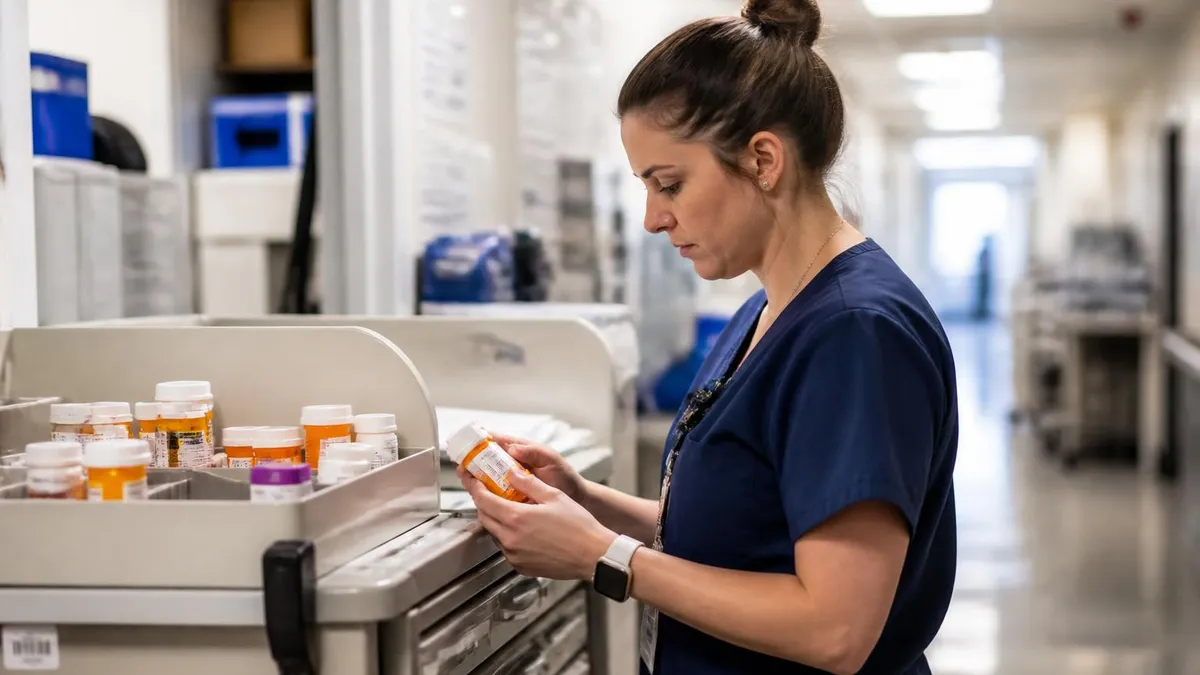
The NCSBN charges a flat $200 registration fee for both NCLEX-RN and NCLEX-PN attempts in the United States. Canadian candidates pay $360 CAD. On top of that, your state board of nursing collects its own licensure application fee, which ranges roughly from $75 to $200 depending on jurisdiction.
You may also pay a fingerprinting fee, a transcript fee, and a Nursys verification fee. Budget around $350 to $500 total for the first attempt and remember that any retake means paying the NCSBN fee again. A handful of states tack on extra one-time charges for temporary practice permits.
Recommended NCLEX Prep Timeline (3-6 Months)
Month 6 - Set the foundation
Month 4-5 - Content review
Month 3 - Domain rotation
Month 2 - High-yield review
Month 1 - Test simulation
Week of test - Light review
Test day
NCLEX Format: Pros and Cons
- +Adaptive testing finishes faster for strong candidates (often under 90 minutes)
- +Pass/fail format removes percentile pressure
- +NGN item types reward clinical reasoning over memorization
- +Five-hour cap with built-in optional breaks reduces fatigue
- +Same blueprint nationwide — no state-by-state variation in the test itself
- −Adaptive algorithm makes self-monitoring of progress impossible during the test
- −NGN case studies are longer and more cognitively demanding than legacy items
- −$200 retake fee adds up quickly if multiple attempts are needed
- −Limited official practice — most prep happens with third-party question banks
- −Five-hour cap is mentally draining even for candidates who finish early

NCLEX Pass Rates — How Hard Is It?
The 2024 NCLEX-RN first-time pass rate for US-educated candidates was approximately 84%. The first-time NCLEX-PN pass rate hovered around 80%. Repeat-takers and internationally educated candidates pass at lower rates, typically 40% to 55% depending on country of origin.
Pass rates also vary significantly by nursing program, with the strongest BSN programs reporting first-time results over 95% and weaker programs landing in the 60s. For a state-by-state breakdown read the nclex pass rates page, which tracks RN and PN results by jurisdiction and by school category.
Failed attempts are not the end of the road. You can retake the NCLEX after a 45-day waiting period imposed by the NCSBN, and most state boards allow up to eight attempts in a 12-month rolling window.
The pattern that emerges from candidate forums is consistent. Roughly 50% of first-time fails pass on their second attempt. That number climbs only modestly with each subsequent try. Investing in a structured remediation plan before retesting matters far more than rushing back to the testing center as soon as your 45 days expire.
What Should You Bring On Test Day?
Pearson VUE has strict rules. You must bring one valid, signature-bearing, government-issued photo ID. The name on the ID must exactly match the name on your ATT. Acceptable IDs include a driver license, passport, military ID, or permanent resident card. Expired IDs are turned away at the door. You also need your ATT either printed or accessible on your phone screen.
You cannot bring food, water bottles, study notes, watches, phones, jewelry beyond a wedding band, hats, or outerwear into the testing room. Everything goes into a locker. The center supplies a marker and laminated noteboard for scratchwork, and you can request a fresh board mid-test if you fill yours up.
How To Start Preparing
The single most predictive prep activity is high-volume question practice with deep rationale review. The NCSBN itself recommends 2,500 to 3,000 practice questions before test day for most candidates. Pair questions with structured content review using a book like Saunders, plus a video lecture series for the topics you find conceptually shaky. Skip passive reading. Every study session should end with practice items so you train recall, not recognition.
If you want a curated resource roundup, the best nclex prep guide compares the most popular review courses head to head. It walks through pricing, question count, video lecture quality, and which courses suit visual versus reading-oriented learners best.
Two question banks dominate every recommendation list. Archer is the budget pick at under $100 and is famous for slightly harder items than the real test. UWorld is the gold-standard pick at around $200 to $400 with the cleanest rationales in the industry. If you are short on time, the nclex 30 day study plan compresses the prep into a four-week sprint that has worked for thousands of repeat candidates.
The Bottom Line
The NCLEX is the gateway to your nursing career. It is hard, it is adaptive, and it is psychologically intense, but it is also designed to be passed by any well-prepared nursing graduate.
Understand the four-domain test plan, get fluent with NGN item types, log thousands of practice questions with rationales, and treat the test as the job interview it really is. Walk in calm, work each question on its own merits, and let the algorithm do the rest.
Quick recap to lock in the essentials. NCLEX stands for National Council Licensure Examination. It comes in RN and PN versions. The test is computer adaptive and runs 75 to 145 items in up to five hours.
Scoring is pass or fail through a 95% confidence interval. The current version is the Next Generation NCLEX, live since April 2023, with case studies and bowtie items front and center. The four-domain blueprint weights physiological integrity heaviest, and the average US-educated first-timer passes around the 84% mark.
NCLEX Test Day Checklist
- ✓Valid government-issued photo ID with signature, matching ATT exactly
- ✓Printed or digital ATT from Pearson VUE
- ✓Arrive at the testing center at least 30 minutes early
- ✓Light breakfast — protein and slow carbs, no excess caffeine
- ✓Snack and water bottle for locker (consumed during scheduled breaks)
- ✓Confirm directions, parking, and traffic the day before
- ✓Sleep at least eight hours the night before — no last-minute cramming
- ✓Leave watch, phone, jewelry, hat, and outerwear at home or in locker
- ✓Bring layers — testing rooms can be cold
- ✓Mental warmup: review your strongest topic the morning of for confidence
NCLEX History and Quick Facts
The NCLEX did not always look like this. From 1944 through 1994, every nursing candidate sat for a paper-and-pencil exam called the State Board Test Pool Examination. It ran two full days and used hundreds of questions on a scaled scoring system. The NCSBN converted the test to computer adaptive form in April 1994 and became the first major US licensure exam to make that jump.
The shift to NGN in April 2023 was the biggest format revision in nearly three decades. The NCSBN spent six years validating the new clinical-judgment items through field tests embedded in regular NCLEX exams. That is why the test continued to look familiar to candidates testing in 2021 and 2022, even as the redesign was already underway behind the scenes.
Some quick facts worth filing away. Around 200,000 nursing candidates take the NCLEX-RN each year in the United States, with another 50,000 sitting for the NCLEX-PN. Roughly 15% of test-takers are repeat candidates. The most common content area where candidates lose points is pharmacology, followed by safety and infection control.
Studies of failed first attempts consistently show that low question-bank volume, not poor school grades, is the strongest predictor of a fail. A 3.9 nursing GPA does not protect you if you only logged 800 practice questions before test day. Conversely, a 3.0 student who grinds through 3,000 carefully reviewed items often passes on the first try because the NCLEX rewards pattern recognition under pressure, not transcript polish.
One detail many new graduates miss is the role of quick results. In most US states, you can pay an extra fee to receive your unofficial pass-fail outcome 48 business hours after testing. That is well ahead of the official board release, which usually lands four to six weeks later. The unofficial result is not a license, but it tells you whether to celebrate or start planning your remediation right away.
Read more about scheduling, registration, and quick results inside the dedicated nclex schedule guide, and combine it with a focused nclex study plan to keep your prep on rails.
The combination of a realistic schedule and a high-volume question bank is what separates first-time pass candidates from the repeat crowd every single year. Treat your prep like a part-time job, log every question, review every rationale, and the NCLEX becomes a hurdle you clear, not a wall you hit. The day after you pass, your nursing license is days away from being printed.
NCLEX Questions and Answers
Related NCLEX Guides

How to Pass the NCLEX Exam in 2026 — Complete Study Guide
NCLEX Exam Eligibility — Complete Guide (2026)

Best NCLEX Prep 2026: Top Resources, Study Strategy, and How to Pass

NCLEX Pass Rates: RN & PN Statistics by State and School
30-Day NCLEX Study Plan — Pass on Your First Try

Free NCLEX RN Practice Test: 2026 Study Guide
About the Author

Registered Nurse & Healthcare Educator
Johns Hopkins University School of NursingDr. Sarah Mitchell is a board-certified registered nurse with over 15 years of clinical and academic experience. She completed her PhD in Nursing Science at Johns Hopkins University and has taught NCLEX preparation and clinical skills courses for nursing students across the United States. Her research focuses on evidence-based exam preparation strategies for healthcare certification candidates.
Join the Discussion
Connect with other students preparing for this exam. Share tips, ask questions, and get advice from people who have been there.
View discussion (8 replies)