
NBT Maths Past Papers: Where to Find Them and How to Practice for the MAT 2026
🎯 NBT maths past papers: official full papers aren't published, but you can practice MAT-style questions free. Fees, dates and prep steps for 2026 intake.
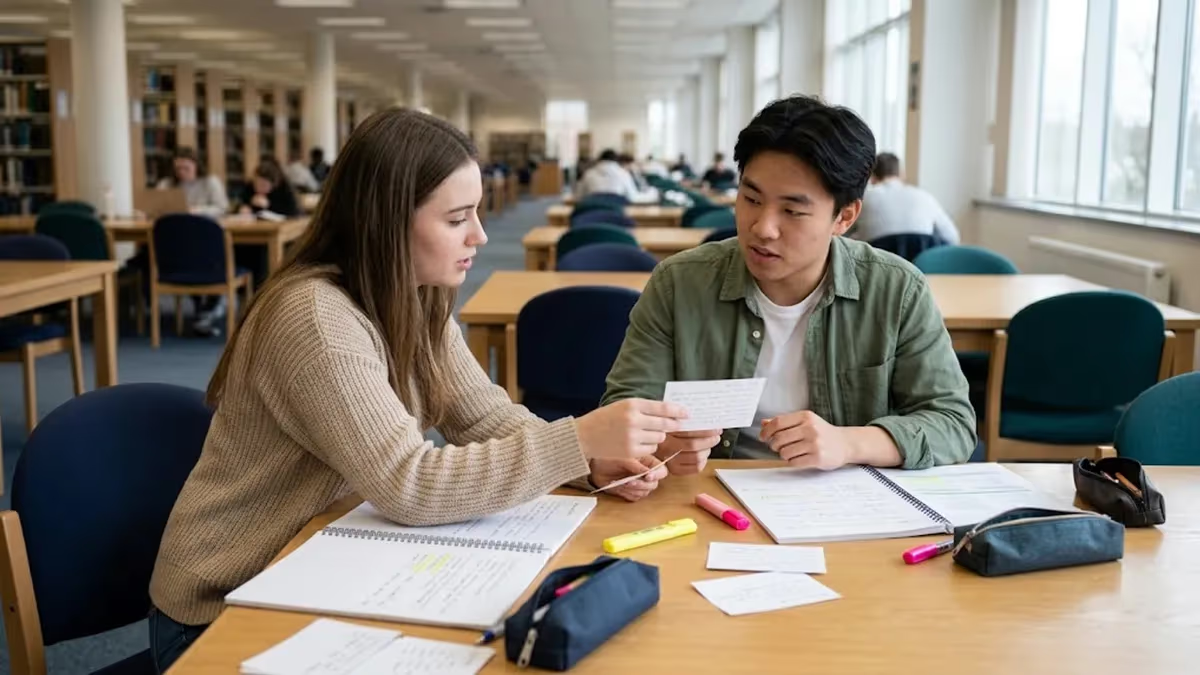
NBT maths past papers are not officially published: the National Benchmark Tests Project (NBTP) keeps its live Mathematics (MAT) forms secure. You can still practice with sample questions, free MAT-style quizzes, and your own school maths papers. The MAT is a 3-hour multiple-choice test written alongside the 3-hour AQL.
NBT Maths Past Papers: Key Facts (Updated October 2026)
| Fact | Details | Source |
|---|---|---|
| Tests and timing | AQL in the morning and MAT in the afternoon, both written on the same day; each lasts 3 hours and is multiple choice | NBTP 2026 Brochure |
| Delivery | Pencil-and-paper at a venue, or online at home with the minimum computer specification and a stable internet connection; forms are equated | NBTP: How to Book a Test |
| Fees (ZAR) | AQL + MAT R390; AQL only R195; remark R250; a rewrite means registering and paying again | NBTP 2026 Brochure |
| 2027 intake dates | 20 pencil-and-paper dates and 3 online sessions; the next session is 9 January 2027 | NBTP 2027 Intake Dates and Venues |
| Deadlines for 9 Jan 2027 | Register by 6 December 2026; pay by 14 December 2026 | NBTP Test Calendar |
| Results | Institutions receive results about 3 weeks after the test and writers about 4 weeks; results are valid for 3 years from the year written | NBTP: Access Your Results |
| Administered by | The National Benchmark Tests Project (NBTP) | NBT official website |
If you searched for nbt maths past papers, you probably want one thing: real questions to practice before test day. The honest picture is mixed. Unlike school exams, NBT forms are equated and kept confidential, so no archive of full old papers exists. What does exist is enough to prepare well: the MAT structure is stable, its content draws on the high-school mathematics curriculum, and its skills can be trained with targeted practice.
Before you hunt for papers, understand where the MAT sits. It is one half of the national bench mark test programme, which South African universities use for placement and, in some faculties, admission. US readers will know the idea from placement exams such as Accuplacer: a benchmark that shows what you can do now, not a grade. The maths paper covers algebra, functions, geometry, trigonometry and data handling, with multiple-choice answers and no trick formats.
Who actually needs the maths section? That depends on your degree. Engineering, science, health sciences, commerce and actuarial programmes usually require the MAT, while many humanities degrees ask only for the AQL, which combines academic literacy and quantitative literacy. Always read your university's admission page, because requirements differ by faculty and can change between intakes. Registering for the wrong combination wastes money, and a missing MAT result can delay an offer or a placement decision.
Practice material comes in three layers. First, the NBTP brochure and website describe the tests and the style of questions. Second, free question banks on this site mirror the topics and difficulty of the quantitative sections. Third, your old school papers remain valuable, since the MAT draws on the same curriculum. Combining all three gives you something close to a past paper without needing a leaked one, which you should never trust or use.
A quick word on the other NBT. Searches for nbts also surface NBT Bank, the US community bank, with queries like nbt bank near me, nbt routing number, nbt bank customer service and nbt online banker. None of that relates to this exam. If you want the bank's routing number or branch hours, use the bank's own website. Everything below is about the National Benchmark Tests for South African university entry, so you can skip the banking results.
This guide explains what a past paper means for the NBT, where to find legitimate practice, how to work through each paper type, and how to fit it into a schedule before the 9 January 2027 session. It reflects the NBTP's published 2027 intake calendar and fees as verified in September 2026. Where the NBTP has not published a detail, such as the number of questions per paper, we say so rather than guess.
How Long, How Much and How Valid Is the NBT Maths Test?
What Is the Format of the NBT Maths Test (MAT)?
The Academic and Quantitative Literacy test runs for three hours in the morning. It is multiple choice and covers reading and reasoning in English plus quantitative literacy. Most applicants must write it, whatever their degree.
The Mathematics test also lasts three hours and is multiple choice. It measures readiness for maths-heavy degrees such as engineering, science and commerce. The NBTP has not published an official question count, so rely on timing practice instead.
Writers can sit at a venue with pencil and paper or online from home. Online testing needs the minimum computer specification and stable internet. Both modes use equated forms, so neither version is easier than the other.
Institutions receive results about three weeks after the test and writers about four weeks. Results are valid for three years from the year written. A rewrite means registering and paying the full fee again.
Where Can I Find NBT Past Papers and Memo?
You will not find an official NBT past paper with a memo, because the NBTP does not release its live test forms. Each sitting uses equated forms, meaning different questions calibrated to the same difficulty, so old papers would not predict future ones anyway. Any site selling full NBT papers with a memo is either repackaging sample questions or offering unverified material. Treat those claims with caution and protect your payment details.
What you can use are legitimate substitutes. The NBTP brochure describes each test domain and the style of items. Many universities also link to preparation information from their admission pages. For a broader view, our guide to past papers of nbt lists the practice material we maintain, including question sets that follow the same multiple-choice layout used on test day, so you can build a routine around them.
Memo-style answers matter as much as the questions. When you practice, do not only check whether you got the letter right. Write out the full working for every item, then compare your method with a worked solution. The NBT is multiple choice, but the distractors are built from common mistakes, such as forgetting to flip an inequality or dropping a negative sign. Seeing your own error pattern is the real value of any memo.
Video explanations help when a written memo is too brief. If an answer makes no sense after two attempts, watch a walkthrough, redo the question without notes the next day, and log it in an error notebook. This loop of attempt, review and retry beats passively reading solutions. It also trains the habit the MAT rewards most: spotting which method fits a problem within the first thirty seconds of reading it.
Be careful with unofficial downloads. A PDF claiming to be a recent NBT paper may contain questions that were never on any test, or errors in the answer key. Practicing on wrong answers is worse than not practicing at all. A simple check is to ask whether the source explains how each question maps to a MAT topic. If it cannot, drop it and return to material you can verify against your textbook or teacher.
School papers are the best free archive. National Senior Certificate mathematics papers from the Department of Basic Education are published openly, and they cover the same topic families the MAT samples: algebra, functions, geometry, trigonometry and data handling. Use them for content, then practice speed separately with multiple-choice sets. The NBT rewards accuracy under time pressure, and school papers alone rarely train that second skill, so mix both.
If your goal is a particular degree, build your practice around it. Applicants to competitive programmes such as actuarial science at UCT should spend extra weeks on algebra fluency and number sense. Check the faculty's admission rules for current score expectations, since cut-offs belong to the university, not the NBTP. The NBTP reports performance levels, and each institution decides how to use them when ranking or placing applicants.
Are NBTs Worth Practicing With Past Papers or Sample Questions?
Official sample material comes from the NBTP itself. Its brochure explains the AQL and MAT domains, the multiple-choice style and the purpose of benchmarking, while the FAQ pages answer registration and results questions. These sources are accurate and current, which makes them your reference for format. They are limited in volume, so read them first for orientation, then move on to larger banks for the repetition that actually raises scores.
Treat official samples as a specification, not a full course. Note the question stems, how many options appear, and which topics get emphasis. Then rebuild that style when you practice elsewhere. Re-read the brochure the week before your test, because details such as arrival time, identification and permitted items affect your day more than any single maths topic does. Verify everything on nbt.ac.za before you rely on a rumour.
Are Past Papers and Practice Sets Enough to Prepare for the NBT Maths Test?
- +They build familiarity with multiple-choice timing before test day
- +Error patterns show exactly which topics need repair
- +Timed sets train stamina for a three-hour sitting
- +School papers and free quizzes cost little or nothing
- +Repetition makes standard methods automatic and fast
- +Practice reduces test-day anxiety and surprises
- −Full official NBT past papers are not published
- −Unofficial downloads may contain wrong answers
- −Practice alone cannot fix missing foundational concepts
- −School papers do not train multiple-choice speed
- −Too many papers without review wastes study time
- −Practice sets cannot predict your exact score or university cut-off
How Do I Get Ready to Practice for the NBTs?
- ✓Confirm which NBT tests your university and faculty require.
- ✓Download the NBTP brochure from nbt.ac.za and read the test descriptions.
- ✓Note the registration and payment deadlines for your chosen session.
- ✓Take one untimed diagnostic set and mark every mistake.
- ✓Sort errors into algebra, functions, geometry, trigonometry and data handling.
- ✓Gather two or three Department of Basic Education maths papers with memos.
- ✓Create an error log with date, topic, score and error type.
- ✓Schedule five practice sessions a week of 60 to 90 minutes.
- ✓Book two full three-hour simulations for the final two weeks.
- ✓Check your venue route or computer setup the day before the test.
Practice the skill, not the paper
Because each NBT sitting uses new equated forms, memorizing old questions gains you nothing. What carries over is method selection, accuracy and pacing. Aim to solve any standard problem type within ninety seconds, and use your error log to find the topics where you lose time.
Can I Skip the Math Section on the NBT Test?
You can skip the maths test only if your institution does not require it. The NBTP lets you register for the AQL alone at R195, instead of R390 for both tests, and that option exists for programmes that do not need mathematics. The decision is not yours to make alone, however. Faculty requirements decide, and a wrong guess can force a second registration and a second fee.
Start by checking each university on your shortlist. Write down which programmes need the AQL only and which need the AQL plus the MAT. If two universities disagree, register for the larger combination so one result serves both. Results stay valid for three years from the year written, so a single sitting can support applications for later intakes too, provided each institution accepts it.
Consider what skipping costs you beyond the fee. A MAT result may be used for placement, directing you into the right first-year maths stream or support course. A student who skips an optional test may receive a default placement instead. If you feel comfortable with maths, writing the optional test gives you stronger evidence for your application. Weigh that against the extra R195 and the longer day.
Remember that the quantitative literacy part of the AQL still tests number sense, graphs, tables and everyday reasoning, even if you skip the MAT. So you cannot avoid maths-style thinking entirely. Our quantitative literacy quizzes are a good warm-up for that section, and they build the data-reading speed the MAT relies on. Treat quantitative literacy as a separate skill from formal algebra and practice both in parallel.
Format and logistics also differ. The AQL runs in the morning and the MAT in the afternoon, each lasting three hours, so a double sitting makes for a long day. Bring water and any approved stationery listed in your confirmation. If you test online at home, check the minimum computer specification and your internet connection the day before, since technical problems eat into your concentration and cannot be fixed mid-test.
Many learners ask about studying on a phone. There is no official NBTP app, but you can practice in a browser. Our explainer on nbt mobile prep covers what exists and what does not, including how to use mobile-friendly quizzes during commutes. Short ten-minute sessions on a phone work well for formula recall, while longer timed sets belong at a desk with paper and a pen.
If you are unsure, email the admissions office and keep the reply. Ask three things: whether the MAT is required, whether it is recommended, and how the result is used. Admissions staff answer these questions daily, and a written reply protects you if you later disagree about requirements. Do this before the registration deadline, because a rewrite means registering and paying the full fee again.
For the 9 January 2027 session, you must register by 6 December 2026 and pay by 14 December 2026. Writers receive results about four weeks after the test. Confirm every date on the official NBT calendar before you pay.
Are There NBT AQL Test Past Papers Too?
AQL papers follow the same rule as maths: no full past papers are released. The AQL, short for Academic and Quantitative Literacy, runs three hours and is multiple choice, covering academic literacy and quantitative literacy in one morning session. Practice therefore means sample questions and skill drills. For reading, use long articles with inference questions. For quantitative literacy, use tables, graphs, percentages and ratio problems under a strict timer.
Searches such as nbt aql past papers and aql nbt past papers come from learners who sit both tests on the same day. That is sensible planning: the AQL occupies the morning, so your maths practice must also build stamina. Run a full three-hour block at least twice before test day, one reading-heavy and one number-heavy, and notice when your accuracy drops. Most learners fade after the second hour, and stamina is trainable.
A useful comparison helps you split study time. The AQL rewards reading speed, vocabulary in context and careful interpretation of graphs. The MAT rewards method selection, algebraic accuracy and spatial reasoning. If your school maths is strong, shift hours toward the AQL reading section. If maths is weak, protect at least 60 percent of your weekly hours for MAT topics. Revisit the split every Sunday using practice scores rather than your mood.
Rumours sometimes circulate about an nbt ban or sudden rule changes. The NBTP calendar for the 2027 intake lists 20 pencil-and-paper dates and 3 online sessions, so the tests are running normally. No explicit rule changes from 2025 to 2026 have been published beyond the new fee schedule and calendar. Our complete study hub tracks updates, but always confirm with the official NBT website before you pay.
Online versus pencil-and-paper is another choice. Online writers test at home with a minimum computer specification and a stable internet connection, while pencil-and-paper writers go to a venue. Both versions use equated forms, so neither is easier. Pick based on your circumstances: a quiet room and reliable data favor online, while shared housing or unreliable power favors a venue. Remote-writer queries go to nbtremote@uct.ac.za.
Build a practice log with four columns: date, topic, score and error type. After each session, mark whether errors were careless, conceptual or timing-related. Careless errors need checking habits, conceptual errors need relearning, and timing errors need speed drills. After three weeks the log shows exactly what to fix. It is the closest thing to a personal past-paper analysis, and it beats memorizing answers to any single set.
Finally, keep perspective. The NBT does not pass or fail you. It benchmarks your current level, and universities interpret it alongside your school results. A moderate score is not the end of an application, and a high score does not guarantee a place. Use practice to reduce surprises, not to chase perfection, and sleep well the night before. A calm writer with solid habits usually outperforms a stressed one with more hours.
What Is the Best Way to Prepare for the NBT Maths Test?
The best preparation plan is six weeks of structured practice built on timed multiple-choice sets. Spend week one diagnosing weak topics, weeks two to four fixing them, and the last two weeks on full-length simulations. Aim for five sessions per week of 60 to 90 minutes. Consistency matters more than marathon weekends, because maths skills fade quickly when you do not use them every few days.
Start the diagnosis with an untimed set. Solve every question properly, mark your answers, and sort mistakes by topic: algebra, functions, geometry, trigonometry, data handling and number work. The topic with the most mistakes becomes your first target. Resist the urge to start with your favorite topic, since comfortable practice feels productive but changes your score least. Be honest about gaps now, because test day will be honest for you.
Next, drill fundamentals until they are automatic. Check your NBT confirmation for the rules on calculators at your session, and practice accordingly. Fractions, exponents, factorizing, simultaneous equations and rearranging formulas appear constantly. Fluency here saves minutes per question. If you can factorize a quadratic in ten seconds, you free time for harder items. Use flash drills of 20 questions with a five-minute limit to build that automatic response.
Practice strategic elimination. Multiple-choice questions allow you to rule out options, substitute answer choices back into equations, and estimate to discard unreasonable values. Mark any question that costs more than two minutes, move on, and return if time remains. Read your test instructions to see whether wrong answers are penalized before relying on guessing. Elimination is a skill, and a few weeks of deliberate practice makes it quick and reliable.
Simulate test day twice. Sit at a desk, set a three-hour timer, remove your phone, and complete a full-length mixed set. Afterwards, spend an hour reviewing. Notice pacing: how many questions you finished at the one-hour and two-hour marks. If you spent half your time on the first third, adjust your approach. Simulations expose fatigue, rushing and panic patterns that short quizzes hide, which is why they belong in the final fortnight.
Handle logistics early. Register before the deadline: for the 9 January 2027 session, registration closes 6 December 2026 and payment is due by 14 December 2026. Pay through the listed channels, such as EasyPay or direct deposit or EFT to NBT Project, and keep proof of payment. Results reach institutions about three weeks after the test and writers about four weeks, so apply early enough to meet your university's deadlines.
In the last 48 hours, stop learning new topics. Review your error log, redo ten questions you previously missed, and check your venue route or computer setup. Prepare your ID, confirmation and stationery. Eat a normal breakfast, arrive early, and read each question fully before choosing an answer. Afterwards, remember the retake rule: a rewrite means registering and paying again, so give your first sitting your best honest effort.
NBT Questions and Answers

NBT Practice Test 2026

NBT Past Papers: Your Complete Guide to Practice Tests & Exam Prep

Is There an NBT App? The Truth About NBT Android & Mobile Prep in 2026

National Benchmark Test (NBT) 2026: Complete Study Guide & Prep Hub

National Benchmark Tests (NBT) 2026 — South Africa Guide to the AQL and MAT
My NBT Account: How to Log In, Reset Your Password, and Manage Your Profile
NBT Practice Test Video Answers
About the Author

Educational Psychologist & Academic Test Preparation Expert
Columbia University Teachers CollegeDr. Lisa Patel holds a Doctorate in Education from Columbia University Teachers College and has spent 17 years researching standardized test design and academic assessment. She has developed preparation programs for SAT, ACT, GRE, LSAT, UCAT, and numerous professional licensing exams, helping students of all backgrounds achieve their target scores.
Join the Discussion
Connect with other students preparing for this exam. Share tips, ask questions, and get advice from people who have been there.
View discussion (9 replies)