
What Is the National Interpreter Certification? A Complete Guide
What Is the National Interpreter Certification? A Complete Guide: Effective communication is a human right, and for the Deaf and hard-of-hearing…
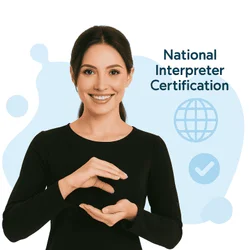
Effective communication is a human right, and for the Deaf and hard-of-hearing community, sign language interpreters play a crucial role in ensuring accessibility across all aspects of life. The National Interpreter Certification (NIC), awarded by the Registry of Interpreters for the Deaf (RID), is one of the most respected credentials for professionals working in American Sign Language (ASL) interpretation.
This certification validates an interpreter’s ethical conduct, linguistic fluency, and ability to navigate diverse settings ranging from healthcare to legal proceedings. Whether you're an aspiring interpreter or a professional seeking advancement, the NIC opens doors to meaningful career opportunities and confirms your commitment to communication equity.
NIC Practice Test Questions
Prepare for the NIC - National Interpreter Certification exam with our free practice test modules. Each quiz covers key topics to help you pass on your first try.
NIC ASL Proficiency
NIC Exam Questions covering ASL Proficiency. Master NIC Test concepts for certification prep.
NIC Consecutive Interpreting
Free NIC Practice Test featuring Consecutive Interpreting. Improve your NIC Exam score with mock test prep.
NIC Cultural & Linguistic Competency
NIC Mock Exam on Cultural & Linguistic Competency. NIC Study Guide questions to pass on your first try.
NIC Educational Settings
NIC Questions and Answers on Educational Settings. Free NIC practice for exam readiness.
NIC Ethical Decision-Making & Professional...
NIC Mock Test covering Ethical Decision-Making & Professional Conduct. Online NIC Test practice with instant feedback.
NIC Ethics & Professional Standards
Free NIC Quiz on Ethics & Professional Standards. NIC Exam prep questions with detailed explanations.
NIC Interpreting & Transliterating Skills
NIC Practice Questions for Interpreting & Transliterating Skills. Build confidence for your NIC certification exam.
NIC Language Receptive & Expressive Skills
NIC Test Online for Language Receptive & Expressive Skills. Free practice with instant results and feedback.
NIC Legal Settings
NIC Study Material on Legal Settings. Prepare effectively with real exam-style questions.
NIC Medical Settings
Free NIC Test covering Medical Settings. Practice and track your NIC exam readiness.
NIC Professional Ethics
NIC Exam Questions covering Professional Ethics. Master NIC Test concepts for certification prep.
NIC Quality Assurance & Editing
Free NIC Practice Test featuring Quality Assurance & Editing. Improve your NIC Exam score with mock test prep.
NIC Simultaneous Interpreting
NIC Mock Exam on Simultaneous Interpreting. NIC Study Guide questions to pass on your first try.
Key Takeaways
Free NIC Practice Test Online
The NIC is a nationally recognized certification for interpreters of American Sign Language (ASL) in the United States.
It is issued by the Registry of Interpreters for the Deaf (RID) and signifies high-level interpreting skills and ethical standards.
The NIC is required or preferred by many employers, especially in healthcare, education, legal, and government sectors.
Candidates must pass a knowledge exam and a performance exam that tests real-world interpreting scenarios.
NIC-certified interpreters often command higher salaries and greater access to specialized assignments.
Understanding the National Interpreter Certification (NIC)
The National Interpreter Certification (NIC) assesses an interpreter’s ability to interpret accurately and ethically in both expressive (spoken-to-signed) and receptive (signed-to-spoken) directions. Administered by RID, the NIC is one of several credentials available to ASL interpreters but is widely regarded as the gold standard in the industry.
The NIC tests candidates on:
Ethical decision-making in interpreting scenarios
Linguistic and cultural competence in ASL and English
Adherence to RID’s Code of Professional Conduct
Situational responsiveness, including healthcare, education, business, and legal contexts
Certification demonstrates a professional interpreter's readiness to handle complex and sensitive communication with both Deaf and hearing clients.

Steps to Become Nationally Certified as an Interpreter
The NIC certification process requires formal education, ASL proficiency, and passing standardized exams. RID has developed a multi-step pathway to ensure that only competent professionals earn the credential.
To become NIC certified, follow these steps:
Meet Educational and Training Requirements
Candidates must have at least a bachelor’s degree in any field. For those without a degree, RID offers an alternative pathway via an Education Equivalency Program (EEP).
Demonstrate Language Proficiency
Interpreters should have advanced fluency in ASL and English. Many candidates build their skills through interpreter training programs or Deaf Studies degrees.
Register with RID
Candidates must be members of the Registry of Interpreters for the Deaf (RID) and create an account to track eligibility, exam results, and certification status.
Pass the NIC Knowledge Exam
This computer-based test includes 150 multiple-choice questions on ethics, linguistics, and interpreting protocols. Administered by PSI Test Centers.
Pass the NIC Performance Exam
A video-based exam that assesses interpreting in various real-world scenarios such as healthcare consultations, education lectures, or courtroom settings.
Comply with Certification Maintenance
NIC holders must renew their certification every four years, which includes earning Continuing Education Units (CEUs) and upholding the RID Code of Professional Conduct.
Job Role and Responsibilities of NIC-Certified Interpreters
NIC-certified interpreters work in diverse environments where seamless communication between Deaf and hearing individuals is essential. Their primary role is to convey messages accurately while maintaining the tone, intent, and cultural context.
Typical responsibilities include:
Interpreting spoken English into ASL and vice versa during meetings, classes, or events
Providing real-time interpretation in hospitals, schools, legal settings, or public services
Managing ethical dilemmas and confidentiality in sensitive situations
Adjusting interpreting techniques based on the audience’s age, culture, or subject matter
Collaborating with Deaf professionals, educators, and service providers
Maintaining up-to-date knowledge of RID ethics and current best practices
NIC interpreters may also specialize in areas like legal interpreting, educational interpreting, or video relay services (VRS), depending on their interests and qualifications.
NIC Certification Salary Outlook
Holding an NIC credential enhances job prospects and salary potential across interpreting sectors. Salaries vary depending on specialization, region, and employment status (freelance vs. full-time).
Typical salary ranges include:
Entry-Level Interpreters: $45,000–$60,000 per year
Experienced NIC-Certified Interpreters: $60,000–$80,000 per year
Specialized/Legal Interpreters: $80,000–$100,000+
Freelance Interpreters (Hourly): $40–$80 per hour
NIC-certified professionals can also pursue consulting, training, or administrative positions in interpreting organizations or educational institutions.

Exam Fees and Certification Costs
The NIC certification process involves several fees. These costs may vary over time, so candidates should consult the RID website for the most current details.
Estimated costs include:
RID Membership Fee: $165 annually (required for exam eligibility)
NIC Knowledge Exam: $225
NIC Performance Exam: $410
Retake Fees: Vary depending on the exam component
Continuing Education Costs: Vary by provider
RID also offers financial assistance through scholarships and grants to support aspiring interpreters, especially from underrepresented communities.
Conclusion
The National Interpreter Certification (NIC) is a prestigious credential that validates an interpreter's skills, ethical judgment, and professionalism. Earning this certification is more than just passing a test—it's a commitment to advancing communication access and equality for the Deaf and hard-of-hearing community.
Whether you’re starting your interpreting journey or looking to elevate your career, the NIC offers recognition, growth, and respect in the interpreting profession. With strong demand across education, healthcare, law, and media, certified interpreters are essential agents of inclusive communication.
(NIC) National Interpreter Certification Questions and Answers
About the Author
Certified Professional Development Expert & Niche Certification Advisor
University of Pennsylvania Graduate School of EducationDr. Alexandra Kim holds a PhD in Professional Studies from the University of Pennsylvania and is a Certified Professional in Learning and Performance (CPLP) and Certified Professional in Talent Development (CPTD). With 17 years of corporate training and professional certification advisory experience, she helps professionals navigate specialized, emerging, and cross-industry certification programs.