
Bridal Makeup Artist: Complete Career Guide & Booking Strategy 2026 September
⏳ Bridal makeup artist career guide: training, kit, trial workflow, wedding-day pricing, photographer referrals, and booking systems that scale to six
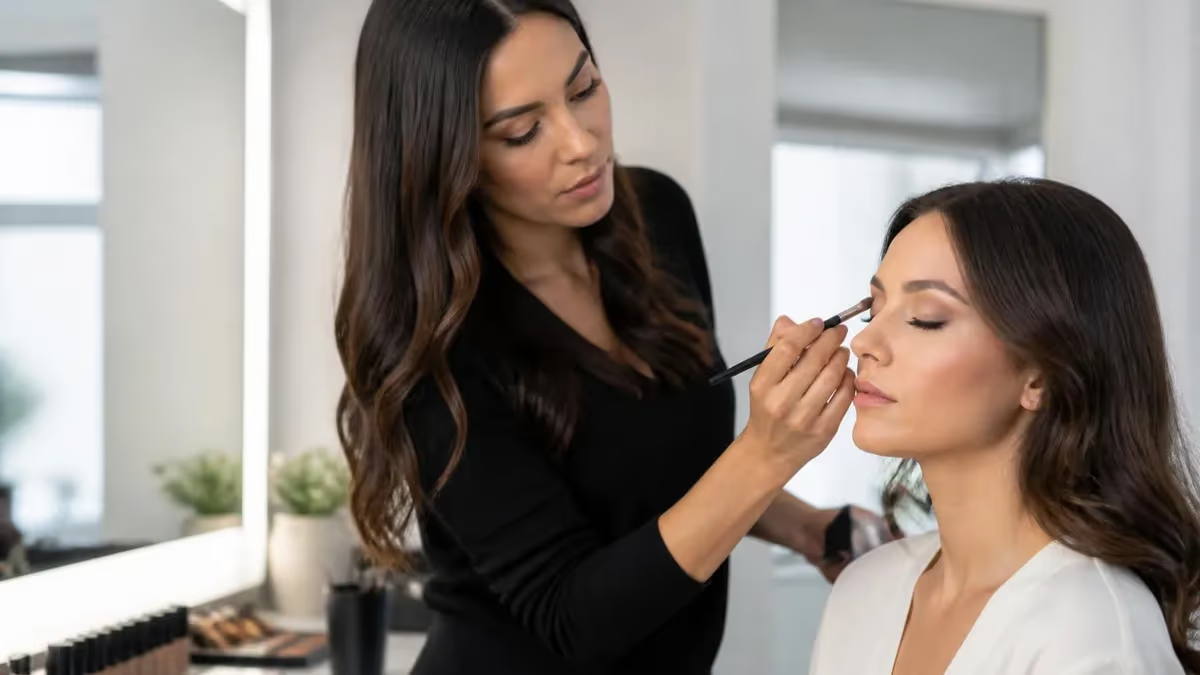
Bridal makeup is the calmest, highest-paying, and most repeat-driven niche in the makeup industry, and most new MUAs underestimate how different it is from editorial, film, or counter work. A bride is not a model.
She will cry. She will hug her mother. She will eat a sandwich. She will sweat under photography lights for nine hours, then get photographed at distances ranging from six inches (the ring shot) to sixty feet (the church balcony). Your job is to build a face that survives every one of those moments and still looks like her, only better.
This guide walks the entire bridal MUA career path: the specialty that separates you from generalists, the training and certifications that actually matter, the kit you cannot fake your way through, the trial-to-wedding-day workflow, and what to charge.
If you are weighing whether bridal is even right for you, here is the short version. Brides book six to eighteen months in advance, pay deposits, refer friends in tight clusters, and almost never ghost. The flip side is Saturday mornings forever, alarm clocks at four a.m., and emotional labor nobody warns you about.

Editorial, film, and bridal share brushes and not much else. Editorial work rewards experimentation, heavy product, and a director who tells you when to wipe it all off. Film work rewards continuity, prosthetics knowledge, and the patience to powder the same forehead two hundred times a day.
Bridal rewards none of those. Bridal rewards predictability, speed, and emotional intelligence.
The bridal MUA wins on three measurables: longevity (does the face survive eight to twelve hours), photographic fidelity (does it photograph the way the bride imagined), and chair experience (did she feel relaxed and pretty during the trial and the morning-of).
A bride who loved her trial will tell her engaged friends. A bride who felt rushed or talked-down-to will warn them. The difference between a $400 bride and a $1,200 bride is rarely the brushes. It is the chair experience and the predictability of the result.
The bridal specialty also has a real product profile. Editorial leans on shimmer and pigment payoff. Film leans on alcohol-activated palettes. Bridal leans on long-wear cream foundation, sealed with finely-milled powder, set with a humidity-resistant spray, finished with strip or cluster lashes that read on camera without looking heavy in person.
Strip bridal makeup down to the metrics that determine whether you get rebooked through her referrals: longevity (does the face survive 8-12 hours of ceremony, photos, tears, and dancing), photographic fidelity (does it match what she imagined when she sees the gallery), and chair experience (did she feel relaxed and beautiful during the trial and morning-of, not rushed or talked down to). Brides do not pay for your brush collection. They pay for those three outcomes.
Nobody hires a bridal MUA by checking her diploma. Brides hire by Instagram grid, then by referral, then by trial. That said, the path you take to get good matters because it determines how fast you stop losing money on every job. Three routes work, and they are not equivalent.
The first is full cosmetology or esthetics school. Slowest path (600 to 1,600 hours), most expensive ($6,000 to $20,000), and the only one that gives you a state license in most jurisdictions. Best if you also plan to offer skin services or brow shaping.
The second is private MUA academy. Programs from Make Up For Ever Academy, Cinema Makeup School, EI School of Professional Makeup, or smaller regional studios run 4 to 24 weeks and cost $3,000 to $25,000. The good ones drill on bridal, give you a working kit, and put you in front of live models. The bad ones charge twenty thousand for a glorified YouTube playlist.
The third is mentorship and self-study, which is how most successful bridal MUAs actually trained. Assist an established artist for a season, build a portfolio with styled shoots and friends, and take targeted courses (airbrush, lashes, mature skin, deep-skin tone work) as you find gaps.
Certifications worth getting once working: bloodborne pathogens (Barbicide, $20-$40 online), an airbrush cert from your compressor manufacturer, and an Allied Beauty Association or PBA membership for industry pricing on insurance. None of these book you a wedding. All of them defend your rate.
600-1,600 hours, $6K-$20K, state license. Best if you also want to offer skin services. Required for makeup-only work in a handful of states (check your board).
4-24 weeks, $3K-$25K, focused curriculum. Quality varies massively. Vet by graduate portfolios and confirm instructors are working pros.
Assist a working artist for a season, build a portfolio with styled shoots, target courses for specific gaps (airbrush, lashes, mature skin). Cheapest path to paid work if you are honest about weaknesses.
Bloodborne pathogens ($20-$40), airbrush manufacturer cert, PBA/ABA membership. None book weddings; all defend your rate and professionalism.
A bridal kit is not a starter kit with more stuff. It is a deliberately curated loadout where every product has been tested on at least a dozen faces, in at least three lighting conditions, and through at least one eight-hour wear test.
Foundation is the single most important category. You need a long-wear cream foundation (Face Atelier, Temptu, Kett, or MUFE Ultra HD), a full-coverage cream-to-powder for problem skin, and either a high-end traditional foundation or an airbrush system for skin that demands a flawless finish.
Carry the full shade range. A bridal kit that cannot match a bride two shades darker than the lightest sample is unprofessional, period. If you do not have brown-skin shades, you do not have a bridal kit.
Powder gets a section of its own because it is what makes bridal photograph well. Translucent powders read flashback on camera. Use a finely-milled tinted setting powder (Laura Mercier, Make Up For Ever HD, or Charlotte Tilbury Airbrush Flawless) and a separate banana or peach powder for under-eye.
Lashes, blush, and a sealing spray finish the kit. Strip lashes plus a strong but waterproof adhesive handle most brides. A cream blush layered with a powder blush reads on every skin tone and survives tears. The sealing spray is what makes your work last twelve hours.
Long-wear cream (Face Atelier, Temptu, Kett, MUFE Ultra HD) plus a cream-to-powder for problem skin. Carry the full shade range; missing brown-skin shades disqualifies you from bridal work in any diverse market. Add an airbrush system once you have the volume to justify the learning curve.
The trial is where you either make the bride a fan for life or quietly lose her, and the difference is almost never about skill. It is about expectation-setting.
A trial that takes ninety minutes and produces a look the bride sort of likes is a failure. A trial that takes two and a half hours, produces a look she loves, and includes a written record of every product is a win even if her exact skin tone is impossible to match.
Block at least two hours, ideally two and a half. Charge separately for it ($75-$200), and apply some or all of that to the wedding-day total if she books. Have her arrive with clean, moisturized skin and three to five reference photos (not thirty).
Spend the first fifteen minutes talking, not painting. Ask about her dress neckline, her venue lighting, her sweat profile, her tendency to cry, her photographer's style, and whether she ever wears foundation in normal life. The answers shape everything.
During application, narrate what you are doing and why. That kind of running commentary builds trust faster than any portfolio piece. After application, photograph her in three lighting conditions: window daylight, your ring light, and direct on-camera flash. Show her each result.
Document the trial in writing. Every product, every brush, every shade. Many bridal MUAs use a trial card or a Notion template. The recipe protects you and impresses her.
Photograph the bride in window daylight, your ring light, and direct on-camera flash at the end of every trial. Show her each shot. The number-one cause of wedding-day complaints is a face that looked perfect in the suite but read flashback or muddy in the gallery. A three-light trial photo catches this in advance and gives you time to swap products. Skipping this is the single most common preventable mistake in bridal work.
On-location wedding-day work is a different animal from the trial. You are in a hotel suite, a getting-ready loft, a bridal cottage, or a parent's living room, and the lighting is whatever it is. The wedding-day workflow has to be airtight or you will be the reason the bride is late.
Arrive thirty to forty-five minutes before your first scheduled application. Scout for the best window of natural light and set up there. Use a portable LED ring or panel as backup. Venue lighting is unreliable.
Run the bridal party first, bride last. Doing the bride first creates a problem: she sits in her makeup for two extra hours while you finish six bridesmaids, and that is two hours of sweating, eating, hugging, and crying on a fresh face.
Pace yourself. A typical bridesmaid application is forty-five minutes including lashes; the bride is sixty to ninety. Five bridesmaids plus a bride is roughly six and a half hours of chair time. If the timeline does not work, bring an assistant. A second artist (paid $400-$800 for the day) doubles your throughput.
Pack a touch-up bag for the bride. A small zip pouch with her exact lipstick, a powder compact, blotting papers, a folded cotton swab, and a written note telling her maid of honor what is in it and when to use it. This costs you ten dollars and produces some of the most grateful thank-you messages you will ever receive.

Wedding-Day Workflow Checklist
- ✓Arrive 30-45 minutes before first scheduled application
- ✓Scout best natural-light window and set up there
- ✓Bring portable LED ring or panel as backup lighting
- ✓Lay out only the products you will actually use; keep case organized
- ✓Run bridal party first, bride last (unless first-look schedule)
- ✓Plan 45 minutes per bridesmaid, 60-90 minutes for the bride
- ✓Bring an assistant for any party of 4+ to protect the timeline
- ✓Pack a touch-up bag with her exact lipstick + powder + blotting papers
- ✓Sanitize visibly between every face; brides notice
- ✓Photograph the finished bride in your ring light before she stands
Bridal pricing in the US ranges from $150 for a stripped-down face on a budget bride in a low-cost market to $1,500 and up for an in-demand artist in New York, Los Angeles, or a destination market. There is no single right number, but there is a wrong way to price: by the hour.
Charge by the service, with travel and bridal-party add-ons priced separately. Hourly pricing trains brides to rush you, and rushed bridal makeup looks rushed.
A workable starter structure in a mid-tier market (Atlanta, Phoenix, Charlotte): bridal trial $150, wedding-day bridal application $400, bridesmaid $125, mother-of $130, flower girl light service $50, travel inside thirty miles included, beyond that $1 per mile.
Add a $75-$150 early-start fee for any application before 7 a.m. and a $100-$200 second-artist coordination fee when you bring an assistant. Many MUAs also add a destination day rate of $1,500-$3,000 plus expenses for full-day out-of-state work.
Raise rates every twelve months and every time your calendar passes 70% booked for the upcoming wedding season. Brides who balk at a price are not your brides; they are someone else's brides, and you will replace them with brides who will not.
MUA Bridal Specialty Pros and Cons
- +Brides book 6-18 months out — predictable calendar and cash flow
- +30-50% non-refundable deposits stabilize revenue
- +High referral density: one happy bride feeds 3-8 inquiries
- +Repeat services possible (anniversary refresh, vow renewal, family shoots)
- +Day rates of $400-$1,500+ scale cleanly with skill and portfolio
- +Off-season (Nov-Feb) is when next year books
- −Every Saturday is committed during peak season (May-Oct)
- −Early start times: 4-6 a.m. alarms are routine
- −Emotional labor: nervous brides, family dynamics, in-law tension
- −Kit cost is real: $4,000-$10,000 to build a market-ready loadout
- −Liability exposure: general + professional insurance is mandatory
- −Seasonal income swings demand disciplined cash management
The photographer and planner referral network is the single biggest revenue lever in bridal makeup, and it is almost entirely under your control. Photographers see twenty to fifty weddings a year. Planners see thirty to a hundred and twenty. They both have a short list of MUAs they recommend without being asked.
Step one: identify the photographers and planners in your market whose aesthetic matches yours. Follow their work for a season. Comment substantively (not "love this!" emojis). Step two: when you book a wedding with one of them on the team, deliver the smoothest day of their year.
Be early. Be quiet on the radio. Touch up the bride before the first-look without being asked. Hand the photographer the lipstick tube so he or she can give it to the bride for the dance. Photographers remember the artist who made their day easier.
Step three: send the photographer or planner ten of your best images from that wedding, with credit attached, within forty-eight hours. They will use those images for marketing, and your name will travel with them.
Step four: stay in touch off-season. A handwritten thank-you in January, a coffee in March, an Instagram tag when they publish a feature. The MUAs who own a market did this consistently for two to four years before it compounded.
By bride number ten, manual booking will eat you alive. By bride number thirty, you need a system. The category-standard tools are HoneyBook, Dubsado, and 17hats for full client management, plus Acuity Scheduling or Calendly for trial bookings.
Each handles contracts, deposits, invoices, and automated emails. The differences are mostly aesthetic. Pick one and use it fully rather than half-using two.
A minimum viable system: a contract template (PBA and NABCP offer reviewable templates), a deposit policy of 30-50% non-refundable on booking, an inquiry form that captures wedding date, venue, party size, and ceremony time, an automated thank-you email that sets a 24-48 hour reply expectation, and a calendar that blocks travel time around every booking.
Above the floor you add automated review requests at 14 days post-wedding, a gallery-delivery email at 30 days, and an anniversary email at one year. The anniversary email books anniversary refresh sessions for the bride's wedding album and is one of the highest-margin services in the bridal calendar.
Insurance is not optional. Carry general liability ($1M per occurrence, $2M aggregate) and professional liability separately. PBA, NABCP, and Hiscox all sell artist-specific policies for $200-$500 a year. A single allergic reaction to a foundation ingredient can end a career without coverage.
Bridal demand is seasonal everywhere except a few year-round markets (Las Vegas, parts of Southern California, Hawaii, parts of Florida). In most US markets, peak season is May through October with two smaller pulses around Valentine's Day and New Year's Eve.
The implication is that your calendar will look like a barbell and your cash flow will follow it. Plan accordingly. Off-season strategy matters as much as in-season execution.
November through February is when you book the next year. Sixty to seventy percent of next-year weddings inquire between October and February, often within a week of getting engaged. Refresh your portfolio with styled shoots, take continuing education, and run promotions for engagement shoots, anniversary refreshes, and corporate headshot days.
Off-season is also when you renegotiate vendor relationships and update pricing. Raising rates in May during peak is professional suicide. Raising them in November is a Tuesday.
Marketing platforms tilt seasonal too. TheKnot and WeddingWire inquiries peak November through March. Instagram engagement on bridal content peaks May through September. Pinterest planning activity is heaviest December through March. A bridal MUA who runs the same content year-round on all three is wasting effort.
Bridal makeup is one of the rare creative careers where the path to a six-figure income is mapped, predictable, and almost entirely under your control. The brides exist, they have budgets, they book months in advance, and they refer their friends.
The skills are learnable on a measurable timeline. The only real gate is whether you commit to the niche or keep splitting your attention between bridal, editorial, and counter work, hoping one of them takes off.
Pick a market. Build a kit that can match every skin tone in it. Train deliberately on the specific challenges of bridal: longevity, photography, mature skin, deep-skin foundation matching, lashes that read on camera. Charge what a Saturday is worth. Document everything. Show up early. Raise rates every twelve months.
Read the FAQ below for the specific questions brides and new MUAs ask most often, and use the practice tests linked above to drill the technical knowledge most bridal exams and licensing boards still test on.
MUA Questions and Answers
About the Author
Licensed Cosmetologist & Beauty Licensing Exam Specialist
Paul Mitchell SchoolsMichelle Santos is a licensed cosmetologist with a Bachelor of Science in Esthetics and Salon Management from Paul Mitchell School. She has 16 years of salon industry experience and 8 years preparing students for state cosmetology board exams in theory, practical skills, and sanitation. She specializes in licensure preparation for cosmetologists, estheticians, and nail technicians.
Join the Discussion
Connect with other students preparing for this exam. Share tips, ask questions, and get advice from people who have been there.
View discussion (7 replies)