
MTA Complaints: How to File a Complaint, Track Service Issues, and Get Resolution from the Metropolitan Transportation Authority
MTA complaints guide — 📚 how to file subway, bus, LIRR, and Metro-North complaints, track resolution, and escalate unresolved issues effectively.
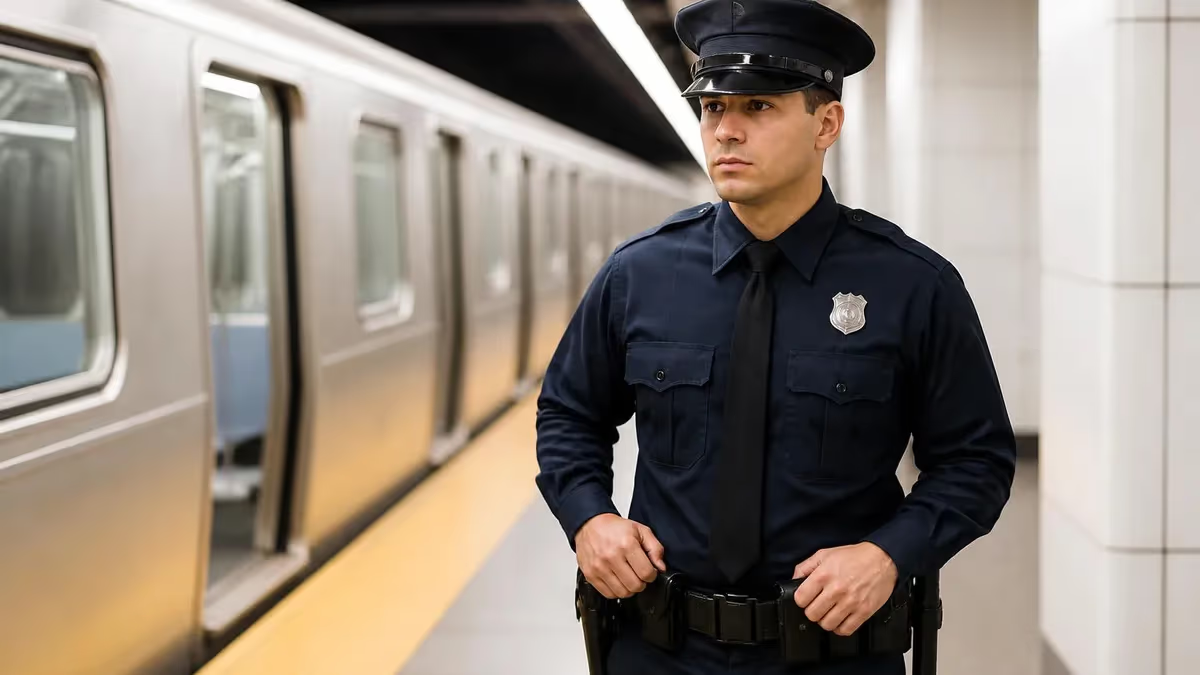
Filing mta complaints is one of the most direct ways riders, employees, and members of the public can hold the Metropolitan Transportation Authority accountable for service quality, safety, fare disputes, accessibility shortfalls, and the conduct of personnel across the subway, bus, LIRR, Metro-North, and bridges and tunnels divisions. Whether you experienced a delayed train, an inoperable elevator, a rude interaction with a station agent, or witnessed a safety violation, the MTA maintains formal channels designed to capture, log, route, and respond to every reported concern within a defined window.
The MTA receives hundreds of thousands of customer contacts each year through phone lines, the official website, the MYmta app, social media, written letters, and in-person visits to customer service centers. Each complaint is assigned a tracking number, routed to the appropriate operating division, and answered by a customer service representative or supervisor. Understanding which channel to use — and how to phrase your complaint — can dramatically shorten the time between submission and meaningful resolution from the agency.
Not every complaint receives the same treatment. Safety-related reports involving criminal activity, harassment, or dangerous conditions are prioritized and may be routed to the MTA Police, NYPD Transit Bureau, or the Office of the Inspector General. Service complaints about delays, cleanliness, or equipment failures typically flow to the relevant operating agency, while accessibility complaints fall under the ADA compliance office. Knowing the proper destination prevents your complaint from being lost in a queue or closed without action.
This guide walks through every method available for filing mta complaints, the typical response timelines, escalation paths when initial responses are unsatisfactory, and your rights as a customer or employee. It also covers how to document incidents properly, what evidence strengthens a complaint, and how to invoke external oversight bodies such as the New York State Comptroller, the MTA Inspector General, and state legislative committees when internal processes fail to deliver a satisfactory outcome.
You will also learn how complaint data is used internally — feeding into performance dashboards, station inspection schedules, disciplinary reviews, and capital planning decisions. Riders who frame their complaints with specific dates, times, train or bus numbers, station locations, and employee badge numbers contribute to a data record that has historically driven real operational changes, from improved elevator maintenance contracts to revised conductor training and expanded weekend service patterns across multiple lines.
For aspiring MTA Police officers, understanding the complaint ecosystem is also part of the job. Officers interact daily with members of the public who may file complaints against them, and they must know the agency's internal affairs procedures, civilian complaint review processes, and the documentation standards that protect both the officer and the public during any subsequent investigation conducted by the department or by external bodies overseeing transit law enforcement personnel.
Before diving into the specifics, set realistic expectations. The MTA acknowledges that not every complaint will end in a refund, a policy change, or formal discipline. However, a well-documented, properly routed complaint creates a permanent record, contributes to systemic data, and frequently produces a written response that explains what action — if any — was taken. That transparency is the baseline standard the agency has committed to under its customer service charter and public accountability framework adopted by the MTA Board.
MTA Complaints by the Numbers
Primary MTA Complaint Channels
The statewide 511 hotline routes transit complaints to the MTA. Operators take detailed reports, issue tracking numbers, and route to the relevant division. Available 24 hours a day, seven days a week, with language assistance services.
The Contact Us form at mta.info captures structured complaints with required fields for date, time, location, division, and incident category. Submissions generate an automatic confirmation email containing your case number.
The official MYmta mobile app allows riders to report service issues, accessibility problems, and station conditions directly from the platform. Photos and geolocation data can be attached to strengthen the report.
Mailed complaints to MTA Customer Service, 2 Broadway, New York, NY 10004, create a paper trail useful for serious matters. Certified mail with return receipt provides proof of delivery for escalation purposes.
Customer service centers at major terminals — including Grand Central, Penn Station, and Atlantic Terminal — accept walk-in complaints. Staff can issue tracking numbers and explain the routing process face to face.
The step-by-step process for filing mta complaints begins with identifying the correct division. If your issue involves the subway, buses in New York City, or Staten Island Railway, your complaint flows to New York City Transit. LIRR and Metro-North operate as separate commuter rail divisions with their own customer service teams. Bridges and Tunnels complaints — concerning E-ZPass disputes, tolls by mail, or staff conduct at crossings — route to the MTA Bridges and Tunnels customer service unit, which has its own dedicated phone and online portals.
Once you know the division, gather the specifics before contacting anyone. Note the exact date and time of the incident, the train route number or bus route, the direction of travel, the station name or bus stop, and any identifying information about employees involved, such as name badges or vehicle numbers. Photographs, video clips, MetroCard or OMNY transaction receipts, and witness contact details substantially strengthen the report and reduce the chance that the agency closes your case for lack of evidence.
When you file by phone through 511, follow the prompts for transit complaints and request a written confirmation be emailed to you. Operators are trained to read back the details, so listen carefully and correct any errors immediately. Ask for the tracking number before ending the call and write it down. That number is your key reference for follow-up inquiries, freedom of information requests, and any future escalation to oversight bodies or media outlets covering the MTA's response.
Online submissions through mta.info funnel into a customer relationship management system that automatically classifies complaints by category, assigns priority, and routes them to a queue managed by the appropriate division. You will receive an email confirmation within minutes containing your case number, followed by a substantive response within fourteen calendar days for standard service complaints. ADA accessibility complaints carry a shorter response target, typically within ten business days under federal disability rights regulations.
If you prefer the MYmta app, log in with your existing MTA account or create a guest profile. Tap the menu icon, select Customer Feedback, choose the relevant category — delay, cleanliness, employee conduct, fare dispute, accessibility, or safety — and provide as much detail as the form allows. Attaching a geotagged photo dramatically increases the chance that the maintenance, cleaning, or operations team can verify and address the underlying condition within hours rather than the standard two-week window.
Written letters remain a respected channel for serious matters such as personal injury, formal employee misconduct allegations, and disputes the agency has already declined to resolve through quicker channels. Address mail to MTA Customer Service, 2 Broadway, New York, NY 10004, and consider sending it certified with return receipt requested. Reference any prior tracking numbers in the letter and clearly state the resolution you are seeking, whether that is a refund, a policy review, an apology, or formal disciplinary action against an identified employee.
Throughout the process, keep a personal file. Save the confirmation email, screenshot the submission, retain copies of any photos or video, and log every phone call with the date, time, and name of the representative you spoke with. This documentation becomes essential if you later escalate to the MTA Inspector General, the New York State Department of Transportation, the Federal Transit Administration, or a state legislator whose committee oversees the agency's operations and budget allocations each year.
MTA Practice Test Questions
Prepare for the MTA - Police Exam exam with our free practice test modules. Each quiz covers key topics to help you pass on your first try.
MTA Police MCQ
MTA Exam Questions covering Police MCQ. Master MTA Test concepts for certification prep.
MTA Police Reading Comprehension Test
Free MTA Practice Test featuring Police Reading Comprehension Test. Improve your MTA Exam score with mock test prep.
MTA Police Written Test
MTA Mock Exam on Police Written Test. MTA Study Guide questions to pass on your first try.
MTA Community Policing
MTA Test Prep for Community Policing. Practice MTA Quiz questions and boost your score.
MTA Constitutional Rights
MTA Questions and Answers on Constitutional Rights. Free MTA practice for exam readiness.
MTA Criminal Law
MTA Mock Test covering Criminal Law. Online MTA Test practice with instant feedback.
MTA Emergency Response
Free MTA Quiz on Emergency Response. MTA Exam prep questions with detailed explanations.
MTA Investigation Techniques
MTA Test Online for Investigation Techniques. Free practice with instant results and feedback.
MTA Law Enforcement Procedures
MTA Study Material on Law Enforcement Procedures. Prepare effectively with real exam-style questions.
MTA Traffic and Patrol Procedures
Free MTA Test covering MTA Traffic and Patrol Procedures. Practice and track your MTA exam readiness.
MTA Transit System Knowledge
MTA Exam Questions covering MTA Transit System Knowledge. Master MTA Test concepts for certification prep.
MTA Complaints by Operating Division
New York City Transit handles the largest volume of mta complaints, covering subway, local and express buses, paratransit Access-A-Ride, and the Staten Island Railway. Common complaints involve train delays, signal failures, dirty stations, broken turnstiles, faulty MetroCard or OMNY readers, and conductor or bus operator conduct. Reports route through 511 or mta.info and are logged in the Customer Communications database used by station supervisors and depot managers.
Subway-specific complaints about elevator or escalator outages are urgent — federal ADA regulations require the MTA to restore accessibility equipment quickly. Bus complaints often reference route numbers and run numbers visible on schedules. Including the bus's four-digit fleet number, which appears on the rear and side panels, helps depot managers identify the specific operator and vehicle involved in the incident reported by the rider.
Is Filing an MTA Complaint Worth the Effort?
- +Creates a permanent record that contributes to systemic performance data
- +Frequently produces a written response explaining action taken
- +Refunds for chronic delays and service disruptions are routinely approved
- +ADA accessibility complaints trigger federally mandated remediation timelines
- +Tracking numbers allow follow-up and escalation if the initial response is inadequate
- +Repeated complaints about the same employee or condition build a documented pattern
- +Free to file through phone, web, app, or in-person channels
- −Standard response window of fourteen days can feel slow for urgent issues
- −Not every complaint results in a refund, policy change, or disciplinary action
- −Generic complaints lacking specifics are often closed without meaningful action
- −Phone wait times during peak hours can exceed twenty minutes on 511
- −Anonymous complaints carry less weight than those with full contact information
- −Some complaints require escalation to external oversight bodies for resolution
Pros and Cons at a Glance
| Pros | Cons |
|---|---|
| Creates a permanent record that contributes to systemic performance data | Standard response window of fourteen days can feel slow for urgent issues |
| Frequently produces a written response explaining action taken | Not every complaint results in a refund, policy change, or disciplinary action |
| Refunds for chronic delays and service disruptions are routinely approved | Generic complaints lacking specifics are often closed without meaningful action |
| ADA accessibility complaints trigger federally mandated remediation timelines | Anonymous complaints carry less weight than those with full contact information |
| Tracking numbers allow follow-up and escalation if the initial response is inadequate | Some complaints require escalation to external oversight bodies for resolution |
Strong MTA Complaint Documentation Checklist
- ✓Record the exact date and time of the incident, down to the minute
- ✓Note the train route, bus route, or facility name where the issue occurred
- ✓Capture the train number, bus fleet number, or vehicle identifier if visible
- ✓Photograph any physical conditions such as broken equipment or unsanitary areas
- ✓Save MetroCard, OMNY, or ticket transaction receipts proving you were present
- ✓Write down employee names, badge numbers, or descriptions if conduct was involved
- ✓Collect names and contact information for any witnesses to the incident
- ✓Describe in writing exactly what happened in chronological order without speculation
- ✓State clearly what resolution you are seeking, such as refund, apology, or review
- ✓Submit through the appropriate channel and save the tracking number for follow-up
Specificity drives results.
MTA complaint analysts consistently report that complaints containing precise dates, times, train or bus numbers, station locations, and identifiable employee information are resolved at far higher rates than vague reports. A complaint stating 'the 6 train was late this morning' will likely be closed with a generic apology. A complaint citing 'Train 6 northbound, departed 86th Street at 8:14 AM on Tuesday, arrived 96th Street at 8:31 AM' triggers an actual operational review.
When the MTA's initial response to your complaint is unsatisfactory — whether the agency closes the case without action, fails to respond within the promised window, or provides a generic reply that does not address the substance of your concern — multiple escalation paths exist. The first internal step is to request supervisory review by replying to the closing communication and asking that a supervisor or division manager personally examine the file. Reference your original tracking number and clearly state why the response was inadequate.
If supervisory review still produces no satisfactory outcome, the MTA Office of the Inspector General provides independent oversight. The OIG investigates fraud, waste, abuse, employee misconduct, and systemic failures within the agency. Complaints to the OIG can be filed online at mtaig.ny.gov or by calling its dedicated hotline. The OIG is structurally independent from MTA operating divisions, which means it can pursue investigations that internal customer service teams might be reluctant or unable to advance against their own colleagues.
External state-level oversight comes from the New York State Comptroller's Office, which audits MTA finances and operations, and from the State Senate and Assembly committees on transportation, which hold hearings on agency performance. Constituents who believe their complaint reflects a systemic issue can contact their state legislator's office to request inquiry assistance. Legislative staff routinely contact MTA government affairs liaisons on behalf of constituents and can often produce responses far faster than direct channels.
Federal oversight applies primarily to civil rights and accessibility matters. The Federal Transit Administration enforces Title VI of the Civil Rights Act and ADA accessibility requirements for transit agencies receiving federal funding. Complaints alleging discrimination based on race, color, national origin, or disability can be filed with the FTA's Office of Civil Rights. The U.S. Department of Justice also accepts ADA complaints involving inaccessible stations, broken elevators, or inadequate paratransit service operations.
For complaints involving personal injury, property damage, or claims for monetary damages exceeding what customer service can authorize, the MTA's Law Department handles formal notices of claim. New York State law generally requires that a notice of claim be filed within ninety days of the incident as a precondition to any lawsuit against the MTA or its subsidiaries. Missing that deadline often forfeits the right to sue, regardless of how strong the underlying merits of the personal injury or property damage case may be.
Media escalation is a legitimate path when internal and external oversight have failed. Local outlets covering transit — including the New York Daily News, the New York Post, amNewYork Metro, Streetsblog NYC, and the THE CITY nonprofit newsroom — regularly publish investigations sparked by reader complaints. Reaching out to a transit reporter with a well-documented file, including tracking numbers and prior agency responses, can generate public attention that motivates agency action faster than additional internal escalation steps would.
Finally, social media can amplify legitimate complaints when other channels stall. The MTA actively monitors mentions on platforms such as X and Bluesky, and high-visibility posts that tag the official accounts sometimes produce same-day responses. However, social media should supplement — not replace — the formal complaint process, because tracking numbers and written records carry more weight in any subsequent escalation than viral posts that may be quickly forgotten by both the audience and the agency communications team monitoring those channels.
If your complaint involves personal injury, property damage, or any matter that may lead to a lawsuit against the MTA, you generally must file a formal Notice of Claim within ninety days of the incident under New York General Municipal Law. Missing this deadline can permanently bar your right to sue, regardless of the underlying merits. Consult an attorney promptly for any injury matter.
Complaints involving MTA Police conduct follow a distinct path from general customer service complaints. The MTA Police Department, which patrols LIRR and Metro-North properties and certain MTA facilities, maintains an Internal Affairs Bureau responsible for investigating allegations of officer misconduct, excessive force, discourtesy, and policy violations. Civilians and employees can file complaints directly with Internal Affairs by phone, mail, or in person at the MTA Police headquarters at 420 Lexington Avenue in Manhattan.
For incidents on the New York City subway and bus systems, the NYPD Transit Bureau is the primary law enforcement entity. Complaints against NYPD officers — including those assigned to transit duty — are filed with the Civilian Complaint Review Board, an independent city agency with authority to investigate force, abuse of authority, discourtesy, and offensive language by NYPD personnel. The CCRB accepts complaints online at nyc.gov/ccrb, by phone at 311, or in person at its lower Manhattan office downtown.
Filing a police conduct complaint requires the same documentation discipline as service complaints, with added emphasis on identifying the officer involved. Note the officer's name and shield number from the uniform nameplate, the time and location of the encounter, and any witnesses present. Body-worn camera footage, where available, is a crucial evidence source — request its preservation in writing as soon as possible, since retention periods can be limited and footage may be overwritten or purged after standard retention windows expire.
The investigative process for police complaints typically takes several months and may involve interviews with the complainant, witnesses, and the officer, review of video and audio evidence, and analysis of relevant policies and training records. Findings are classified as substantiated, unsubstantiated, exonerated, or unfounded. Substantiated findings can lead to discipline ranging from training and counseling to suspension or termination, depending on the severity of the misconduct and the officer's prior disciplinary history within the department.
For aspiring MTA Police officers preparing for the entrance exam, understanding the complaint and discipline process is essential professional knowledge. Officers must document encounters thoroughly through memo books, incident reports, and where applicable body-worn camera activation, because their own records become the foundation of any defense against a misconduct allegation. Exam preparation materials such as the MTA Police Exam: Requirements, Written Test, Physical Agility Test, Academy Training, and Career Path resource cover these documentation expectations in greater depth across multiple modules.
Officers also have rights during the complaint investigation process under collective bargaining agreements and applicable state laws, including the right to representation by a union delegate or attorney during interviews, the right to advance notice of the allegations under investigation, and the right to review evidence before providing a statement. These procedural protections balance accountability with fairness and are a routine topic of academy training, refresher courses, and supervisory development programs offered through the MTA Police academy curriculum throughout an officer's career.
Whether you are filing a complaint against an officer or preparing for a career as one, the underlying principle is the same — careful documentation, accurate identification, and use of the proper channel produce far better outcomes than emotional responses, anonymous tips, or social media venting. Complaints filed through formal channels create records that can drive systemic change, while undocumented grievances rarely produce any institutional response at all, regardless of how legitimate the underlying concerns may actually be in any given incident.
Practical tips for getting the best outcome from your mta complaints start with timing. File as soon as possible after the incident — ideally the same day. Memory fades, witnesses become harder to reach, and physical evidence such as a damaged turnstile may be repaired before anyone can verify your account. Most channels are available twenty-four hours a day, so there is rarely a justifiable delay for routine service complaints about timeliness, cleanliness, or equipment functionality at stations and on board trains and buses.
Use professional, factual language even when you are frustrated. Complaints written in measured tones describing specific events get taken more seriously than rants laced with insults or threats. Stick to what you personally observed, avoid speculation about motives, and let the facts carry the argument. If you witnessed something illegal or dangerous, say so plainly without exaggeration. Customer service representatives and investigators handle thousands of complaints each year and recognize credible reports immediately from the tone and specificity.
Follow up if you do not receive a response within the promised window. Reference your tracking number, the date you submitted, and the channel you used. Polite persistence — without harassment — communicates that you are tracking the case and expect resolution. If two follow-ups produce no response, escalate to a supervisor or to one of the external oversight bodies discussed earlier in this guide, such as the MTA Office of the Inspector General or your state legislator's constituent services team.
Consider grouping related complaints when appropriate. If a single station has multiple persistent issues — broken elevator, dirty platforms, malfunctioning OMNY readers — file one comprehensive complaint listing each issue with its own specifics rather than multiple separate complaints that may be routed to different queues and handled in isolation. A consolidated complaint paints a fuller picture of conditions at that station and is more likely to trigger a coordinated facility inspection by station maintenance and operations supervisors covering that location.
Keep your contact information current with the MTA throughout the resolution process. Many complaints are closed simply because the agency could not reach the complainant for clarification. Provide both email and phone, and check spam folders regularly because MTA correspondence sometimes triggers spam filters on common email providers. If you change contact information mid-process, notify the agency in writing and reference your tracking number so the case file is updated promptly across all relevant systems and division databases.
Learn from the response. Even closed complaints often contain useful information about MTA policies, operational realities, and the standards by which performance is measured. If the response cites a specific rule or service standard, save that language for future reference. Patterns in responses across multiple complaints reveal how the agency thinks about service quality, accountability, and rider expectations — knowledge that strengthens future complaints and informs civic advocacy on transit issues facing the New York metropolitan region today.
Finally, remember that your complaint is one data point in a vast feedback ecosystem. The MTA aggregates complaint data into performance dashboards reviewed by senior leadership, board members, and external auditors. Recurring themes drive capital plans, operating budget priorities, and labor negotiations. A single complaint may not reshape the agency overnight, but thousands of well-documented complaints in aggregate have driven measurable improvements in elevator reliability, station cleanliness, on-time performance, and customer service training programs over the past decade across all operating divisions.
Sample MTA - Police Exam Practice Questions
Try these questions from our free MTA - Police Exam practice tests. The correct answer and an explanation follow each question.
When a community policing officer receives complaints about noise from a local bar, the MOST comprehensive response includes:
- A. Issuing a summons to the bar owner immediately
- B. Coordinating with the business owner, licensing board, and neighbors to develop a mutual agreement
- C. Posting extra officers outside the bar every weekend permanently
- D. Ignoring the complaint as a civil matter outside police jurisdiction
Answer: B. Coordinating with the business owner, licensing board, and neighbors to develop a mutual agreement
Community policing addresses quality-of-life issues by bringing together all affected parties to craft sustainable solutions.
A passenger approaches an officer and states that they witnessed someone leave a backpack behind and run from the station. The officer should FIRST:
- A. Reassure the passenger and continue patrol
- B. Immediately pick up the backpack and check the contents
- C. Secure a perimeter around the backpack and notify supervisors
- D. Ask the passenger to point out the backpack, then move it outside
Answer: C. Secure a perimeter around the backpack and notify supervisors
An abandoned bag with a fleeing suspect warrants establishing a safe perimeter and alerting supervisors and specialized units.
What federal act grants MTA Police Officers arrest authority on MTA property across multiple states?
- A. The Patriot Act
- B. The Interstate Commerce Act
- C. The Rail Safety Improvement Act
- D. The MTA Compact Act
Answer: D. The MTA Compact Act
The MTA Compact Act grants MTA Police cross-jurisdictional arrest authority on MTA property spanning New York and Connecticut.
Choose the phrase or term that most accurately conveys the same meaning as the underline word. The cops executed the search warrant's instructions and removed the door from its hinges when the suspect refused to unlock it.
- A. presented
- B. broke down
- C. signed
- D. carried out
Answer: D. carried out
In the context of the sentence, 'executed' means to put into effect or perform the instructions of the search warrant. The phrase 'carried out' most accurately conveys this meaning, as it signifies the performance or completion of a task or order, which is what the police did with the warrant's instructions.
MTA Questions and Answers
MTA Careers: How to Apply for Jobs at careers.mta.org and Build a Career with the Metropolitan Transportation Authority
MTA Police Exam: Requirements, Written Test, Physical Agility Test, Academy Training, and Career Path
MTA Police Practice Test
MTA Employment: Jobs, How to Apply, and the Hiring Process
MTA Benefits: Complete Guide to Health Insurance, Pension, Retirement, and Employee Perks at the Metropolitan Transportation Authority
About the Author

Educational Psychologist & Academic Test Preparation Expert
Columbia University Teachers CollegeDr. Lisa Patel holds a Doctorate in Education from Columbia University Teachers College and has spent 17 years researching standardized test design and academic assessment. She has developed preparation programs for SAT, ACT, GRE, LSAT, UCAT, and numerous professional licensing exams, helping students of all backgrounds achieve their target scores.