
MTA Bus Info: Complete Guide to Routes, Schedules, Real-Time Tracking, and Service Updates Across New York City
✏️ MTA bus info guide: routes, schedules, real-time tracking, fares, service alerts, and tips for riding NYC buses across all five boroughs.
Finding accurate mta bus info is essential for the millions of riders who depend on New York City's vast surface transit network every single day. The Metropolitan Transportation Authority operates one of the largest bus systems in North America, with more than 5,800 buses traveling across roughly 320 local, limited, Select Bus Service, and express routes throughout the five boroughs. Whether you commute to work in Manhattan, take your kids to school in Queens, or visit family in the Bronx, knowing how to access reliable schedule and route data saves time, money, and considerable frustration.
This comprehensive guide explains everything riders need to know about MTA buses in 2026, including how to look up routes, decode the alphanumeric bus numbering system, use real-time tracking tools like BusTime, understand fare structures with OMNY tap-to-pay, and plan multi-leg trips that combine buses with subway service. We will also cover service alerts, accessibility features, paratransit options through Access-A-Ride, and tips for navigating detours, weather disruptions, and overnight service patterns.
The MTA bus network carries roughly 1.2 billion riders annually under normal conditions, making it a critical lifeline for neighborhoods underserved by the subway. Bus routes reach areas like eastern Queens, the south shore of Staten Island, and pockets of the Bronx where rail service simply does not exist. For these residents, the bus is not a backup option — it is the primary mode of transportation, and reliable scheduling information directly affects employment, healthcare access, and daily quality of life.
In recent years, the MTA has invested heavily in modernizing its bus operations. The agency has rolled out all-door boarding on Select Bus Service corridors, deployed hundreds of battery-electric buses, redesigned local networks in Queens and the Bronx, and expanded its digital tools including the official MTA app and the TrainTime platform. Each of these changes affects how riders find and interpret schedule information, so understanding the current system is more important than ever before stepping onto a curb.
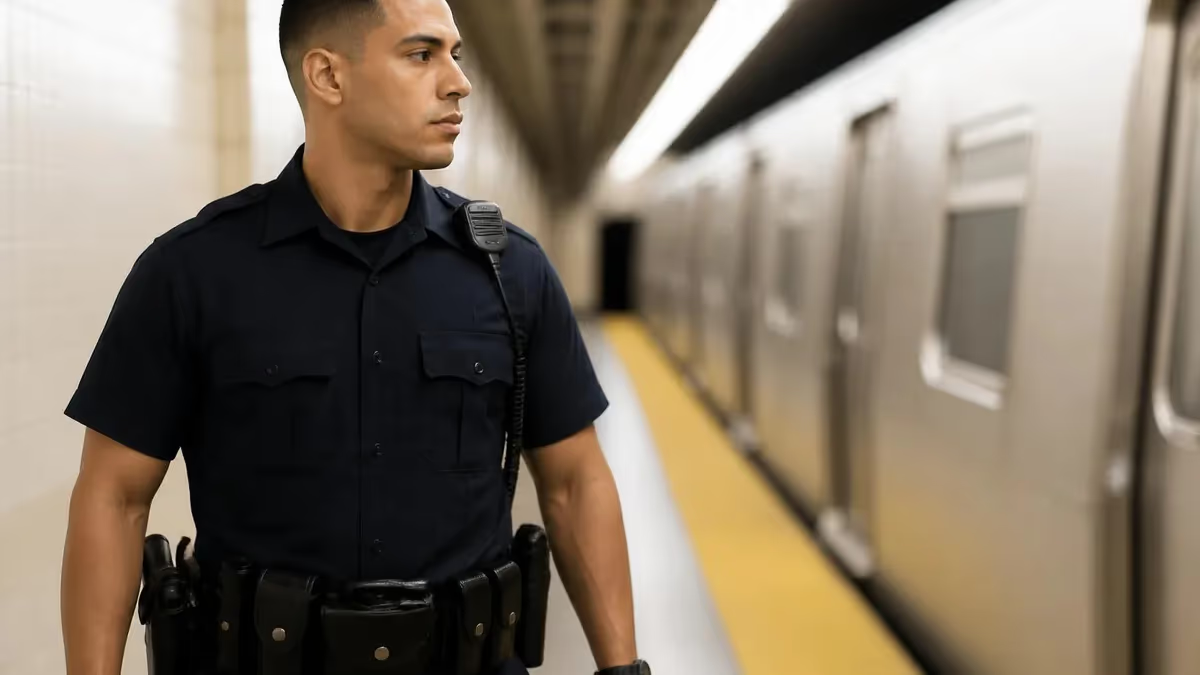
If you are studying for a transit-related career, you may also want to review our guide on the MTA Police Exam: Requirements, Written Test, Physical Agility Test, Academy Training, and Career Path to understand how law enforcement supports bus and rail operations across the system. MTA Police officers patrol terminals, depots, and select corridors where buses and commuter rail intersect.
Throughout this article, we will walk through every tool the MTA provides for looking up bus information, explain common terminology, and offer practical advice for first-time riders, daily commuters, tourists, and accessibility-focused passengers. By the end, you will know exactly where to find departure times, how to interpret a route map, what to do when service is disrupted, and how to file complaints or compliments through official channels.
We will also touch on the human side of bus operations — the drivers, dispatchers, mechanics, and customer service representatives who keep buses running 24 hours a day in a city that never truly sleeps. Understanding the operational complexity behind a simple bus stop helps riders appreciate the system and use it more effectively, especially when things do not go according to plan.
MTA Bus System by the Numbers
Understanding MTA Bus Route Types and Numbering
Local routes stop at nearly every block and serve as the workhorse of neighborhood transit. Routes carry letter prefixes — M for Manhattan, B for Brooklyn, Bx for Bronx, Q for Queens, and S for Staten Island — followed by a route number.
Limited buses skip many local stops to provide faster travel along busy corridors. They share route numbers with local versions but display 'Limited' on the destination sign. Service usually operates during peak hours on heavily traveled routes.
SBS routes feature off-board fare payment, all-door boarding, dedicated bus lanes, and traffic signal priority. SBS lines like the M15, B44, and Bx12 dramatically reduce travel times along key corridors and operate with distinctive blue-striped buses.
Express buses use letter prefixes ending in 'X' (BxM, BM, QM, SIM) and travel long distances on highways with a $7.00 fare. They serve commuters from outer-borough neighborhoods directly into Manhattan business districts with limited stops.
Many routes operate 24 hours, while others are replaced by overnight service patterns. Late-night buses often request stops between official stations on local routes for safety, a program called Request-A-Stop available between 10 PM and 5 AM.
Real-time tracking has transformed how riders interact with MTA buses. The agency launched its BusTime system more than a decade ago, and it now provides accurate location data for every bus in the fleet using GPS-equipped onboard computers. Riders can access this data through several channels, including the official MTA app, the bustime.mta.info website, SMS text messages, and integrations with third-party apps like Google Maps, Citymapper, and Transit. Each of these channels pulls from the same underlying data feed, so accuracy is consistent across platforms.
To use BusTime via text message, riders text their stop code or intersection to 511123 and receive a list of upcoming buses with estimated arrival times. Every official MTA bus stop displays a six-digit stop code on the pole-mounted sign, making this feature particularly useful for riders without smartphones or for situations where mobile data is unavailable. The system replies in under ten seconds and lists the next three buses by route, direction, and distance away from the stop.
The official MTA app offers a more visual experience, displaying buses as moving dots on a map alongside route lines and stop markers. Users can save favorite stops, set up push notifications for delays, and view full schedules including weekend and holiday variations. The app also integrates subway, Metro-North, and Long Island Rail Road information, making it a single tool for planning multi-modal trips across the entire MTA network in a single session.
One important caveat: BusTime estimates are based on current bus location and historical travel times between stops, not fixed schedules. During heavy traffic, weather events, or unusual demand, predictions can shift rapidly. A bus that appears two minutes away may take five minutes to actually arrive if it gets stuck at a light, picks up a wheelchair passenger, or encounters a double-parked vehicle blocking the bus lane on a busy commercial street.
For commuters who depend on consistent timing, the MTA also publishes scheduled departure times for the start of each route, called terminal departures. These times are generally more reliable than mid-route predictions because buses begin their runs on schedule from depots and terminal stops. Knowing the terminal departure time and adding the typical travel time to your stop can be more accurate than relying solely on real-time predictions during disrupted conditions.
If you're interested in transit careers more broadly, our overview of MTA Careers: How to Apply for Jobs at careers.mta.org and Build a Career with the Metropolitan Transportation Authority covers bus operator, mechanic, dispatcher, and customer service positions, all of which contribute to keeping the BusTime system accurate and the buses themselves moving. Bus operations is one of the largest employment categories at the agency.
Third-party apps sometimes display additional features the official tools lack, such as crowding predictions, walking directions to alternate stops, or comparison between bus and subway travel times. However, these apps depend on the MTA's data feed remaining operational, so when the agency experiences IT outages, third-party tools become unreliable simultaneously. For mission-critical trips, double-checking via the official channels is always recommended before committing to a specific bus.
MTA Practice Test Questions
Prepare for the MTA - Police Exam exam with our free practice test modules. Each quiz covers key topics to help you pass on your first try.
MTA Police MCQ
MTA Exam Questions covering Police MCQ. Master MTA Test concepts for certification prep.
MTA Police Reading Comprehension Test
Free MTA Practice Test featuring Police Reading Comprehension Test. Improve your MTA Exam score with mock test prep.
MTA Police Written Test
MTA Mock Exam on Police Written Test. MTA Study Guide questions to pass on your first try.
MTA Community Policing
MTA Test Prep for Community Policing. Practice MTA Quiz questions and boost your score.
MTA Constitutional Rights
MTA Questions and Answers on Constitutional Rights. Free MTA practice for exam readiness.
MTA Criminal Law
MTA Mock Test covering Criminal Law. Online MTA Test practice with instant feedback.
MTA Emergency Response
Free MTA Quiz on Emergency Response. MTA Exam prep questions with detailed explanations.
MTA Investigation Techniques
MTA Test Online for Investigation Techniques. Free practice with instant results and feedback.
MTA Law Enforcement Procedures
MTA Study Material on Law Enforcement Procedures. Prepare effectively with real exam-style questions.
MTA Traffic and Patrol Procedures
Free MTA Test covering MTA Traffic and Patrol Procedures. Practice and track your MTA exam readiness.
MTA Transit System Knowledge
MTA Exam Questions covering MTA Transit System Knowledge. Master MTA Test concepts for certification prep.
MTA Bus Info: Fares, OMNY, and Transfer Rules
OMNY is the MTA's contactless fare payment system, accepted on all buses, subways, and Staten Island Railway stations. Riders tap a contactless credit card, debit card, smartphone wallet, smartwatch, or OMNY card on the reader near the front door. The system charges the standard fare of $2.90 and automatically applies fare capping, meaning weekly riders never pay more than $34 between Monday and Sunday regardless of how many trips they take.
OMNY card readers are also positioned at all doors of Select Bus Service buses, allowing all-door boarding. Riders must tap before boarding SBS buses and retain their receipt or digital confirmation in case of fare inspection. Plainclothes inspectors periodically check SBS buses, and riders without proof of payment face fines of $100 or more, so always confirm your tap registered before stepping on board the SBS vehicle.
Riding MTA Buses vs Other NYC Transit Options
- +Reaches neighborhoods without subway access including eastern Queens and Staten Island
- +Real-time tracking via BusTime provides accurate arrival predictions
- +OMNY tap-to-pay with automatic fare capping saves money for frequent riders
- +Free transfers to subway and other buses within two hours
- +Ground-level views make navigation easier for tourists and new residents
- +Accessibility features including kneeling buses and wheelchair ramps on every vehicle
- +24-hour service on many routes connects late-shift workers and overnight commuters
- −Vulnerable to traffic congestion that subway service avoids underground
- −Slower than subway for long-distance trips within Manhattan and Brooklyn cores
- −Service frequency drops significantly during overnight and weekend hours
- −Express bus fare of $7 deters casual use compared to standard $2.90 routes
- −Limited shelter at many stops leaves riders exposed to weather conditions
- −Detours and reroutes during construction can confuse infrequent riders quickly
- −Crowding during peak hours can cause buses to skip stops or run behind
Pros and Cons at a Glance
| Pros | Cons |
|---|---|
| Reaches neighborhoods without subway access including eastern Queens and Staten Island | Vulnerable to traffic congestion that subway service avoids underground |
| Real-time tracking via BusTime provides accurate arrival predictions | Slower than subway for long-distance trips within Manhattan and Brooklyn cores |
| OMNY tap-to-pay with automatic fare capping saves money for frequent riders | Service frequency drops significantly during overnight and weekend hours |
| Free transfers to subway and other buses within two hours | Limited shelter at many stops leaves riders exposed to weather conditions |
| Ground-level views make navigation easier for tourists and new residents | Detours and reroutes during construction can confuse infrequent riders quickly |
| Accessibility features including kneeling buses and wheelchair ramps on every vehicle | Crowding during peak hours can cause buses to skip stops or run behind |
MTA Bus Info Checklist Before You Board
- ✓Verify the route number and direction on the front and side destination signs
- ✓Confirm your OMNY payment method is loaded and your phone or card is ready
- ✓Check BusTime or the MTA app for current arrival predictions and service alerts
- ✓Stand at the official bus stop pole, not midblock, except during Request-A-Stop hours
- ✓Have exact change ready if using cash on local buses since drivers cannot make change
- ✓Signal the driver by raising your hand as the bus approaches your stop in daylight
- ✓For SBS routes, tap at the off-board machine and retain proof of payment
- ✓Move toward the rear after boarding to allow others to enter through the front
- ✓Pull the stop request cord or press the strip one block before your destination
- ✓Exit through the rear doors on local buses to keep boarding flow moving efficiently
Save your most-used stop codes
Add your daily bus stop codes to your phone's contacts or notes app for instant access. Text the code to 511123 anytime to get the next three arrival times without opening an app or using mobile data. This works perfectly when service is delayed and apps are slow to load.
Accessibility is a foundational priority for the MTA bus system, and every bus in the active fleet is fully wheelchair accessible. Each vehicle features either a low-floor design with a fold-out ramp or an older high-floor model with a hydraulic lift. Drivers are trained to deploy these devices upon request, secure mobility devices using the onboard tie-down system, and ensure passengers are safely positioned before resuming travel. The kneeling feature also lowers the front of the bus by several inches at every stop, making boarding easier for elderly riders and parents with strollers.
Audio and visual announcements identify each upcoming stop, allowing riders with vision or hearing impairments to track their progress along the route. The announcements use a standardized voice and consistent terminology, and the visual displays inside each bus show both the next stop and the final destination. Riders can request that drivers announce specific stops aloud if the automated system fails or if landmarks are needed instead of street names for orientation purposes during their trip.
For riders whose disabilities prevent them from using fixed-route buses, the MTA operates Access-A-Ride, a complementary paratransit service. Eligible riders schedule trips at least one day in advance and pay the same $2.90 fare as standard bus service. Vehicles range from sedans to wheelchair-accessible vans, and trips can begin and end anywhere within the five boroughs and parts of Nassau and Westchester counties. The MTA also operates an on-demand pilot program in select neighborhoods, allowing same-day booking through an app similar to ride-hail platforms.
Service animals are welcomed on all MTA buses without restrictions, and emotional support animals must be in carriers per the MTA's official animal policy. Non-service pets must be small enough to fit in a closed carrier that can be placed on the rider's lap or stored under the seat. Drivers have authority to deny boarding to animals that pose safety concerns, though this rarely happens in practice. The agency emphasizes inclusion and works closely with disability advocacy groups to refine policies regularly.
Strollers are permitted on buses but must be folded during peak hours when buses are crowded. The MTA introduced an open stroller pilot program on select routes, allowing parents to keep strollers open in designated areas similar to wheelchair zones. The pilot has expanded gradually, and parents should check the MTA website or app for current route eligibility before assuming open stroller boarding is permitted on their specific bus route or time of day.
For seniors aged 65 and older, the Reduced-Fare OMNY program cuts the fare in half for both bus and subway service at all times of day, including peak hours. Eligible riders apply online or by mail and receive a special OMNY card linked to their reduced-fare status. The same program covers riders with qualifying disabilities documented through a medical professional, and the card works on every route from local Manhattan buses to express Staten Island commuter service.
Customer service representatives are available by phone at 511 to assist with accessibility questions, trip planning, and complaints about specific buses or drivers. The MTA also maintains a dedicated paratransit phone line for Access-A-Ride scheduling and a TTY relay service for deaf and hard-of-hearing riders. Online forms on the MTA's contact page route inquiries to the appropriate department within two business days, and serious safety concerns receive expedited attention from supervisory staff.
During snow emergencies, hurricanes, or major incidents, the MTA may suspend bus service partially or completely. Always check the MTA app for the latest alerts before traveling, and sign up for email or text notifications to receive instant updates. Buses are often the last service to be restored after major weather events because streets must be cleared first.
Service alerts and detours are an unavoidable reality of operating buses on city streets shared with private cars, delivery trucks, emergency vehicles, and construction crews. The MTA publishes alerts through multiple channels simultaneously, including the official app, the mta.info website, social media accounts on X and Facebook, email subscription lists, and audio announcements on board buses experiencing the disruption. Riders who depend on a specific route for daily commuting should subscribe to email or text alerts for that particular line.
Detours fall into several categories, each requiring a different response from riders. Planned detours, such as those for street fairs, parades, or scheduled construction, are announced days or weeks in advance with specific dates and alternative stop locations posted at affected stops. Unplanned detours, including those caused by accidents, building fires, or police activity, can begin without warning and may persist for hours. In both cases, the MTA updates BusTime predictions to reflect the new routing whenever operationally possible.
When a bus is detoured around a closed segment of its normal route, missed stops are typically replaced with temporary stops along the detour path. These temporary stops are not always marked with permanent signage, so riders may need to ask the driver or check the alert text to confirm exactly where to wait or disembark. Drivers will announce major detour deviations over the PA system, but riders unfamiliar with the alternate streets should pay close attention to landmarks and intersections.
Construction projects on bridges, tunnels, and major arterials can cause months-long detours for affected routes. Examples include the ongoing rehabilitation of various bridges in the Bronx and Queens, which have required express buses to use alternate crossings during specific construction phases. The MTA coordinates closely with the New York City Department of Transportation and the Port Authority to minimize disruptions, but riders should still budget extra time during major capital projects affecting their commute.
For riders who want to dig deeper into MTA operations and employment, our guide on MTA Employment: Jobs, How to Apply, and the Hiring Process explains how dispatchers, supervisors, and customer service teams coordinate detours, communicate with drivers in real time, and update digital systems to keep riders informed. These behind-the-scenes roles directly affect how smoothly the system handles unexpected disruptions every day.
Weather-related service changes follow a tiered approach based on storm severity. During a Winter Weather Travel Advisory, service continues but with potential delays. A Travel Ban triggers partial suspension of express routes and local routes on steep hills or unplowed streets. Full system shutdowns are rare and require explicit declaration from the MTA Chair, typically in coordination with the Governor's office. After any weather suspension, service resumes gradually as streets are confirmed safe and depots reactivate their fleets.
Riders who experience persistent issues with a specific route can file complaints through the MTA customer service portal. Common complaints include bus bunching, no-shows where the predicted bus never arrives, drivers passing stops without stopping, and broken HVAC during extreme temperatures. The MTA investigates complaints by reviewing onboard video, GPS data, and driver schedules. Riders who provide specific dates, times, and bus numbers receive more thorough responses than vague generalized complaints.
Practical tips can make the difference between a smooth bus ride and a frustrating experience. First, always have a backup plan. If your usual bus runs every 10 minutes during rush hour but only every 30 minutes on weekends, plan around the lower frequency and build in extra buffer time for connections. Apps like Citymapper and Transit can suggest alternative routes if your primary option is delayed, often combining a short walk with a different bus or subway line to keep you moving toward your destination efficiently.
Second, learn the geography of your most-used routes. Even if you rely on GPS-based apps, knowing which way the bus turns at major intersections and where express stops are located helps you stay oriented when the network goes down or your phone battery dies. Memorize a few landmark intersections along your route and the order in which neighborhoods appear so you can recognize when to pull the request cord even without onboard announcements working.
Third, be a respectful rider. Move toward the back of crowded buses to make room for boarders, offer priority seats near the front to seniors, pregnant riders, and people with disabilities, keep conversations and music at a moderate volume, and avoid blocking the aisle with large bags or open strollers when not in designated areas. Courteous behavior makes the entire system work better for everyone and creates a more pleasant environment for the dozens of riders sharing each vehicle.
Fourth, take advantage of off-peak travel when your schedule allows. Buses between roughly 9:30 AM and 3:30 PM on weekdays are significantly less crowded than peak hours, and the same fare gets you a more comfortable ride with consistent seating availability. Travel times during off-peak windows are also often shorter because traffic congestion drops sharply outside commute periods, especially on local and limited routes through central business districts in Manhattan.
Fifth, keep emergency contacts and key information accessible. Save the MTA customer service number (511), the police non-emergency number, and a trusted friend or family member's contact in your phone's emergency menu. Buses are generally safe, but knowing how to report incidents quickly matters when minutes count. The MTA's Help Point intercoms on platforms and customer service phones at major terminals connect directly to dispatchers who can route emergency response when needed in real time.
Sixth, explore the network beyond your daily routine. New York's bus system reaches beaches, parks, museums, and neighborhoods that are difficult to access by subway alone. The B68 in Brooklyn ends near Coney Island, the Q53 connects Woodside to Rockaway Beach, and the M5 traverses Manhattan from Washington Heights to South Ferry with stops near landmarks tourists rarely see. A weekend bus ride can become a low-cost sightseeing tour with comfortable seating and air conditioning included.
Finally, stay informed about long-term changes. The MTA periodically redesigns entire borough networks to improve frequency and coverage. The Queens Bus Network Redesign launched its first phase in 2025, and the Brooklyn Bus Network Redesign is following in subsequent years. Major redesigns renumber routes, shift stops, and change schedules significantly, so even longtime riders should review the latest mta.info maps periodically to confirm their familiar routes still operate the same way they always have.
Sample MTA - Police Exam Practice Questions
Try these questions from our free MTA - Police Exam practice tests. The correct answer and an explanation follow each question.
Under New York law, what is the time limit within which a person arrested without a warrant must be brought before a judge?
- A. 12 hours
- B. 24 hours
- C. 48 hours
- D. 72 hours
Answer: B. 24 hours
New York law generally requires that a person arrested without a warrant be arraigned within 24 hours.
Which of the following is NOT an MTA-operated transit service in New York?
- A. Long Island Rail Road (LIRR)
- B. Metro-North Railroad
- C. NYC Subway (NYCT)
- D. New Jersey Transit (NJT)
Answer: D. New Jersey Transit (NJT)
New Jersey Transit is operated by the state of New Jersey and is not under MTA jurisdiction.
What is the primary role of an MTA Police Officer compared to a city police officer on transit property?
- A. Enforce traffic laws only
- B. Enforce laws and maintain order specifically within the MTA transit system
- C. Issue parking violations citywide
- D. Respond to non-transit emergencies exclusively
Answer: B. Enforce laws and maintain order specifically within the MTA transit system
MTA Police Officers have jurisdiction over MTA-owned properties including subway stations, buses, and rail lines to enforce laws and maintain public order.
An officer stops a man based on reasonable suspicion. The man refuses to identify himself. In New York, the officer can:
- A. Arrest him immediately for obstruction
- B. Detain him briefly while the investigation continues but may not arrest solely for refusing to identify
- C. Force him to provide ID by searching his person
- D. Release him immediately since he has no legal obligation to speak
Answer: B. Detain him briefly while the investigation continues but may not arrest solely for refusing to identify
New York is not a 'stop and identify' state; a person is not required by law to provide ID during an investigative stop, though the officer may continue the brief detention.
MTA Questions and Answers
MTA Careers: How to Apply for Jobs at careers.mta.org and Build a Career with the Metropolitan Transportation Authority
MTA Police Exam: Requirements, Written Test, Physical Agility Test, Academy Training, and Career Path
MTA Police Practice Test
MTA Employment: Jobs, How to Apply, and the Hiring Process
MTA Police Exam
About the Author

Educational Psychologist & Academic Test Preparation Expert
Columbia University Teachers CollegeDr. Lisa Patel holds a Doctorate in Education from Columbia University Teachers College and has spent 17 years researching standardized test design and academic assessment. She has developed preparation programs for SAT, ACT, GRE, LSAT, UCAT, and numerous professional licensing exams, helping students of all backgrounds achieve their target scores.