
MSHA Meaning: What the Mine Safety Agency Does and Why It Matters 2026 October
Pass your MSHA Meaning: What the Mine Safety exam on the first attempt. Practice questions with detailed answer explanations, hints, and instant scoring. 💡
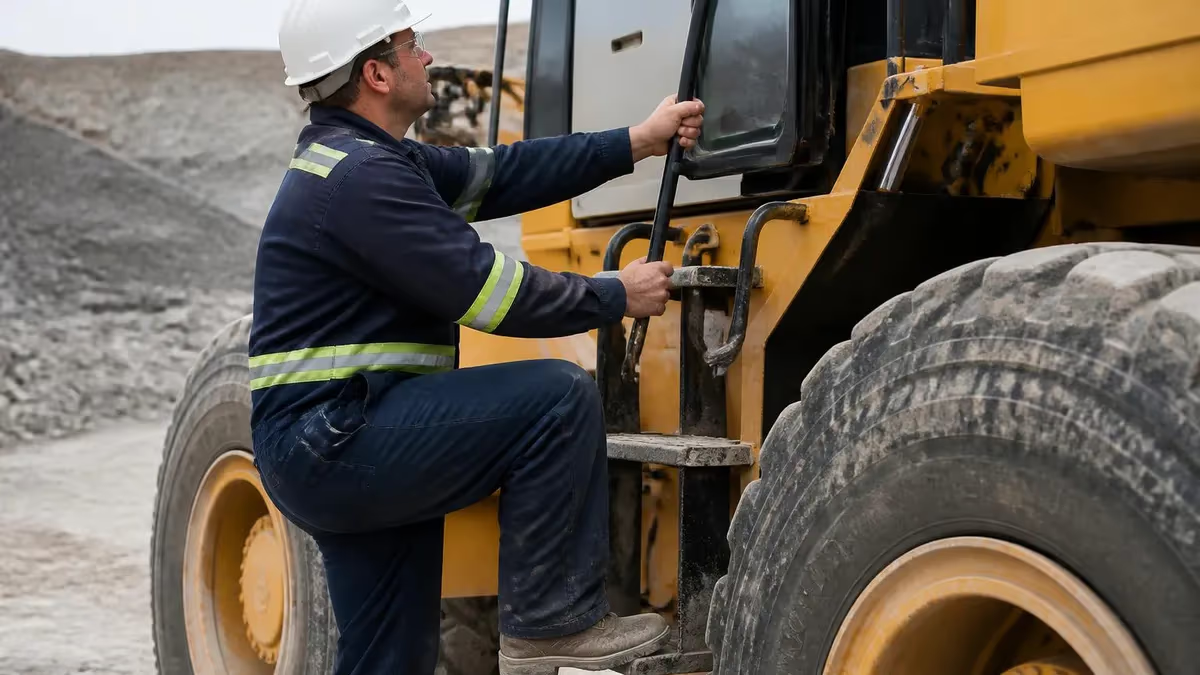
If you work in mining, quarrying, or aggregate processing — or you're entering the industry — you've probably heard the acronym MSHA thrown around. But what does MSHA actually stand for, what does it do, and what does its authority mean for workers and mine operators?
MSHA stands for the Mine Safety and Health Administration. It's a federal agency within the U.S. Department of Labor that enforces safety and health regulations for all mining operations in the United States. That's a short definition, but the practical implications are extensive — from mandatory training hours to surprise inspections to serious civil and criminal penalties for violations.
What Does MSHA Stand For?
MSHA stands for Mine Safety and Health Administration. It's pronounced as an initialism (M-S-H-A) rather than a word, and it's one of the most commonly searched acronyms in the construction and extraction industries because compliance with MSHA regulations is required for anyone working at a mine site — including contractors who aren't full-time mining employees.
The agency's full name tells you exactly what it does: it focuses on safety (preventing accidents and injuries) and health (preventing long-term occupational diseases) in mining environments. These are distinct concerns — a falling rock or equipment accident is a safety issue; years of silica dust exposure causing lung disease is a health issue. MSHA addresses both.
What Is MSHA's Authority?
MSHA derives its authority from the Federal Mine Safety and Health Act of 1977 (Mine Act), which significantly expanded an earlier 1969 law following a series of catastrophic mine disasters. The Mine Act covers:
- All surface and underground coal mines
- All surface and underground metal and nonmetal mines (gold, copper, iron, stone quarries, sand and gravel operations, etc.)
- Any facility that processes mine-extracted materials on the mine property
OSHA (Occupational Safety and Health Administration) does NOT cover mining — MSHA does. This is a common source of confusion. If you work at a mine or quarry, your safety is regulated by MSHA, not OSHA. The two agencies have a formal agreement defining their jurisdictional boundaries, and MSHA takes over at the point where ore or material leaves the mine property.
- ✓Review the official MSHA exam content outline
- ✓Take a diagnostic practice test to identify weak areas
- ✓Create a study schedule (4-8 weeks recommended)
- ✓Focus on your weakest domains first
- ✓Complete at least 3 full-length practice exams
- ✓Review all incorrect answers with detailed explanations
- ✓Take a final practice test 1 week before exam day
What Does MSHA Do?
MSHA's core functions break into four areas:
1. Enforcement Through Inspections
MSHA inspectors are authorized to enter any mine in the US at any time without advance notice. Underground coal mines must be inspected at least four times per year; surface mines and all other operations at least twice per year. During inspections, MSHA evaluates compliance with health and safety standards and can issue citations, orders, and civil penalties for violations.
MSHA can also issue a "Withdrawal Order" — forcing miners out of a hazardous area or shutting down all or part of a mine until a hazard is corrected. These orders can be issued on the spot. There's no grace period for an immediate danger situation.
2. Mandatory Safety Training (New Miner Training)
One of MSHA's most well-known requirements is mandatory safety training. Before a new miner can work at a mine, they must complete MSHA-approved new miner training. Surface miners must complete 24 hours of training; underground miners must complete 40 hours. This training covers hazard recognition, emergency procedures, equipment safety, and miners' rights under the Mine Act.
Annual refresher training is also required — 8 hours per year for all miners. As a contractor working at a mine site, you must also meet these training requirements even if your primary employer isn't a mining company.
3. Standard Setting
MSHA publishes mandatory health and safety standards (in 30 CFR — Code of Federal Regulations, Title 30) that cover everything from permissible explosive gas levels in coal mines to noise exposure limits to equipment guarding requirements. These standards are legally binding on mine operators.
4. Education and Technical Assistance
MSHA's Office of Educational Policy and Development provides training assistance to mines, including free training materials, instructor training, and technical guidance. The agency recognizes that smaller operators may not have internal safety training infrastructure and provides resources to help them comply.
MSHA Training Requirements: What Miners Need to Know
If you're entering the mining industry, understanding MSHA's training requirements is non-negotiable. Mines that allow untrained workers on site face serious citations and penalties, and individual workers can be barred from site access without the required credentials.
New Miner Training (Part 46 vs. Part 48)
Training requirements fall under two parts of MSHA regulations:
- 30 CFR Part 46 — applies to surface mines (stone quarries, sand and gravel, surface coal, and surface metal mines). Requires 24 hours of training for new miners before they work in an unsupervised capacity.
- 30 CFR Part 48 — applies to underground mines and some specialty surface operations. Requires 40 hours for new miners.
The training covers: introduction to work environment, recognition and avoidance of hazards, emergency evacuation, first aid, statutory rights of miners, accident prevention, and equipment and machinery safety relevant to the work environment.
Annual Refresher Training
All miners — regardless of experience — must complete 8 hours of annual refresher training every 12 months. This keeps safety knowledge current and addresses new hazards or regulatory changes. Mine operators must document this training and keep records for five years.
Task Training
Any miner assigned to a new task they haven't previously performed must receive task-specific training before doing that work. This isn't a separate formal credential — it's documented on-the-job training for specific equipment or procedures.
MSHA Violations and Penalties
MSHA has meaningful enforcement tools, and violations aren't just a paperwork inconvenience — they come with real consequences.
Citations and Civil Penalties
When an MSHA inspector finds a violation, they issue a citation. Civil penalties for violations can range from a few hundred dollars for minor paperwork issues to tens of thousands of dollars for serious violations, particularly those involving significant and substantial (S&S) hazards. S&S designations — meaning the violation is reasonably likely to result in injury — carry higher penalties.
Unwarrantable failure violations (knowing and willful failure to meet a standard) can result in withdrawal orders and pattern-of-violation designations, which trigger even more frequent inspections and potential mine shutdown.
Criminal Penalties
Mine operators, agents, and supervisors can face criminal charges for willful Mine Act violations. If a willful violation results in death, the penalty can be up to one year in prison for a first offense and up to five years for subsequent offenses. These aren't theoretical — MSHA has pursued criminal prosecutions in connection with major mining disasters.
Imminent Danger Orders
If an MSHA inspector finds an imminent danger — a condition that could reasonably be expected to cause death or serious injury before normal enforcement could eliminate it — they must issue a withdrawal order immediately. All miners must leave the hazard area. This authority supersedes the operator's judgment and isn't subject to appeal before compliance.
Miners' Rights Under MSHA
The Mine Act isn't just about regulating operators — it also establishes specific rights for miners that are worth knowing if you work in the industry.
- Right to request an inspection: Miners can request an MSHA inspection if they believe a violation exists, and they can request confidentiality so the mine operator doesn't know who filed the request.
- Right to walk-around: Miners or their representatives have the right to accompany MSHA inspectors during inspections.
- Right to refuse unsafe work: Miners have the right to refuse work in areas they reasonably believe are immediately dangerous — and cannot be discriminated against for doing so.
- Whistleblower protection: Miners are protected from retaliation for reporting safety violations or exercising any rights under the Mine Act. Retaliation (termination, suspension, demotion) is illegal and subject to reinstatement and back pay orders.
These protections are meaningful because the power imbalance between a miner and a mine operator can be significant, especially in remote operations. The Mine Act specifically creates these rights to ensure safety concerns can be raised without fear.
Preparing for MSHA Training and Testing
If you're heading into new miner training, the 24- or 40-hour requirement can feel like a lot — but the content is practical, not theoretical. The training covers hazards you'll actually encounter. Taking it seriously pays off in actual on-site safety, not just compliance.
Some operators conduct their own MSHA-approved training programs; others use third-party providers. Either way, you should arrive with a basic understanding of mining safety concepts. Practice tests that mirror MSHA content categories help you engage with the material more actively during training and retain it better afterward.
MSHA: Pros and Cons
- +msha — mSHA credential is recognized by employers and industry professionals
- +Higher earning potential compared to non-credentialed peers
- +Expanded career opportunities and professional advancement
- +Structured learning path builds comprehensive knowledge
- +Professional development that stays current with industry standards
- −Preparation requires significant time and study commitment
- −Associated costs for exams, materials, and renewal fees
- −Continuing education needed to maintain credentials
- −Competition for advanced positions can be challenging
- −Requirements and standards may vary by state or region
Pros and Cons at a Glance
| Pros | Cons |
|---|---|
| msha — mSHA credential is recognized by employers and industry professionals | Preparation requires significant time and study commitment |
| Higher earning potential compared to non-credentialed peers | Associated costs for exams, materials, and renewal fees |
| Expanded career opportunities and professional advancement | Continuing education needed to maintain credentials |
| Structured learning path builds comprehensive knowledge | Competition for advanced positions can be challenging |
| Professional development that stays current with industry standards | Requirements and standards may vary by state or region |
Sample MSHA - Mine Safety and Health Administration Practice Questions
Try these questions from our free MSHA - Mine Safety and Health Administration practice tests. The correct answer and an explanation follow each question.
What is the primary role of a safety data sheet (SDS) in Mine Safety and Health Administration operations related to electrical safety?
- A. To provide detailed information about chemical hazards and safe handling procedures
- B. To track employee work schedules
- C. To document production quality metrics
- D. To list approved vendors for supplies
Answer: A. To provide detailed information about chemical hazards and safe handling procedures
Safety Data Sheets provide comprehensive information about chemical substances including hazard identification, composition, first-aid measures, handling and storage requirements, and exposure controls.
What does the term "root cause analysis" refer to in surface mining safety within Mine Safety and Health Administration?
- A. A systematic method to identify the underlying reasons for an incident
- B. A quick assessment of surface-level issues
- C. A financial audit of safety expenditures
- D. A review of employee qualifications
Answer: A. A systematic method to identify the underlying reasons for an incident
Root cause analysis goes beyond symptoms to identify the fundamental, underlying reasons why an incident occurred, enabling more effective corrective actions.
What does the term "root cause analysis" refer to in electrical safety within Mine Safety and Health Administration?
- A. A systematic method to identify the underlying reasons for an incident
- B. A quick assessment of surface-level issues
- C. A financial audit of safety expenditures
- D. A review of employee qualifications
Answer: A. A systematic method to identify the underlying reasons for an incident
Root cause analysis goes beyond symptoms to identify the fundamental, underlying reasons why an incident occurred, enabling more effective corrective actions.
What is the primary role of a safety data sheet (SDS) in Mine Safety and Health Administration operations related to surface mining safety?
- A. To provide detailed information about chemical hazards and safe handling procedures
- B. To track employee work schedules
- C. To document production quality metrics
- D. To list approved vendors for supplies
Answer: A. To provide detailed information about chemical hazards and safe handling procedures
Safety Data Sheets provide comprehensive information about chemical substances including hazard identification, composition, first-aid measures, handling and storage requirements, and exposure controls.
Take the full MSHA - Mine Safety and Health Administration practice test
About the Author

Attorney & Bar Exam Preparation Specialist
Yale Law SchoolJames R. Hargrove is a practicing attorney and legal educator with a Juris Doctor from Yale Law School and an LLM in Constitutional Law. With over a decade of experience coaching bar exam candidates across multiple jurisdictions, he specializes in MBE strategy, state-specific essay preparation, and multistate performance test techniques.
Join the Discussion
Connect with other students preparing for this exam. Share tips, ask questions, and get advice from people who have been there.
View discussion (8 replies)