
What is a Millwright? Trade, Duties, Pay, and How to Become One 2026 October
A millwright installs, maintains, and repairs industrial machinery. Here's what the trade involves, how much it pays, and how to qualify. 🎓
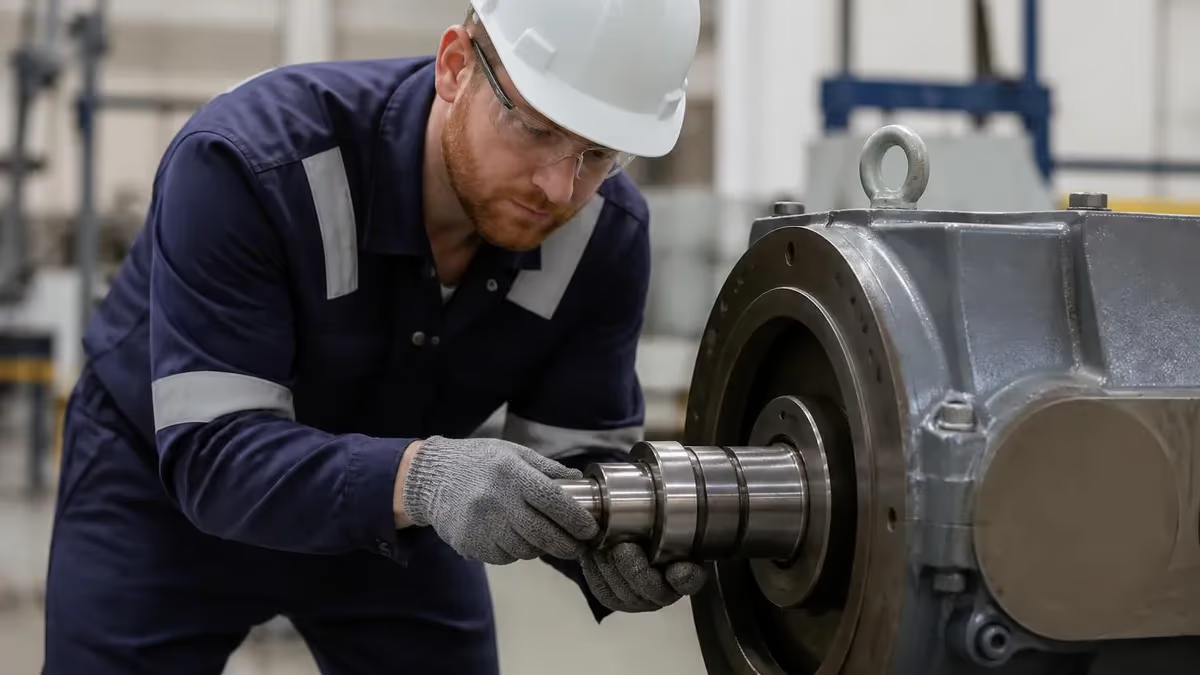
What is a Millwright? The Trade, the Duties, the Paycheck, and How to Become One
If you walk into any factory, paper mill, power plant, or grain elevator in North America and ask who keeps the heavy machinery running, the answer is almost always the same. The millwright. The job is one of the oldest skilled trades on the continent, going back to the people who built and serviced the grinding stones in colonial flour mills, and it is still in high demand today. What most outsiders do not realize is how technical, well-paid, and underrated the trade has become.
A millwright is a journeyman tradesperson who installs, aligns, dismantles, repairs, and maintains industrial machinery. The work happens anywhere heavy equipment is bolted to a foundation, runs continuously, or has to be moved into and out of service without warning. That covers steel mills, refineries, chemical plants, lumber yards, food-processing facilities, and increasingly the data-center cooling and wind-turbine industries.
This guide answers the basic questions in one place. What the job actually involves day to day, the difference between a millwright and a mechanic or industrial electrician, what kind of training and certification it takes, what the pay looks like at different stages, and how to enter the trade whether you are a high-school student or a career changer. By the end you will know whether the work fits you and what the next step looks like.
For a deeper look at the certification path, our Millwright Certification practice test hub covers the topics on the journey-level exam. The Millwright Union Guide explains the union vs non-union pathways in detail.
The Short Answer
A millwright is a skilled-trades professional who installs, aligns, maintains, and repairs heavy industrial machinery in factories, mills, power plants, refineries, and similar facilities. The job blends mechanical, hydraulic, pneumatic, and basic electrical knowledge. Most millwrights enter the trade through a four-year apprenticeship that pairs paid on-the-job hours with classroom instruction. Median annual pay in the United States runs about $62,000, with experienced union millwrights in industrial cities earning well over $90,000 once overtime is included. The trade is recognized as a Red Seal occupation in Canada and as a Department of Labor apprenticeship in the United States.
Millwright Trade by the Numbers

What a Millwright Actually Does on the Job
The textbook answer is that a millwright installs and maintains heavy industrial machinery. The lived-experience answer is more interesting. A typical week mixes scheduled preventive maintenance, urgent breakdown calls, precision alignment work, rigging and lifting jobs, and a fair amount of problem solving when a million-dollar piece of equipment refuses to start.
On the installation side, a millwright might assemble a new conveyor system at a food-processing plant, set and grout a 40-ton pump base at a refinery, or rig and align the turbine on a hydroelectric generator. The work demands precision instruments: dial indicators, laser alignment tools, micrometers, and feeler gauges. Bolt-tightening alone is its own subspecialty, since improperly torqued bolts in heavy machinery can cause catastrophic failures.
On the maintenance side, the day looks more like detective work. A pump is vibrating outside its acceptable range. A gearbox is running hot. A conveyor is misaligned by a fraction of a degree. A millwright reads vibration data, checks oil samples for metal particles, and uses thermal imaging to diagnose the issue before anything breaks. Catching a worn bearing in advance saves a plant tens of thousands of dollars in downtime. Catching it after the bearing fails is what makes the 3 a.m. call-in necessary.
The third bucket of the job is rigging. Millwrights move and lift heavy equipment, sometimes pieces weighing several tons, using cranes, hoists, jacks, and skates. The training includes load calculations, rigging hardware inspection, and crane-signal hand language. A botched lift in an industrial setting can kill people. Millwrights with a strong rigging background tend to command premium pay because the skill is genuinely dangerous to perform badly.
Four Core Skill Areas of a Millwright
- Examples: Bearings, gears, shafts
- Tools: Micrometers, dial indicators
- Goal: Precision alignment
- Examples: Pumps, cylinders, valves
- Tools: Pressure gauges, flow meters
- Goal: Leak-free systems
- Examples: Cranes, hoists, slings
- Tools: Load charts, signal training
- Goal: Safe heavy moves
- Examples: Repair welds, modifications
- Tools: MIG, TIG, stick
- Goal: Code-compliant repairs
Millwright vs. Mechanic vs. Industrial Maintenance Worker
One of the most common questions from people researching the trade is how it differs from related jobs. The titles overlap in practice, but each has a distinct scope.
Millwright vs. Industrial Mechanic
Industrial mechanic is sometimes used as a synonym for millwright, but the formal trades are different. A millwright traditionally focuses on installation, alignment, and major rebuilds. An industrial mechanic focuses on routine maintenance and repair of equipment that is already installed. In Canada, the Red Seal recognizes the two trades as separate (Industrial Mechanic Millwright is the official designation, blending both). In the U.S., the Bureau of Labor Statistics groups them together as Industrial Machinery Mechanics, Machinery Maintenance Workers, and Millwrights.
Millwright vs. Industrial Electrician
An industrial electrician handles the electrical side of plant equipment: motor wiring, control circuits, drives, and PLCs. A millwright handles the mechanical side: shafts, bearings, gearboxes, conveyors. The two trades work together on almost every major piece of industrial equipment. Many shops cross-train their journeymen so an electrician can perform basic mechanical work and a millwright can do basic troubleshooting on motor controls, but the deep expertise is separated by the apprenticeship pathway.
Millwright vs. Pipefitter
Pipefitters install and maintain the piping that carries fluids and gases through industrial plants. Millwrights install and maintain the rotating and reciprocating equipment that the pipes connect to. In smaller shops one journeyman may do both, but in heavy industry the roles are split by trade card and union local.
Where Millwrights Work
Industry segments: Automotive plants, paper mills, steel mills, food and beverage processing, pharmaceutical manufacturing.
Typical work: Conveyor systems, packaging lines, mixers, presses, ovens, and overhead cranes. Pay tends to be steady with regular daytime shifts.
Employer profile: Large established manufacturers usually employ millwrights as direct hires with full benefits. Smaller plants may use contract millwright services.

How to Become a Millwright
The trade is entered the same way most heavy-industry skilled trades are: through an apprenticeship. The typical pathway in the United States is a four-year program registered with the Department of Labor, sponsored by either a union local (most commonly the Millwright and Wood Workers Local of the United Brotherhood of Carpenters) or a non-union company training program. In Canada, the same structure applies but the credential is the Red Seal Industrial Mechanic (Millwright).
Step 1: Meet Entry Requirements
Apprenticeship programs require a high school diploma or GED, physical fitness, willingness to work in industrial environments, and the ability to pass a math placement test. Most programs prefer applicants with some mechanical aptitude, demonstrated through a hobby like auto repair, robotics club, or prior factory work. Drug testing is universal.
Step 2: Apply and Interview
Union locals run periodic intake windows where they accept applications for a fixed number of seats. The application typically includes a short aptitude test, an interview with a panel of journeymen, and reference checks. Non-union employer-sponsored programs work more like a regular job interview followed by an apprenticeship offer.
Step 3: Complete the Four-Year Program
The U.S. Department of Labor standard for the millwright apprenticeship is 8,000 hours of on-the-job training and 576 hours of related classroom instruction across four years. Apprentices earn a percentage of the journeyman wage that increases each year: typically 50 to 60 percent in year one, climbing to 90 to 95 percent in year four.
Step 4: Pass the Journeyman Exam
The final step is a journey-level exam that covers mechanical theory, blueprint reading, rigging, alignment, welding, and safety. After passing, you receive your journey card and become eligible for full journeyman pay and the right to supervise apprentices.
From High School to Journeyman Millwright (4-Year Path)
Year 0
Application
Year 1
Year 2
Year 3
Year 4
Millwright Pay: What to Expect at Each Stage
One of the reasons the trade has held its appeal is the pay. Even at the apprentice stage, millwrights in industrial regions earn enough to support a household. By the journeyman stage, the pay is comparable to many bachelor-degree professions with the added benefit of zero student-loan debt.
Apprentice Pay
U.S. apprentices in union locals start at roughly 50 to 60 percent of the local journeyman wage. In a major Midwestern industrial city where the journeyman rate is $36 an hour, that translates to roughly $19 to $22 an hour during year one. Pay raises happen at six-month or twelve-month intervals as the apprentice clears training milestones.
Journeyman Pay
The Bureau of Labor Statistics puts the national median for industrial machinery mechanics and millwrights at about $62,000 annual base. That figure does not include overtime, which is plentiful in this trade. A union millwright in a high-cost industrial market who works steady overtime on plant outages can clear $90,000 to $110,000 a year without taking a side job.
Foreman and Supervisor
Experienced millwrights who move into foreman or supervisor roles add 10 to 25 percent to the journeyman wage. The pay tops out around $130,000 in major industrial centers. A small number become field superintendents on capital projects and earn well over $150,000.
Geographic Differences
Pay varies sharply by region. Top-paying U.S. metro areas tend to be heavy-industry cities like Beaumont-Port Arthur, Houston, Pittsburgh, Detroit, and Anchorage. Rural and Southern states with lower industrial concentration pay 20 to 30 percent less. Canada's Red Seal millwrights in Alberta and Ontario earn comparable or slightly higher pay than U.S. counterparts when converted.
Is a Millwright Career Right for You?
- +No college debt — Earn while you learn. Apprenticeships pay from day one, so you avoid student-loan burden.
- +Stable demand — Industrial plants always need maintenance. Recession or boom, the equipment must run.
- +High earning ceiling — Experienced millwrights with overtime regularly exceed $90,000-$100,000 annually.
- +Hands-on problem solving — Every day is different. The work is varied and intellectually engaging.
- −Physical demand — Heavy lifting, awkward positions, and long hours on your feet. Tough on aging bodies.
- −Industrial environment — Hot, cold, dirty, loud, sometimes hazardous. Not for everyone.
- −On-call requirements — Plant breakdowns happen at 2 a.m. Many positions include rotating on-call duty.
- −Travel for outages — Plant shutdowns often require weeks of out-of-town work. Hard on family life.
Pros and Cons at a Glance
| Pros | Cons |
|---|---|
| No college debt — Earn while you learn. Apprenticeships pay from day one, so you avoid student-loan burden. | Physical demand — Heavy lifting, awkward positions, and long hours on your feet. Tough on aging bodies. |
| Stable demand — Industrial plants always need maintenance. Recession or boom, the equipment must run. | Industrial environment — Hot, cold, dirty, loud, sometimes hazardous. Not for everyone. |
| Hands-on problem solving — Every day is different. The work is varied and intellectually engaging. | Travel for outages — Plant shutdowns often require weeks of out-of-town work. Hard on family life. |

Apprenticeship Application Checklist
- ✓Earn a high school diploma or GED with at least basic algebra coursework completed
- ✓Maintain a clean driving record and have reliable transportation to job sites
- ✓Pass a basic math and mechanical aptitude test (similar to the ASVAB)
- ✓Pass a pre-employment drug screen — drug testing is universal in this trade
- ✓Identify your closest United Brotherhood of Carpenters Millwright local or company-sponsored program
- ✓Apply during the open intake window for your local (some only intake once or twice a year)
- ✓Practice for the interview: explain why you want the trade, not just any job
- ✓Be ready to start at the bottom in your first year — every journeyman started there
Common Misconceptions About the Millwright Trade
Like every long-established trade, the millwright career attracts a layer of folklore that has not kept pace with how the work has actually evolved. Most of the misconceptions are inherited from a previous generation and miss what the trade looks like in modern industrial facilities running modern computerized maintenance management systems and predictive analytics tools.
The millwright trade is often misunderstood by people on the outside. A few stubborn misconceptions keep good candidates from applying when they would have thrived in the work.
The first is that the trade is purely physical. While the work is hands-on, the modern millwright spends a significant amount of time reading vibration data, interpreting alignment laser readings, and consulting equipment manuals. The math is real. Trigonometry shows up in rigging calculations. Algebra shows up in pump sizing. People who write off the trade as just turning wrenches are picturing the trade from 1965, not 2025.
The second is that the trade is closed to women. Millwright apprenticeships have actively recruited women for the last decade, and federal grants now subsidize female apprentices in many states. The work itself is gender-neutral. Strength matters less than technique, since proper rigging and lifting equipment do the heavy work. A 130-pound woman with good rigging skills will out-perform a 220-pound man who skips the safety training.
The third is that the trade has no upward path. In reality, the journey card opens doors. Many millwrights become field superintendents, plant maintenance managers, training instructors, or independent contractors. Some use the certification into adjacent fields like reliability engineering or industrial inspection. The journey card is a starting point, not a ceiling.
How to Decide if This is the Right Trade for You
The honest test is whether you enjoy taking things apart and putting them back together. If you spent your teenage years rebuilding bikes, fixing lawn mowers, or pulling apart broken appliances, the millwright trade will feel like extension of what you already love doing, just with bigger equipment and a paycheck. If you find that work tedious, the trade will probably feel the same after the novelty wears off.
The second test is your tolerance for variable conditions. A millwright works inside heated plants in winter and on rooftop equipment in summer. The work environment is rarely climate-controlled. Cold, heat, dust, noise, and grease are constants. If those things drain you, look at trades with more controlled work environments.
If both tests come back positive, the next step is to visit a local apprenticeship office or call the Millwright local in your area. Most locals welcome walk-in inquiries and can tell you when the next intake window opens, what the application looks like, and what you can do in the meantime to strengthen your application.
Millwright Specialty Pay Premiums
Specialty Tracks Within the Millwright Trade
The journeyman card is the start, not the finish line. Within two or three years of finishing the apprenticeship, most journeymen choose a specialty that becomes their long-term focus, often through additional certifications and on-the-job experience.
By the third or fourth year of an apprenticeship, most millwrights gravitate toward one or two specialty areas based on what their employer needs and what they personally enjoy. The journeyman card opens the door to all of these, but the specialty defines how the career evolves.
Precision Alignment
Alignment specialists focus on getting rotating equipment running within tight tolerances. They work with laser shaft alignment systems, vibration analyzers, and dial indicators. A pump misaligned by a few thousandths of an inch can shorten bearing life by years and cost a plant tens of thousands in repairs. Alignment specialists become the people other journeymen call when something will not run quietly.
Vibration Analysis and Reliability
This is the predictive-maintenance side of the trade. Specialists use accelerometers, oil analysis, thermography, and ultrasonic testing to detect problems before they become breakdowns. The credential path runs through ISO Category I-IV vibration analyst certifications, and a fully credentialed vibration specialist commands a pay premium of 20 to 30 percent over the base journeyman rate.
Heavy Rigging
Some millwrights focus on the rigging and lifting side of the trade. They become the people who plan and execute multi-ton equipment moves, often in tight spaces. The credential path includes NCCCO rigger and crane operator certifications. Heavy rigging is the highest-paying specialty in many markets because the work is rare, technically demanding, and unforgiving of mistakes.
Industrial Welding and Fabrication
Millwrights who pursue welding certifications add capability that pure-mechanical journeymen do not have. AWS D1.1 and ASME Section IX certifications open doors to pressure-vessel and structural-steel work, which command premium pay on outage and construction projects.
Wind Turbine Specialist
The wind-energy industry has created an entirely new specialty: turbine millwright. These journeymen work at heights, often climbing 100-meter towers, and combine mechanical, hydraulic, and basic electrical troubleshooting in a single role. The pay is excellent but the work is physically demanding and the rotation schedules are tough on family life.
Sample Millwright Certification Practice Questions
Try these questions from our free Millwright Certification practice tests. The correct answer and an explanation follow each question.
When troubleshooting a three-phase motor that fails to start, what should a millwright verify first?
- A. Rewind the motor stator windings
- B. Check for correct voltage at the motor terminals
- C. Rebuild the motor bearings immediately
- D. Perform a megohmmeter test on the windings
Answer: B. Check for correct voltage at the motor terminals
Confirming voltage is present at the motor terminals ensures power is reaching the motor before performing more invasive or time-consuming diagnostic steps.
When performing lockout/tagout (LOTO) on electrical equipment, what is the FIRST step a millwright must complete?
- A. Apply the lockout hasp to the disconnect switch
- B. Notify affected employees that equipment will be shut down
- C. Identify all energy sources associated with the equipment
- D. Test equipment with a voltmeter to verify de-energization
Answer: C. Identify all energy sources associated with the equipment
OSHA LOTO procedures require identifying all hazardous energy sources first so that none are overlooked during isolation, preventing unexpected energization.
What is a 'proof load' test for rigging hardware, and at what multiple of the Working Load Limit (WLL) is it typically conducted?
- A. A visual inspection at 100% WLL performed before each use on a job site
- B. A non-destructive load test at 200% of the WLL to verify the hardware sustains the load without permanent deformation
- C. A destructive pull test at 500% of the WLL used to establish the breaking strength for new hardware designs
- D. A field test at 50% of the WLL performed after any incident to confirm the hardware is still serviceable
Answer: B. A non-destructive load test at 200% of the WLL to verify the hardware sustains the load without permanent deformation
A proof load test is a non-destructive quality-assurance test applied by the manufacturer or a certified testing facility at twice (2×) the Working Load Limit. The hardware must hold the proof load without any permanent deformation, cracking, or failure. This confirms the hardware is fit for its rated service — it is not a routine field check.
What is the first corrective step a millwright should take after discovering a 'soft foot' condition on a motor?
- A. Proceed with the alignment and compensate for the reading.
- B. Add or remove shims under the appropriate foot to eliminate the rock.
- C. Tighten all the hold-down bolts to maximum torque.
- D. Replace the motor bearings.
Answer: B. Add or remove shims under the appropriate foot to eliminate the rock.
A soft foot creates a strain on the machine's frame, which can interfere with alignment readings. It must be corrected by adding or removing shims under the problem foot before proceeding with any alignment adjustments.
Millwright Questions and Answers
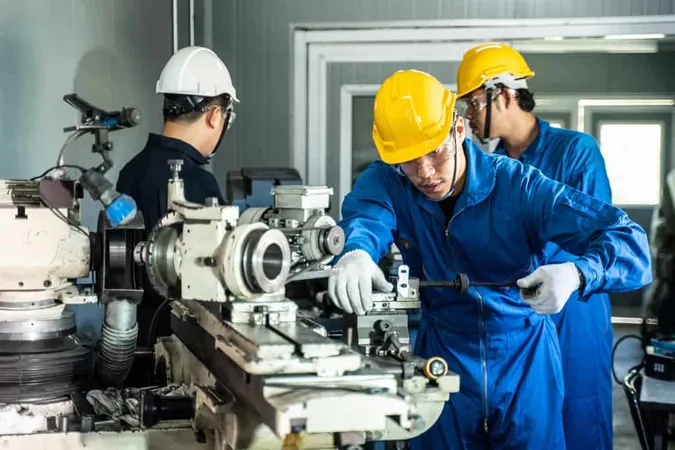

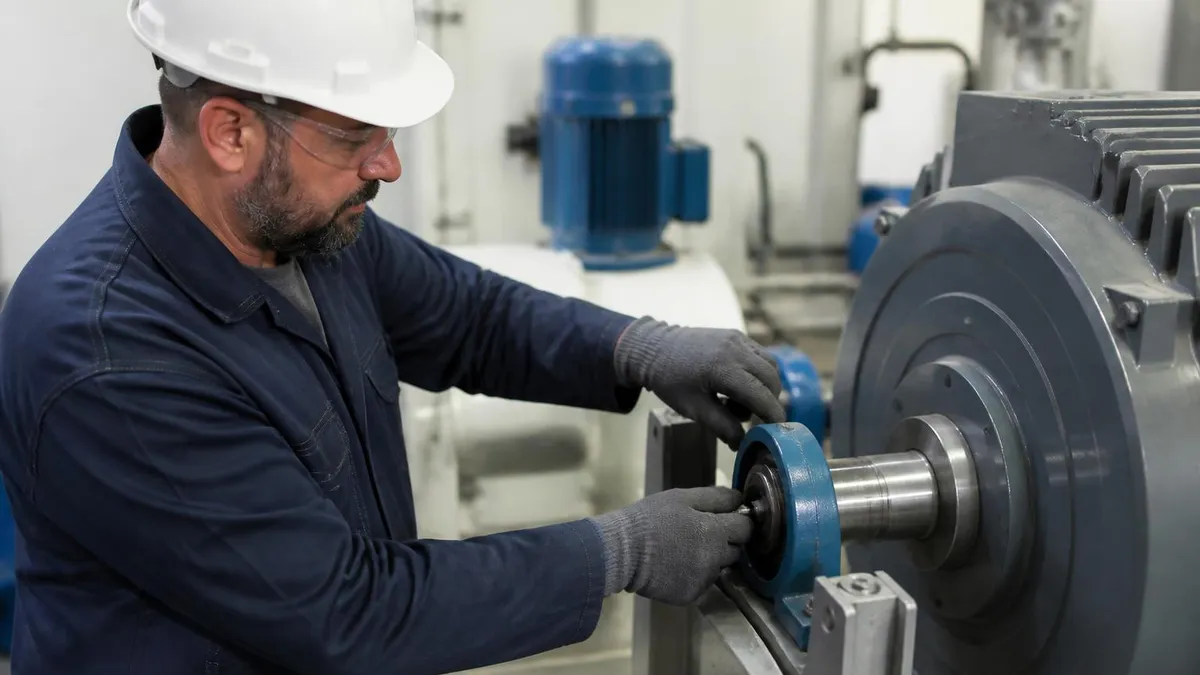
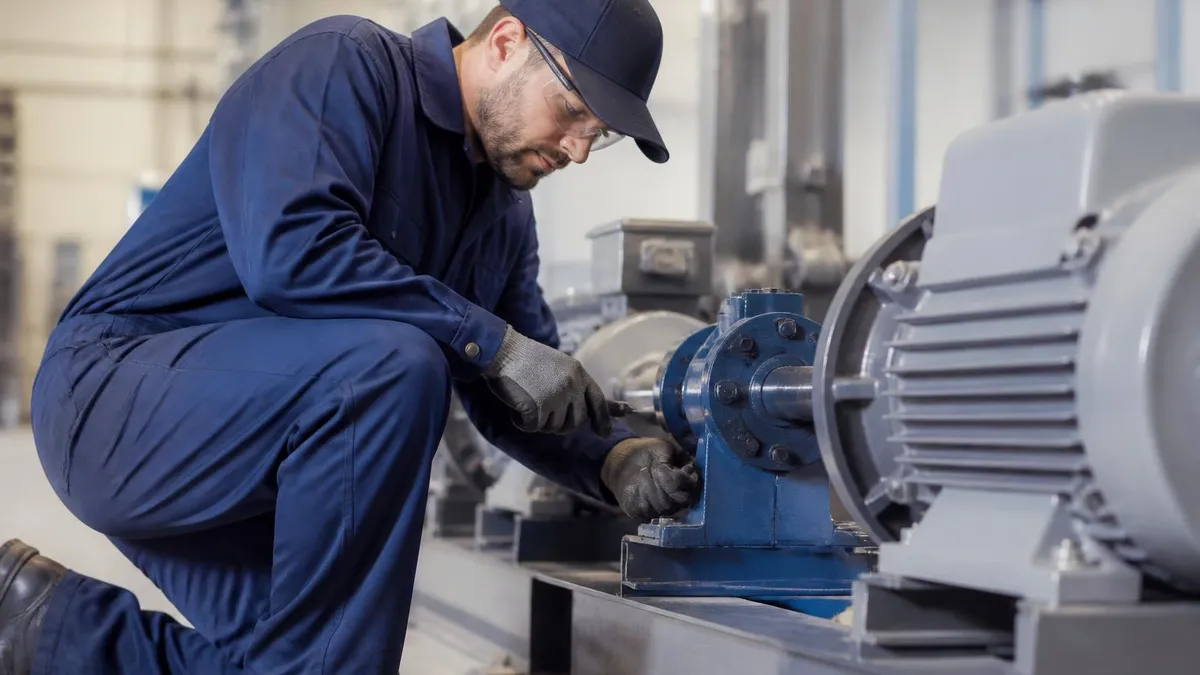
About the Author

Educational Psychologist & Academic Test Preparation Expert
Columbia University Teachers CollegeDr. Lisa Patel holds a Doctorate in Education from Columbia University Teachers College and has spent 17 years researching standardized test design and academic assessment. She has developed preparation programs for SAT, ACT, GRE, LSAT, UCAT, and numerous professional licensing exams, helping students of all backgrounds achieve their target scores.