
Milady Cosmetology State Board Exam Guide: What It Covers and How to Study
📗 Prepare for the Milady Cosmetology State Board certification. Practice questions with answer explanations covering all exam domains.
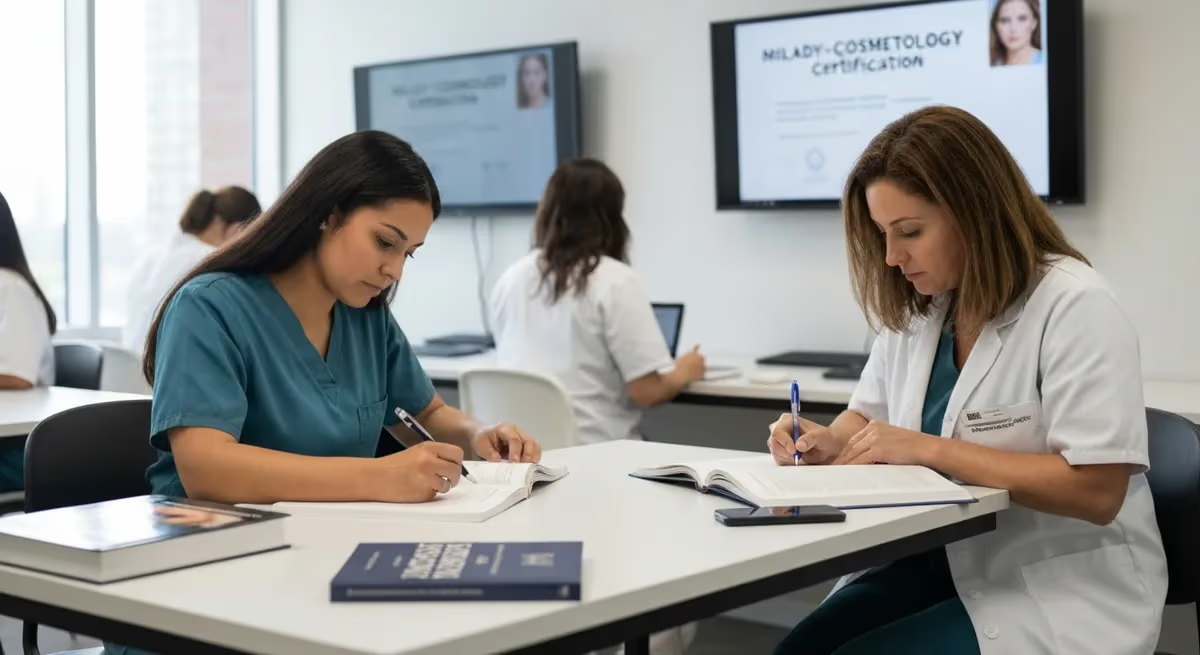
The cosmetology state board exam consists of two parts: a written (theory) exam and a practical (hands-on) exam. The written portion draws heavily from the Milady Standard Cosmetology textbook, testing knowledge of safety and sanitation, hair care sciences, chemical services, skin care, nail care, and salon business practices. Most states require a passing score on both portions before issuing a cosmetology license.
The Milady Cosmetology exam uses a multiple-choice format with questions covering all major domains. Most versions allow 2-3 hours for completion.
Questions test both knowledge recall and application skills. A score of 70-75% is typically required to pass.

Understanding the State Board Exam
The Milady cosmetology state board exam is the final hurdle between cosmetology school and your professional license. Understanding how the exam is structured helps you allocate your study time effectively.
Written (Theory) Exam:
The written exam tests your knowledge of cosmetology theory — the science and principles behind the techniques you learned in school. Most states use exams developed by the National-Interstate Council of State Boards of Cosmetology (NIC) or similar testing organizations. The exam typically contains 100 to 120 multiple-choice questions covering:
- Safety and infection control: Sanitation, disinfection, sterilization, bloodborne pathogens, OSHA regulations, and salon safety procedures
- Hair care sciences: Hair structure, growth cycles, hair and scalp conditions, shampoo chemistry, conditioning treatments
- Chemical services: Hair coloring theory, permanent waving, chemical relaxing, lightening, and the chemistry behind each service
- Haircutting and styling: Cutting techniques, sectioning, elevation, finger angle, styling tools, and thermal styling principles
- Skin care and makeup: Skin anatomy, skin types, facial treatments, hair removal, and cosmetic application
- Nail care: Nail structure, manicure and pedicure procedures, nail disorders, and artificial nail applications
- Salon business: Client communication, record keeping, retail sales, and professional ethics
Practical Exam:
The practical exam requires you to demonstrate competency in performing cosmetology services on a mannequin or live model (state-dependent). You are evaluated on technique, sanitation practices, safety procedures, and time management. Common practical exam services include:
- Haircutting (graduated bob, layered cut, or other specified style)
- Chemical waving (permanent wave rod placement and processing)
- Hair coloring application (virgin application or retouch)
- Roller setting and thermal styling
- Scalp treatment or facial procedure
- Manicure
Both parts must be passed to receive your license. In most states, if you pass one part but fail the other, you can retake only the failed portion without repeating the entire exam.
Key Milady Chapters and Topics
The Milady Standard Cosmetology textbook is organized into chapters that align with the state board exam content areas. Some chapters carry significantly more weight on the exam than others. Here are the highest-priority topics to focus your study on.
Infection Control and Safety (Chapters 5-6) — Heavily Tested
This is consistently the most heavily tested topic on the written exam. You need to know the difference between cleaning, disinfecting, and sterilizing. Understand EPA-registered disinfectants, proper dilution ratios (typically 1:10 bleach solution), contact times, and which tools require hospital-grade disinfection versus those that only need cleaning. Know the difference between direct and indirect transmission of pathogens, standard precautions for bloodborne pathogens, and proper disposal of contaminated materials.
Key terms to master: bactericidal, virucidal, fungicidal, tuberculocidal, non-porous versus porous items, single-use items, autoclave, wet sanitizer, and OSHA requirements.
Hair Structure and Chemistry (Chapters 11-12)
Understanding hair at the molecular level is essential for both the written and practical exams. Know the three layers of the hair shaft (cuticle, cortex, medulla), the role of keratin and disulfide bonds, melanin types (eumelanin and pheomelanin), the hair growth cycle (anagen, catagen, telogen), and how pH affects the hair.
Chemical Texture Services (Chapters 20-21) — Heavily Tested
Chemical texture services — permanent waving and chemical relaxing — are among the most complex and most tested topics. You must understand the chemistry: permanent waves break disulfide bonds with thiol compounds (thioglycolate), then reform them in a new configuration using a neutralizer (oxidizer). Chemical relaxers use hydroxide (lye or no-lye) to permanently break disulfide bonds and restructure the hair into a straighter configuration.
Know the differences between acid waves, alkaline waves, and exothermic waves. Understand processing time factors, rod selection, wrapping techniques, and safety precautions. Test your chemical texture knowledge with our Chemical Texture Services practice quiz — this topic appears heavily on both written and practical exams.
Hair Coloring (Chapters 22-23)
Hair coloring theory covers the color wheel (primary, secondary, tertiary colors), the law of color, levels and tones, developer volumes (10, 20, 30, 40 volume), and the four categories of hair color: temporary, semi-permanent, demi-permanent, and permanent. You need to understand oxidative versus non-oxidative color, the role of ammonia and MEA, lifting versus depositing, and how to perform strand tests, patch tests, and predisposition tests.
Skin Care and Anatomy (Chapters 8, 17)
Know the layers of the skin (epidermis, dermis, subcutaneous), skin functions, skin types and conditions, Fitzpatrick scale, common skin disorders, contraindications for facial treatments, and basic facial massage movements (effleurage, petrissage, tapotement, friction, vibration).
Milady Cosmetology Study Tips
What's the best study strategy for Milady Cosmetology?
Focus on weak areas first. Use practice tests to identify gaps, then study those topics intensively.
How far in advance should I start studying?
Most successful candidates begin 4-8 weeks before the exam. Create a structured study schedule.
Should I retake practice tests?
Yes! Take each practice test 2-3 times. Focus on understanding why answers are correct, not memorizing.
What should I do on exam day?
Arrive 30 min early, bring required ID, read questions carefully, flag difficult ones, and review before submitting.
- ✓Confirm your exam appointment and location
- ✓Bring required identification documents
- ✓Arrive 30 minutes early to check in
- ✓Read each question carefully before answering
- ✓Flag difficult questions and return to them later
- ✓Manage your time — don't spend too long on one question
- ✓Review flagged questions before submitting
Study Strategies That Work
Effective preparation for the Milady cosmetology state board exam combines consistent review with active learning techniques. Here are strategies that consistently help students pass on their first attempt.
Start 6-8 Weeks Before Your Exam Date
Cramming the night before a state board exam rarely works. The material covers too many topics — from chemistry to anatomy to business — for last-minute memorization. A 6-8 week study plan allows you to cover all major topics, identify weak areas, and build confidence through practice testing.
Use the Milady Exam Review Book
The Milady Exam Review companion book is specifically designed for state board prep. It contains chapter-by-chapter review questions that mirror the format and difficulty of the actual exam. Work through every chapter, marking questions you get wrong, and revisit those topics in the main textbook.
Active Recall Over Passive Reading
Simply re-reading chapters is one of the least effective study methods. Instead, use active recall:
- Read a section, close the book, and write down everything you remember
- Create flashcards for key terms, chemical formulas, and procedures
- Teach concepts to a study partner — explaining forces deeper understanding
- Take practice quizzes after each study session to test what you retained
Focus Disproportionately on High-Weight Topics
Not all chapters carry equal weight on the exam. Prioritize your study time:
| Priority | Topics | Study Time |
|---|---|---|
| Highest | Infection control, chemical texture, hair coloring | 40% of total study time |
| High | Hair structure, skin care, anatomy | 25% of total study time |
| Medium | Haircutting, styling, nail care | 20% of total study time |
| Lower | Salon business, professional image, history | 15% of total study time |
Take Full-Length Practice Exams
Two weeks before your exam, start taking full-length practice tests under exam-like conditions. Time yourself, avoid looking up answers, and score yourself honestly. This builds test-taking stamina and reveals which topics still need work. Practice with our Chemical Texture Services questions to test your knowledge of one of the most challenging exam topics.
Practical Exam Preparation
The practical exam evaluates your ability to perform cosmetology services safely and competently. Many students focus entirely on the written exam and neglect practical preparation — this is a mistake, as the practical portion has its own passing requirements.
What Examiners Look For:
Practical exam evaluators score you on three categories:
- Sanitation and safety: Proper hand washing, tool disinfection, workstation setup, draping the client, and disposing of single-use items. This is evaluated throughout every service, not just at the beginning.
- Technical skill: Correct execution of the assigned service — proper sectioning, consistent tension, accurate application, and finished result quality.
- Time management: Completing each service within the allocated time. Rushing causes mistakes. Going over time results in point deductions or automatic failure on that section.
Common Practical Exam Mistakes:
- Forgetting to sanitize hands between services — Examiners watch for this at every transition. Wash or sanitize hands before touching the mannequin or model, after handling chemicals, and after touching your face or hair.
- Improper tool setup — All tools should be pre-arranged, visibly clean, and organized before you begin. Searching for tools during a timed service costs valuable seconds.
- Skipping the strand test — For chemical services, performing a strand test is often a required step. Skipping it — even if you know the processing time — can result in point deductions.
- Uneven sections — In haircutting and chemical application, clean, consistent sections demonstrate competency. Sloppy sectioning signals lack of control.
- Not timing your processing — Set a timer for chemical services. Examiners want to see that you monitor processing time, not guess.
Practice Schedule:
In the final four weeks before your practical exam, practice each required service at least 3-4 times. Time yourself to ensure you can complete each service within the allowed period. Ask an instructor or experienced stylist to watch your practice and provide feedback. Record yourself on video and watch the playback — you will catch mistakes you did not notice in the moment.
Milady Cosmetology Pros and Cons
- +Milady exam content is organized around a published blueprint, making targeted preparation efficient and systematic
- +Official and third-party practice materials provide realistic exposure to question types before the actual exam
- +Score reporting after practice tests and the actual exam provides detailed feedback for focused improvement
- +Study communities (forums, Discord groups, Reddit) share current insights about tested content and effective strategies
- +Multiple registration windows and retake policies give candidates flexibility in timing and recovery from suboptimal first attempts
- −High-quality preparation materials require financial investment that not all candidates can easily access
- −Time required for thorough preparation is often underestimated, leading to rushed review of critical content
- −Milady preparation resources vary widely in quality and accuracy — not all published guides are aligned with current exam content
- −Self-study without external accountability increases the risk of avoiding weak subjects and over-studying familiar ones
- −Performance under actual exam conditions often differs from practice performance due to time pressure and stress factors
Milady Cosmetology Questions and Answers
About the Author
Licensed Cosmetologist & Beauty Licensing Exam Specialist
Paul Mitchell SchoolsMichelle Santos is a licensed cosmetologist with a Bachelor of Science in Esthetics and Salon Management from Paul Mitchell School. She has 16 years of salon industry experience and 8 years preparing students for state cosmetology board exams in theory, practical skills, and sanitation. She specializes in licensure preparation for cosmetologists, estheticians, and nail technicians.
Join the Discussion
Connect with other students preparing for this exam. Share tips, ask questions, and get advice from people who have been there.
View discussion (6 replies)