
How Long Are MEPS Physicals Good For? Validity and Expiration 2026 September
Learn how long MEPS physicals are valid, what causes them to expire, when you need a new physical, and what happens if your results expire before shipping. 🆕
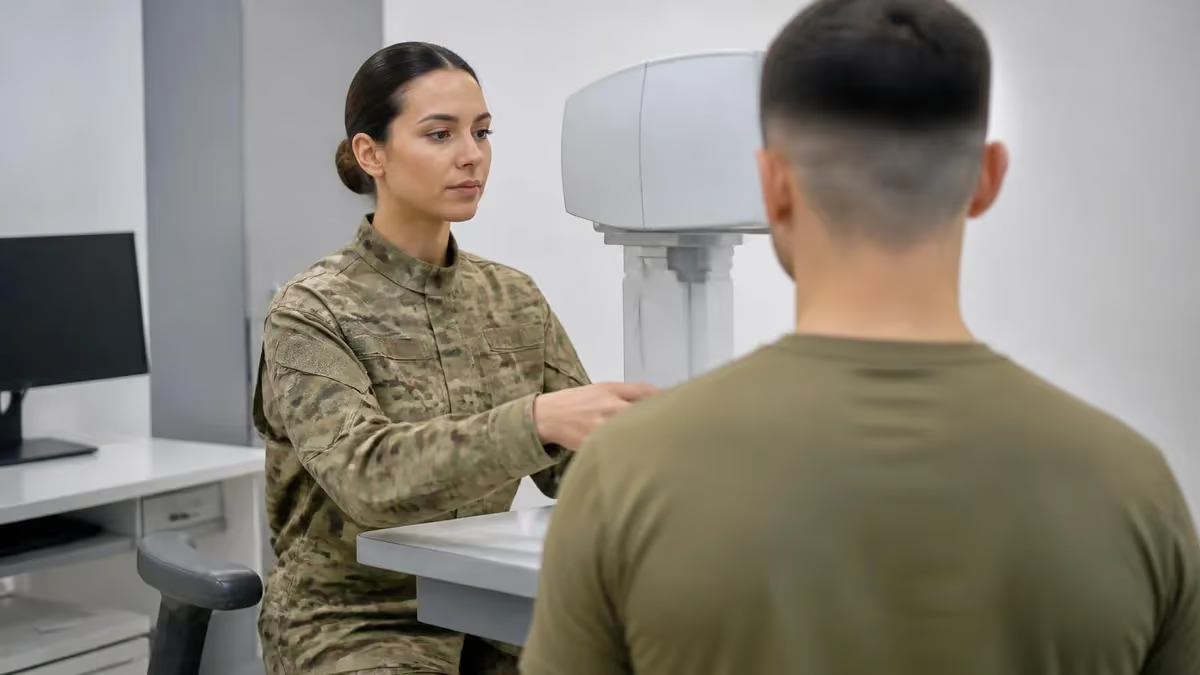
How Long Are MEPS Physicals Good For?
A is generally valid for two years from the date it was completed. If you ship to within two years of physical, your results are considered current and no re-examination is required. The two-year validity period applies broadly across all military branches and covers most of the medical and administrative components of the MEPS evaluation.
However, two years is the general rule — not an absolute one. Certain components of the MEPS evaluation have shorter validity windows, and individual circumstances can trigger a requirement for updated testing or re-examination even within the two-year period. A significant medical change, a new prescription, or a disqualifying condition discovered after your initial physical can all require updated documentation before you can ship. Your recruiter is the best source for current, branch-specific validity requirements, as policies are updated periodically and vary somewhat between the Army, Navy, Marines, Air Force, Space Force, and Coast Guard.
The two-year clock starts from the date your medical examination was completed at MEPS — not from the date you took the ASVAB, the date you met with a recruiter, or the date your DEP (Delayed Entry Program) contract was signed. If your physical was completed January 15, 2024, it remains valid through January 15, 2026. Shipping to basic training before that date means you don't need a new physical. Shipping after that date triggers the need for re-evaluation.
It's worth clarifying what the covers and why the two-year window exists. The physical examination assesses your current medical fitness for military service — vision, hearing, orthopedic function, cardiovascular health, and dozens of other medical criteria. The two-year validity window reflects the military's judgment that a person who passed medical standards two years ago is unlikely to have developed a disqualifying condition in that time without the recruiter's awareness. This is a reasonable assumption for healthy young adults, but it's an assumption — not a guarantee that nothing has changed.
For recruits who are medically borderline — those who required a waiver or were close to the limits on vision, hearing, or other standards — the two-year assumption is more precarious. A gradual decline in vision or hearing over two years could place someone outside standards at shipping even if they were within range at their original physical. Regular self-monitoring and honesty with your recruiter about any perceived health changes protects you from a surprise disqualification on your shipping day.

MEPS Physical Validity Key Facts
What Expires and What Doesn't in a
Not all components of the MEPS evaluation expire simultaneously. Understanding which elements have shorter validity windows helps you and your recruiter plan your ship date without triggering unnecessary re-testing. The HIV serology test — a blood test for HIV antibodies — has a validity period of only one year. If your physical was completed 14 months ago and you haven't shipped yet, you'll likely need a new HIV blood draw before processing. This is one of the most common reasons recruits need a partial re-evaluation at MEPS rather than a full physical.
The urinalysis () conducted at MEPS also has a validity window shorter than the two-year physical. Drug testing results are typically considered valid for 12 months. Recruits who have been in the Delayed Entry Program (DEP) for over a year may need to provide a new urine sample before shipping, particularly if the branch's policy requires current urinalysis results. This is handled at a re-visit to MEPS, not a full re-examination, but it does require a return trip to the .
The ASVAB score used for job qualification has the same two-year validity period as the physical. If both were completed on the same date, they typically expire together. However, if you've taken the ASVAB multiple times at different dates, your most recent valid score from within the two-year window is used for job selection purposes. Candidates who want to improve their ASVAB score before shipping must retake the test within the validity window of their original physical if they want to use the new score for job selection.
The physical fitness elements of the MEPS evaluation — height, weight, and body fat measurements — are noted at the time of your physical. If you've had significant weight changes since your original MEPS visit, the MEPS physician may require updated measurements before clearing you for shipping. Being significantly overweight relative to the military height/ at shipping time is grounds for delayed shipping until you meet the standard, and your original physical findings don't exempt you from current standards.
One often-overlooked aspect of validity is the mental health screening component. If you received a mental health evaluation during your original — perhaps for a disclosed history that required review — that evaluation is part of your permanent processing record. A new diagnosis, medication, or mental health treatment after your original physical must be disclosed even if the overall two-year physical window hasn't expired, because the mental health standards apply at the time of shipping, not just at the time of the original evaluation.

While the MEPS physical overall is valid for 2 years, these components expire sooner and may require updating before your ship date:
- HIV serology test: 1 year — most commonly updated before shipping for DEP members
- Urinalysis / drug test: Approximately 12 months — may need fresh sample for long-DEP recruits
- Medical waivers: Validity varies by condition and branch — waiver may need re-approval if significant time passes
- Prescription medications: If you start a new medication after your physical, update your recruiter immediately — may require documentation
- New injuries or diagnoses: Any new medical condition discovered after your physical must be disclosed; may require MEPS evaluation before shipping
When You Need a New
A full re-examination at MEPS is required if your two-year validity period expires before you ship. This most commonly affects recruits who entered the DEP with a longer anticipated wait time — often for specific job training pipelines or officer programs. Recruits who enlist for high-demand specialties with shorter training pipelines rarely encounter the two-year expiration because they ship relatively quickly after enlisting.
Medical events that occur after your original physical may also trigger a re-evaluation regardless of whether the two-year window has passed. If you're in an accident, have surgery, receive a new medical diagnosis, begin taking prescription medication, or experience any significant health change while in the DEP, you're required to disclose this to your recruiter. Concealing a post-physical medical event is a federal offense under the — it creates grounds for separation after enlistment and potentially criminal liability for fraudulent enlistment.
Mental health events — including psychiatric treatment, prescription for psychotropic medications, or hospitalization for mental health reasons — after your require disclosure and evaluation. Military service has specific mental health standards, and any new mental health diagnosis or treatment received after your original MEPS evaluation can affect your shipping eligibility. Your recruiter will coordinate with MEPS staff on how to handle disclosure and whether a waiver or updated evaluation is needed.
A common misconception is that the DEP contract "locks in" your physical results permanently. It doesn't. The DEP contract commits you to service and preserves your job selection, but it doesn't freeze your medical status. If a condition develops that would disqualify you for your chosen specialty or for military service generally, the DEP contract can be voided or modified, and your physical results are subject to re-evaluation based on your current health status at shipping.
Recruits who are in the DEP and have concerns about whether their physical will hold up — perhaps because of a minor health issue or a condition they're managing — benefit most from transparency with their recruiter. A recruiter who knows about a potential concern can proactively coordinate with the MEPS medical staff to determine whether a waiver is available, whether additional documentation addresses the concern, or whether a re-evaluation is warranted before the shipping deadline. Managing this proactively is always better than a surprise at the on the morning of your ship date.
The ASVAB score also requires a brief mention in the context of re-evaluation. If you return to MEPS for a physical re-examination, you don't automatically take the ASVAB again unless your original score expired. Most recruits don't need to retake the ASVAB for a physical re-exam. However, if you want to change occupational specialty to one requiring a higher score, a voluntary ASVAB retake is possible — that's a separate process that your recruiter coordinates independent of any physical re-evaluation requirement.
MEPS Physical Validity by Situation
- Short DEP (under 12 months): Almost certainly no re-evaluation needed — physical remains fully valid
- 12–18 months in DEP: HIV test likely expired; expect a blood draw re-visit to MEPS before shipping
- 18–24 months in DEP: HIV and urinalysis validity both at risk; coordinate re-testing schedule with recruiter
- Over 24 months in DEP: Full physical re-examination required if past the 2-year anniversary of your original MEPS visit
- Any DEP period: Disclose any new medical conditions, medications, or health events to recruiter immediately

Branch-Specific Physical Validity Rules
While the two-year standard applies broadly, each military branch has authority to set additional or more stringent validity requirements for specific programs, ratings, or occupational specialties. Navy recruits enlisting in nuclear or aviation fields, for example, may have additional medical requirements with their own validity timelines. Air Force recruits accessing into pilot training have vision and physical fitness standards that are evaluated in the normal but may be re-evaluated if the commissioning timeline extends significantly.
The Coast Guard's recruiting process routes through MEPS but the Coast Guard maintains some independent standards, particularly for certain ratings that involve waterborne operations in demanding environments. Marine Corps recruiting is among the most stringent in terms of physical standards, and the Marines sometimes require physical re-evaluations for recruits who have been in the poolee program (their equivalent of DEP) for extended periods, even if the two-year physical hasn't expired.
National Guard and Reserve Component recruiting follows the same basic validity rules as active duty recruiting. Reserve Component recruits who enter the DEP with the expectation of shipping after their current semester or academic year finishes sometimes find that timing the physical too early creates unnecessary pressure to ship before circumstances allow. Discussing the anticipated ship date with a recruiter before going to MEPS for the first time allows for better timing of the physical examination relative to your expected commitment date.
Space Force is the newest military branch and processes through MEPS with the same baseline standards as the Air Force, since Space Force personnel are commissioned or enlisted from existing Air Force infrastructure. Space Force candidates should expect the same physical validity rules as Air Force recruits, though as the branch matures and establishes its own distinct personnel policies, some aspects of physical validity requirements may be clarified in Space Force-specific guidance.
For recruits whose spans a significant period — 18 months or more in the DEP — it's particularly valuable to work with a recruiter who has experience managing long-timeline enlistments. Experienced recruiters know exactly which components expire at which intervals and can proactively schedule MEPS re-visits to refresh HIV tests, urinalysis, or other expiring elements without disrupting the overall ship timeline. A recruiter who has handled multiple long-DEP cases typically has a system for this, while newer recruiters may need guidance from their recruiting station leadership.
Army recruits typically have the most flexibility in DEP length — the Army accepts long-term DEP commitments for recruits waiting for specific jobs or training school slots. This makes Army recruiters most likely to manage recruits whose MEPS physicals are approaching expiration. Talking to your Army recruiter specifically about the physical validity timeline and any upcoming partial re-evaluation visits should happen at least 90 days before your ship date.
MEPS Physical Validity: Common Scenarios
No re-examination needed. Your original MEPS physical results are valid as long as no new medical conditions, waivers, or shorter-validity components have expired.
A new full MEPS physical is required. Your recruiter will schedule a return trip. Existing ASVAB scores may still be valid separately.
Requires a return trip to MEPS for a blood draw only — not a full re-examination. Usually scheduled in the weeks before your ship date.
Must be disclosed to recruiter regardless of whether physical is still valid. May require a medical waiver or MEPS re-evaluation before shipping is cleared.
If more than 2 years since separation, a new MEPS physical is typically required. Prior service applicants must also meet current medical standards, not just the standards at initial enlistment.
If your weight at shipping day doesn't meet branch standards, you may be delayed regardless of your original physical results. Standards apply at the time of shipping, not at the time of the physical.
Tips for Avoiding MEPS Physical Expiration Issues
The most effective way to avoid physical validity problems is to work closely with your recruiter to align your anticipated ship date with your physical examination date. If you know you want to ship in approximately 18 months, getting your MEPS physical 18 months before your preferred ship date — rather than at the start of the process — keeps you well within the two-year window. Many recruits get their physical done as early as possible out of enthusiasm for the process, then find themselves facing re-evaluation requirements because the timeline extended.
Staying in regular contact with your recruiter throughout the DEP period is not just good practice — it's the mechanism by which physical validity issues are caught and resolved before they become a problem. Recruiters track their poolees' shipping timelines and should be proactively alerting DEP members whose HIV test or physical is approaching expiration. If your recruiter isn't raising this issue and you've been in the DEP for over 18 months, ask directly about the validity status of your physical components.
Taking care of your health during the DEP period is practical advice that directly affects physical validity. Maintaining your weight within military standards, avoiding any activity that could result in surgery or a disqualifying medical condition, and staying off any prescription medications that weren't disclosed at your original physical keeps your MEPS records current and accurate.
Recruits who experience a significant medical event — even a temporary one like a broken bone or a kidney stone — and fail to disclose it create a situation where their physical record is no longer accurate, which has consequences that extend beyond the shipping timeline.
Preparing for the physical re-examination — if one is required — is largely the same as preparing for your original MEPS visit. Get adequate sleep, eat a reasonable meal the evening before, avoid caffeine for several hours before hearing tests, and come with the same documentation you brought the first time: Social Security card, photo ID, birth certificate, and any updated medical records that document conditions disclosed in your original physical. If a condition has changed since your original physical, bring documentation of that change from a treating physician.
Maintaining physical fitness during the DEP period serves double duty: it prepares you for the physical demands of and keeps your weight and body composition within military standards. Recruits who start working out consistently after enlisting, improve their cardiovascular fitness, and arrive at basic training ahead of the physical baseline are at a significant advantage over those who coast through the DEP period. The physical validity of your and your physical readiness for training are separate concerns — but both require attention throughout your time in the DEP.
MEPS Physical Validity Checklist
- ✓Know the exact date your MEPS physical was completed — this starts the 2-year validity clock
- ✓Ask your recruiter about the HIV test validity (1 year) if you've been in DEP longer than 10 months
- ✓Disclose any new medical conditions, injuries, surgeries, or medications to your recruiter immediately
- ✓Track your weight monthly to ensure you'll meet height/weight standards on your ship date
- ✓If your physical expires before your planned ship date, schedule the re-examination at least 6–8 weeks ahead
- ✓For National Guard or Reserve components, confirm ship date timing with your unit before your physical date
- ✓Ask your recruiter to confirm the validity status of all physical components 60–90 days before your ship date
- ✓Keep copies of your MEPS medical documentation in case you need to reference previous examination results
DEP Timeline Considerations for Physical Validity
- +Most recruits ship well within the 2-year window — physical validity is rarely a problem for short-DEP enlistees
- +Partial re-evaluations (HIV blood draw, urinalysis update) are much less involved than a full MEPS re-examination
- +MEPS staff process re-evaluation appointments efficiently — most take less than half a day
- +An expired physical doesn't end your enlistment process — it just requires scheduling a return MEPS appointment
- +Being in good health throughout DEP means re-evaluation results typically match your original clearance
- −Physical expiration can delay a planned ship date if discovered close to the departure window
- −A full re-examination opens the possibility of being found disqualified for a condition not present at the original physical
- −New medical conditions disclosed during re-evaluation may require waivers, extending the timeline significantly
- −HIV test validity is often overlooked by both recruiters and recruits — a common source of last-minute delays
- −National Guard and Reserve recruiters vary in how proactively they track DEP physical validity for part-time enlisted candidates
MEPS Physical Validity Questions and Answers
About the Author

Retired Military Officer & Armed Forces Test Preparation Specialist
United States Army War CollegeColonel Steven Harris (Ret.) served 28 years in the US Army, earning a Master of Arts in Military Science from the Army War College and a Bachelor of Science in Criminal Justice. He has coached thousands of military enlistment and officer candidate program applicants through the ASVAB, AFQT, AFCT, OAR, and officer selection assessment processes across all military branches.
Join the Discussion
Connect with other students preparing for this exam. Share tips, ask questions, and get advice from people who have been there.
View discussion (8 replies)