
MEPS Miami Florida: Your Complete Guide to the Doral Processing Station
MEPS Miami Florida guide: 7789 NW 48th St Doral address, ASVAB, physical, dress code, lodging, two-day timeline, what to bring, tips. 💡
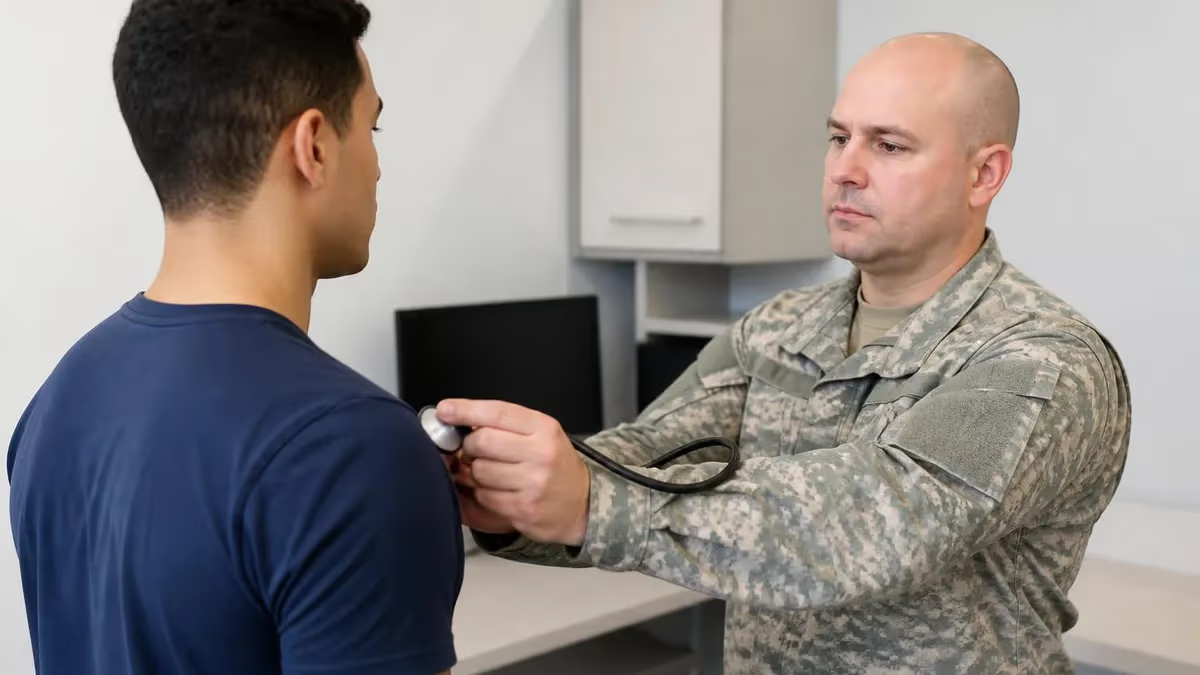
So you've signed your enlistment paperwork at the recruiter's office — congratulations. The next stop on your road into uniform is MEPS Miami Florida, the regional Military Entrance Processing Station that handles every applicant from South Florida, the Keys, and parts of the Caribbean basin. You'll go there twice in most cases: once for processing and qualification, and once for shipping out to basic training. It's a big day. Actually, it's usually two big days. And if you've never been through anything like it before, the whole experience can feel a little intimidating.
Here's the good news — it's not as scary as it sounds. MEPS is run by a mix of military and civilian staff whose job is to make sure you're medically, mentally, and morally qualified to serve. They've processed thousands of applicants exactly like you, and they've seen every kind of nervous first-timer walk through those doors.
The trick is showing up prepared. This guide walks you through everything: the address, the parking, the lodging, what to wear, what to bring, how the ASVAB and physical actually work, and the small details that trip up first-timers and force them to come back another day. Read it carefully and you'll walk in confident.
Whether you're enlisting in the Army, Navy, Marines, Air Force, Coast Guard, Space Force, National Guard, or a Reserve component — Miami MEPS handles all of them. Same building. Same process. Different uniform at the end. The Department of Defense runs 65 of these stations nationwide, and Miami's the gateway for thousands of Floridians and Caribbean nationals every year. By the time you finish reading this, you'll know exactly what's coming.

Miami MEPS By The Numbers
Miami MEPS sits in Doral, just west of the airport. The official address is 7789 NW 48th Street, Doral, FL 33166. It's tucked into a quiet business park off NW 87th Avenue, a short hop from the Florida Turnpike and the Palmetto Expressway (SR-826). If you're driving in from Broward or Palm Beach you'll probably take the Turnpike south, exit at NW 12th Street, and follow signs into Doral.
From the Keys it's a straight shot up US-1 and then onto the Palmetto north. From Tampa or Orlando you'd typically fly into MIA the day before and use the contracted hotel system. Plug the address into Google Maps the night before — Miami traffic is no joke, especially southbound on I-95 during morning rush, and being late on day one is a really bad look that can cost you your processing slot.
Your recruiter handles most of the logistics. If you live more than 50 miles away, the government usually puts you up at a contracted hotel the night before, and a shuttle runs from the lobby at oh-dark-thirty to get you to the station by 0430 or 0500.
If you're local — Hialeah, Kendall, Doral itself, even down to Homestead — you'll either drive yourself or get dropped off. Either way you'll be standing in the parking lot before the sun is up, ID in hand, watching the building lights flicker on. Parking is available on-site but limited. If you can get a ride, take it.
The building itself is unassuming from the outside — a clean, low-rise federal facility with American flags out front and tinted security glass at the entrance. Inside it's all linoleum floors, fluorescent lights, exam rooms, and waiting areas. Functional, not fancy. Think DMV crossed with a doctor's office, run with a touch more discipline than either.
Miami MEPS at a Glance
Located at 7789 NW 48th Street, Doral, FL 33166 — just west of Miami International Airport, off the Palmetto Expressway. Miami MEPS serves all applicants from South Florida, the Keys, the Bahamas, and parts of the Caribbean. It processes Army, Navy, Marines, Air Force, Coast Guard, Space Force, Army and Air National Guard, and every branch's Reserve component under one federal roof. Open weekdays, with most applicants arriving by 0500 for an all-day processing schedule that ends in the late afternoon with the Oath of Enlistment.
What actually happens once you're inside? A lot, and fast. The day kicks off with a security check — think airport-style screening. You'll empty pockets, walk through a metal detector, and hand over your phone for the duration of medical. Then you'll get a briefing in the main holding area where a senior NCO or civilian staffer explains the schedule, the rules of behavior, and what the day looks like.
Pay attention. They cover things like dress code violations, where you can and can't sit, when you can use the restroom, what to do if you start feeling sick. After that you split into groups based on what you still need to complete — most applicants are doing some combination of ASVAB, medical, and final paperwork.
If you haven't taken the ASVAB yet, you'll head to the testing room for the Computer Adaptive Test version (CAT-ASVAB). Most applicants knock it out in about 90 minutes. The CAT adjusts difficulty based on your answers — get one right, the next question gets harder; get one wrong, it eases up. There's no penalty for guessing, so don't leave anything blank.
Next comes the medical workup — vision, hearing in a soundproof booth, blood pressure (often retaken if you're nervous and it spikes), urinalysis for drugs and pregnancy, a blood draw for HIV and basic labs, and a full physical examination with a doctor who'll check your range of motion, scars, tattoos, and overall body composition. After medical comes background and security questioning, where you'll review every detail on your enlistment paperwork with a counselor and confirm there's nothing you forgot to disclose. Honesty matters here. Hiding something will end your career before it starts.
The Four Phases of MEPS Processing
Security screening, briefings, paperwork verification, and group assignments. You'll surrender your phone and electronics for the duration of the medical portion. Plan on standing in line.
Computer-adaptive ASVAB if you haven't already tested, then a full medical workup — vision, hearing, blood pressure, urinalysis, blood draw, doctor's physical, and the famous duck walk.
Counselor reviews every detail of your enlistment paperwork, criminal history, financial obligations, drug use, and full medical history. Honesty here is absolutely non-negotiable.
Service-specific liaison helps you choose an MOS, AFSC, or rating based on your line scores and current availability. Sign the contract. Raise your right hand. You're officially in.

Once you clear medical and background, you'll meet with a service liaison to pick a job. This is where the MOS, AFSC, or rating you've been talking about with your recruiter becomes real. You'll see what's actually available given your ASVAB line scores, your medical profile, your security clearance eligibility, and the needs of your branch on that particular day. Sometimes the dream job is right there waiting.
Sometimes you have to flex — your top pick might be closed for the next six months, and you'll need to weigh whether to wait or pick something else. Either way, this is a conversation, not an order. Ask questions before you sign. Ask about bonuses. Ask about training pipeline length. Ask about typical follow-on duty stations. The counselor isn't your enemy, but they're not your career advisor either — that's on you.
After you've chosen and a contract is printed, you'll review every page with a counselor. They'll read key clauses out loud and ask you to initial alongside them. Pay attention. Don't just nod. If something doesn't match what your recruiter promised, speak up before you sign. Once the ink is dry the contract is binding. Then the moment most applicants remember for the rest of their lives: you raise your right hand and take the Oath of Enlistment in front of a commissioned officer.
That's the legal moment you join. From there you're either sent home as a Future Soldier, Sailor, Airman, Marine, Guardian, or Coastguardsman to wait for your ship date — anywhere from a few weeks to over a year out — or, if you're shipping that same week, you'll come back to MEPS, do final paperwork, draw your travel orders, and fly out to basic training that afternoon.
What Happens At Each Stage
Shuttle leaves the hotel at 0430. You'll be through security by 0500. Bring your Social Security card, ID, birth certificate, and any medical paperwork your recruiter requested. Cell phones get locked up — no exceptions during medical. Briefings start at 0530 with a senior NCO who covers the day's flow.
Packing for MEPS is simple if you keep it minimal. You don't need much. You do need the right paperwork, and forgetting any of it can torpedo your whole day. Bring your Social Security card, your driver's license or state ID, your birth certificate (an original or certified copy — no photocopies, no laminated wallet versions, no photos of the document on your phone), and any medical paperwork your recruiter has asked you to bring.
If you wear glasses, bring them along with your prescription. Contacts are fine but the eye exam wants you in glasses if you've got them. If you've had any kind of surgery, bring the operative report. If you've taken any prescription medication in the last year, bring the bottle or a printout from the pharmacy.
Leave the jewelry at home. Skip the cologne and perfume — Florida heat plus close-quarters waiting rooms plus heavy scent equals a headache for everyone. Don't bring a laptop, a tablet, headphones, AirPods, smartwatches, or anything else that screams "stuff I care about" — there's nowhere safe to stash it and you'll be told to leave it in a locker anyway.
A small backpack with your documents, a phone charger, a bottle of water, and a couple of snacks is plenty. Wallet, ID, paperwork. That's the core. If you're a smoker or vaper, leave it in the car. There's no smoking on the property, and going outside for a break is generally not allowed during processing.
MEPS will not process you without original or certified copies of your birth certificate and Social Security card. Photocopies, screenshots, and laminated wallet versions don't count. If you've ever been arrested, ticketed, or seen a doctor for anything more than a common cold, bring full documentation. Forgetting paperwork is the number-one reason South Florida applicants get rescheduled and lose their ship date.
Dress code matters more than you'd think. Miami MEPS — and every MEPS — enforces a strict appearance standard. You're not in uniform yet, but you're representing yourself as a future service member, and the staff watches. Show up in clean, conservative clothing. Collared shirt or modest top. Pants or a knee-length skirt. Closed-toe shoes. No ripped jeans, no tank tops, no graphic tees with crude or political messages, no flip-flops, no shorts. Hats come off indoors. Hair should be neat and out of your face.
For the medical portion you'll change into a gown or strip down to your underwear at points — so wear underwear you're comfortable being seen in, because at one stage all the male applicants do the famous "duck walk" together to check joint mobility. It feels weird. Everybody does it. Nobody cares what you look like. Just go with it.

What To Bring To Miami MEPS
- ✓Social Security card (original) and government-issued photo ID
- ✓Original or certified copy of your birth certificate
- ✓Glasses if you wear them, plus the current prescription
- ✓Any medical records, surgery notes, or prescription bottles your recruiter requested
- ✓Court documents for any arrest, ticket, or legal incident — even minor ones
- ✓A small backpack with phone charger, water, and a couple of snacks
- ✓Conservative clothes: collared shirt, pants, closed-toe shoes — no shorts, no tank tops
Lodging is where a lot of first-timers worry, and they shouldn't. If your recruiter sets you up at the contracted hotel — typically near the airport or somewhere along NW 36th Street — the room and meals are covered by the government. You don't pay a dime. You'll get a meal voucher for dinner the night before and breakfast the morning of, redeemable at the hotel restaurant.
Don't go wild. Skip the spicy food. Skip the carne asada from that food truck down the block. And definitely skip the alcohol. You need clean urinalysis numbers, and you need to feel sharp at 0430 — not nursing a hangover or a stomach ache. Hydrate with water. Eat something simple. Go to bed.
You'll likely share a room with another applicant — that's normal. Be respectful, hit the rack early, and set two alarms. Charge your phone. Lay out your clothes and documents the night before so you're not fumbling in the dark at 4 AM. Buses leave the lobby on a fixed schedule and they will not wait.
Showing up late to MEPS is the number-one reason people get rescheduled, and rescheduling is a hassle that can push your ship date back by weeks — sometimes months if your medical paperwork expires and has to be redone. There's also a sign-in sheet in the hotel lobby the night before. Sign it. If your name's not on it, you can be flagged as a no-show and reported back to your recruiter the next morning.
Miami MEPS Pros and Cons
- +All branches processed at one Miami location — no driving to a second site
- +Government-paid lodging and meals if you live more than 50 miles away
- +Experienced staff who walk thousands of applicants through every year
- +You leave with a signed contract, a job, and a ship date in hand
- +Free shuttle from the contracted hotel — no parking hassle in Doral
- −Very early start — shuttle at 0430 means you're up at 0345
- −Long day with significant hurry-up-and-wait between stations
- −Medical disqualifications can surface unexpectedly and end the process
- −Phones are confiscated for hours — limited contact with family
- −Miami traffic is brutal if you're driving yourself in for a 0500 arrival
The typical timeline at Miami MEPS runs two days. Day one is travel and lodging — you arrive at the hotel by late afternoon, get your briefing from the staff, eat dinner, sleep. Day two is the actual processing day: shuttle at 0430, in the building by 0500, briefings start at 0530, ASVAB or medical from 0600 to roughly noon, lunch in the chow hall around 1200, job selection and contract review in the afternoon, oath of enlistment late afternoon. Most applicants are heading home by 1700 — though long medical reviews can stretch later.
If you're shipping out the same week, your "day two" looks different — final paperwork in the morning, then transport from MEPS to Miami International for a flight to whichever basic training installation matches your branch (Fort Jackson, Great Lakes, Parris Island, Lackland, Cape May, depending on service). Either way, plan for a full day. Eat breakfast. Hydrate. Bring patience and a paperback. There's a lot of hurry-up-and-wait built into the schedule, and the chairs aren't exactly comfortable. Trust the process, follow instructions, and you'll roll out by evening with everything squared away.
A few final pointers from people who've walked that hallway. Tell the truth. On every form, in every interview, about every medical condition, every traffic ticket, every prescription you've ever taken. MEPS staff are trained to spot inconsistencies, and recruiter-coached lies have a way of surfacing during background checks, fingerprint hits, or follow-up doctor reviews.
A waiver-eligible issue you disclose up front is a small problem — most can be cleared with a doctor's note or a quick administrative review. The same issue discovered after you sign is fraud and gets you discharged, sometimes with money owed back to the government.
Be polite. The MEPS staff process hundreds of applicants a week and they remember the rude ones. Yes Ma'am, Yes Sir, eye contact, firm handshake, no eye-rolling when you're told to wait. Move with purpose between stations. Don't sit on floors or lean on walls. Don't argue with the staff if a result comes back you didn't expect — ask questions calmly, get a clear explanation, and follow up with your recruiter afterward. Your behavior at MEPS becomes part of the unofficial record, and recruiters do talk to each other.
One more thing: practice. The ASVAB is the gate that decides which jobs are open to you, and a higher score equals more choices. If you've got a week before your appointment, take a few practice tests, brush up on word knowledge and arithmetic reasoning, get familiar with the format. It's free, it's online, and a 10-point bump on your AFQT can be the difference between cyber operations and cooking eggs in a chow hall.
And when you're done — when you've taken that oath and shaken hands and walked back out into the Miami sunshine — take a breath. You did it. The hardest part of the enlistment process is officially behind you. Basic training is next, and that's a whole different story for a whole different day.
MEPS Questions and Answers
About the Author
Retired Military Officer & Armed Forces Test Preparation Specialist
United States Army War CollegeColonel Steven Harris (Ret.) served 28 years in the US Army, earning a Master of Arts in Military Science from the Army War College and a Bachelor of Science in Criminal Justice. He has coached thousands of military enlistment and officer candidate program applicants through the ASVAB, AFQT, AFCT, OAR, and officer selection assessment processes across all military branches.
Join the Discussion
Connect with other students preparing for this exam. Share tips, ask questions, and get advice from people who have been there.
View discussion (8 replies)