
Mensa Test Answers: What to Expect, How to Prepare, and How to Score in the 98th Percentile
Learn what mensa test answers look like, how scoring works, and how to prepare. Full prep guide with practice tips. 🎯 Start your free practice test today.

Understanding mensa test answers is the first step toward earning a place in the world's most recognized high-IQ society. Mensa accepts only individuals who score in the top 2% of the general population on a standardized intelligence test, which means knowing how the questions are structured — and what correct answers look like — gives you a meaningful edge before you ever sit down for the official exam. Practice with the free Mensa practice test on PracticeTestGeeks (1,050+ questions with answer explanations).
Whether you're brand new to the concept or you've already taken a preliminary online quiz, this guide breaks down exactly what to expect, how answers are scored, and what study strategies actually work. For a full overview of the benefits you'll unlock once you qualify, explore our in-depth page on mensa test answers and membership perks.
Mensa was founded in England in 1946 by Roland Berrill and Dr. Lancelot Ware, who believed that people of high intelligence deserved a space to connect across social, economic, and professional boundaries. Today, Mensa International spans more than 50 countries and counts over 145,000 members worldwide, with American Mensa alone home to roughly 50,000 members.
The organization offers two primary paths to membership: a supervised IQ test administered by Mensa itself, or evidence of a prior qualifying score on an approved standardized test such as certain SAT, ACT, or GRE exams taken under specific conditions. Understanding which path suits you best is just as important as understanding the answers you'll encounter along the way.
Many people wonder what the actual test content looks like and whether it resembles school exams or workplace aptitude assessments. The Mensa Admission Test is a two-part proctored exam that covers a wide range of reasoning domains, including spatial visualization, number series, verbal analogies, pattern recognition, and abstract logic.
None of the questions require specialized academic knowledge — there are no history facts, no chemistry formulas, and no literature quotes to memorize. Instead, every question measures your capacity for novel reasoning, meaning your ability to identify relationships and patterns you may never have seen before. This distinction matters enormously for how you should prepare.
One of the biggest misconceptions about Mensa test answers is that they can simply be memorized. Unlike standardized academic tests where certain formulas or vocabulary lists reliably appear, Mensa's question banks rotate and vary extensively. What you can memorize, however, are the underlying reasoning strategies — the mental moves that transform a confusing matrix puzzle or a tricky number sequence into a solvable problem. Candidates who study strategies rather than specific answers consistently outperform those who rely on test dumps or leaked question sets, which are unreliable at best and misleading at worst.
The scoring system for the Mensa Admission Test is norm-referenced, meaning your raw score is compared against a large population sample rather than evaluated against a fixed percentage of correct answers. You do not need to answer every question correctly to qualify — you need to outperform approximately 98% of the comparison population. In practice, many successful Mensa applicants report that time management is the single largest challenge: both subtests are timed, and running out of time before attempting every question is a common obstacle that targeted practice can directly address.
Preparation resources have expanded dramatically in recent years, and free online practice tests now provide an accessible starting point for gauging your current ability level. PracticeTestGeeks offers six Mensa-style practice tests covering critical thinking, memory and concentration, spatial visualization, number series, word problems, and mixed-challenge formats. Each test mirrors the cognitive demands of the real Mensa exam while giving you instant feedback on which reasoning domains need the most work. Consistent, deliberate practice across all six question types is the most reliable way to maximize your score before test day.
This article will walk you through every major aspect of Mensa test answers: the structure of the exam, the specific question types you'll encounter, the cognitive skills each type measures, how to interpret your practice scores, common mistakes to avoid, and a science-backed preparation strategy you can follow over four to eight weeks. By the time you finish reading, you'll have a clear, actionable plan for approaching the Mensa Admission Test with genuine confidence.
Mensa: upcoming dates and official changes
- Oct 1, 2026: American Mensa is running a 50% discount on Local Group testing for October 2026, so it costs $30 instead of $60 through Oct. 31. (American Mensa, Ltd.)
Facts verified Oct 20, 2026 against American Mensa, Ltd.. Dates that have passed are removed automatically.
- A qualifying score on the Mensa Admission Test means scoring at or above 98 percent of the general population. (American Mensa, Ltd.)
- The Mensa Admission Test costs $60 when taken at a session proctored by American Mensa Local Group volunteers. (American Mensa, Ltd.)
- The Mensa Admission Test costs $99 when taken as a private session at one of American Mensa's 400+ approved testing facilities. (American Mensa, Ltd.)
- Candidates may take a Mensa Admission Test or test battery only once every eight weeks. (American Mensa, Ltd.)
- American Mensa membership dues are $107 per year, with additional family members at $72, a three-year membership at $290 and a five-year membership at $475. (American Mensa, Ltd.)
- The Mensa Admission Test is offered at sessions proctored by Local Group volunteers or as private sessions at more than 400 approved testing facilities nationwide. (American Mensa, Ltd.)
- American Mensa does not offer the Mensa Admission Test to anyone under 14, and test-takers must bring a photo ID with proof of date of birth. (American Mensa, Ltd.)
- Private Mensa Admission Test results arrive in two to three business days, while Local Group testing results take two to three weeks. (American Mensa, Ltd.)
Facts verified Oct 20, 2026 against American Mensa, Ltd.. Dates that have passed are removed automatically.
Mensa Exam at a Glance
| Item | Detail | Official source |
|---|---|---|
| Passing score | 98th percentile (top 2%) | American Mensa, Ltd. |
| Exam fee (Local Group testing) | $60 (Local Group session) | American Mensa, Ltd. |
| Exam fee (Private testing) | $99 (private testing center) | American Mensa, Ltd. |
| Retake policy | Once every 8 weeks | American Mensa, Ltd. |
| Renewal | $107/year dues; $72 additional family member; $290 three-year; $475 five-year | American Mensa, Ltd. |
| Delivery | Local Group proctored sessions or private sessions at 400+ testing facilities | American Mensa, Ltd. |
| Eligibility | Age 14+ with photo ID showing date of birth | American Mensa, Ltd. |
| Score release | 2–3 business days (private); 2–3 weeks (Local Group) | American Mensa, Ltd. |
Facts verified Oct 20, 2026 against American Mensa, Ltd.. Dates that have passed are removed automatically.
Free Mensa Study Tools
Interactive Mensa resources on PracticeTestGeeks, free to start:
- Free Mensa IQ Critical Thinking Practice Test — 37 questions with instant scoring and answer explanations
- Mensa flashcards — review key terms and concepts card by card
- Mensa study guide — topic-by-topic overview of what the exam covers
- Mensa cheat sheet — one-page printable summary for last-minute review
Mensa by the Numbers
Mensa Admission Test Format
| Section | Questions | Time | Weight | Notes |
|---|---|---|---|---|
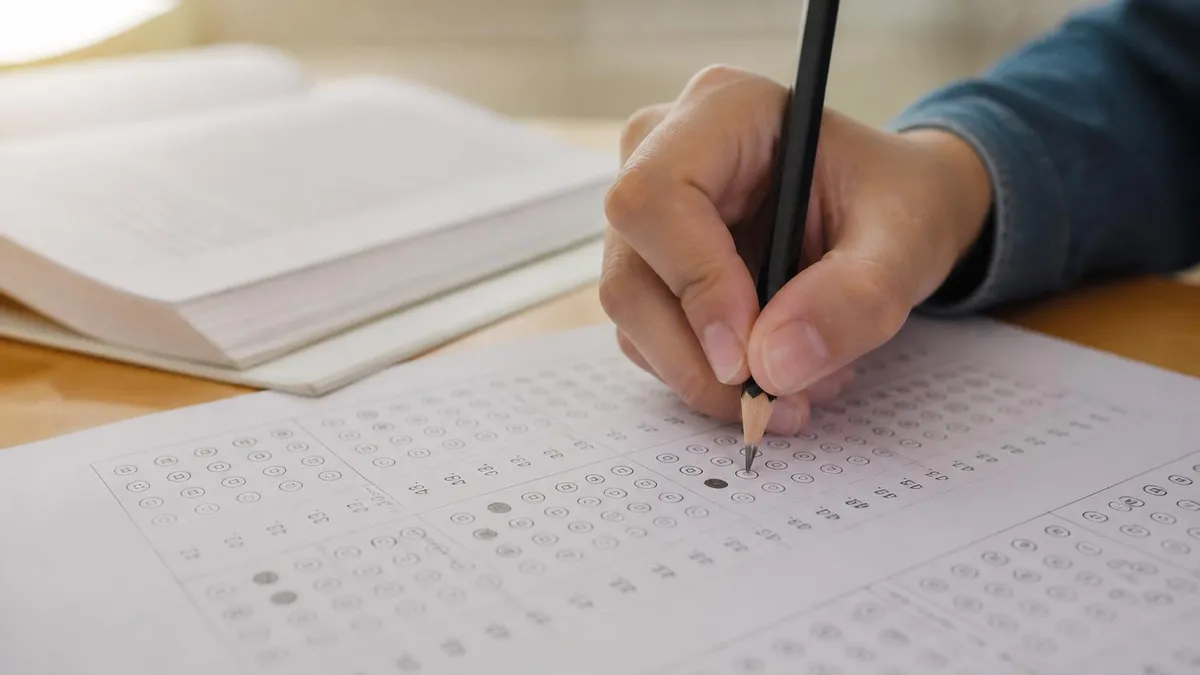
| Mensa Wonderlic (Part 1) | 50 | 12 min | Combined | Verbal, numerical, spatial reasoning |
| Mensa Culture Fair (Part 2) | 168 | 38 min | Combined | Pattern recognition, matrices, sequences |
| Total | 218 | 50 minutes | 100% |
The two sections of the Mensa Admission Test assess different but complementary cognitive abilities, and understanding what correct answers look like in each section is essential preparation. The first subtest — sometimes called the Mensa Wonderlic — presents a fast-paced mix of verbal analogies, arithmetic reasoning, spatial orientation, and reading comprehension. Questions progress in difficulty, and the tight 12-minute window means you'll need to move quickly. Most test-takers do not complete all 50 questions, so knowing when to skip and return is a core time-management skill rather than a sign of weakness.
The second subtest is a culture-fair IQ measure, designed specifically to minimize the influence of language background, education level, and cultural exposure. This section is heavily weighted toward abstract pattern recognition: you'll see matrix puzzles where you must identify which shape completes a visual grid, series of figures that follow a logical transformation rule, and pattern-matching problems that require you to detect relationships across multiple dimensions simultaneously.
Correct answers in this section always follow a consistent internal logic — there is always exactly one option that satisfies all of the pattern's rules at once. Training yourself to identify those rules methodically, rather than guessing by intuition, is the single most effective preparation strategy.
Verbal analogy questions — common in the first subtest — follow a predictable structure: A is to B as C is to D. The key to getting these right is identifying the precise relationship between A and B before scanning the answer choices. Relationships commonly tested include part-to-whole (wheel is to car), cause-and-effect (drought is to famine), function (knife is to cut), degree (warm is to hot), and antonym pairings.
Candidates who read the answer choices before determining the relationship often get distracted by plausible-sounding distractors. The correct approach is to state the relationship in a clear sentence first, then find the answer choice that fits that sentence exactly.
Number series questions require you to identify the mathematical rule governing a sequence and predict the next term. Common rules include arithmetic progressions (adding or subtracting a fixed amount), geometric progressions (multiplying or dividing by a fixed ratio), alternating sequences (two interwoven patterns), and Fibonacci-style rules where each term is the sum of the previous two.
When you encounter a series and the rule isn't immediately obvious, calculating the differences between consecutive terms is almost always the fastest diagnostic step. If the first-level differences aren't constant, calculate the differences of the differences — a second-level arithmetic pattern is one of the most frequently tested structures on the Mensa exam.
Spatial visualization questions present rotating shapes, unfolded cube nets, mirror images, or embedded figures, and ask you to mentally transform or match them. Research in cognitive psychology consistently shows that spatial reasoning is one of the most trainable components of IQ — people who practice with spatial puzzles regularly show measurable improvements on standardized spatial tests within just a few weeks. The recommended training approach is to work through puzzles slowly at first, explicitly naming each transformation ("this shape is rotated 90 degrees clockwise and reflected across its vertical axis") before gradually increasing speed as the mental operations become automatic.
Word problems on the Mensa exam blend arithmetic, logic, and reading comprehension in a single question. A typical word problem might describe a scenario involving rates, ratios, or overlapping sets and ask you to calculate a specific value.
The most reliable strategy is to extract the key quantities and relationships before performing any arithmetic — write down what is given, what is unknown, and what operation connects them. Candidates who jump directly into calculating often miss a qualifier buried in the problem setup, such as "all but three of the candidates" or "twice as many as the remainder," which completely changes the correct answer.
Abstract reasoning matrices are arguably the most important question type to master for the culture-fair subtest. A typical matrix presents a 3x3 grid of figures with one cell missing, and your task is to identify which of four or five answer options correctly completes the pattern.
Successful test-takers approach these by scanning for changes across rows, then across columns, and checking whether the same transformation rule applies consistently in both directions. Attributes to track include shape type, number of elements, shading, size, orientation, and position. Keeping a mental checklist of these attributes prevents the common mistake of fixating on one feature while overlooking another that turns out to be decisive.
Many readers pair this guide with the "mensa practice test" to check their readiness before exam day.
Many readers pair this guide with the mensa test free to check their readiness before exam day.
Many readers pair this guide with the mensa iq challenge to check their readiness before exam day.
What Is Mensa and What Do Qualifying Scores Mean?
Mensa is an international high-IQ society open to anyone who can demonstrate a score at or above the 98th percentile on an approved standardized intelligence test. Founded in 1946, the organization has no political or religious affiliation and exists primarily to build intellectual exchange among its members through local chapters, special interest groups, publications, and annual national gatherings. Membership spans every profession, age group, and background imaginable — the only shared criterion is cognitive ability.
Unlike many professional organizations, Mensa does not require academic credentials, certifications, or professional experience. A 16-year-old high school student and a retired physician can both qualify through the same test, evaluated by the same scoring standard. This egalitarian approach to intellectual community is a core part of Mensa's identity and part of what makes understanding the test — and its answers — so broadly interesting to people from all walks of life.

Mensa Membership: Is It Worth Pursuing?
- +Access to a global network of intellectually curious people across 50+ countries
- +Local chapter events, lectures, and discussion groups in most major US cities
- +Special interest groups covering hundreds of topics from chess to quantum physics
- +Annual national gatherings (Mensa Annual Gathering) with hundreds of talks and events
- +Discounts and perks through Mensa's member benefits program
- +Personal validation of cognitive ability through a rigorous, internationally recognized standard
- −Annual membership dues (~$79/year for American Mensa) add up over time
- −Admission test requires in-person proctored sitting at a registered testing site
- −One-year waiting period before retesting if you do not pass on the first attempt
- −Networking value depends heavily on your local chapter's activity level
- −Membership alone does not provide career or academic advantages directly
- −Some people find the social culture overly insular or focused on IQ as identity
Pros and Cons at a Glance
| Pros | Cons |
|---|---|
| Local chapter events, lectures, and discussion groups in most major US cities | Admission test requires in-person proctored sitting at a registered testing site |
| Special interest groups covering hundreds of topics from chess to quantum physics | One-year waiting period before retesting if you do not pass on the first attempt |
| Annual national gatherings (Mensa Annual Gathering) with hundreds of talks and events | Networking value depends heavily on your local chapter's activity level |
| Discounts and perks through Mensa's member benefits program | Membership alone does not provide career or academic advantages directly |
| Personal validation of cognitive ability through a rigorous, internationally recognized standard | Some people find the social culture overly insular or focused on IQ as identity |
Mensa Test Preparation Checklist
- ✓Take a baseline practice test in each of the six cognitive domains to identify your weakest areas before studying.
- ✓Set a target test date at least six weeks out so you have adequate structured preparation time.
- ✓Complete at least two timed practice sessions per week under realistic conditions — no pausing, no looking up answers mid-test.
- ✓Review every incorrect answer immediately after each practice session and identify the reasoning error you made.
- ✓Study number series rules explicitly: arithmetic, geometric, alternating, Fibonacci, and prime sequences.
- ✓Practice spatial rotation and mirror-image puzzles for at least 15 minutes daily to build automatic mental transformation skills.
- ✓Work through verbal analogy question sets and practice stating the A-to-B relationship in a full sentence before selecting an answer.
- ✓Simulate the exact time pressure of both subtests: 12 minutes for 50 questions (Wonderlic-style) and 38 minutes for 168 questions (culture-fair).
- ✓On abstract matrix questions, always check for changes in shape, number, shading, size, orientation, and position before selecting an answer.
- ✓Register for your official Mensa Admission Test at least 30 days in advance to secure your preferred location and date.

Strategy Beats Memorization Every Time
Candidates who score in the top 5% of Mensa practice tests consistently report that they focus on identifying the underlying rule of each question type rather than recognizing specific questions they've seen before. The Mensa Admission Test rotates its question bank extensively — but the logic patterns that generate correct answers are finite and learnable. Mastering roughly 12 core reasoning strategies covers the vast majority of question types you will encounter.
Common mistakes on the Mensa exam often come down to mismanaging time and second-guessing correct answers. Research on standardized testing consistently shows that test-takers who change their initial answer selection perform worse on average than those who stick with their first instinct — but this rule only applies when the first instinct was arrived at through genuine reasoning rather than random guessing.
If you worked through a number series carefully and arrived at an answer through a clear logical chain, trust that answer. If you selected something because it "felt" right without being able to articulate why, that is a case where taking additional time to verify is worthwhile.
Skipping difficult questions strategically is one of the highest-use skills on the timed subtests. Because both sections are scored based on total correct answers — not penalized for incorrect answers — there is no downside to guessing on questions you cannot solve within a reasonable time.
The optimal approach is to move through each test at a pace that allows you to attempt every question, answering easy ones immediately, flagging medium-difficulty ones for a quick second pass, and making educated guesses on the hardest ones if time runs short. Many candidates leave points on the table not because they couldn't solve those questions given enough time, but because they never even reached them.
Fatigue and anxiety are underappreciated performance factors on intelligence tests. Studies have shown that sleep deprivation equivalent to just one poor night's rest can temporarily reduce measured cognitive performance by a margin equivalent to several IQ points. If your test is scheduled for a morning slot, prioritize getting at least seven to eight hours of sleep the night before. Avoid cramming the night before your exam — the marginal benefit of one more practice session the evening before is far outweighed by the cognitive cost of reduced sleep quality and increased anxiety.
Nutrition and physical state on test day also matter more than most candidates expect. Cognitive performance on reasoning tasks is measurably impaired by hunger, dehydration, and caffeine withdrawal. Eat a balanced meal containing protein and complex carbohydrates roughly 90 minutes before your test, drink adequate water, and — if you are a regular coffee drinker — have your normal amount of caffeine rather than trying to use it as a performance enhancer beyond your baseline. Novel stimulant doses can increase anxiety and reduce fine motor control, which hurts performance more than it helps.
Practice test timing is one of the most reliable predictors of how well candidates perform on the real Mensa exam. Candidates who have completed at least eight to ten full timed practice sessions before their official test consistently report that the pacing of the real exam felt familiar and manageable. The opposite group — those who studied primarily through untimed practice or conceptual reading — often report being caught off guard by the speed required and not finishing key sections. Timed practice is non-negotiable in an effective preparation plan.
Mental flexibility — the ability to shift reasoning strategies mid-question when your first approach isn't working — is another trait that distinguishes high scorers. If you've spent more than 30 seconds on a matrix puzzle without making progress, the most productive move is usually to shift your attention from the feature you were analyzing to a different attribute (for example, switching from tracking shape changes to tracking the number of elements). Fixation on a single analytical frame when it isn't yielding insight is one of the most common ways that intelligent people underperform on pattern-recognition tests.
Finally, understanding the structure of incorrect answer choices — called distractors — can be surprisingly useful. Mensa test designers craft wrong answers that reflect common reasoning errors: answers that would be correct if you applied the rule one step too early, answers that match one dimension of the pattern but not another, and answers that mirror the wrong half of an analogy. Recognizing these distractor types and actively checking whether you might be falling for one of them before finalizing your answer is a meta-cognitive skill that takes practice but pays significant dividends.
American Mensa enforces a mandatory waiting period of one calendar year between supervised Mensa Admission Test attempts. This policy means that if you sit for the exam without adequate preparation and do not qualify, you cannot retest immediately — you must wait a full year. Investing in structured preparation before your first attempt is strongly recommended, as the cost is not just the ~$40 registration fee but potentially a full year of delay in pursuing membership.
Building an eight-week preparation plan is the most structured way to approach the Mensa Admission Test, and the architecture of that plan should follow a clear progression from diagnostic to focused practice to full simulation. In weeks one and two, take a baseline practice test in each of the six cognitive domains without any preparation — your goal is to establish an honest starting point, not to perform well. Record your accuracy percentage and your time-per-question in each domain. These numbers tell you exactly where to focus your preparation energy over the following weeks.
Weeks three and four should be dedicated to your two or three weakest domains. If your spatial visualization accuracy is 55% while your verbal reasoning accuracy is 80%, that gap represents far more potential score improvement per hour of study than polishing an already-strong domain. Use targeted practice sets — ideally timed at the same pace as the real exam — and review every incorrect answer immediately. The goal is not simply to see more questions; it is to internalize the reasoning strategy behind each question type so deeply that it becomes automatic.
Weeks five and six are the time to shift toward mixed practice and begin integrating all domains. Take full two-part timed practice sessions that mirror the real exam as closely as possible: a 12-minute 50-question section followed by a 38-minute 168-question section with a short break in between. After each session, review your accuracy by domain and track whether your weakest areas are improving. Most candidates see meaningful score gains in their target domains between weeks four and six if they've been consistent about deliberate, reviewed practice.
Weeks seven and eight should prioritize exam simulation and mental preparation. During this phase, reduce the total volume of new questions and instead focus on three or four full timed simulations under realistic conditions — same time of day as your scheduled exam, same setting, same pacing strategy. The goal is to make the exam feel familiar before you ever enter the testing room. Practice your question-skipping and educated-guessing strategies explicitly so they are automatic on test day rather than requiring conscious deliberation that consumes precious seconds.
One often-overlooked component of final preparation is developing a consistent question-pacing strategy and sticking to it regardless of how the exam feels in the moment. Many candidates pace well during practice but abandon their strategy when they hit a streak of difficult questions and feel anxiety rising.
Committing in advance to a specific action — "if I spend more than 25 seconds on a question without progress, I mark my best guess and move on" — removes the in-the-moment deliberation that burns time and increases stress. Pre-commitment to a pacing rule is a form of cognitive load reduction that directly benefits performance.
The night before your exam, do nothing intellectually demanding. Go for a walk, watch something enjoyable, eat a good dinner, and get to bed at a reasonable hour. Your brain consolidates learning during sleep, which means the practice you've done over the past eight weeks is literally being organized and reinforced while you sleep the night before the exam. Studying late into the night prevents this consolidation from happening fully and introduces fatigue that degrades the cognitive sharpness you've spent weeks building. Rest is preparation, not procrastination.
On the morning of your test, arrive at the testing center at least 15 minutes early to allow time to settle, review the instructions without rushing, and complete any administrative steps without stress. Bring a government-issued photo ID, confirm the address and parking situation the day before, and wear comfortable clothing in layers since testing room temperatures vary. A calm, unhurried arrival sets a positive psychological tone that carries into the exam itself — and given how much preparation you'll have invested, giving yourself those 15 extra minutes is an easy way to protect that investment.
Practical tips for the day of the Mensa exam begin with mindset. Walking into the testing room knowing you have completed a structured preparation program is itself a performance advantage — research on self-efficacy consistently shows that candidates who believe their preparation was adequate perform better than equally prepared candidates who feel uncertain about their readiness. The weeks of timed practice sessions, domain-targeted drills, and full simulations you've completed are real evidence of readiness. Remind yourself of that evidence before you begin.
During the exam itself, read every question completely before looking at the answer choices. On both subtests, answer choices are carefully designed to trap candidates who skim and jump to conclusions. On verbal analogy questions especially, the first answer that seems plausible is frequently not the best answer — it's a distractor that fits one aspect of the relationship but not the most precise characterization of it. Slowing down to read fully and think before scanning answers saves time in the aggregate because it reduces the frequency of re-reads and second-guessing.
For number series questions during the exam, develop a two-step habit: first, calculate the differences between consecutive terms; second, if those aren't constant, calculate the differences of the differences. This two-step diagnostic takes fewer than ten seconds and resolves the majority of sequence questions you'll encounter. For the minority of sequences that require a different approach — such as alternating sequences or multiplicative patterns — familiarity from practice will make those recognizable at a glance rather than requiring extended analysis.
On the culture-fair subtest, where you have 168 questions in 38 minutes, your average time per question is approximately 13 seconds. This is genuinely fast — faster than most people's natural pace — which is why extensive timed practice is so critical. The questions themselves are not individually difficult at a conceptual level; the challenge is maintaining speed and focus across 168 items without mental fatigue causing careless errors on questions you would easily answer correctly if well-rested and unhurried. Pace drills during preparation are specifically training your brain to sustain that speed comfortably.
If you finish either subtest with time remaining, use the surplus to return to questions you flagged as uncertain rather than re-examining questions you already answered confidently. Going back to confident answers and second-guessing them is a well-documented source of score reduction on timed tests. Your flagged questions represent genuine uncertainty where additional review time has real value; your confident answers represent settled decisions that are more likely to be harmed than helped by revisiting them.
After you complete the exam and are waiting for results, resist the temptation to search online for specific questions or answer keys. Not only is this a violation of Mensa's testing ethics policy, but the question bank is extensive enough that recalled questions rarely match what other test-takers have reported, leading to misleading self-assessment. Instead, use the waiting period to explore what Mensa membership would look like in practice — research your local chapter's event calendar, read about the special interest groups that align with your interests, and begin planning how you'd engage with the community if you qualify.
Whether you pass on your first attempt or need a second try after a year of additional preparation, the cognitive skills you develop through structured Mensa test preparation are genuinely valuable beyond the exam itself. Faster pattern recognition, more disciplined analytical reasoning, better time management under pressure, and stronger spatial visualization are capabilities that transfer directly to academic performance, professional problem-solving, and everyday decision-making. The preparation process is worth undertaking for its own sake, not only for the membership credential it may yield.
Sample Mensa Practice Questions
Try these questions from our free Mensa practice tests. The correct answer and an explanation follow each question.
In a 3×3 magic square, each row, column, and diagonal sums to the same magic constant. Given top row: 2, 7, 6; middle row: 9, 5, 1; what is the sum of the bottom row?
- A. 15
- B. 12
- C. 18
- D. 14
Answer: A. 15
The magic constant for this square is 15 (each row, column, diagonal); bottom row = 4, 3, 8 sums to 15.
A series shows: filled triangle, outline triangle, filled triangle, outline triangle... What is the 9th figure?
- A. Outline triangle
- B. Filled triangle
- C. Filled square
- D. Outline square
Answer: B. Filled triangle
The pattern alternates: odd positions are filled, even positions are outline. Position 9 is odd, so it is a filled triangle.
In a number triangle, each number equals the sum of the two numbers directly above it. Bottom row: 1, 3, 3, 1. Second row: 4, 6, 4. Third row: 10, [?]. What is the missing value?
- A. 10
- B. 14
- C. 8
- D. 12
Answer: A. 10
Third row: 4+6=10 and 6+4=10; the second value in the third row is also 10.
What is next: 4, 7, 12, 19, 28, ?
- A. 37
- B. 38
- C. 39
- D. 40
Answer: C. 39
Differences are 3, 5, 7, 9, 11 — increasing odd numbers, so 28 + 11 = 39.
Mensa Questions and Answers

Mensa Membership Benefits: What You Actually Get When You Join

Is the Mensa IQ Test Accurate? What the Science Actually Says

Why Join Mensa: Everything You Need to Know About the World's Top IQ Society

Mensa Society: What It Is, How to Join, and What Membership Means

What Is Mensa Membership? Everything You Need to Know About Joining the World's Top IQ Society
How this page was made: written with AI tools. Exam facts are checked against the official sources listed below. Not reviewed by a subject-matter expert. Editorial policy
Sources & references
Exam facts on this page (fees, format, dates, passing scores) are checked against these official sources; the date is our last check. Editorial policy
- us.mensa.org — Score release, test delivery, eligibility, fees, passing score, retake policy, renewal, exam information · verified Oct 2026