
Mensa Quiz and Answers: Free Practice Tests to Prep for the Real IQ Exam 2026
Master the Mensa quiz with free practice tests, sample questions, and answers. Prep smarter and boost your IQ score. 🧠

If you have ever wondered what is Mensa and whether you have what it takes to join, working through authentic mensa quiz and answers is the single most effective way to find out. Mensa is the world's oldest and largest high-IQ society, admitting only individuals who score in the top 2 percent of the general population on a standardized intelligence test. Practice with the free Mensa practice test on PracticeTestGeeks (1,050+ questions with answer explanations).
Each year, thousands of Americans sit the supervised Mensa Admission Test, and a solid chunk of them walk away disappointed — not because they lack raw intelligence, but because they never practiced the specific question types the exam throws at them. A focused preparation plan built around realistic practice questions closes that gap dramatically.
Understanding the menses meaning of each question category on the Mensa test helps you allocate study time strategically. The exam is not a single homogeneous block of trivia. It spans spatial visualization, logical sequences, verbal analogies, number series, and working-memory tasks — and each category rewards a different cognitive skill. Candidates who treat every question type as interchangeable tend to plateau quickly, while those who identify their weakest areas and drill them with targeted quizzes see the sharpest score gains in the shortest time.
Many test-takers also wonder why is my menses late when results do not arrive when expected — a reminder that Mensa scores typically take two to three weeks to process after the proctored sitting, and unofficial score estimates from practice tests should never be confused with the official threshold. The official cutoff is an IQ equivalent of approximately 130 on a Cattell-scaled test or 132 on a Stanford-Binet. Practicing with timed quizzes builds the mental stamina needed to sustain peak performance across both subtests you will face on exam day.
The question formats you encounter in a solid mensa quiz closely mirror those on the real Mensa Admission Test, giving you authentic exposure to the timing pressure and difficulty gradient before anything is on the line. Research consistently shows that test-takers who complete at least four to six full-length practice sessions outperform unprepared candidates by an average of eight to twelve percentile points — a margin that is often the difference between qualifying and falling just short. Spaced repetition over several weeks produces far better outcomes than a last-minute cram session the night before your test date.
Menses irregular periods of study — cramming one weekend and ignoring preparation the next — are among the most common reasons otherwise capable candidates underperform. Cognitive skills like pattern recognition and spatial reasoning need consistent, incremental challenge to grow. Building a structured weekly practice routine, even if it is only twenty to thirty minutes per day, keeps the relevant neural pathways active and ensures you arrive at the test center in peak mental condition rather than rusty from weeks of inactivity.
This article walks you through everything you need to know about Mensa quiz formats, scoring benchmarks, question-type breakdowns, and proven study strategies. You will find six categorized free practice tests linked throughout the page, a detailed FAQ, and expert prep tips drawn from test-takers who successfully earned membership. Whether you are sitting the Mensa Admission Test for the first time or retaking it after a previous attempt, the resources here will help you walk in confident and walk out with a qualifying score.
Mensa: upcoming dates and official changes
- Oct 1, 2026: American Mensa is running a 50% discount on Local Group testing for October 2026, so it costs $30 instead of $60 through Oct. 31. (American Mensa, Ltd.)
Facts verified Oct 20, 2026 against American Mensa, Ltd.. Dates that have passed are removed automatically.
- A qualifying score on the Mensa Admission Test means scoring at or above 98 percent of the general population. (American Mensa, Ltd.)
- The Mensa Admission Test costs $60 when taken at a session proctored by American Mensa Local Group volunteers. (American Mensa, Ltd.)
- The Mensa Admission Test costs $99 when taken as a private session at one of American Mensa's 400+ approved testing facilities. (American Mensa, Ltd.)
- Candidates may take a Mensa Admission Test or test battery only once every eight weeks. (American Mensa, Ltd.)
- American Mensa membership dues are $107 per year, with additional family members at $72, a three-year membership at $290 and a five-year membership at $475. (American Mensa, Ltd.)
- The Mensa Admission Test is offered at sessions proctored by Local Group volunteers or as private sessions at more than 400 approved testing facilities nationwide. (American Mensa, Ltd.)
- American Mensa does not offer the Mensa Admission Test to anyone under 14, and test-takers must bring a photo ID with proof of date of birth. (American Mensa, Ltd.)
- Private Mensa Admission Test results arrive in two to three business days, while Local Group testing results take two to three weeks. (American Mensa, Ltd.)
Facts verified Oct 20, 2026 against American Mensa, Ltd.. Dates that have passed are removed automatically.
Mensa Exam at a Glance
| Item | Detail | Official source |
|---|---|---|
| Passing score | 98th percentile (top 2%) | American Mensa, Ltd. |
| Exam fee (Local Group testing) | $60 (Local Group session) | American Mensa, Ltd. |
| Exam fee (Private testing) | $99 (private testing center) | American Mensa, Ltd. |
| Retake policy | Once every 8 weeks | American Mensa, Ltd. |
| Renewal | $107/year dues; $72 additional family member; $290 three-year; $475 five-year | American Mensa, Ltd. |
| Delivery | Local Group proctored sessions or private sessions at 400+ testing facilities | American Mensa, Ltd. |
| Eligibility | Age 14+ with photo ID showing date of birth | American Mensa, Ltd. |
| Score release | 2–3 business days (private); 2–3 weeks (Local Group) | American Mensa, Ltd. |
Facts verified Oct 20, 2026 against American Mensa, Ltd.. Dates that have passed are removed automatically.
Free Mensa Study Tools
Interactive Mensa resources on PracticeTestGeeks, free to start:
- Free Mensa IQ Critical Thinking Practice Test — 37 questions with instant scoring and answer explanations
- Mensa flashcards — review key terms and concepts card by card
- Mensa study guide — topic-by-topic overview of what the exam covers
- Mensa cheat sheet — one-page printable summary for last-minute review
Mensa by the Numbers

Mensa Admission Test Format
| Section | Questions | Time | Weight | Notes |
|---|---|---|---|---|
| Subtest 1 — Wonderlic Personnel Test | 50 | 12 min | 50% | Verbal, numerical, and logical reasoning |
| Subtest 2 — Mensa Admission Test (Culture Fair) | 150 | 38 min | 50% | Nonverbal, pattern, and spatial reasoning |
| Total | 200 | 50 minutes | 100% |
Understanding what is Mensa at a deeper level means grappling with what an IQ score actually represents. The Mensa Admission Test does not measure knowledge, education, or career success — it measures fluid reasoning: your ability to identify patterns, solve novel problems, and manipulate abstract information without relying on previously memorized facts.
This distinction matters enormously for preparation. Brushing up on general trivia will not move your score; training your brain to see relationships between abstract shapes, numbers, and concepts will. That is why every good preparation strategy begins with categorized mensa quiz and answers sessions rather than broad study guides.
The menses meaning behind each of the two Mensa subtests reflects this emphasis on fluid intelligence. Subtest 1, the Wonderlic Personnel Test, includes fifty questions across twelve minutes — roughly fourteen seconds per question. It covers arithmetic, vocabulary, spatial reasoning, and logic in a rapid-fire format designed to stress-test your working memory under time pressure. Many candidates find this subtest more forgiving once they recognize that leaving hard questions and returning later is a legal and effective strategy. Never stare at a single question for more than twenty seconds during your first pass through the paper.
Subtest 2 is culture-fair, meaning it is intentionally designed to minimize the advantage of English proficiency or formal education. Questions appear as visual matrices, figure sequences, and spatial puzzles where you must identify the rule governing a series and select the element that completes it.
These question types feel alien to most adults who have not practiced them since childhood IQ tests, which is why targeted spatial and pattern practice provides the largest single scoring boost per hour of preparation time invested. Even twenty targeted practice sessions can shift your performance by five to ten percentile points on this subtest alone.
Menses irregular periods of progress are completely normal when training for a high-stakes IQ test. You may find that your practice scores stagnate for one or two weeks before jumping noticeably — this reflects the consolidation phase of skill learning, where neural connections strengthen between explicit practice sessions. Cognitive scientists call this the learning plateau, and pushing through it with consistent daily practice is the key differentiator between candidates who qualify and those who fall just short. Track your scores across each practice session and celebrate small improvements in speed as much as raw accuracy.
Many candidates ask whether Mensa tests intelligence that can actually be improved or whether IQ scores are fixed at birth. The evidence from cognitive training research is nuanced: overall IQ is fairly stable in adults, but performance on specific question types — particularly spatial visualization and number series completion — responds meaningfully to targeted practice. Think of it less as raising your IQ and more as learning to express the intelligence you already have under timed, high-pressure conditions. Practice teaches your brain to recognize familiar patterns quickly so you spend less cognitive effort on recognition and more on reasoning.
Clots in menses of difficult questions cluster predictably around abstract reasoning matrices and multi-step arithmetic sequences. Experienced Mensa coaches recommend categorizing every practice question you miss into one of five error types: misread the question, ran out of time, recognized the pattern type too slowly, made an arithmetic error, or genuinely did not know the pattern rule. Tracking error types across sessions reveals your true weakest area with precision that generic score feedback cannot provide. Once identified, that weak area becomes your highest-priority focus for the following week's practice sessions.
The mensa panties — that is, the preparatory groundwork and mental readiness you bring into the test room — matters as much as raw cognitive ability on exam day. Sleep quality, hydration, and pre-test anxiety management all measurably affect fluid reasoning scores. Studies published in the Journal of Experimental Psychology show that a single night of poor sleep reduces working memory capacity by up to 20 percent, directly impacting the kind of rapid pattern recognition the Mensa test demands. Arriving well-rested, well-hydrated, and having eaten a balanced meal gives your brain every possible advantage when the timer starts.
For a fuller set of questions on this topic, see our mensa practice test resource.
For a fuller set of questions on this topic, see our mensa test free resource.
For a fuller set of questions on this topic, see our mensa norway iq test resource.
Mensa Quiz Question Types: What You Will Actually Face
Spatial visualization questions present a series of shapes, grids, or figures that follow a hidden rule — rotation, reflection, scaling, color alternation, or element addition — and ask you to select which option completes the sequence. These questions appear on both Mensa subtests and are heavily weighted on the culture-fair subtest. The most effective preparation strategy is to work through at least fifty spatial sequence questions per week, pausing after each miss to write out the rule in plain English before moving on.
Pattern-based matrix questions display a three-by-three or two-by-three grid of figures with one cell missing and ask you to identify the answer from six options. The trick is to analyze rows and columns independently: identify the rule operating left-to-right, then verify it operates top-to-bottom before selecting your answer. Many candidates pick a plausible-looking answer without confirming the second axis, leading to avoidable errors. Practicing this two-axis verification habit during prep sessions means it becomes automatic under timed conditions on test day.

Pros and Cons of Taking the Mensa Admission Test
- +Official Mensa membership provides lifelong proof of scoring in the top 2% globally
- +Access to local and national Mensa events, networking groups, and interest-based SIGs
- +Practice tests measurably improve spatial reasoning and pattern recognition skills
- +Multiple testing dates per year allow flexible scheduling around your preparation timeline
- +Prior qualifying scores from 200+ standardized tests are accepted in lieu of the Mensa test
- +Passing the test opens doors to Mensa scholarship programs and career networking benefits
- −The $60 proctored test fee is non-refundable even if you do not qualify on that attempt
- −Retakes require a waiting period and an additional fee, making unprepared sittings costly
- −Test anxiety significantly impacts fluid reasoning scores for many otherwise-qualified candidates
- −The two-to-three-week results wait creates prolonged uncertainty after the exam sitting
- −Mensa membership requires annual dues ($79 for US adults) to maintain active status
- −Some candidates experience social pressure or identity concerns tied to a qualifying or non-qualifying result
Pros and Cons at a Glance
| Pros | Cons |
|---|---|
| Access to local and national Mensa events, networking groups, and interest-based SIGs | Retakes require a waiting period and an additional fee, making unprepared sittings costly |
| Practice tests measurably improve spatial reasoning and pattern recognition skills | Test anxiety significantly impacts fluid reasoning scores for many otherwise-qualified candidates |
| Multiple testing dates per year allow flexible scheduling around your preparation timeline | The two-to-three-week results wait creates prolonged uncertainty after the exam sitting |
| Passing the test opens doors to Mensa scholarship programs and career networking benefits | Some candidates experience social pressure or identity concerns tied to a qualifying or non-qualifying result |
Mensa Test Prep Checklist: What to Do Before Exam Day
- ✓Complete at least four full-length timed practice tests before your scheduled exam date
- ✓Categorize every missed practice question by error type: timing, recognition, arithmetic, or unfamiliar rule
- ✓Dedicate one focused weekly session exclusively to your weakest question category
- ✓Practice the two-axis verification technique for every matrix and spatial grid question
- ✓Build a personal library of the twelve most common number sequence pattern families
- ✓Sleep at least seven to eight hours on each of the two nights before your exam sitting
- ✓Eat a balanced meal with complex carbohydrates and protein within two hours of the test
- ✓Arrive at the test center fifteen minutes early to complete check-in without rushing
- ✓Bring a valid government-issued photo ID and review the Mensa test center rules in advance
- ✓During the exam, skip any question that takes longer than twenty seconds and return to it last
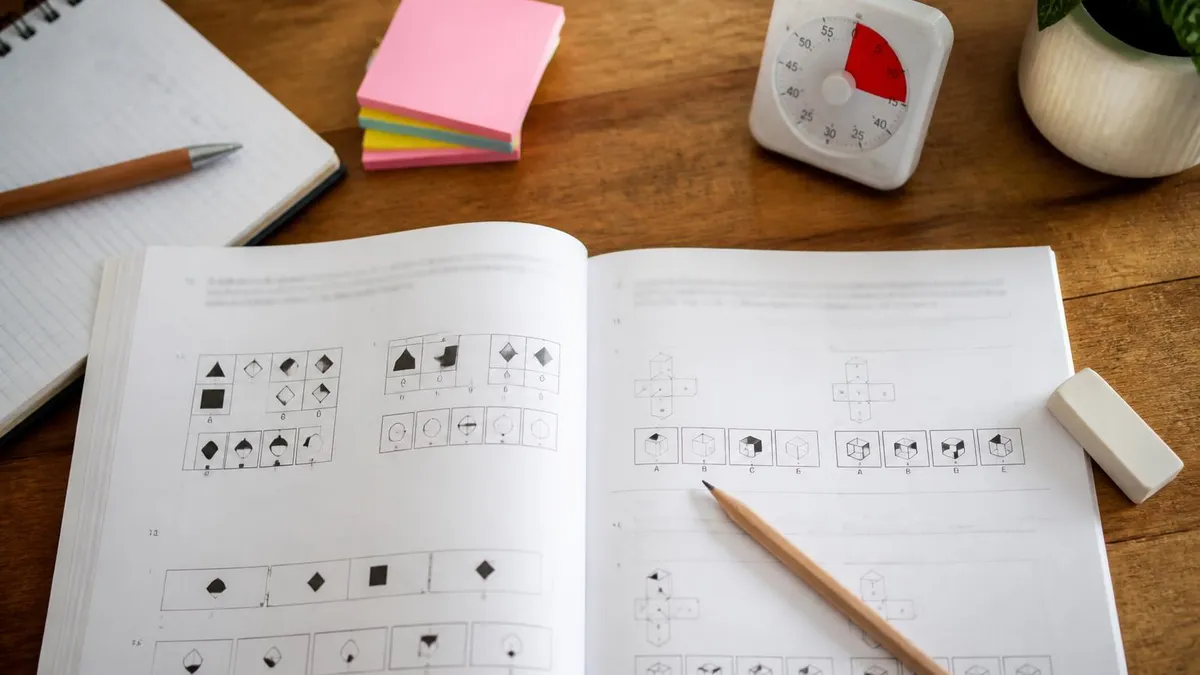
Practice Speed, Not Just Accuracy
The single most underestimated factor on the Mensa Admission Test is time pressure. Many candidates who score well on untimed practice sessions fail to qualify on the actual test because they have never trained under realistic twelve-minute and thirty-eight-minute constraints. Always set a timer during every practice session — accuracy without speed will not earn a qualifying score.
Scoring on the Mensa Admission Test works differently from most standardized exams most candidates have encountered. There is no penalty for guessing — every unanswered question scores zero, while every correctly guessed answer scores one point. This means the optimal strategy is always to provide an answer for every single question, even if you have no genuine idea and are selecting randomly from the remaining options. On a four-option multiple choice question, a random guess yields a 25 percent chance of a correct answer, which is better than zero. Never leave a question blank when time is expiring.
The qualifying threshold is expressed as a percentile rather than a raw score, because the Mensa test is normed against a large representative population sample. Scoring in the 98th percentile means you performed better than 98 out of every 100 people in that norming population — not that you answered 98 percent of questions correctly.
On many versions of the Mensa test, qualifying candidates answer only 65 to 75 percent of questions correctly, because the test is intentionally designed so that very few people answer all questions within the time limit. Do not let a lower-than-expected raw score on a practice test discourage you if your percentile placement is strong.
Menses postpone tablets is a search that has nothing to do with IQ testing, but the concept of delaying something important resonates with many Mensa candidates who keep postponing their test registration out of fear of failure. Research on test anxiety consistently shows that avoidance increases anxiety over time rather than reducing it, while incremental exposure through practice tests reduces it. The act of sitting a timed practice test — even when you perform poorly — normalizes the testing environment and blunts the stress response that impairs working memory on the real exam day.
Understanding score reporting timelines helps set realistic expectations. After a proctored Mensa sitting, your answer sheets are mailed to Mensa headquarters for scoring by hand. The official result letter typically arrives two to three weeks after your test date and reports whether you qualified — without stating your precise IQ score or raw score total. If you want your actual score, you must request it separately and pay a small additional fee. Some local Mensa groups provide immediate unofficial feedback on the day, but this is not universal across all testing locations.
Candidates who have previously taken other IQ tests — including the Stanford-Binet, Wechsler Adult Intelligence Scale, Raven's Progressive Matrices, or more than two hundred other accepted instruments — may qualify for Mensa membership by submitting prior scores rather than sitting the Mensa Admission Test. If you tested as a child and achieved a high score, those records can often satisfy Mensa's qualification requirement if administered by a licensed psychologist. Contact Mensa directly to confirm whether your specific prior test result is on the accepted list before paying the current testing fee.
Clots in menses of difficult questions — those multi-step problems that block progress mid-session — are inevitable on the real exam. The strategic response is not to power through them in order but to mark them, skip forward, accumulate easier points, and return with remaining time. This question-skipping discipline is one of the highest-use tactics available, yet many candidates feel psychologically compelled to resolve each question before moving on. Training yourself to skip ruthlessly during practice sessions makes the behavior automatic when stakes are real and time pressure is acute.
The relationship between preparation volume and qualifying probability is well documented in Mensa's own reported statistics. Candidates who report zero preparation have a first-attempt pass rate below 10 percent. Those who complete three to five practice tests see first-attempt pass rates climb to approximately 25 to 30 percent. Candidates who complete a structured six-to-eight-week program with eight or more timed sessions routinely report pass rates above 50 percent. The data makes a clear case: every additional practice session meaningfully increases your odds, and the cost of preparation is measured in hours, not dollars.
Mensa requires a waiting period between official test attempts, and the retake fee applies in full. If you sit the exam underprepared and do not qualify, you will wait and pay again before getting another official chance. Completing a structured preparation program before your first attempt is strongly recommended — it is both faster and less expensive than relying on multiple retakes to eventually qualify.
Once you receive a qualifying Mensa score, the next step is submitting your official membership application along with the qualifying evidence and your annual dues payment. US Mensa membership costs $107 per year for adults, with discounted rates available for students, seniors, and life memberships. Within weeks of approval you will receive your membership card, welcome packet, and login credentials for the national member portal, where you can locate your nearest local group, browse Special Interest Groups organized around hundreds of topics, and register for regional and national events including the annual Mensa Annual Gathering.
Many new members are surprised to discover that Mensa's social and intellectual calendar is far richer than they anticipated when they first took the qualifying test. Local Mensa groups across the United States host monthly game nights, pub quizzes, book clubs, science discussions, political debates, and family events.
The national organization also offers a strong pen pal program, an online forum with hundreds of active threads, and the award-winning Mensa Bulletin magazine delivered to every member's door. For candidates who initially viewed membership as a credential to list on a resume, these community aspects often become the most valued part of joining.
Menses diarrhea as a symptom of exam nerves is real for many high-stakes test-takers — the gut-brain connection means acute anxiety produces genuine gastrointestinal distress, which further impairs concentration and working memory. Managing pre-test anxiety through structured preparation is the most effective long-term solution. When you have completed eight timed practice sessions and know exactly what to expect, the exam environment holds far fewer unknowns, and your physiological stress response is proportionally smaller. Preparation is not just about knowing the material — it is about making the test feel familiar.
Diarrhea and menses of stress also describe what poorly prepared candidates experience in the waiting period after the exam. Having completed thorough practice means you walk out of the test center with a reasonably accurate sense of how you performed, rather than agonizing uncertainty over the next two to three weeks. Calibrated self-assessment is itself a skill developed through consistent practice — when you have done enough mock tests, your subjective confidence after each session correlates closely with your actual score, and that metacognitive accuracy transfers directly to the real exam.
The question of menses postpone tablets — or in the test context, whether to postpone your exam date when you feel underprepared — deserves a practical answer. If your scheduled test date is fewer than three weeks away and you have not yet completed at least two timed practice sessions, rescheduling is usually the right call. Most US Mensa local groups allow date changes up to a week in advance. Arriving at the exam with a minimum of four completed practice tests under your belt is the threshold most successful candidates identify in retrospect as the meaningful readiness marker.
Building a comprehensive picture of your readiness requires tracking more than just total scores. Chart your accuracy rate by question type across sessions to reveal whether you are strong in verbal reasoning but weak in spatial visualization, or fast at arithmetic but slow at abstract matrices. A radar chart of your performance across five question categories gives you a visual map of exactly where to invest remaining preparation time. Targeted drilling of weak categories consistently outperforms general review across all categories in the four weeks before a high-stakes cognitive test.
For candidates retaking the Mensa test after a previous non-qualifying score, the most important diagnostic question is: which error type caused most of my wrong answers last time? Timing errors — running out of time before answering all questions — call for speed drills and strategic skip practice.
Recognition errors — encountering pattern types you had never seen before — call for broader exposure to question variety. Arithmetic errors on word problems call for careful two-read practice and deliberate calculation checking. Each error type has a targeted remedy, and matching your preparation to your actual failure mode is far more efficient than generic re-studying.
The final weeks before your Mensa test date should shift from skill-building to performance consolidation. This means reducing the total volume of new practice material and increasing the proportion of time spent on full-length timed simulations under realistic conditions. Sit at a quiet desk, eliminate phone notifications, set a timer for twelve minutes for your Wonderlic-style subtest and thirty-eight minutes for your culture-fair subtest, and treat each simulation as the real thing. The psychological habit of performing under these specific constraints is itself a learnable skill, and it takes repetition to ingrain.
Menses panties — that is, the protective layer of confidence that thorough preparation provides — is more than metaphor. Candidates who arrive at the Mensa test center knowing they have put in the work report measurably lower anxiety and measurably higher scores than equally intelligent candidates who arrive unprepared. This performance gap between equally capable candidates is entirely attributable to preparation quality, not innate ability. Every practice test you complete is a direct investment in that confidence layer, and it pays compound returns on exam day when the timer starts and the first question appears in front of you.
Managing your time across the two subtests requires explicit strategy rather than instinct. On Subtest 1, the target pace is roughly one question every fourteen seconds. Mentally checkpoint at the twenty-five-question mark: if you have used more than six minutes, accelerate your pace.
On Subtest 2, the spatial and matrix subtest, a reasonable target is one question every fifteen seconds for the first hundred questions, leaving roughly seven minutes for the final fifty which tend to be harder. Adjust based on your personal practice data — if you consistently finish with time remaining, you may be moving too quickly and sacrificing accuracy for speed.
Nutrition and sleep hygiene in the seventy-two hours before your exam deserve the same strategic attention you give to question-type practice. Cognitive neuroscience research shows that adequate sleep during the learning phase consolidates memory and pattern recognition skills — meaning the sleep you get after a practice session is nearly as important as the session itself.
In the final three days before your exam, prioritize seven to nine hours of sleep per night, reduce caffeine intake to your normal baseline to avoid disrupted sleep, and avoid introducing new foods or activities that could disrupt your routine and leave you uncomfortable on exam morning.
On the day of the exam, arrive early, bring identification, and spend the waiting time doing a brief warm-up rather than last-minute cramming. A two-minute mental arithmetic warm-up — running through multiplication tables or a simple number series — activates the prefrontal cortex and working memory systems you will need in the test room. Avoid reviewing difficult practice questions immediately before entering, as encountering problems you cannot solve raises anxiety without improving performance. Trust the preparation you have already done, maintain a calm and focused mindset, and approach each question with the methodical process you developed during your practice sessions.
After the exam, avoid the temptation to obsessively reconstruct your answers. The two-to-three-week wait for results is easier when you redirect that cognitive energy toward other goals rather than replaying ambiguous questions in your head. If you feel confident about your performance, begin exploring local Mensa events and the member community so you are ready to engage immediately when your qualifying letter arrives. If you are uncertain, begin planning a structured preparation extension in case a retake is needed — having a plan removes the anxiety of uncertainty and keeps your momentum going regardless of the outcome.
Ultimately, the Mensa qualifying test is one of the most transparent and meritocratic credentials available to adults in the United States. There are no prerequisites, no educational requirements, no application essays, and no interviews — only a single performance threshold based entirely on how you perform on two short cognitive tests on one specific morning. That simplicity is both enabling and demanding. The only variable you can control between now and your test date is the quality and consistency of your preparation, and the free practice tests on this page give you everything you need to make that preparation count.
Sample Mensa Practice Questions
Try these questions from our free Mensa practice tests. The correct answer and an explanation follow each question.
Which sentence is free of redundancy?
- A. The reason is because it rained.
- B. She returned back home.
- C. He combined the two together.
- D. They arrived at the station.
Answer: D. They arrived at the station.
The fourth sentence avoids the repeated meanings found in the others.
Sam, Tom, and Uma all passed the same exam. Sam studied 3 hours, Tom studied 5 hours, Uma studied 7 hours. What rule is inductively supported about study time?
- A. Exactly 3 hours of study guarantees passing
- B. More study time always leads to higher marks
- C. Students who study at least 3 hours tend to pass
- D. No one who studies fewer than 5 hours can pass
Answer: C. Students who study at least 3 hours tend to pass
The evidence shows three students who studied 3, 5, and 7 hours all passed. The most defensible inductive conclusion is that studying at least 3 hours is associated with passing — not a certain guarantee, and no data exists about students who studied less.
Which shape does NOT belong: circle, oval, sphere, square?
- A. Square
- B. Circle
- C. Oval
- D. Sphere
Answer: A. Square
Circle, oval, and sphere are all based on curves with no straight edges or angles. A square has straight sides and right angles, making it fundamentally different from the curved shapes.
What is the missing number in the matrix? [3, 6, 9] / [5, 10, 15] / [7, 14, ?]
- A. 21
- B. 18
- C. 16
- D. 28
Answer: A. 21
Each row multiplies the first element by 1, 2, and 3; 7×3 = 21. Also, column 3 = column 2 × 1.5: 9, 15, 21.
Take the full Mensa practice test
Mensa Questions and Answers

Mensa Membership Benefits: What You Actually Get When You Join

Mensa Sverige Test: Complete Study Guide to IQ Testing and Membership

Is the Mensa IQ Test Accurate? What the Science Actually Says

Why Join Mensa: Everything You Need to Know About the World's Top IQ Society

Mensa Society: What It Is, How to Join, and What Membership Means
How this page was made: written with AI tools. Exam facts are checked against the official sources listed below. Not reviewed by a subject-matter expert. Editorial policy
Sources & references
Exam facts on this page (fees, format, dates, passing scores) are checked against these official sources; the date is our last check. Editorial policy
- us.mensa.org — Score release, test delivery, eligibility, fees, passing score, retake policy, renewal, exam information · verified Oct 2026