
How to Pass the Mensa Test 2026 September: Tips, Practice & Strategy
How to pass the Mensa IQ test 2026 September: proven strategy, question-type tips, and free practice tests. Covers matrices, verbal analogies, and test-day prep. ✅

Mensa Test: Key Numbers

Can You Actually Study for an IQ Test?
Short answer: yes and no. Your underlying cognitive capacity — raw fluid intelligence — is largely stable as an adult. No amount of cramming will add 20 IQ points overnight. That's honestly the part most Mensa prep guides skip entirely.
Here's what CAN move your score: familiarity with question formats, pattern-recognition fluency, pacing under time pressure, and reducing test anxiety. Research on the practice effect consistently shows that first-time test-takers underperform simply because the formats feel unfamiliar. The Mensa practice test environment is genuinely unlike most other tests you've taken — abstract matrices, number sequences with no text anchor, spatial rotations. If you've never seen these before, you'll waste precious seconds just orienting yourself.
The goal of prep isn't to become smarter. It's to remove every avoidable obstacle between your real ability and your score. Unfamiliarity is an obstacle. Anxiety is an obstacle. Poor pacing is an obstacle. Fix all three, and you give your actual cognitive performance the best possible conditions to show up cleanly.
Studies on IQ training programs (particularly the n-back working memory research) suggest that fluid intelligence shows small but measurable gains with sustained cognitive training — think weeks of daily practice, not a weekend cram session. The gains aren't enormous or dramatic. More importantly, pattern-recognition fluency — the speed at which you identify the rule in a matrix or sequence — is absolutely trainable, and that speed matters enormously on a timed test.
So approach preparation with clear expectations: you're not gaming the test. You're removing the friction that would otherwise suppress your score. The difference between someone who barely misses and someone who qualifies is often not raw IQ — it's test-taking efficiency. Two weeks of smart, focused practice is enough to build that efficiency. More than that and you're likely experiencing diminishing returns rather than meaningful gains. The key is deliberate practice — targeting your weak question types specifically, not just taking the same mixed practice test over and over hoping the score changes.
The Honest Truth About IQ Prep
Practice won't make you a genius — but it can absolutely make you a better test-taker. Every question type on the Mensa test has a recognizable structure. Once you know what to look for, you stop spending time figuring out what the question is asking and start using that time to actually answer it. That's the real value of practice. Prior qualifying test scores (pre-1994 SAT, certain GRE scores) may also mean you already qualify — check before scheduling a new test.
What the Mensa Test Actually Covers
American Mensa uses two supervised tests: the Mensa Admission Test (a two-part battery) and the Mensa Wonderlic test. Both are timed, and both assess the same core cognitive domains — just with different specific formats. Internationally, Mensa chapters use various supervised tests, and prior qualifying test scores may be accepted as proof without a new test.
The question types you'll encounter fall into six main clusters. Understanding each cluster is the first step to preparing strategically. The Mensa logical reasoning questions form the backbone of most formats — syllogisms, deductive chains, conditional statements. Mensa numerical reasoning includes number series, arithmetic patterns, and applied math. Spatial and matrix reasoning tests your ability to mentally rotate shapes or identify the missing piece in a visual pattern grid. Verbal analogies, vocabulary precision, and linguistic inference test language-based intelligence. Coding sequences — letter-number substitutions — test processing speed and rule extraction. And odd-one-out problems test categorical reasoning.
Each of these has distinct solving strategies. The Mensa Admission Test battery includes two separate tests, each timed independently. You need to score at the 98th percentile on at least ONE of the two — you don't need to ace both. This is important: if you're significantly stronger at verbal reasoning than numerical reasoning, your verbal score alone can qualify you. Know your strengths going in and focus your prep time strategically on the question types that matter most for your strongest battery.
Six Question Types on the Mensa Test
Syllogisms, if-then chains, and deductive arguments. Every premise is true — your job is to follow the logic exactly, even when the conclusion feels counterintuitive.
- Key skill: Ignoring real-world intuition
- Practice quiz: Mensa Logical Reasoning
Find the rule governing a sequence and predict the next number. Rules include arithmetic steps, geometric ratios, alternating patterns, and Fibonacci-style sums.
- Key skill: Finding differences between consecutive terms
- Practice quiz: Mensa Numerical Reasoning
Identify the missing tile in a 3x3 grid, or determine which shape completes a visual pattern. Rules operate independently across rows and columns.
- Key skill: Checking row AND column rules simultaneously
- Practice quiz: Mensa Spatial Visualization
A is to B as C is to ?. Tests vocabulary range and the ability to identify semantic relationships — part-to-whole, synonym, antonym, function, degree.
- Key skill: Naming the relationship before looking at options
- Practice quiz: Mensa Verbal Reasoning
A code replaces letters with numbers (or other letters). Decode the rule and apply it to a new word. Speed matters — these are often pure processing rate questions.
- Key skill: Identifying the shift or substitution rule quickly
- Practice quiz: Mensa Critical Thinking
Which item doesn't belong? May rely on category membership, visual features, or abstract properties. Often has multiple valid groupings — pick the most precise one.
- Key skill: Confirming the other three items share a tighter rule
- Practice quiz: Mensa Deductive Reasoning
Pattern-Recognition Tips by Question Type
Pattern recognition is the meta-skill that underlies every Mensa question type. The test rewards people who can quickly extract the rule from a stimulus and apply it — not people who brute-force every possibility. Here's how to approach each category with that lens.
Matrix and Spatial Questions
Don't stare at the whole grid. Start by examining one row and asking: what changes from left to right? Then examine one column: what changes top to bottom? Most 3x3 matrices follow consistent rules independently in each direction — rotation, size change, number of elements, shading pattern. If you check the row rule and the column rule separately, the correct answer almost always becomes obvious.
The most common mistake is guessing based on visual similarity to the existing patterns rather than confirming the rule. Always verify your answer satisfies BOTH the row and the column rule before committing. Our Mensa spatial reasoning quiz is built specifically around this skill.
Number Series
Always start by computing the difference between consecutive terms. Write them out: +3, +3, +3 (arithmetic), or ×2, ×2, ×2 (geometric), or +2, +4, +6 (increasing step), or +3, -1, +3, -1 (alternating). If differences don't reveal a clean rule, try looking at every other term — many series are two interleaved sequences. The Mensa number series questions from our practice bank are particularly useful here because they include all the standard rule types you're likely to face.
Verbal Analogies
Name the relationship BEFORE you look at the answer choices. Say it out loud or write it down: "A hammer DRIVES a nail — so a knife CUTS what?" Naming the relationship first prevents the answer options from misdirecting you. The wrong answers are designed to share surface-level similarity (both involve tools, both involve movement) while missing the actual relationship. If your relationship name fits two options equally, sharpen it — be more specific about degree or direction.
Logical Deduction and Syllogisms
The golden rule: accept every premise as 100% true, even if it contradicts what you know about the world. "All birds can fly. Penguins are birds. Therefore penguins can fly" — in pure logic, this is valid. The Mensa test uses abstract or counterfactual premises deliberately to prevent common-sense reasoning from substituting for logical reasoning. If you find yourself thinking "but that's not true in real life," that's a signal: use the logic, not your knowledge. The Mensa logical deduction problems quiz specifically targets this skill with graduated difficulty.
Odd-One-Out and Classification
Don't stop at the first grouping you notice. With four items — apple, orange, hammer, banana — you might first notice "one of these is not a fruit." But then ask: is there a more precise rule where three of the four share it even more tightly? Sometimes the intended grouping is less obvious but more defensible. If the question provides five items and asks for two outliers, there's usually a very tight group of three that share a specific, narrow property. Always spend an extra five seconds double-checking before selecting your final answer.

Practice Quizzes by Question Type
Best quiz: MENSA Logical Reasoning
These questions test deductive chains and syllogisms. Work through each statement individually and accept all premises as absolutely true. Don't let real-world knowledge override the logical chain.
Also try: Mensa IQ Logical Deduction Problems for harder multi-premise problems with more variables.
Timing and Test-Taking Strategy
The Mensa Admission Test is timed — and time pressure is one of the biggest differentiators between test-takers who qualify and those who miss the cutoff. Most people who don't qualify don't fail because they got questions wrong. They fail because they ran out of time before reaching questions they would have answered correctly.
The 30-Second Rule
If you're not making progress on a question within 30 seconds, mark it and move on. Come back at the end. A question you skip and return to with fresh eyes in 90 seconds costs less total time than a question you stare at for 3 minutes and eventually guess anyway. The test doesn't penalize skipping — blank answers count the same as wrong answers in most formats, so skipping isn't cowardice, it's strategy.
Easy Questions Come Late Too
Many test-takers assume difficulty increases linearly through the test. It doesn't always. Some easy questions appear late in the section. If you never reach them because you spent too long on hard early questions, you've left easy points on the table. Pace yourself so you touch every question at least once before you go back to reconsider harder ones.
Calibrate in Your Practice Sessions
Before the real test, do at least two timed practice sessions under realistic conditions — no interruptions, no looking up answers mid-session. Time yourself per section. If you're consistently running out of time, that's a pacing problem to solve in practice, not on test day. The Mensa IQ matrix reasoning sessions are useful for building pacing intuition on visual questions, which tend to eat more time than verbal ones.
First Instincts on Pattern Questions
Research on test-taking consistently finds that first-instinct answers on pattern recognition questions are right more often than second-guesses. When you've correctly identified the pattern rule and applied it, your first answer is usually correct. Second-guessing happens when anxiety creeps in — "I found this too quickly, it can't be right." Trust the math. If you verified the pattern works in two directions, your answer is probably correct. The Mensa IQ visual pattern analysis quiz is great for training this instinct — take it timed and practice committing to your first answer.
Test-Day Timing Checklist
- ✓Spend no more than 30 seconds on any single question before moving on
- ✓Mark skipped questions clearly so you can find them in your review pass
- ✓Aim to complete all questions before going back to skipped ones
- ✓For matrix questions: check row rule AND column rule before choosing an answer
- ✓For number series: write down the differences between terms before guessing a pattern
- ✓Trust your first instinct on visual pattern questions — second-guessing loses time
- ✓Reserve the last 2-3 minutes for a quick check of any blank answers
- ✓Don't spend extra time on questions you're already confident about
Reducing Test Anxiety
Test anxiety is real and it's measurable — studies using cognitive load tasks show that anxious test-takers use more working memory resources managing their emotional state, leaving less capacity available for the actual problem. On an IQ test, where working memory is being directly measured, that's a direct score suppressor.
Reframe What the Test Means
The single most effective anxiety intervention is reframing the stakes. The Mensa test doesn't measure your worth as a person. It measures one narrow slice of cognitive performance on one particular day. If you qualify, great — you join an interesting society. If you don't, your life is unchanged. Treating it as low-stakes data about yourself, rather than a judgment of your intelligence, genuinely reduces performance anxiety in a measurable way.
Exposure via Practice
Anxiety about the Mensa test is partly anxiety about the unknown. Take as many practice sessions as you can before the test. Not because the exact questions repeat — they don't — but because familiarity with the format removes the "what is this?" cognitive load on test day. Walk in recognizing every question type immediately, without needing to orient yourself. Our Mensa mixed challenge test gives you that mixed-format exposure closest to the real experience.
Physical Preparation
Sleep and cognitive performance are tightly linked. Sleep deprivation of even one night measurably impairs working memory, processing speed, and executive function — exactly what the Mensa test measures. Prioritize 7-9 hours the night before. Avoid alcohol for 48 hours before. Exercise lightly the morning of — 20-30 minutes of moderate activity improves cognitive performance for 2-4 hours afterward. Eat before the test; blood glucose directly affects sustained attention. None of these are magic, but they're all marginal gains that compound.
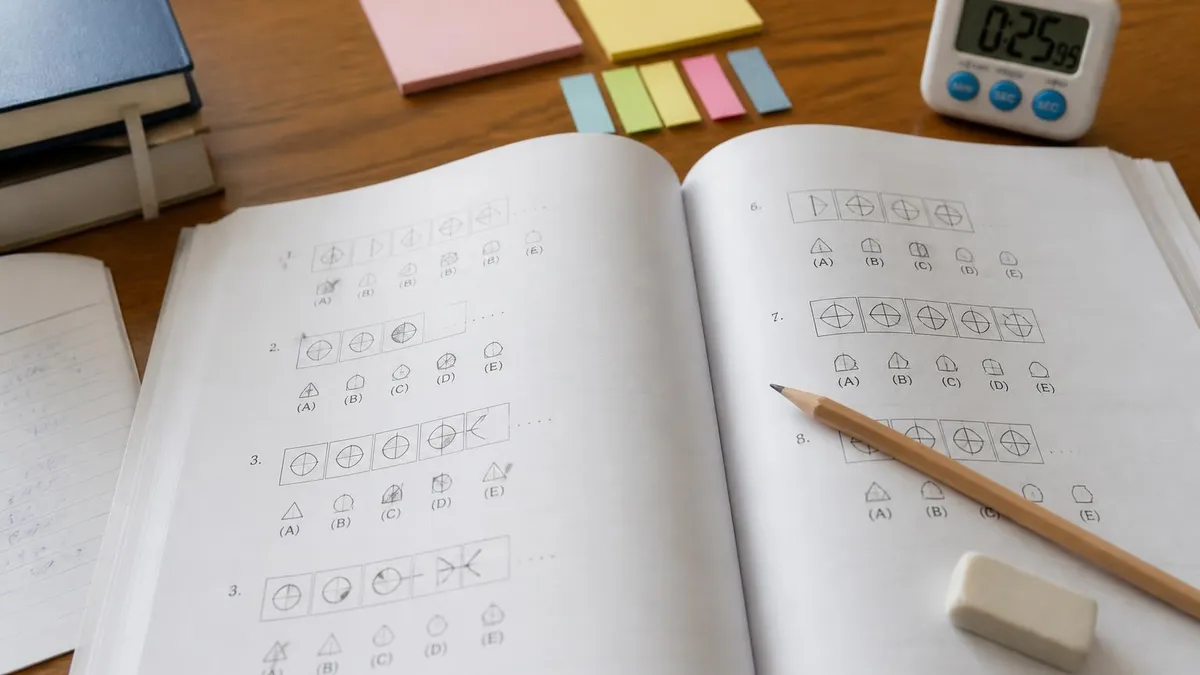
Practice vs No Practice: What the Evidence Shows
- +Format familiarity — stop wasting time figuring out what a question asks
- +Pattern-recognition speed — identify rules faster with repeated exposure
- +Timing intuition — develop a natural sense of when to move on
- +Confidence — fewer unknowns on test day means less anxiety
- +Working memory efficiency — trained routines free capacity for harder problems
- +Strategy fluency — correct approaches become automatic, not deliberate
- −Raw fluid intelligence — cognitive capacity is largely stable in adults
- −Crystallized knowledge — Mensa tests process, not trivia or memorized facts
- −Large score jumps — gains are typically 2-5 points, not 15-20
- −Test-specific shortcuts — no tricks exist that reliably inflate IQ scores
- −Last-minute cramming — one-night review has minimal effect on IQ scores
- −Outcome guarantee — no preparation approach guarantees a qualifying score
2-Week Mensa Prep Schedule
Days 1-2: Diagnostic
Days 3-5: Question-Type Drilling
Days 6-7: Mixed Practice
Days 8-10: Timed Sessions
Days 11-12: Review Errors
Day 13: Light Review
Test Day
What to Expect on Test Day
American Mensa administers supervised tests at testing sites across the country, typically on weekends. You register in advance and pay a fee (around $40 as of 2026). The test is held in-person, supervised, and timed. No calculators. No reference materials. Just you and a pencil.
Bring valid photo ID. Arrive 10-15 minutes early to get settled before the proctor explains the format. If you have questions about accommodations for disabilities, contact American Mensa directly before scheduling — they do accommodate documented conditions with advance notice.
You'll receive your results by mail within a few weeks of testing. The results indicate pass or no-pass — you won't receive a specific IQ number from American Mensa. If you qualify, membership application information follows. For the full breakdown of scores, test formats, and what happens after you pass, see the Mensa IQ test guide. For score cutoffs and IQ thresholds across all accepted test formats, see the Mensa IQ requirement article.
Retake Rules and the Practice Effect
American Mensa allows retakes, but with a catch: you must wait at least one year between supervised test attempts. This policy exists specifically to limit the practice effect — Mensa doesn't want the test to reward pure memorization of item formats.
Here's the paradox: because retakes require a year's wait, your preparation before the first attempt matters enormously. You don't get a low-stakes warm-up. Get your preparation right before you go in.
The practice effect on IQ tests is well documented. People who've taken a specific IQ test before score slightly higher on a repeat — typically 3-8 points — due to format familiarity and reduced anxiety. This is why Mensa mandates a year's gap: enough time for most of the practice-effect gain to dissipate. Practicing with our question bank gives you format familiarity without using actual test items.
If you don't qualify on your first attempt, use the year that follows productively. Identify which question types contributed most to the miss, target those in practice, and consider whether the how to join Mensa guide surfaces any alternative qualifying paths — prior test scores, alternative batteries — that apply to your situation.
One thing worth considering: the Mensa test isn't the only route in. Many people qualify via prior standardized test scores they took years ago — SAT, GRE, GMAT, military aptitude tests, and others. American Mensa maintains a list of accepted tests and minimum qualifying scores. If you took any of these before the cutoff dates, you may already be eligible without sitting another test. That's worth checking before you schedule anything. The Mensa IQ requirement page has the current list of accepted prior tests and their qualifying thresholds.
Mensa Test: What It Costs
Mensa Questions and Answers
Related Mensa Guides

Mensa IQ Test Guide 2026: Format, Qualifying Score & Free Practice

Mensa Requirements 2026: Complete Guide to IQ Scores, Tests, Eligibility & Membership Qualification

Mensa IQ Test: Score Requirements, Format & Prep Guide

Mensa AG 2025: Complete Guide to the Mensa Organization, Membership & What It Really Means

Mensa Sample Test 2026: Free Practice Questions, Scoring & Qualification Guide
About the Author

Educational Psychologist & Academic Test Preparation Expert
Columbia University Teachers CollegeDr. Lisa Patel holds a Doctorate in Education from Columbia University Teachers College and has spent 17 years researching standardized test design and academic assessment. She has developed preparation programs for SAT, ACT, GRE, LSAT, UCAT, and numerous professional licensing exams, helping students of all backgrounds achieve their target scores.