
LMSW Meaning — What Does LMSW Stand For and What Do LMSWs Do? 2026
Prepare for the LMSW Meaning certification. 🎓 Practice questions with answer explanations covering all exam domains.

LMSW — What It Stands For and What It Means
LMSW is the abbreviation for Licensed Master Social Worker. The credential has two components:
- Licensed: State-issued license to practice social work professionally. Each state issues its own LMSW license through a state licensing board.
- Master: Requires completion of a Master of Social Work (MSW) degree from an accredited program. A bachelor's degree (BSW) alone is not sufficient for LMSW licensure.
- Social Worker: Profession focused on helping individuals, families, and communities navigate challenges including mental health, poverty, abuse, disability, housing, and healthcare access.
What LMSWs do:
- Conduct psychosocial assessments and develop care plans
- Provide supportive counseling under the supervision of a licensed clinical supervisor
- Connect clients with community resources and services (case management)
- Work in hospitals, schools, child welfare agencies, nonprofits, and government agencies
- Advocate for clients within systems (courts, healthcare, housing agencies)
- Document client progress and maintain case files
LMSWs typically work in one of three settings: clinical settings (hospitals, outpatient mental health agencies), community/government settings (child protective services, public assistance), or policy and administrative roles.
LMSW vs LCSW — Key Differences
The LMSW and LCSW (Licensed Clinical Social Worker) are different levels of social work licensure. Understanding the distinction is critical for career planning.
LMSW:
- Entry-level master's license — obtained immediately after completing an accredited MSW program and passing the ASWB Master exam
- Can practice social work but must work under clinical supervision
- Cannot provide independent psychotherapy or diagnose mental disorders in most states
- Cannot bill independently for clinical services in many insurance systems
LCSW:
- Advanced clinical license — requires additional supervised clinical hours (typically 2–3 years) after obtaining the LMSW
- Can practice independently, provide psychotherapy, and diagnose mental health conditions
- Can bill insurance directly as an independent provider
- Opens private practice and higher-level clinical roles
The path is sequential: MSW degree → LMSW exam → supervised practice (2–3 years) → LCSW exam → independent clinical practice. Some states use different terminology — New York uses LMSW/LCSW, Texas uses LMSW/LCSW, California uses ACSW/LCSW.
LMSW: upcoming dates and official changes
- Aug 3, 2026: ASWB launched the 2026 examination blueprints on August 3, 2026, reducing the examination to 110 scored and 12 pretest questions while retaining four hours. (Association of Social Work Boards (ASWB), examination owner; state licensing boards issue LMSW licenses)
- Jul 31, 2026: ASWB suspended its online-proctoring pilot for the Social Work Licensing Exams effective July 31, 2026. (Association of Social Work Boards (ASWB), examination owner; state licensing boards issue LMSW licenses)
Facts verified Oct 18, 2026 against Association of Social Work Boards (ASWB), examination owner; state licensing boards issue LMSW licenses. Dates that have passed are removed automatically.
- The ASWB Masters examination contains 122 questions, comprising 110 scored questions and 12 unscored questions. (Association of Social Work Boards (ASWB), examination owner; state licensing boards issue LMSW licenses)
- The ASWB Masters examination passing score generally ranges from 66 to 78 correct answers out of 110 scored questions, depending on the examination form. (Association of Social Work Boards (ASWB), examination owner; state licensing boards issue LMSW licenses)
- The ASWB Masters examination registration fee is US$230. (Association of Social Work Boards (ASWB), examination owner; state licensing boards issue LMSW licenses)
- Candidates retaking the ASWB Masters examination must register again and pay the examination fee. (Association of Social Work Boards (ASWB), examination owner; state licensing boards issue LMSW licenses)
- ASWB requires candidates to wait 90 days between Masters examination attempts unless a waiting-period waiver is granted. (Association of Social Work Boards (ASWB), examination owner; state licensing boards issue LMSW licenses)
- The ASWB Masters examination is administered at Pearson test centers. (Association of Social Work Boards (ASWB), examination owner; state licensing boards issue LMSW licenses)
- Candidates for the ASWB Masters examination must apply for a social work license and receive examination preapproval. (Association of Social Work Boards (ASWB), examination owner; state licensing boards issue LMSW licenses)
- ASWB receives official Masters examination results from Pearson VUE within 24 hours after the examination. (Association of Social Work Boards (ASWB), examination owner; state licensing boards issue LMSW licenses)
Facts verified Oct 18, 2026 against Association of Social Work Boards (ASWB), examination owner; state licensing boards issue LMSW licenses. Dates that have passed are removed automatically.
LMSW Exam at a Glance
Facts verified Oct 18, 2026 against Association of Social Work Boards (ASWB), examination owner; state licensing boards issue LMSW licenses. Dates that have passed are removed automatically.
Free LMSW - Licensed Master Social Worker Study Tools
Interactive LMSW - Licensed Master Social Worker resources on PracticeTestGeeks, free to start:
- Free LMSW Questions and Answers — 7 questions with answer explanations
- LMSW - Licensed Master Social Worker flashcards — review key terms and concepts card by card
- LMSW - Licensed Master Social Worker study guide — topic-by-topic overview of what the exam covers
- LMSW - Licensed Master Social Worker cheat sheet — one-page printable summary for last-minute review
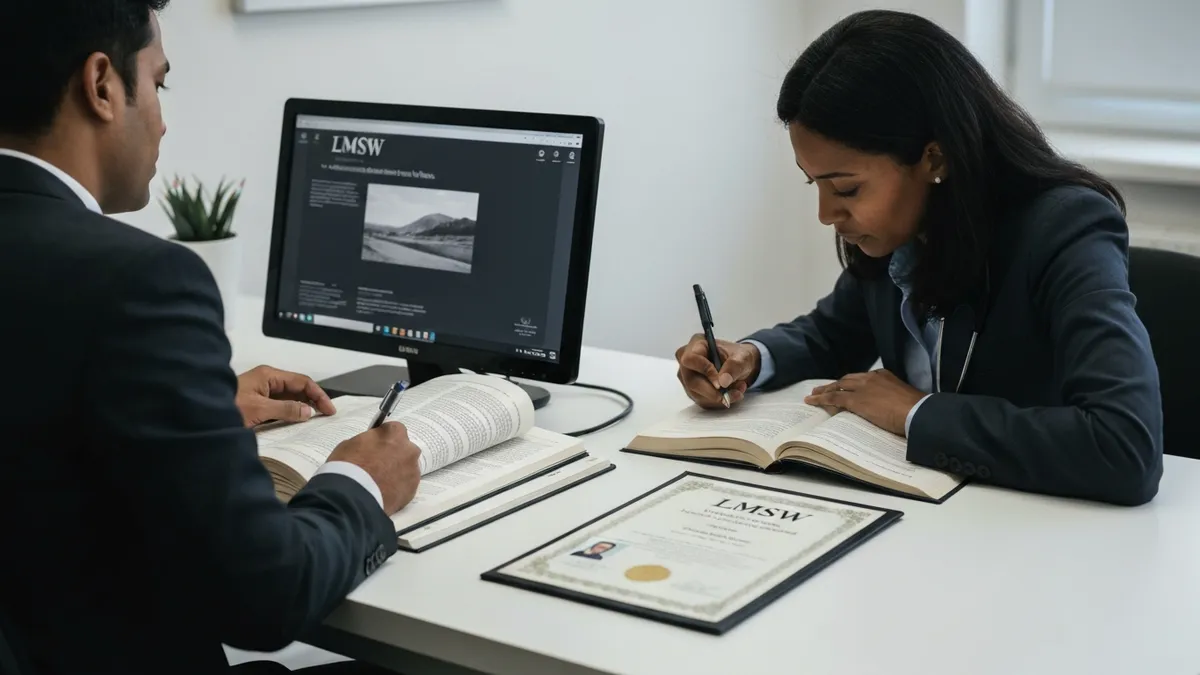
LMSW Exam — ASWB Master Level
The LMSW licensing exam is administered by ASWB (Association of Social Work Boards) through Pearson VUE testing centers. All US states and Canadian provinces use the ASWB exam system.
Exam format:
- 122 total questions (110 scored, 12 unscored pretest — you cannot tell which is which)
- 4-hour time limit
- Multiple choice, 4 options per question
- Delivered at Pearson VUE testing centers
Content areas (ASWB Master Level):
- Professional Values and Ethics (~35%)
- Assessment and Planning (~33%)
- Intervention and Practice (~32%)
Exam fees: ASWB exam registration is $230. State licensing application fees are separate (varies by state, typically $50–$200).
Pass rates: ASWB publishes pass rate data. First-time pass rates for the Master exam are approximately 75–80% for US candidates with recent MSW degrees. Pass rates are lower for candidates who have been out of school for several years, highlighting the importance of studying soon after graduation.
LMSW Salary
LMSW salaries vary considerably by setting, state, and years of experience:
- Entry-level hospital social worker: $48,000–$58,000/year
- Child welfare social worker: $42,000–$62,000/year (government)
- School social worker: $50,000–$70,000/year (public school systems)
- Nonprofit case manager: $40,000–$55,000/year
- VA or federal social worker: $55,000–$80,000/year
The national median salary for social workers (all levels) is approximately $58,380/year (BLS, 2026). LMSWs typically earn in the lower-to-middle range; LCSWs in private practice or senior clinical roles earn considerably more. New York, California, Washington DC, and Massachusetts are consistently the highest-paying states for social workers.
- ✓Confirm your exam appointment and location
- ✓Bring required identification documents
- ✓Arrive 30 minutes early to check in
- ✓Read each question carefully before answering
- ✓Flag difficult questions and return to them later
- ✓Manage your time — don't spend too long on one question
- ✓Review flagged questions before submitting

- +Validates your knowledge and skills objectively
- +Increases job market competitiveness
- +Provides structured learning goals
- +Networking opportunities with other certified professionals
- −Study materials can be expensive
- −Exam anxiety can affect performance
- −Requires dedicated preparation time
- −Retake fees apply if you don't pass
Pros and Cons at a Glance
| Pros | Cons |
|---|---|
| Validates your knowledge and skills objectively | Study materials can be expensive |
| Increases job market competitiveness | Exam anxiety can affect performance |
| Provides structured learning goals | Requires dedicated preparation time |
| Networking opportunities with other certified professionals | Retake fees apply if you don't pass |
Sample LMSW - Licensed Master Social Worker Practice Questions
Try these questions from our free LMSW - Licensed Master Social Worker practice tests. The correct answer and an explanation follow each question.
A client scores 22 on the PHQ-9. What severity level does this indicate and what clinical action is most warranted?
- A. Mild depression; psychoeducation only
- B. Moderate depression; watchful waiting
- C. Moderately severe depression; initiate treatment
- D. Severe depression; immediate safety assessment and intensive intervention
Answer: D. Severe depression; immediate safety assessment and intensive intervention
A PHQ-9 score of 20–27 indicates severe depression, warranting immediate safety assessment and likely intensive treatment including medication consultation.
A social worker using the SLAP assessment discovers a client has a plan to overdose on medications tonight. What does the 'A' in SLAP stand for?
- A. Affect
- B. Availability of means
- C. Agency support
- D. Anxiety level
Answer: B. Availability of means
In SLAP (Specificity, Lethality, Availability, Proximity to help), 'A' stands for Availability of the means to carry out the plan.
A social worker is using the SLAP assessment during a crisis. What does the 'A' in SLAP stand for?
- A. Availability of means
- B. Affect regulation
- C. Attitude toward death
- D. Awareness of consequences
Answer: A. Availability of means
SLAP assesses Specificity of plan, Lethality of method, Availability of means, and Proximity of rescue — 'A' refers to whether the client has access to the means described.
During a family therapy session, a teenager discloses to the social worker that they have been using marijuana recreationally but asks the social worker not to tell their parents. The teenager does not appear to be in danger. What is the MOST appropriate response?
- A. Immediately disclose the information to the parents to ensure the teenager's safety
- B. Honor the teenager's confidentiality and explore the behavior further within the session
- C. End the session and file a report with child protective services
- D. Dismiss the teenager's concerns and redirect the family session to other topics
Answer: B. Honor the teenager's confidentiality and explore the behavior further within the session
Recreational marijuana use by a teenager, while concerning, does not constitute imminent danger and does not automatically trigger a duty to breach confidentiality. The social worker should explore the behavior further while respecting the client's privacy within the bounds of applicable law.
Take the full LMSW - Licensed Master Social Worker practice test
LMSW Questions and Answers
More Social Work and Healthcare Resources
How this page was made: written with AI tools. Exam facts are checked against the official sources listed below. Not reviewed by a subject-matter expert. Editorial policy
Sources & references
Exam facts on this page (fees, format, dates, passing scores) are checked against these official sources; the date is our last check. Editorial policy
- bhec.texas.gov — Renewal, eligibility · verified Oct 2026
- op.nysed.gov — Renewal, score validity, eligibility, fees · verified Oct 2026
- aswb.org — Eligibility, score release, retake fee, retake policy, passing score, test delivery, test dates, registration, fees, exam format · verified Oct 2026