
National Law Enforcement Appreciation Day: History, How to Honor Officers, and Why January 9 Matters
National Law Enforcement Appreciation Day (Jan 9) honors police nationwide. Learn the history, traditions, and how agencies and citizens participate. 🆕
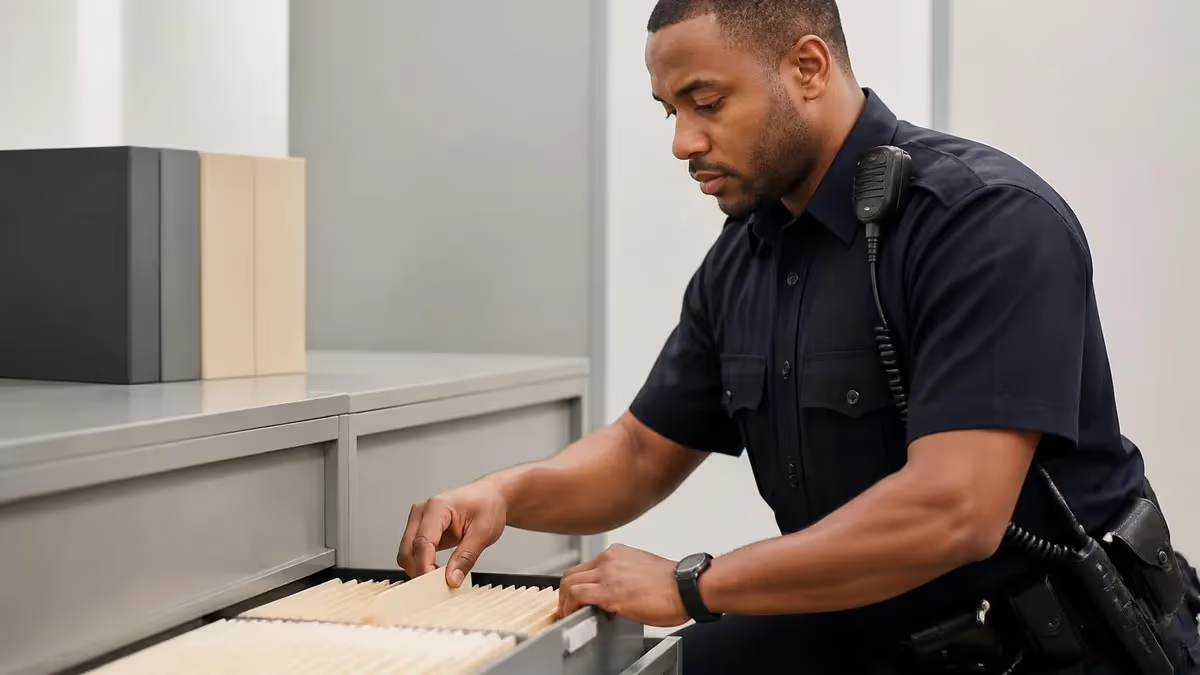
National Law Enforcement Appreciation Day, observed every January 9, is a nationwide tribute to the more than 800,000 sworn officers who serve American communities at the federal, state, county, and municipal levels. Established in 2015 by Concerns of Police Survivors (C.O.P.S.) and supported by major associations such as the FOP and IACP, the day asks citizens to wear blue, thank an officer, and recognize the personal sacrifice behind the badge. It is a quiet, civic moment of gratitude rather than a federal holiday.
The observance grew out of a difficult period for American policing. After several high-profile attacks on officers between 2014 and 2015, families of fallen law enforcement personnel asked the public for one specific day each year that would focus on appreciation rather than controversy. January 9 was chosen because it falls during the cold winter patrol months when morale tends to dip, and because it sits between the New Year and Martin Luther King Jr. Day, anchoring a season of civic reflection on justice and service.
While the day began with patrol officers in mind, it now spans every corner of American policing — from sheriff's deputies in rural Montana to the texas rangers law enforcement division, from tribal police to federal agents at FBI, DEA, ATF, USMS, and Homeland Security Investigations. Schools, churches, restaurants, and small businesses often join in with cards, free meals, blue porch lights, and social media tributes using the hashtag #LEAD.
For agencies, the day is also a recruiting and retention tool. Departments use January 9 to highlight community policing wins, promote academy applications, share body-camera footage of positive interactions, and recognize officers nearing 20- or 30-year service milestones. It is one of the few moments on the calendar when local news, federal partners, and citizens coordinate a unified message of support for the profession.
This guide explains the origins of National Law Enforcement Appreciation Day, the agencies and officers it honors, the traditions that have grown around it, and the practical ways civilians, families, businesses, and recruits can participate. It also covers the structure of American policing — federal, state, and local — so readers understand exactly who is being honored when they wear blue on January 9.
Whether you are a citizen looking to send a meaningful thank-you, a small business planning a January promotion, a journalist preparing coverage, or a recruit studying for an academy entrance exam, this article gives you the historical context, statistics, and ideas you need. Each section ends with study tools and quiz links so aspiring officers can use the day as motivation to begin their own careers in service.
Throughout this guide, you will see references to federal training pipelines, state-level POST boards, and the cultural traditions that surround police memorial weeks each May. National Law Enforcement Appreciation Day in January complements — but does not replace — Peace Officers Memorial Day on May 15, which President Kennedy established in 1962. Together, the two observances bookend the year with gratitude and remembrance.
National Law Enforcement Appreciation Day by the Numbers

History of National Law Enforcement Appreciation Day
Pre-2015: Scattered Local Tributes
2014: Tensions Rise Nationwide
January 9, 2015: First Official Observance
2016-2019: Growth and Federal Recognition
2020-2023: Renewed Focus and Recruiting Crisis
2024 and Beyond: A Permanent Civic Tradition
To understand who is honored on National Law Enforcement Appreciation Day, you need to understand the layered structure of American policing. The United States does not have a single national police force. Instead, it has more than 18,000 separate agencies operating across three levels — federal, state, and local — each with distinct jurisdictions, training requirements, and statutory authority. The day recognizes officers across all of them, from a small-town deputy with 6 sworn personnel to a federal task force operating in multiple districts.
At the federal level, agencies fall under executive-branch departments. The Department of Justice houses the FBI, DEA, ATF, and U.S. Marshals Service. The Department of Homeland Security oversees ICE, HSI, CBP, and the Secret Service. The Treasury houses IRS Criminal Investigation. There are over 65 federal law enforcement agencies employing roughly 137,000 full-time officers with arrest and firearm authority. The question "fbi law enforcement dayton neighborhood" reflects how citizens often search for the federal presence in their specific city or region.
State-level agencies include state police, highway patrols, bureaus of investigation, and specialized units like state ABC enforcement, fish and wildlife officers, and capitol police. Every state operates a Peace Officer Standards and Training (POST) commission that sets minimum hiring, academy, and continuing-education standards. State agencies typically have statewide arrest authority and primary jurisdiction on interstates, state property, and major investigations that cross county lines.
Local agencies — municipal police departments, county sheriff's offices, university police, and transit police — make up the largest segment of American law enforcement. The roughly 12,000 local police departments and 3,000 sheriff's offices employ over 700,000 sworn officers combined. The vast majority of public-citizen police interactions, traffic stops, and 911 responses are handled by these local agencies, which is why January 9 places so much emphasis on neighborhood-level officers.
Tribal law enforcement adds another important layer. The Bureau of Indian Affairs Office of Justice Services and roughly 200 tribal police departments serve sovereign tribal nations across the country. Their officers are cross-deputized in many jurisdictions and face unique challenges including vast patrol areas and dual federal-tribal authority. They are equally honored on appreciation day, often through tribal-led ceremonies and proclamations.
Finally, the question "which branch enforces laws" or "what branch enforces laws" comes up frequently. The answer is the executive branch at every level of government. Federal law enforcement falls under the executive branch led by the President. State agencies operate under the governor. Local police chiefs report to mayors or city managers, while sheriffs are independently elected executive-branch officers. Understanding this civics foundation helps citizens appreciate the constitutional role officers play.
National Law Enforcement Appreciation Day touches every one of these layers. When a citizen wears blue or drops off donuts at the local precinct, that gesture ripples up through the chain — supporting not just the patrol officer at the front desk, but every federal agent, state trooper, deputy, and tribal officer connected to the broader public-safety mission.

Law Enforcement Practice Test Questions
Prepare for the Law Enforcement exam with our free practice test modules. Each quiz covers key topics to help you pass on your first try.
Law Enforcement Criminal Investigation Fun...
Law Enforcement Exam Questions covering Criminal Investigation Fundamentals. Master Law Enforcement Test concepts for certification prep.
Law Enforcement Criminal Law and Procedure
Free Law Enforcement Practice Test featuring Criminal Law and Procedure. Improve your Law Enforcement Exam score with mock test prep.
Law Enforcement Patrol Operations and Tactics
Law Enforcement Mock Exam on Patrol Operations and Tactics. Law Enforcement Study Guide questions to pass on your first try.
Law Enforcement Professional Conduct and E...
Law Enforcement Test Prep for Professional Conduct and Ethics. Practice Law Enforcement Quiz questions and boost your score.
Law Enforcement Traffic Law and Enforcement
Law Enforcement Questions and Answers on Traffic Law and Enforcement. Free Law Enforcement practice for exam readiness.
Law Enforcement Use of Force Principles
Law Enforcement Mock Test covering Use of Force Principles. Online Law Enforcement Test practice with instant feedback.
Law Enforcement Community Policing and Ethics
Free Law Enforcement Quiz on Community Policing and Ethics. Law Enforcement Exam prep questions with detailed explanations.
Law Enforcement Constitutional and Case Law
Law Enforcement Practice Questions for Constitutional and Case Law. Build confidence for your Law Enforcement certification exam.
Law Enforcement Emergency Response and Cri...
Law Enforcement Test Online for Emergency Response and Crisis Management. Free practice with instant results and feedback.
Law Enforcement Evidence Collection and Cr...
Law Enforcement Study Material on Evidence Collection and Crime Scene Management. Prepare effectively with real exam-style questions.
Law Enforcement Patrol and Investigation D...
Free Law Enforcement Test covering Patrol and Investigation Duties. Practice and track your Law Enforcement exam readiness.
Law Enforcement Practice Test
Law Enforcement Exam Questions covering Practice Test. Master Law Enforcement Test concepts for certification prep.
Spotlight: Texas Rangers, FBI, and the Alabama Law Enforcement Agency
The Texas Rangers, founded in 1823 by Stephen F. Austin, are one of the oldest law enforcement organizations in North America. Today the Rangers operate as a division of the Texas Department of Public Safety with roughly 166 commissioned Rangers handling major investigations, unsolved homicides, public corruption cases, and officer-involved shootings statewide.
On National Law Enforcement Appreciation Day, the Rangers are frequently highlighted in Texas school curricula, museum exhibits at the Texas Ranger Hall of Fame in Waco, and social media tributes. Their distinctive Cinco Peso star badge has become an iconic symbol of American policing heritage and is referenced in dozens of agency challenge coins traded on January 9.
Is January 9 the Right Day for Police Appreciation?
- +Falls during cold winter patrol months when officer morale historically dips
- +Sits between New Year and MLK Day, anchoring a season of civic reflection
- +Distinct from Peace Officers Memorial Day in May, avoiding overlap
- +Backed by C.O.P.S., FOP, IACP, and survivor organizations
- +Recognized by Senate resolutions and presidential proclamations
- +Provides recruiting and retention opportunities for understaffed agencies
- −Not a federal holiday, so no automatic time off or pay differential
- −Some citizens unaware the day exists despite social media campaigns
- −Date can conflict with holiday-season fatigue and staffing shortages
- −Critics argue one day is insufficient given year-round risks officers face
- −Coverage often overshadowed by larger January news cycles
- −Smaller agencies sometimes lack resources to organize formal events
Pros and Cons at a Glance
| Pros | Cons |
|---|---|
| Falls during cold winter patrol months when officer morale historically dips | Not a federal holiday, so no automatic time off or pay differential |
| Sits between New Year and MLK Day, anchoring a season of civic reflection | Some citizens unaware the day exists despite social media campaigns |
| Distinct from Peace Officers Memorial Day in May, avoiding overlap | Date can conflict with holiday-season fatigue and staffing shortages |
| Backed by C.O.P.S., FOP, IACP, and survivor organizations | Critics argue one day is insufficient given year-round risks officers face |
| Recognized by Senate resolutions and presidential proclamations | Coverage often overshadowed by larger January news cycles |
| Provides recruiting and retention opportunities for understaffed agencies | Smaller agencies sometimes lack resources to organize formal events |

10 Ways to Honor Law Enforcement Appreciation Day
- ✓Wear blue clothing or a blue ribbon throughout the day on January 9
- ✓Change your social media avatar to a blue line or department-supportive image
- ✓Drop off coffee, donuts, or a thank-you card at your local precinct or sheriff's office
- ✓Display a blue porch light or place a small blue flag at your home or business
- ✓Write a personal letter to an officer who has helped your family in the past
- ✓Donate to C.O.P.S., the National Law Enforcement Officers Memorial Fund, or local FOP lodges
- ✓Attend a citizen academy, ride-along, or open house hosted by your local agency
- ✓Teach children at home or in classrooms about the role of police in their community
- ✓Tag your local department on social media using #LEAD and #ThankYouLEO
- ✓Support a small business owned by a retired officer or military-and-police veteran
One quiet thank-you can outlast a thousand headlines.
Officers consistently report in retention surveys that the single most meaningful form of public support is a direct, in-person thank-you from a citizen they served. A handwritten note left at the front desk often gets posted in the locker room for months. National Law Enforcement Appreciation Day works because it converts general goodwill into personal contact.
National Law Enforcement Appreciation Day has grown well beyond department parking lots. Restaurants, coffee chains, fitness studios, hardware stores, and local boutiques now build January 9 promotions around the observance. Krispy Kreme typically offers free donuts and coffee to officers in uniform or with valid ID. Chick-fil-A franchises, Dunkin' locations, and many local diners follow with similar gestures. These promotions are not coordinated nationally but reflect a strong grassroots tradition that has formed organically over the past decade.
Schools and youth organizations play a significant role. Many elementary classrooms invite a school resource officer to read a book, demonstrate equipment, or talk about community safety. High school civics teachers use the day to discuss the structure of American policing, federal versus local jurisdiction, and questions like "which branch enforces laws." Scout troops and 4-H clubs often deliver cookies or care packages to local stations. These interactions plant early seeds of trust and sometimes inspire future recruits.
Faith communities have embraced the day as well. Churches, synagogues, and mosques in many cities offer special prayer services or invite local chaplains to speak. Police chaplain corps — volunteer clergy who ride along with officers and support survivors — frequently see a January spike in interest. For agencies that have lost personnel in the line of duty, the day overlaps with ongoing grief and gives congregations a tangible way to support both officers and their families.
Real estate agents, insurance brokers, and gym owners often advertise law enforcement discounts as a year-round practice but highlight them again on January 9. The alabama law enforcement agency and similar state organizations publish lists of participating businesses, making it easier for officers and their families to find supportive vendors. These discounts are a small but meaningful form of economic recognition for a profession with relatively modest median pay.
Civic and veteran organizations — American Legion, VFW, Elks, Rotary, Kiwanis, and Lions Clubs — host appreciation breakfasts, awards luncheons, or fundraisers for survivor families. These events often draw mayors, sheriffs, and chiefs and serve as informal recruiting environments. Many departments report that lateral applicants and academy interest spike in the two weeks following well-attended January 9 events, particularly in regions with persistent staffing shortages.
Even global communities take part. American expatriates in cities with sizable U.S. populations — including military families stationed near Italy, Germany, Japan, and Korea — organize informal gatherings. American studies courses sometimes compare U.S. policing to other systems, such as the Carabinieri or Polizia di Stato that handle law enforcement Italy operations. These comparative discussions deepen understanding of how American policing is uniquely decentralized.
The cumulative effect of all these traditions is significant. While January 9 is just one day, the activity around it — the cards, the meals, the school visits, the social media posts, and the open houses — produces an annual pulse of goodwill that officers carry into the difficult months ahead. For a profession that often only makes the news during crisis, that pulse matters.
Do not confuse National Law Enforcement Appreciation Day (January 9) with Peace Officers Memorial Day (May 15), established by President Kennedy in 1962. The January observance celebrates living, serving officers. The May observance honors those who died in the line of duty and includes National Police Week ceremonies in Washington, D.C.
No discussion of National Law Enforcement Appreciation Day is complete without acknowledging the officers who never came home. According to the National Law Enforcement Officers Memorial Fund, more than 24,000 American officers have died in the line of duty since the first recorded death in 1786. The fund maintains the engraved memorial walls in Washington, D.C., which add new names each May during Police Week. Even though January 9 focuses on the living, survivor families remain central to its identity.
Concerns of Police Survivors (C.O.P.S.), founded in 1984, helped originate the day. C.O.P.S. provides peer support, retreats, scholarships, and counseling resources for spouses, children, parents, siblings, co-workers, and extended family of officers killed in the line of duty. On January 9, many survivors share photos and stories of their loved ones using hashtags such as #NeverForget and #HeroesInBlue. The day intentionally bridges remembrance and recognition.
Retired officers also receive special attention. Many agencies host retiree breakfasts, badge ceremonies, or invitation-only roll calls on or near January 9. Retirees often serve as reserve officers, chaplains, range instructors, or volunteer mentors at academies. Their continued involvement keeps institutional knowledge alive and gives newer officers a tangible example of long-service excellence — something to aspire to during a 25- or 30-year career.
Federal training pipelines such as the federal law enforcement training centers (FLETC) in Glynco, Georgia, train roughly 70,000 students per year from over 90 partner agencies. On National Law Enforcement Appreciation Day, FLETC and the FBI Academy at Quantico sometimes host alumni events or release videos showcasing graduate accomplishments. These institutions form the backbone of federal training and represent the next generation of agents who will serve the country.
For aspiring officers, the day often becomes a personal turning point. Many candidates report that watching a January 9 ceremony, hearing a survivor speech, or simply seeing widespread community support motivated them to apply to an academy. If you are exploring a career, start by reviewing law enforcement appreciation day resources, common acronyms, and the differences between federal, state, and local pathways before choosing where to apply.
Notable operations and units also receive recognition. Drug task forces, fugitive recovery teams, and specialty units occasionally release case-closed summaries on January 9. References to events like a law enforcement operation Warwick NY task force action or major federal indictments remind the public that visible appreciation days are backed by year-round, often unseen investigative work that protects neighborhoods from organized crime, trafficking, and violent offenders.
Finally, the day honors the families behind the badge. Spouses who manage households during long shifts, children who grow up with a parent on patrol, and parents who worry every night are inseparable from the officer's service. Many agency chaplains say that recognizing families on January 9 — through small gifts, child-focused events, or simply public thanks — is as important as recognizing the officers themselves.
If you want National Law Enforcement Appreciation Day to mean something beyond a social media post, start planning early. By mid-December, decide whether your household, business, or organization will participate. Choose one or two meaningful actions — a meal delivery, a classroom visit, a donation, or a station drop-off — and confirm logistics with the agency in advance. Most departments have a community-relations officer or public information officer who coordinates appreciation gifts and can prevent duplicate efforts or food-safety concerns.
For families with young children, the day is a chance to teach civic values. Read age-appropriate books about community helpers, watch a short video about how 911 works, and let children write personal thank-you notes. If a parent or family friend is an officer, invite them to share what their day looks like. These small lessons often have a lasting effect, shaping how children view public safety and authority for years to come.
For aspiring law enforcement candidates, January 9 is the perfect day to take the first step toward a career. Schedule a ride-along, attend an open house, or sign up for a citizen academy. Begin physical fitness preparation if you have not already — most academies require running 1.5 miles, push-ups, sit-ups, and sometimes obstacle courses. Mental preparation matters too: review constitutional law, criminal procedure, ethics, and patrol fundamentals before submitting any application.
If you are studying for an academy entrance exam or state POST test, use January 9 as a kickoff date for a structured study schedule. Aim for 8 to 12 weeks of focused review covering criminal law, traffic enforcement, patrol tactics, ethics, use of force, and investigations. Free online practice tests, agency study guides, and POST commission preparation materials are widely available and should be supplemented with reading comprehension and report-writing practice — two areas where many candidates struggle.
For business owners, plan promotions that genuinely benefit officers rather than just generating marketing buzz. A discounted meal that requires officers to wait in line or post on social media may feel performative. A simple "officers eat free today, no ID required if in uniform" is cleaner and more respectful. Coordinate with nearby competitors so officers in your area have multiple options rather than overwhelming one location during a single shift.
For community organizations, consider partnering with C.O.P.S., the National Law Enforcement Officers Memorial Fund, or your local FOP lodge for a charitable component. A pancake breakfast that raises money for survivor scholarships is more meaningful than a flat donation request. These events also strengthen the long-term relationship between civic groups and local law enforcement, paying dividends well beyond January 9.
Finally, remember that appreciation should not be limited to one day. Officers benefit from year-round recognition — a wave from a driver, a thank-you in a coffee shop, attendance at a coffee-with-a-cop event, or a kind comment on a department's social media post. National Law Enforcement Appreciation Day is the anchor, but the goodwill it generates is meant to ripple outward through all 365 days of service. Use January 9 as a starting line, not a finish line.
Law Enforcement Questions and Answers

Law Enforcement Acronyms: CI, FBI, ATF, DEA, SWAT and 100+ Police Abbreviations Decoded

Law Enforcement Discounts 2026: Complete Guide for Active Duty and Retired Officers

Law Enforcement Agency Guide: Federal, State, and Local Roles in American Policing

California Law Enforcement: Agencies, Careers and POST Guide

Law Enforcement Definition: What It Means, Who Does It, and How It Works
About the Author

Educational Psychologist & Academic Test Preparation Expert
Columbia University Teachers CollegeDr. Lisa Patel holds a Doctorate in Education from Columbia University Teachers College and has spent 17 years researching standardized test design and academic assessment. She has developed preparation programs for SAT, ACT, GRE, LSAT, UCAT, and numerous professional licensing exams, helping students of all backgrounds achieve their target scores.
Join the Discussion
Connect with other students preparing for this exam. Share tips, ask questions, and get advice from people who have been there.
View discussion (5 replies)