
LAPD RHD: Inside the Robbery-Homicide Division — Cases, Detectives, and How Elite Investigators Work
📗 LAPD RHD explained: cases, detectives, ranks, salary, gear, and how the Robbery-Homicide Division solves the city's highest-profile crimes.
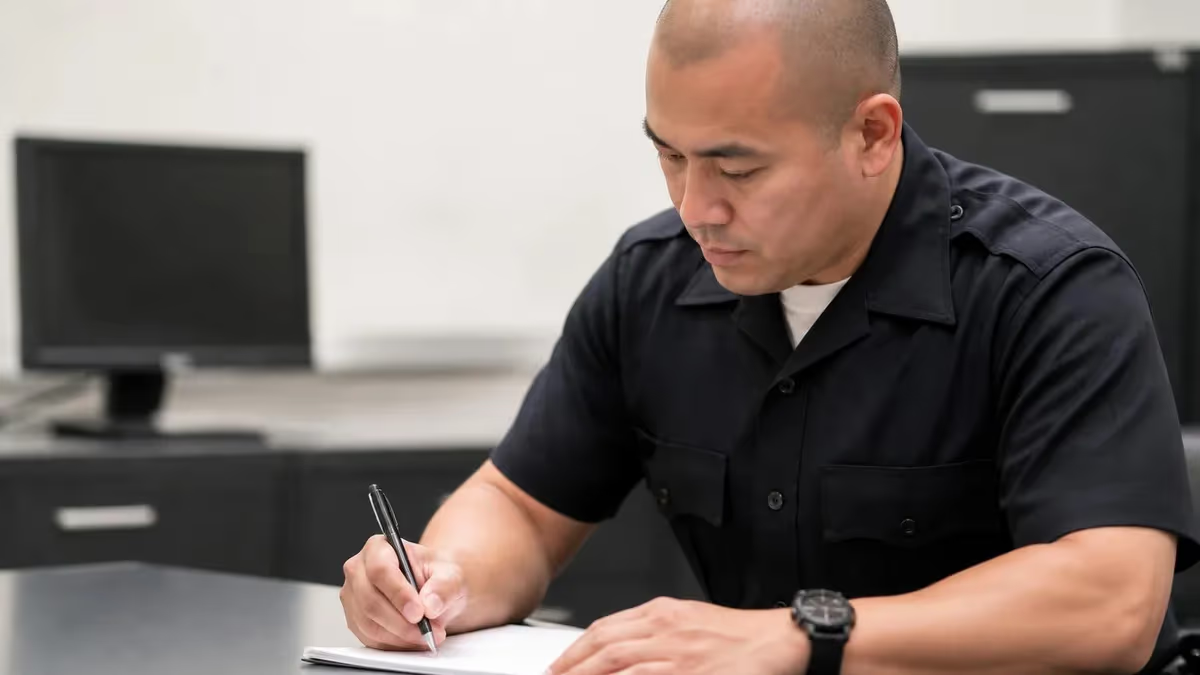
The LAPD RHD, formally known as the Los Angeles Police Department Robbery-Homicide Division, is the most prestigious investigative unit inside one of the largest municipal police agencies in the United States. Detectives assigned to RHD handle the city's most complex, high-profile, and politically sensitive cases, ranging from celebrity homicides and officer-involved shootings to serial robberies and cold cases stretching back decades. The unit operates alongside specialized teams like lapd swat and works closely with federal partners on multi-jurisdictional investigations.
RHD is housed inside the Detective Bureau and reports up through the Chief of Detectives to the LAPD chief. The division is structured into several sections, including Homicide Special, Robbery Special, the Cold Case Homicide Unit, and the Officer-Involved Shooting team. Each section carries a tightly controlled caseload, which means investigators can spend months or years on a single file rather than juggling dozens of cases the way patrol-area detectives often must.
Many of the names you have heard from Los Angeles crime history passed through RHD desks. The Night Stalker investigation, the O.J. Simpson case, the Notorious B.I.G. shooting, the Phil Spector prosecution, and the recent string of follow-home robberies in the Hollywood Hills were all RHD files. That track record is why the unit is treated as the gold standard inside the department and why assignments are fiercely competitive among veteran detectives.
RHD detectives carry standard LAPD credentials and authority but operate with citywide jurisdiction rather than being tied to a single geographic division. This allows them to follow a case anywhere within the 470 square miles of Los Angeles and, with coordination, beyond. Their work product feeds directly into the Los Angeles County District Attorney's Major Crimes Division, which handles the prosecution of the cases RHD builds.
This guide walks through the structure, history, and day-to-day reality of working at RHD. You will learn how detectives are selected, what the typical caseload looks like, how RHD differs from the homicide tables inside the 21 patrol divisions, and what aspiring investigators should do during their first ten years on the job to position themselves for an interview. We will also cover salary ranges, rank progression, and the cultural reputation the unit has earned within the broader law enforcement community.
Whether you are preparing for the LAPD entrance process, studying for promotional exams, or simply trying to understand how a major American police department solves its hardest cases, the material below gives you a working knowledge of RHD that goes well beyond what television dramas portray. The reality is slower, more procedural, and ultimately more interesting than the fictional version.
Use the table of contents to jump to a specific section, or read straight through for the full picture. Each section connects to the others, and the cumulative view is what gives readers a real understanding of how RHD actually functions inside the modern LAPD.
LAPD RHD by the Numbers

How LAPD RHD Is Organized
Handles the city's most complex murder investigations, including serial cases, multi-victim incidents, and politically sensitive files. Detectives may work a single case for years before charges are filed.
Investigates organized takeover robberies, bank robbery series, follow-home crews, and high-value commercial heists. Coordinates closely with the FBI Bank Robbery Squad and federal task forces.
Reopens unsolved murders using modern DNA technology, genetic genealogy, and re-interviewed witnesses. Has cleared cases more than thirty years old by applying forensic techniques unavailable at the original investigation.
Conducts the criminal investigation any time an LAPD officer uses deadly force. Findings are forwarded to the District Attorney's Justice System Integrity Division for review and potential filing decisions.
Investigates serial sexual assaults, kidnap-for-ransom cases, and stranger-on-stranger violent crimes that cross divisional lines or carry exceptional complexity. Pairs detectives with SART forensic nurses and DNA analysts.
The Robbery-Homicide Division was created in the early 1960s to consolidate citywide expertise on the cases that patrol-area homicide tables could not absorb. Over the following six decades it became the unit the rest of the country watched, both because of the cases that landed on its desks and because of the procedural innovations its detectives helped pioneer. Anyone who follows lapd news sees RHD names attached to nearly every major story.
The Hillside Strangler task force in the late 1970s remains a defining moment. Detectives traced the murders of ten women to cousins Kenneth Bianchi and Angelo Buono through painstaking interview work, decades before behavioral analysis was formalized as a tool. The case introduced techniques in offender profiling and inter-agency coordination that influenced how American police departments would handle serial cases for the next forty years.
The Night Stalker investigation in 1985 brought RHD into a citywide manhunt for Richard Ramirez. Detectives processed dozens of scenes across Los Angeles County, working with sheriff's investigators and ultimately producing the fingerprint identification that broke the case. The investigation became a textbook example of how patient evidence work, rather than dramatic confrontation, actually closes the hardest cases.
The 1994 murders of Nicole Brown Simpson and Ronald Goldman put RHD detectives Tom Lange and Philip Vannatter into the global spotlight. The case became a national reckoning over forensic procedure, racial dynamics in policing, and the limits of the criminal trial process. Whatever a reader thinks about the verdict, the case fundamentally changed how LAPD handles evidence collection, chain of custody, and media communication on major files.
The 2002 murder of music producer Phil Spector's house guest, the 1997 killing of rapper Notorious B.I.G., and the 2013 follow-home robberies targeting wealthy Westside residents all moved through RHD. Each case showed a different facet of the unit's work: cooperative witness building, decades-long cold case pursuit, and rapid pattern recognition across a series of incidents that initially looked unconnected.
RHD has also handled cases that never made global headlines but mattered enormously to the families involved. Cold case clearances from the 1980s and 1990s, gang-related murders without cooperating witnesses, and disappearances later proven to be homicides all sit in the division's clearance numbers. The unit's effectiveness on quiet cases is, in some ways, a better measure of its capacity than the famous files.
The history of RHD is also the history of how LAPD changed after the 1991 Rodney King incident, the Rampart scandal, and the federal consent decree that followed. Detective practices around interview recording, evidence documentation, and witness protection were all reshaped during this period, and RHD often piloted the reforms before they were applied department-wide.

LAPD Practice Test Questions
Prepare for the LAPD - Los Angeles Police Department exam with our free practice test modules. Each quiz covers key topics to help you pass on your first try.
LAPD - Los Angeles Police Department Backg...
Free LAPD Practice Test featuring - Los Angeles Police Department Background Investigation Standards. Improve your LAPD Exam score with mock test prep.
LAPD - Los Angeles Police Department Basic...
LAPD Mock Exam on - Los Angeles Police Department Basic Police Terminology. LAPD Study Guide questions to pass on your first try.
LAPD - Los Angeles Police Department Depar...
LAPD Test Prep for - Los Angeles Police Department Department Interview Procedures. Practice LAPD Quiz questions and boost your score.
LAPD - Los Angeles Police Department Logic...
LAPD Questions and Answers on - Los Angeles Police Department Logical and Deductive Reasoning. Free LAPD practice for exam readiness.
LAPD - Los Angeles Police Department Obser...
LAPD Mock Test covering - Los Angeles Police Department Observation and Memory Recall. Online LAPD Test practice with instant feedback.
LAPD - Los Angeles Police Department Physi...
Free LAPD Quiz on - Los Angeles Police Department Physical Fitness Qualifier. LAPD Exam prep questions with detailed explanations.
LAPD - Los Angeles Police Department Readi...
LAPD Practice Questions for - Los Angeles Police Department Reading Comprehension Skills. Build confidence for your LAPD certification exam.
LAPD - Los Angeles Police Department Situa...
LAPD Test Online for - Los Angeles Police Department Situational Judgment and Ethics. Free practice with instant results and feedback.
Inside the Daily LAPD Ranks and Caseload at RHD
RHD detectives typically start the day reviewing overnight communications from patrol divisions, the watch commander, and the on-call homicide notification line. Any incident in the previous 24 hours that may qualify as an RHD callout is triaged, and the duty supervisor decides whether the case stays in the patrol division or rolls up to Robbery-Homicide. This decision involves complexity, media interest, suspect-victim dynamics, and how stretched the divisional table already is.
After triage, detectives meet in case-specific working groups. Homicide Special partners review autopsies scheduled for the day, coordinate with the coroner investigators, and confirm which witnesses have been served subpoenas. The unit's lieutenants and Detective III supervisors set priorities for the week, and the team agrees on who is going to court, who is doing field interviews, and who is on the computer running database checks and warrant returns.
Is RHD the Right Career Goal? Pros and Cons
- +Citywide jurisdiction lets you follow cases anywhere in Los Angeles without divisional handoffs
- +Caseloads are smaller than patrol-area homicide tables, allowing deeper investigation
- +Access to advanced forensic resources, including priority DNA analysis and the crime lab
- +Work alongside federal partners on FBI, ATF, and DEA task forces with broader reach
- +Higher promotional ceiling, with strong pathway to Detective III and lieutenant ranks
- +Prestige inside the department and credibility throughout California law enforcement
- +Opportunity to work cold cases that change families' lives decades after a loss
- −Selection is extremely competitive, with most detectives waiting 10+ years for an interview
- −On-call schedule disrupts personal life, with callouts at any hour for major incidents
- −Court testimony in high-profile cases can extend trials for weeks at a time
- −Media scrutiny on cases means every decision is reviewed publicly
- −Trauma exposure is sustained and cumulative across a multi-decade career
- −Travel for out-of-state interviews and warrant service is frequent
- −Pressure from victim families, command staff, and prosecutors runs continuously

How to Position Yourself for an LAPD RHD Assignment
- ✓Build a strong patrol foundation in a busy division like 77th Street, Newton, or Hollywood
- ✓Pursue an early transfer to a divisional detective table after probation ends
- ✓Volunteer for homicide call-outs and case assists whenever a senior detective needs help
- ✓Complete the Robbert Presley Institute of Criminal Investigation homicide courses
- ✓Earn a Detective II promotion by clearing cases and writing publishable case books
- ✓Develop a reputation for thorough, well-documented interviews that hold up in court
- ✓Build relationships with deputy district attorneys who can speak to your filing quality
- ✓Maintain a clean Internal Affairs and personnel record across your entire career
- ✓Cultivate mentors already inside RHD who can sponsor your interview
- ✓Stay physically fit and qualify consistently on the range to remain operationally ready
The 10-Year Rule
RHD almost never hires a detective with less than ten years of total LAPD experience, and most successful candidates have closer to fifteen. Patience and a track record of clearing difficult cases at the divisional level matter far more than test scores or assignments in trendy specialized units. Time, reputation, and demonstrated trial performance are the real currency.
LAPD compensation for RHD detectives follows the same Detective I, II, and III pay grades that apply department-wide, but the practical earnings tend to run higher because of overtime, court appearance pay, and callout compensation. A Detective II inside RHD with five years in grade frequently earns significantly more than the published base scale once court overtime is factored in. The most current pay charts are published by the Personnel Department and updated each fiscal year.
Base salaries for sworn LAPD personnel start at the Police Officer I level and rise through Police Officer III before a member is eligible to test for Detective. Detective I starts above the top Police Officer III step, Detective II adds another increment, and Detective III, which is the working supervisor rank inside investigative units, sits at the top of the detective pay scale. RHD has a heavy concentration of Detective III positions because of the complexity of the work.
Beyond base pay, RHD detectives receive bilingual bonus where applicable, motor-vehicle bonus for assigned department cars, and educational incentive pay for college degrees and graduate work. Court overtime is paid at time-and-a-half for any appearance outside regular hours, which adds up quickly when a major trial is in session. Pension benefits accrue under the Los Angeles Fire and Police Pensions system, with retirement eligibility at age 50 with 20 years of service.
Career trajectory inside RHD generally moves laterally before it moves up. Detectives often spend years in a single section, then move to another section for breadth before testing for lieutenant or returning to patrol leadership. A small number transition to the Office of the Chief of Detectives, the Counter-Terrorism and Special Operations Bureau, or specialized federal task force assignments that carry deputization with the FBI or U.S. Marshals.
For officers earlier in their careers who are trying to project what RHD pay looks like, the public salary database maintained by the City Controller is a useful reference. It shows actual gross pay including overtime, which paints a more realistic picture than the base scale alone. Career-track planners should also factor in the long-term value of pension multipliers that increase with years of service and final compensation.
RHD work is not the highest-paying assignment inside LAPD on a base-scale comparison, but the combination of stable schedule predictability for daytime court appearances, callout pay for after-hours work, and frequent court overtime tends to push annual totals well above the published numbers. Members weighing the financial trade-offs should also consider the credential value of an RHD tour when transitioning to federal agencies, private investigations firms, or expert witness work after retirement.
Family planning, mortgage capacity, and retirement modeling all need to account for the variability in overtime income. RHD detectives in the middle of a major trial may earn thirty to forty percent above their base in that calendar year, while quieter years come in much closer to the published scale. Conservative budgeting against base pay and treating overtime as bonus income is the approach most veterans recommend.
Candidates applying to LAPD should focus first on passing the academy, completing probation, and excelling in patrol before thinking about specialized assignments. RHD selection happens many years into a career, and the patrol foundation is non-negotiable. Skipping steps or chasing prestige early is the most common reason promising officers never make it to the division.
If your long-term aim is RHD, the path begins with the LAPD entrance process. Candidates apply through the Personnel Department, complete a personal history statement, sit for the written assessment, undergo physical agility testing, pass a polygraph, and survive a comprehensive background investigation. The full timeline from application to academy admission commonly runs nine to fourteen months, sometimes longer if the background unit is working through a large applicant pool.
The written assessment evaluates reading comprehension, writing ability, and decision-making in scenarios designed to surface judgment patterns. Candidates who prepare with realistic practice questions tend to perform measurably better than those who walk in cold. Many also study the lapd phonetic alphabet, common radio codes, and the structure of patrol operations to demonstrate motivated familiarity during oral interviews.
Physical readiness is the other half of the equation. The LAPD physical abilities test includes a 1.5-mile run, a 300-meter sprint, push-ups, sit-ups, and an obstacle course. Candidates who train consistently for three to four months before testing pass at much higher rates than those who rely on baseline fitness. Recruiters explicitly recommend a structured running program, body-weight strength work, and obstacle-specific drills.
Once in the academy, recruits spend approximately six months in intensive training covering law, firearms, defensive tactics, driving, and tactical communications. Academic standards are strict, with weekly written exams and frequent practical evaluations. Graduates are sworn in as Police Officer I and assigned to patrol divisions for an 18-month probationary period during which their performance is evaluated by training officers and supervisors.
Officers who excel during probation are well positioned to apply for early specialized assignments, but the standard recommendation is to spend several years in patrol absorbing the full range of policing experience. Knowledge of report writing, courtroom testimony, investigations, and community dynamics built during patrol years is the raw material that future detectives draw on for the rest of their careers, including any eventual move toward RHD.
The promotion to detective comes through a competitive examination, an oral interview, and review by the personnel board. Once at the Detective I level, the goal is to demonstrate consistent case clearance, good prosecutorial relationships, and clean documentation. Detectives who hit those marks become candidates for the more competitive units, including narcotics, gangs, major assault crimes, and eventually RHD if they continue advancing.
The single most important habit for anyone serious about RHD is sustained excellence over many years. The division does not chase trends or reward shortcuts. It rewards detectives who close hard cases quietly, write clear case books, testify credibly, and conduct themselves professionally in front of victim families and the public. Build that record, and the interview opportunity will come.
Practical preparation for the LAPD process, and eventually for an investigative career that could lead to RHD, requires more than reading. Candidates who succeed treat the entrance exam as a serious test and dedicate real study hours across reading comprehension, situational judgment, and arithmetic reasoning. Setting a study schedule of one to two hours per evening for six to eight weeks before the exam is a reasonable baseline that has produced strong results.
Mock interviews are equally important. The oral panel at LAPD looks for clarity, composure, and motivation. Sitting across from a mentor, a current officer, or a recruiter and answering scenario questions out loud reveals weaknesses that silent preparation hides. Recording your answers, listening back, and refining your phrasing makes a meaningful difference in how you present on the actual day.
The background investigation is the longest single phase of the process, and candidates can either help or hurt their own timeline. Maintaining clean financial records, being completely honest on the personal history statement, and providing references who actually know you well are basics that nonetheless trip up many applicants. Anything not disclosed up front but discovered later is treated as deception, which is disqualifying.
Physical readiness, as mentioned above, deserves its own dedicated training cycle. Even candidates who are athletic in other sports often underestimate the specific demands of the LAPD physical abilities test. Mixing running, body-weight strength training, and grip work three to five times per week for at least eight weeks before the test date is a sensible plan. Recovery and sleep matter as much as the workouts themselves.
Mental health and emotional resilience cannot be ignored. The career produces sustained stress, exposure to traumatic scenes, and unpredictable schedules. Candidates who build healthy habits around sleep, exercise, social support, and counseling early will outlast peers who rely on willpower. The department has expanded its peer support and behavioral health resources significantly over the past decade, and using them is treated as professional, not weak.
For those still in school, finishing a four-year degree provides educational incentive pay later in the career and signals long-term planning to background investigators. Majors in criminal justice, psychology, sociology, foreign languages, and accounting are all valuable depending on the eventual specialization. A second language, especially Spanish, Korean, Tagalog, Armenian, or Mandarin, opens additional bonus pay and assignment opportunities.
Finally, keep perspective. RHD is a worthy long-term aspiration, but the work that gets you there is the patrol shift, the burglary follow-up, the careful interview, the well-written report. Treat every assignment as the one that matters. The detectives currently sitting at RHD desks earned their seats through years of exactly that kind of unglamorous, consistent professional work. That is the actual path.
LAPD Questions and Answers



About the Author
Law Enforcement Trainer & Civil Service Exam Specialist
John Jay College of Criminal JusticeMarcus B. Thompson earned his Master of Arts in Criminal Justice from John Jay College of Criminal Justice and served 12 years as a law enforcement officer before transitioning to full-time academy instruction. He is a POST-certified instructor who has prepared candidates for police entrance exams, firefighter assessments, and civil service examinations across dozens of agencies.
Join the Discussion
Connect with other students preparing for this exam. Share tips, ask questions, and get advice from people who have been there.
View discussion (9 replies)