
What Is a Journeyman Electrician? Career, License & Exam Guide 2026 September
Pass the What Is a Journeyman Electrician? exam with confidence. 🔎 Practice questions with detailed explanations and instant feedback on every answer.
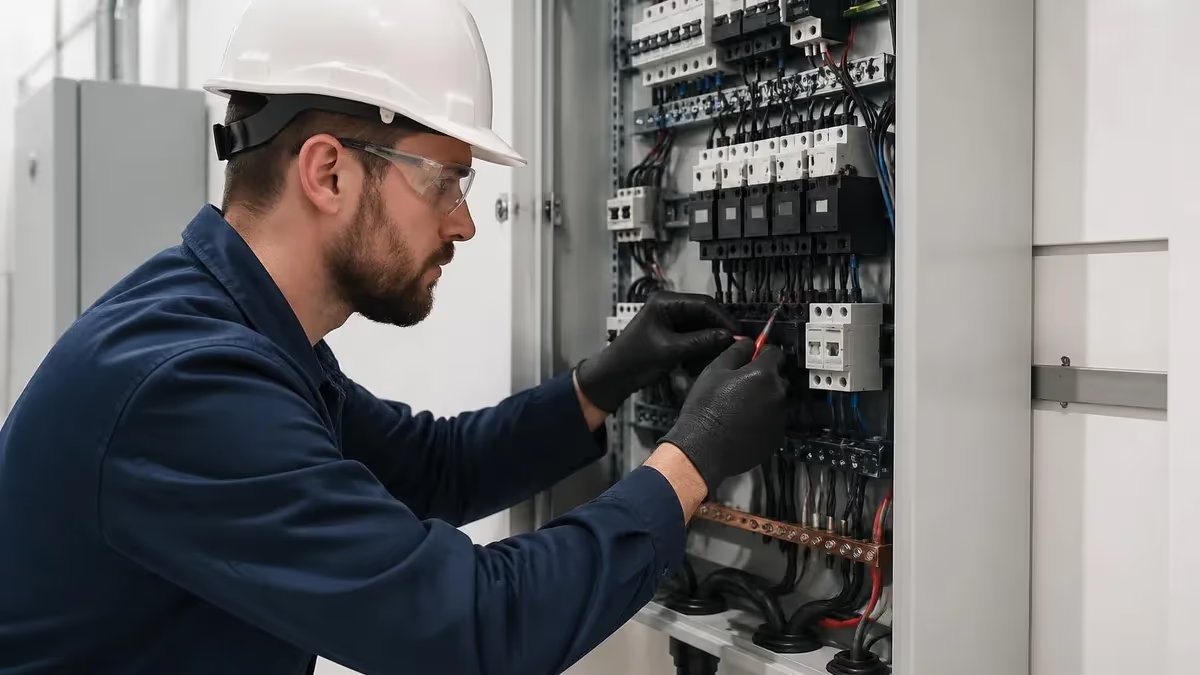
A journeyman electrician is a licensed electrical worker who has completed an apprenticeship program and passed a state or local licensing exam. The journeyman license is the mid-tier credential in the electrician career path — above apprentice, below master electrician. It authorizes you to perform electrical work independently without direct supervision, pull permits under your own license in most jurisdictions, and lead small crews on residential and commercial electrical projects.
The term journeyman comes from the medieval guild system, where a craftsperson who had completed their apprenticeship was entitled to work for wages (the French word journée means day, referring to day wages). In modern electrical trades, the journeyman license is granted by state or local licensing authorities after a candidate meets experience requirements and passes the journeyman electrician exam — typically a written test covering the National Electrical Code (NEC), electrical theory, and installation practices.
What is a journeyman electrician, in practical terms? It's someone with 4–5 years of hands-on electrical experience, comprehensive knowledge of the NEC, and the license to work independently on electrical systems in residential, commercial, and light industrial settings. Journeyman electricians install wiring, circuit breakers, outlets, lighting systems, panels, and electrical equipment in new construction and renovation projects. They troubleshoot electrical faults, service existing systems, and ensure that all work meets code requirements and passes inspection.
The journeyman license is the workhorse credential of the electrical trade. While master electricians run electrical contracting businesses and pull permits for large projects, most of the hands-on electrical installation work in the country is performed by journeymen. Understanding what the license requires, what the exam covers, and what careers it opens is essential if you're considering the electrical trade as a profession.
Electricians are among the highest-paid tradespeople precisely because electrical work is both technically demanding and safety-critical. A mistake in electrical installation can cause fires, electrocutions, and equipment failures that endanger lives. The licensing system exists to ensure that anyone performing electrical work has demonstrated the knowledge to do it safely and correctly. This safety imperative is why the journeyman exam emphasizes NEC knowledge so heavily — the code represents decades of accumulated accident investigation and engineering judgment translated into minimum safety standards for electrical installations.
The electrical trade has traditionally been dominated by men, but that's changing. More women are entering electrical apprenticeships and journeyman programs, driven by strong wages, job security, and growing awareness of the trades as a viable alternative to four-year college degrees. Pre-apprenticeship programs specifically designed to recruit and support women and underrepresented minorities in the electrical trades have expanded access significantly. Organizations like the National Electrical Contractors Association (NECA) and various state apprenticeship programs actively recruit from diverse communities to build a workforce that reflects the communities electricians serve.
Getting your journeyman license is also a meaningful financial investment in your future. Electricians with journeyman licenses earn, on average, 30–40% more than unlicensed electrical helpers and assistants. Over a 30-year career, that wage premium — compounded by union pension contributions and seniority-based wage increases — represents hundreds of thousands of dollars in additional lifetime earnings. The investment in apprenticeship training and exam preparation is one of the highest-return vocational investments available to someone entering the workforce.

The path to becoming a journeyman electrician begins with an apprenticeship. Apprenticeships are typically 4–5 years long and combine on-the-job training (8,000+ hours) with classroom instruction (576+ hours) covering electrical theory, the NEC, blueprint reading, motor controls, and safety. The most common apprenticeship programs are sponsored by the International Brotherhood of Electrical Workers (IBEW) in partnership with the National Electrical Contractors Association (NECA), or by independent electrical contractor associations. Apprenticeship programs are registered with the Department of Labor and provide a structured, earn-while-you-learn path to the journeyman license.
Not all states require formal apprenticeship completion before taking the journeyman exam. Some states allow candidates to document equivalent work experience — typically 8,000 hours under the supervision of a licensed electrician — and sit for the exam without having completed a registered apprenticeship program. This path is common for self-taught electricians who worked their way up through on-the-job training. However, apprenticeship program graduates often have advantages: structured NEC study, documented hours, and exam preparation incorporated into the program curriculum.
The journeyman electrician exam tests your knowledge of the National Electrical Code, which is updated every three years by the National Fire Protection Association (NFPA). Most state journeyman exams allow an open-book NEC reference — meaning you can use your NEC book during the test — but you must be able to navigate it efficiently. Candidates who haven't internalized the NEC's organizational structure spend too much time looking up basic concepts. Effective exam preparation means learning to use the NEC as a reference tool, not memorizing every provision verbatim.
Exam content typically covers residential wiring methods, branch circuit requirements, service entrance calculations, motor controls, grounding and bonding, conduit fill calculations, wire sizing, protection requirements (GFCI, AFCI), and load calculations. Different jurisdictions may weight these topics differently and may test on local amendments to the NEC that your state or city has adopted. Check your jurisdiction's licensing authority for the specific exam outline and any local code adoptions that will be included.
The relationship between the journeyman exam and the National Electrical Code is central to understanding what preparation actually requires. The NEC isn't a textbook — it's a legal document adopted by reference into state and local law. It's written in prescriptive, regulatory language that requires interpretation practice to read fluently. A student who has only read explanations of the NEC in study guides will struggle with exam questions that reference specific NEC article numbers and require you to understand exactly what the code provision requires, permits, or prohibits. You must spend time reading actual NEC text, not just summaries of it.
Many candidates also underestimate the math component of the journeyman exam. Wire sizing, conduit fill, load calculations, and motor circuit calculations all require arithmetic — and errors compound quickly when you're calculating feeder ampacity with correction factors applied for temperature and conductor bundling. If your arithmetic is rusty, refresh your skills on fractions, percentages, unit conversions, and basic algebra before starting NEC-specific prep. A calculator is typically allowed, but you still need to set up the calculations correctly to get the right answer.
The open-book format of most journeyman exams is one of the most misunderstood aspects of exam preparation. Many candidates hear "open book" and assume the exam will be easy — they plan to look everything up rather than studying. This is a serious mistake. The exam is timed, and a candidate who hasn't internalized the NEC's structure will spend the entire test flipping pages while the clock runs. The open-book format tests your ability to use the NEC as a professional tool — the way you'll use it on job sites and during inspections throughout your career. Candidates who score well combine strong working knowledge with fast lookup skills for the provisions they haven't memorized.
Salary for journeyman electricians varies significantly by location, industry sector, and union affiliation. The Bureau of Labor Statistics reports median annual wages for electricians at approximately $61,000 nationally, but union journeymen in high-cost-of-living areas frequently earn $80,000–$100,000+ with overtime, benefits, and pension contributions. Union journeymen working on large commercial or industrial projects earn wages set by collective bargaining agreements — rates that reflect years of negotiation and the high skill level required for complex electrical installations.
Non-union journeymen typically earn somewhat less than union counterparts in the same market, but gain flexibility in working for multiple employers and potentially building toward their own contracting business. The total compensation calculation must include benefits — union journeymen receive healthcare, pension, and vacation contributions that can add 30–40% to base wage value. A $35/hour non-union journeyman may have lower effective compensation than a $32/hour union journeyman with full benefits and pension.
Career progression beyond the journeyman license follows several paths. The most common is pursuing the master electrician license — typically requiring 2 additional years of journeyman experience plus a more comprehensive exam that includes business and contracting law. With a master's license, you can start an electrical contracting business, pull permits independently for projects of any scale, and employ other electricians. Many journeymen also advance into supervision, estimating, project management, or electrical inspection roles that don't require maintaining an active license.
Specialization within the journeyman path opens up some of the most interesting and best-compensated work in the electrical trade. Instrumentation and control electricians work in industrial plants, refineries, and utilities maintaining sensors, control loops, PLCs, and distributed control systems. Electrical linemen work for utilities installing and maintaining transmission and distribution lines — work that's physically demanding, well-compensated, and requires specialized safety training beyond standard journeyman credentials. Low voltage specialists focus on data cabling, fire alarm systems, security, and audio-visual installations — work that sits at the intersection of electrical and IT and is governed by different NEC articles (Article 800 for communication systems, Article 760 for fire alarm systems) than standard power wiring.
Union vs non-union is a decision that shapes the entire journeyman career trajectory. Union journeymen benefit from negotiated wages, comprehensive benefits, defined pension contributions, continuing education through local union training centers, and dispatch halls that connect you with work without the need to job-hunt individually. Non-union journeymen trade some of these benefits for more flexibility — the ability to work for multiple contractors, negotiate individual compensation, and potentially advance faster to supervisory or contracting roles. Both paths lead to successful careers; the choice depends on your priorities around income stability, benefits, and professional autonomy.
The work itself is genuinely varied — a major attraction for electricians who enjoy problem-solving. On a given week, a journeyman might rough-in wiring for a new apartment complex, troubleshoot an intermittent electrical fault in a commercial kitchen, install a 200-amp service upgrade in a residential addition, and program a motor control center in a manufacturing plant. No two jobs are identical, and the work requires constant application of code knowledge, spatial reasoning, and systematic troubleshooting methodology. For people who like hands-on intellectual challenges with tangible results, electrical work provides daily satisfaction that desk jobs rarely match.

Journeyman Electrician Exam Preparation
The NEC is organized logically — general rules in early articles, specific systems and occupancies in later articles. Most exam questions draw from Articles 200–400 (wiring methods, equipment, overcurrent protection) and Articles 210–230 (branch circuits, feeders, services). Learn the organizational structure of the NEC before trying to memorize content — once you know where to find specific rules, you can navigate the open-book exam efficiently rather than flipping randomly.
Tabbing your NEC book is essential. Create tabs for frequently tested articles and important tables (Table 310.12 for conductor ampacity, Table 9 for conduit fill, Chapter 9 Table 5 for conductor dimensions). During exam practice, time yourself finding answers — if it takes more than 90 seconds to find a provision you've studied, it needs a tab. Exam time management depends on being able to locate code provisions quickly.
The demand for electricians remains strong and is expected to grow significantly over the coming decade. Grid modernization, renewable energy installation (solar, EV charging infrastructure, battery storage), data center construction, and the general electrification of systems that previously used fossil fuels are driving sustained demand for skilled electrical workers. Journeyman electricians who develop expertise in photovoltaic systems, EV charging station installation, or industrial automation controls are positioning themselves for the highest-demand segments of the job market.
Safety training is a non-negotiable component of electrical career development. OSHA 10 and OSHA 30 certifications, lockout/tagout (LOTO) procedures, arc flash safety, and confined space entry training are standard requirements on commercial and industrial job sites. Many jurisdictions require OSHA 10 as a minimum for journeymen working on construction projects covered by OSHA 29 CFR 1926. Maintaining current safety certifications keeps you eligible for the widest range of work sites and demonstrates professional responsibility to employers and contractors.
Continuing education is required for license renewal in most states — typically 8–24 hours per renewal cycle, which runs 2–4 years depending on jurisdiction. CE topics often include updated NEC provisions (the code is revised every three years), energy efficiency requirements, new electrical technologies, and safety. Many electrical contractors offer in-house training; IBEW local unions provide CE through their training centers; online providers like Mike Holt Enterprises offer NEC update courses that count toward CE hours in most states.
Mentorship is undervalued in the electrical trade. The most successful journeymen actively seek out experienced master electricians or senior journeymen who are willing to explain the reasoning behind installation decisions — not just the code provisions, but why the code is written the way it is, what failures or accidents the rules were designed to prevent, and how experienced electricians approach complex troubleshooting scenarios. This experiential knowledge can't be learned from a book; it's transmitted through working relationships on job sites. If you're in an apprenticeship program, identify your best mentors and learn from them as actively as possible. The investment in those relationships pays dividends throughout your career.
Looking ahead, the electrical trade is in the middle of a generational transition. Millions of experienced electricians are approaching retirement age, and the pipeline of new apprentices — while growing — is still insufficient to replace them at the current pace. This demographic reality means that well-prepared, licensed journeyman electricians entering the workforce today are entering a market that genuinely needs them. Strong starting wages, rapid advancement opportunities, and the chance to build a master license and your own business are all more accessible than in previous generations. The journeyman license is the foundation — and the foundation is solid.
Technology adoption in the electrical trade is accelerating. Digital multimeters with Bluetooth data logging, thermal imaging cameras for identifying hot connections, and BIM (Building Information Modeling) software for planning complex installations are all tools that modern journeymen use alongside traditional hand tools. Electricians who embrace technology — and especially those who develop proficiency in PLC programming, building automation systems, or solar system design software — command premium wages and are among the most sought-after workers in the industry. The journeyman license is the foundation; continuous learning about emerging technology is what builds a truly resilient and rewarding career.

Journeyman Electrician License Checklist
- ✓Verify your state's specific journeyman license requirements and exam format
- ✓Document all apprenticeship or equivalent work experience hours accurately
- ✓Obtain the correct edition of the NEC that your state's exam uses
- ✓Tab your NEC book with dividers for frequently tested articles
- ✓Complete at least 4 full timed practice exams under open-book conditions
- ✓Register for the exam through your state's approved testing vendor
- ✓Bring required identification and NEC book on exam day
- ✓After passing, submit your license application with all required documentation
- ✓Check reciprocity requirements if you plan to work in multiple states
- ✓Schedule required continuing education for license renewal
Journeyman Electrician Career: Pros and Cons
- +Strong and growing job market driven by electrification and renewable energy
- +Competitive wages — union journeymen in major markets earn $80,000-$100,000+
- +No student loan debt — apprenticeship is earn-while-you-learn
- +Clear career progression path from apprentice to journeyman to master
- +High demand in any economic environment — electrical work can't be outsourced
- +Physical and intellectual challenge — no two job sites are the same
- −Physically demanding work — standing, climbing, heavy lifting, outdoor exposure
- −Risk of electrical shock, arc flash, and fall injuries requires constant safety diligence
- −Shift work, overtime, and travel may be required on large commercial projects
- −Licensing requirements vary by state — not a nationally portable credential without reciprocity
- −Slow advancement if pursuing master license in states with restrictive requirements
Journeyman Electrician Questions and Answers



About the Author

Licensed Master Electrician & Journeyman Exam Specialist
Texas State Technical CollegeFrank Rodriguez is a licensed master electrician with a Bachelor of Science in Electrical Technology from Texas State Technical College. He has 20 years of commercial and industrial electrical contracting experience and 10 years teaching apprenticeship and licensing exam prep programs. Frank specializes in NEC code mastery, load calculations, and electrical theory for journeyman and master electrician candidates.
Join the Discussion
Connect with other students preparing for this exam. Share tips, ask questions, and get advice from people who have been there.
View discussion (1 reply)