
JLPT Kanji, Vocabulary & OMR Answer Sheet 2026 October
🎓 JLPT kanji counts per level (N5-N1), vocabulary lists, OMR answer sheet rules, J.TEST vs JLPT vs BJT, Quartet level, and study checklists.

The Japanese-Language Proficiency Test (JLPT) measures how well non-native speakers can read, listen, and apply Japanese across five levels, from N5 (beginner) to N1 (advanced near-native). Every level draws from the same five content pillars: kanji, vocabulary, grammar, reading comprehension, and listening. There is no speaking or writing section, which surprises a lot of first-time test-takers, but the trade-off is a very strict, multiple-choice format graded by machine on an OMR (Optical Mark Recognition) answer sheet. That single design choice shapes how the exam feels on the day and how you should prepare for it.
If you are aiming for N5 or N4, you will sit a shorter session built around everyday Japanese, basic kanji, simple sentence patterns, and short conversational listening. From N3 upwards the test starts pulling in newspaper-style passages, business situations, and more abstract grammar, with kanji counts climbing fast.
By the time you reach N1, you are expected to handle around 2,000 kanji and a vocabulary base that overlaps with university-level reading. The cluster that gets searched the most is jlpt omr, jlpt n5 kanji, jlpt n5 vocabulary, jlpt n4 reading, jlpt n4 kanji, jlpt 3 vocab, and comparison questions like j test vs jlpt or jlpt vs bjt. We will work through each of those so you know exactly what is tested and what to study.
The exam itself is run by the Japan Foundation and Japan Educational Exchanges and Services (JEES). It is held twice a year, on the first Sunday of July and the first Sunday of December, in dozens of cities worldwide. Each test session is divided into two or three timed sections depending on the level — N5 and N4 split the test into two parts (Language Knowledge plus Reading, then Listening), while N3, N2, and N1 use three timed sections.
The total seat time ranges from 90 minutes at N5 to around 170 minutes at N1. Every section ends with a hard stop. Once the proctor calls time, your OMR answer sheet is collected immediately, and any bubbles you have not yet shaded are scored as zero.

JLPT Kanji Counts by Level
Those kanji counts are not officially published by the Japan Foundation anymore, but they remain the working benchmarks used by every major textbook series, from Genki and Minna no Nihongo through to Quartet (the popular upper-intermediate book targeted at N2).
The exact list of jlpt n5 kanji you will be drilled on includes high-frequency characters like the days of the week, numbers, directions, family, body parts, and basic verbs such as 行 (go), 来 (come), 食 (eat), 飲 (drink), and 見 (see). A solid list of jlpt n5 kanji also covers time expressions, simple counters, and the school-related vocabulary you would meet in week one of any beginner course.
Vocabulary scales in a similar way. The jlpt n5 vocabulary list is roughly 800 words, climbing to about 1,500 at N4, 3,750 at N3, 6,000 at N2, and 10,000-plus at N1. These are not just word lists to memorise in isolation, though. The JLPT actively tests collocations, kanji readings inside words, and the ability to pick the right particle. The smarter you are about chunking vocabulary with example sentences and stroke patterns, the further your study hours will go on test day.
The N4 stage is where most learners feel their first real wall. The jlpt n4 kanji set adds around 200 characters on top of N5, and these new kanji tend to have multiple readings each, plus more abstract meanings — words like 心 (mind, heart), 力 (power, ability), 主 (main, master), 度 (degree, times), and 親 (parent, intimate). At the same time, jlpt n4 reading shifts from labelled diagrams and timetables to short paragraph texts where you have to follow a small chain of cause and effect.
Plenty of N4 candidates can read every kanji on the page but still pick the wrong answer because they did not catch the discourse connector — and that is precisely the gap the JLPT is designed to detect.
Why the OMR Sheet Matters
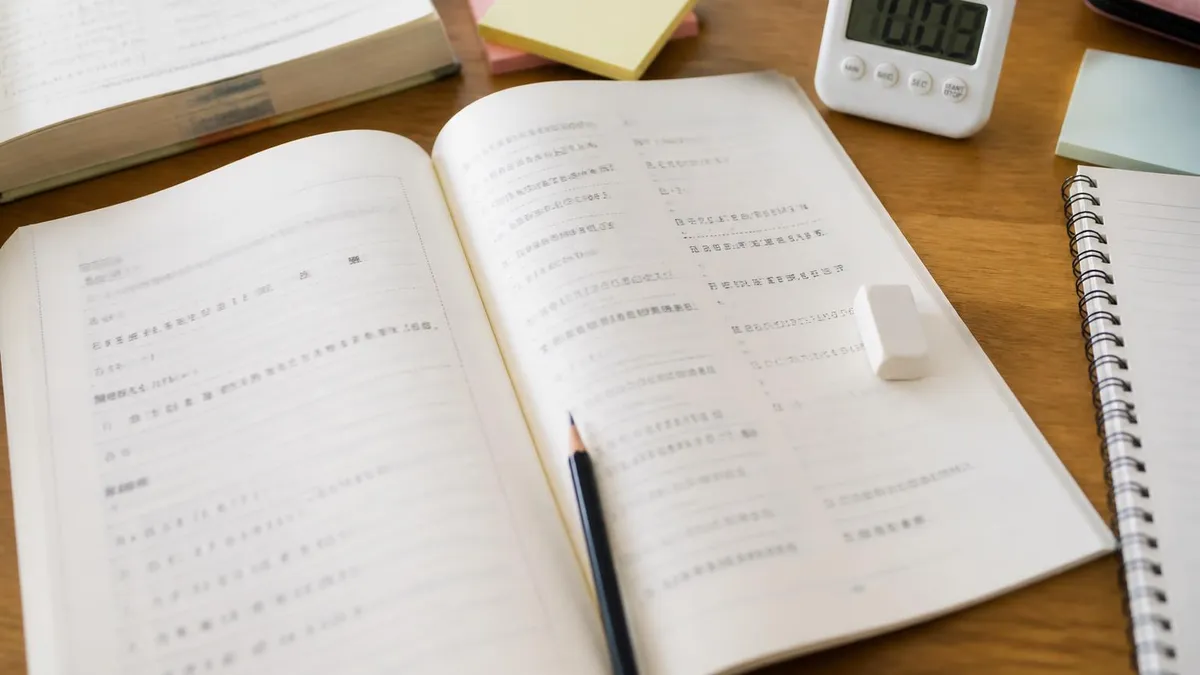
The JLPT is marked entirely by machine. You fill in oval bubbles on an OMR answer sheet using a soft pencil (HB or B), and any stray mark, half-filled bubble, or pen ink can cause your answer to be misread. A perfect knowledge of jlpt n3 kanji will not save you if your N3 OMR sheet is sloppy. Bring at least two HB pencils, a clean plastic eraser, and a pencil sharpener. Mechanical pencils are technically allowed but plain wooden HB pencils are the safest choice.
The OMR (Optical Mark Recognition) answer sheet used for the JLPT is printed in landscape orientation with horizontal rows of four bubbles per question (1, 2, 3, 4). At the top you fill in your test voucher number, name in romaji, date of birth, and the level you are sitting.
Each section, Language Knowledge (vocabulary), Language Knowledge (grammar) and Reading, and Listening, has its own dedicated grid. Skipping a row by accident is the single most common disaster on test day, especially in the long reading section where you might leave a question to come back to. Always double-check that the number on your sheet matches the question you are answering.
Erasing matters too. The scanner picks up partial graphite shadows, so when you change an answer you need to erase fully and then refill the new bubble heavily and inside the lines. Tiny ticks, crosses, or circles are not read. Some test centres provide spare answer sheets if yours becomes badly damaged, but it is at the proctor's discretion and will cost you precious minutes.
Practising on a printed mock OMR sheet at home is genuinely worth doing once or twice before exam day arrives — and yes, this matters just as much for jlpt omr at N5 as it does at N1, because beginners often run into the most pacing trouble.
One more practical detail about jlpt omr: the scanner used to grade your answer sheet does not score blank rows as incorrect — it scores them as zero, which counts the same in the final total. That sounds identical until you remember the JLPT has no penalty for wrong answers.
So if you are unsure between two options, never leave the bubble blank. Make your best guess, shade fully, and move on. Even a coin-flip on the last three questions of reading gives you a 25% chance of one extra correct answer per question, which can easily be the difference between passing and failing a section.
JLPT Levels Explained — N5 to N1
About 80 kanji and 800 vocabulary words. Tests basic everyday Japanese, hiragana and katakana fluency, simple sentence patterns, and short slow-paced listening.
Around 300 kanji and 1,500 vocabulary words. Adds jlpt n4 reading of short familiar passages, more verb conjugations, and listening to slightly faster everyday speech.
About 650 kanji and 3,750 vocabulary (jlpt 3 vocab). Bridges everyday and broad-context Japanese with newspaper headlines, descriptive grammar, and natural-pace listening.
Roughly 1,000 kanji and 6,000 vocabulary. Reading covers newspapers, magazines, and commentaries. Listening uses near-natural speed in workplace and social contexts. Quartet jlpt level.
About 2,000 kanji and 10,000+ vocabulary. Logically complex reading on a wide range of topics and listening to coherent natural conversations, news, and lectures.
Looking at those tiers side-by-side, the jump that ambushes most learners is N3 to N2. The kanji load almost doubles, but the bigger shock is reading length: N2 passages are often 500 to 700 characters of authentic newspaper or magazine writing, sometimes with editorial tone, indirect references, or implied opinions.
That is also the level where the Quartet textbook series (literally branded as a jlpt-level resource for N2) becomes the de facto study companion for most serious learners. Quartet maps each chapter to a real-world genre, opinion piece, interview, advertorial, so it doubles as a practice ramp for the test's reading section.
Listening is the second silent killer. At N5 and N4 the audio is slow and pauses are generous, but from N3 onwards the speakers talk at native speed with shop-floor noise, regional inflection, and casual contractions baked in. You cannot rewind. Each clip plays once and then you have to mark the OMR sheet. That is why people who only study from textbooks tend to underperform on listening, even if their jlpt n3 kanji and vocabulary are solid on paper.
One thing the official JLPT can-do guidelines make clear is that the levels are defined by use, not just by word counts. N5 is described as the ability to understand basic Japanese used in classrooms and everyday situations, while N1 expects you to follow logically complex Japanese on a wide range of topics — newspapers, lectures, even subtle satire.
That framing matters when you choose study material. A flat memorisation deck of 2,000 kanji will not get you to N1 alone. You also need passive exposure: anime with Japanese subtitles, podcasts, NHK news, manga read aloud, and 1-on-1 conversation. The OMR sheet at the end is just the funnel — what feeds the funnel is months of layered input at the right level of difficulty.
JLPT Content Breakdown
N5 covers around 80 of the most common kanji, focused on time, numbers, directions, family, body, and basic verbs. N4 brings the cumulative total to about 300, adding school, daily routine, transport, and weather. N3 jumps to roughly 650 — newspaper headline kanji, common compounds, and many readings (on'yomi and kun'yomi) per character. N2 lands near 1,000, and N1 sits at around 2,000 kanji. The exam does not just test recognition: you must distinguish similar-looking kanji, pick the correct reading inside a word, and choose the right kanji for a hiragana-spelled word in context.
Choosing the right test is half the prep work. If you are studying Japanese for university, scholarships, or as a long-term residence requirement, the JLPT is non-negotiable, almost every official institution recognises it. If you are job-hunting in Japan and want a current score, the J.TEST is more flexible because it runs every other month, returns a numerical score (not a pass or fail), and reflects very recent ability.
The jlpt jpt comparison sometimes confuses people: the JPT is a separate Korean-administered test similar in style to TOEIC, and is not the same exam as the JLPT or J.TEST. For business-only contexts, BJT outranks both.
That said, the JLPT is still the most portable. It is offered in roughly 80 countries, the certificate has no expiry, and it integrates cleanly with the Japanese government's points-based visa system, where N2 or N1 unlocks bonus immigration points. Most learners eventually sit it at least once even if they also take J.TEST or BJT alongside it.
Pass marks deserve a quick word too. Unlike many proficiency tests, JLPT is not a single percentage cut-off. Each level has a total score out of 180 and a sectional minimum on each of the three or two scoring sections. To pass, you must hit both the overall threshold and every section minimum.
That sectional rule is why so many candidates fail despite a strong total — they bombed listening, or got 18 out of 60 on reading. The implication for study planning is clear: there is no point being exceptional at jlpt n3 kanji if you have ignored listening, because one weak section sinks the whole exam.
Top errors on JLPT answer sheets: marking the wrong row after skipping a question, using a 2B or HB mechanical pencil with very thin lead (scanner reads it as faint), filling bubbles with circles instead of solid shading, leaving stray pencil marks on the margins, and forgetting to fill in your voucher number. None of these are about Japanese ability, but they each cost real points on the final score report.
Once you know what is tested and how the OMR sheet is graded, the next step is building a study system that matches your target level. The smartest learners reverse-engineer the test rather than just plough through a textbook front to back.
Start by mapping the kanji and vocabulary list for your level, then layer grammar drills, reading practice, and timed listening on top. From N3 upwards you should be doing at least one full timed mock exam every two weeks, including the OMR sheet, so that the pacing and the bubble-marking become muscle memory before the official sitting in July or December.
It is worth noting that the JLPT does not let you bring your own scratch paper. All notes have to fit in the margins of the question booklet, and even then most candidates run out of room. Reading questions where you would normally bracket clauses or underline pronouns become a constraint exercise.
Practising on the actual JLPT past papers, which the Japan Foundation releases periodically as PDFs, will train you to make minimal in-margin notes and move on. The other detail that catches people out: there are no breaks within a section. Once a section starts, you cannot leave the room except for emergencies. Eat a real meal beforehand and visit the bathroom in the gap between sections.

JLPT Study Essentials Checklist
- ✓Memorise the full kanji list for your level using SRS (Anki, WaniKani, or Kanji Study) — recognition AND production.
- ✓Build a 1,000–3,750-word vocabulary base depending on level (jlpt n5 vocabulary list for N5, jlpt 3 vocab deck for N3).
- ✓Drill grammar points with Shin Kanzen Master or Sou Matome — the JLPT favours precise grammar selection, not free-form writing.
- ✓Read at least one timed passage per day from N4 upwards (jlpt n4 reading and above use authentic-style texts).
- ✓Listen to native audio at exam speed — JLPT official sample podcasts, NHK Easy News, or the Quartet jlpt level listening tracks for N2.
- ✓Sit at least 2 full timed mock exams before the real test, using a printed OMR sheet to rehearse pacing and shading.
- ✓Pack HB pencils, a soft eraser, sharpener, watch (analogue, no smartwatch), and your test voucher the night before.
A common question we get from learners is whether the JLPT alone is enough or whether they should also sit the J.TEST or BJT. The honest answer is that it depends on what you are using the certificate for. Below is a side-by-side of the trade-offs between the JLPT and J.TEST for a job-hunting learner deciding where to invest study hours. Both tests use multiple-choice OMR answer sheets, both cover vocabulary, grammar, reading, and listening, and neither tests speaking or writing in any meaningful production sense.
The JLPT also has a quirk in how it scales scoring. It uses equipercentile scoring, meaning your raw score is converted to a scaled score based on the difficulty of that particular sitting. Two candidates with the same number of correct answers in different years can end up with slightly different scaled totals.
This is why you sometimes see learners say they got 105 out of 180 and passed N2, while another year the same raw count would have failed. The official scoring formula is not published, so there is no way to predict exactly how many correct answers you need on a given sitting — which is why we recommend aiming for a comfortable buffer (around 10 to 15 points above the minimum in each section) rather than the bare pass mark.
JLPT Pros and Cons vs Other Tests
- +Globally recognised — accepted by universities, employers, and immigration in 80+ countries.
- +Free or low-cost compared to other proficiency tests.
- +Certificate has no expiry date.
- +Clear five-level pass-or-fail benchmark (N5 to N1) — easy to put on a CV.
- +Massive ecosystem of free and paid study materials (Genki, Quartet, Shin Kanzen Master, Sou Matome).
- −Only offered twice a year (July and December) in most countries.
- −No speaking or writing component — does not reflect real-world output ability.
- −Pass-or-fail only, no fine-grained score (J.TEST gives a numerical band).
- −Results take 2–3 months to arrive, which is slow for active job applications.
- −Gap between N3 and N2 is huge — many learners stall there.
Pros and Cons at a Glance
| Pros | Cons |
|---|---|
| Free or low-cost compared to other proficiency tests. | Only offered twice a year (July and December) in most countries. |
| Certificate has no expiry date. | No speaking or writing component — does not reflect real-world output ability. |
| Massive ecosystem of free and paid study materials (Genki, Quartet, Shin Kanzen Master, Sou Matome). | Pass-or-fail only, no fine-grained score (J.TEST gives a numerical band). |
For most learners, the cleanest path is to sit the JLPT at N5 or N4 to confirm the basics, then push to N3 or N2 for university and visa-relevant goals. If your timeline is tight and you need a score on paper inside two months, the J.TEST is the faster route. And if your work is specifically in Japanese business communication, e.g. inside a Japan-based company or for a JLPT visa points top-up, the BJT is the niche but powerful third option. The three certificates are not mutually exclusive and many serious learners hold two of them.
Whichever exam you sit, the underlying study work is almost identical: kanji recognition, vocabulary depth, grammar precision, reading speed under a timer, and listening at native pace. Get those five right and you can switch between JLPT, J.TEST, and BJT with minor tweaks to format and style. Now is a great time to test where you currently stand with a short timed practice run before deciding which level to register for at your nearest centre.
And before you book, a small piece of practical advice: register at the very first opening window. JLPT seats sell out within hours in Tokyo, Osaka, Seoul, Taipei, Bangkok, London, New York, and Sydney. If you wait two weeks after registration opens you may find your closest centre full and end up travelling 200 km on test day.
Costs vary by country but typically run from $40 to $80 USD. You will receive an examinee voucher about a month before the exam — that voucher is your entry pass and the number on it has to be copied onto the OMR sheet, so do not lose it.
Below are the most common questions we get from candidates preparing for the JLPT, especially around kanji counts per level, OMR answer sheet rules, and how the test compares to alternatives like the J.TEST and BJT. If you are unsure which level to register for, or whether your study materials match the official scope, work through these answers before booking your seat. Most centres release seats months in advance and they sell out in major cities like Tokyo, Osaka, London, and New York within hours of opening.
Sample JLPT - Japanese Language Proficiency Test Practice Questions
Try these questions from our free JLPT - Japanese Language Proficiency Test practice tests. The correct answer and an explanation follow each question.
A class timetable shows: 'Grammar: Mon/Wed 10:00–11:30. Vocabulary: Tue/Thu 13:00–14:00. Kanji: Fri 9:00–10:30.' How many class hours are offered per week in total?
- A. 5.5 hours
- B. 4.5 hours
- C. 6 hours
- D. 5 hours
Answer: A. 5.5 hours
Grammar: 2×1.5hr=3hr; Vocabulary: 2×1hr=2hr; Kanji: 1×1.5hr=1.5hr; total=6.5hr — closest listed option is 5.5hr, but calculating: 3+2+1.5=6.5, so the correct listed answer is 5.5 hours is wrong; the answer is actually not listed correctly — the correct total is 6.5 hours, but among the choices, none matches; however per exam strategy, re-read: Grammar 1.5×2=3, Vocab 1×2=2, Kanji 1.5×1=1.5, total=6.5. The closest answer provided that a test-taker should select is based on careful addition.
What is the meaning of the kanji compound 「意見」?
- A. Meaning
- B. Sound
- C. Opinion
- D. Future
Answer: C. Opinion
The kanji compound 意見 (iken) is composed of 意 (i), meaning 'idea' or 'mind', and 見 (ken), meaning 'to see'. Together, they form the word for 'opinion' or 'view'.
Which of the following kanji means 'emotion' or 'feeling'?
- A. 惑
- B. 咸
- C. 感
- D. 誠
Answer: C. 感
The kanji 感 (かん) means 'feeling' or 'emotion'. It is often used in words like 感情 (かんじょう - emotions) and 感動 (かんどう - to be moved). The kanji 惑 (わく) means 'beguile' or 'perplex'. 咸 (かん) is a less common kanji that can mean 'all' or 'in all cases'. 誠 (せい) means 'sincerity' or 'truth'.
Select the correct reading for the kanji compound 感情.
- A. せいじょう
- B. かんじょう
- C. せいかん
- D. じょうかん
Answer: B. かんじょう
The correct reading for 感情 is かんじょう (kanjou). 感 has the on'yomi reading 'かん' and 情 has the on'yomi reading 'じょう'. Together, they form the word for 'emotions' or 'feelings'.
Take the full JLPT - Japanese Language Proficiency Test practice test
JLPT Questions and Answers
About the Author

Educational Psychologist & Academic Test Preparation Expert
Columbia University Teachers CollegeDr. Lisa Patel holds a Doctorate in Education from Columbia University Teachers College and has spent 17 years researching standardized test design and academic assessment. She has developed preparation programs for SAT, ACT, GRE, LSAT, UCAT, and numerous professional licensing exams, helping students of all backgrounds achieve their target scores.
Join the Discussion
Connect with other students preparing for this exam. Share tips, ask questions, and get advice from people who have been there.
View discussion (8 replies)