
2009 IPC Plumbing Code: A Complete Training Guide to Requirements and Standards
Master the 2009 IPC plumbing code with our training guide. Learn key requirements, code sections, and how to pass your exam. 📚
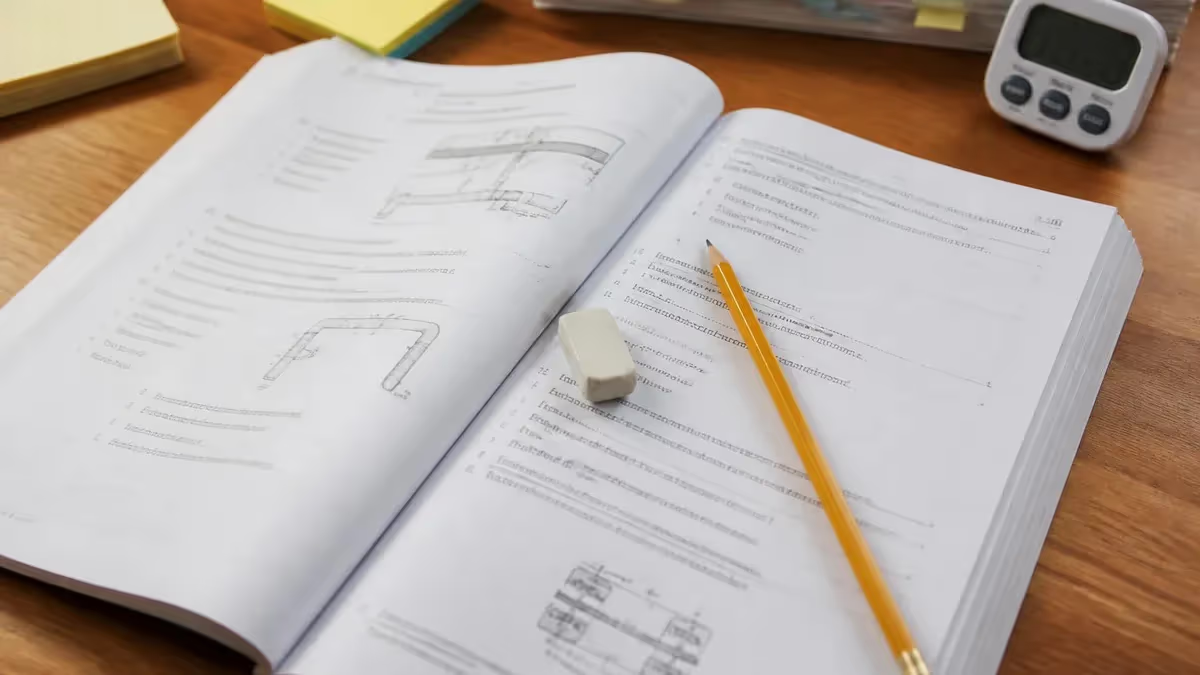
The 2009 IPC — or 2009 International Plumbing Code — is one of the most widely referenced editions of the model plumbing code published by the International Code Council (ICC). If you are a plumbing contractor, journeyman plumber, inspector, or apprentice studying for a licensing exam, understanding what is the international plumbing code and how the 2009 edition shaped modern plumbing standards is essential to your professional success. This guide walks you through every major area of the 2009 IPC so you can approach your exam — and your job — with full confidence.
The 2009 IPC was adopted by dozens of states, counties, and municipalities across the United States as their governing plumbing standard. Even today, many jurisdictions still enforce requirements derived directly from the 2009 edition, making it a highly relevant body of knowledge for anyone working or testing in those areas. Understanding which edition your local jurisdiction has adopted is always your first step before studying for any plumbing code exam, and the 2009 IPC remains a dominant choice in a large number of regions nationwide.
The International Code Council publishes the IPC on a three-year cycle, and the 2009 edition represented a significant update over the 2006 IPC. It introduced clarifications to fixture count requirements, updated provisions for water supply and distribution, refined drainage and vent system design rules, and tightened requirements for trap design and installation. These updates were driven by industry feedback, emerging materials technology, and the ICC's ongoing commitment to improving public health and safety through better plumbing standards.
For exam candidates, the 2009 IPC covers ten major subject areas that appear consistently on plumbing contractor and journeyman licensing exams across the country. These areas include administration and general regulations, definitions, general regulations, fixtures, water heaters, water supply and distribution, sanitary drainage, indirect and special waste, vents, and traps. Each chapter builds on the previous one, and a thorough understanding of the code's structure will dramatically improve both your exam performance and your day-to-day work in the field.
One of the most important things to understand about any IPC edition — including the 2009 version — is that it is a model code. This means the ICC develops it as a template for local governments to adopt, amend, and enforce. A jurisdiction may adopt the 2009 IPC verbatim, or it may adopt it with local amendments that change specific requirements. Always verify what local amendments apply in your jurisdiction before applying code requirements on the job or in a testing scenario that uses a jurisdiction-specific code book.
This training guide is designed to help you navigate the 2009 IPC efficiently. We cover the key chapter-by-chapter requirements, highlight the provisions most commonly tested on licensing exams, and provide practical context so that code language becomes intuitive rather than confusing. Whether you are brand new to the IPC or refreshing your knowledge before a recertification exam, the structured information in this article will accelerate your preparation and deepen your mastery of the 2009 IPC plumbing code.
Throughout this guide you will find study tips, memory aids, and clear explanations of complex provisions. We also provide links to free practice quizzes so you can test your knowledge as you go. The combination of reading, understanding, and active practice testing is the most effective approach to mastering the 2009 IPC — and this guide gives you all three in one place.
2009 IPC Plumbing Code by the Numbers

Key Chapters and Structure of the 2009 IPC
Establishes the scope, intent, and enforcement framework of the IPC. Covers permit requirements, inspections, and the authority of the code official. Understanding this chapter is critical for exam questions about compliance and legal authority.
Chapter 3 covers protection of structure, materials, and workmanship standards. Chapter 4 details fixture requirements including minimum counts per occupancy type, installation clearances, and accessibility provisions under applicable standards.
Governs potable water supply systems including pipe sizing, pressure requirements, backflow prevention, and cross-connection control. This chapter is heavily tested and forms the backbone of safe water delivery in any structure.
Defines how wastewater must be collected and conveyed to the public sewer or private disposal system. Includes pipe sizing tables, slope requirements, cleanout spacing, and building drain connection rules that appear frequently on licensing exams.
Chapter 9 covers the complete venting system including vent pipe sizing, distances from traps, and special venting methods. Chapter 10 addresses trap requirements, prohibited trap types, and trap seal protection — all high-frequency exam topics.
The water supply and distribution provisions of the 2009 ipc plumbing code are among the most detailed and most heavily tested areas on any plumbing licensing exam. Chapter 6 requires that potable water be protected from contamination at all times through the use of approved backflow prevention devices, air gaps, and cross-connection control programs. The chapter specifies that every water service pipe must be sized to deliver adequate pressure and flow at the most remote fixture under peak demand conditions, using the fixture unit method or pressure loss calculations defined in the code's appendices.
Fixture unit values are the foundation of both water supply sizing and drainage system design in the 2009 IPC. The code assigns a fixture unit value to each type of plumbing fixture based on its demand or discharge rate.
For example, a private lavatory carries a water supply fixture unit (WSFU) value of 1, while a bathtub carries a WSFU of 2. On the drainage side, a floor drain has a drainage fixture unit (DFU) value of 2, while a water closet connected to a 3-inch drain carries a DFU of 4. These values are used to enter the pipe sizing tables in Chapter 6 and Chapter 7, and exam candidates who memorize the most common fixture unit values will save significant time during open-book exams.
Chapter 7 of the 2009 IPC governs the sanitary drainage system, which must carry all liquid and waterborne wastes from the plumbing fixtures to the point of disposal. The chapter requires that building drains, branch drains, and stack drains be sized using the DFU method. Horizontal drainage piping must maintain a minimum slope of 1/4 inch per foot for pipes 3 inches in diameter and smaller, and 1/8 inch per foot for pipes 4 inches and larger, unless specific conditions allow for exceptions. These slope requirements are tested very frequently and should be committed to memory.
The 2009 IPC's Chapter 9 on venting is frequently cited as one of the most complex chapters for exam candidates to master. The venting system serves two critical purposes: it allows sewer gases to escape safely to the atmosphere, and it protects trap seals from being destroyed by pressure fluctuations in the drainage system.
The code defines several types of venting arrangements including individual vents, common vents, wet vents, circuit vents, and combination drain and vent systems. Each vent type has specific installation requirements including maximum distance from the trap weir to the vent connection, minimum pipe diameters, and connection height rules.
Wet venting is one of the most useful and frequently tested provisions in Chapter 9. A wet vent serves as both a drain and a vent simultaneously for a limited number of fixtures on the same horizontal branch. The 2009 IPC allows wet venting for bathroom groups — typically a water closet, lavatory, and bathtub or shower — under specific conditions.
The wet vent pipe must be sized to handle the drainage load while still providing adequate air circulation to protect trap seals. Understanding the specific fixture combinations and pipe size requirements for wet venting is a key competency for both the exam and real-world installations.
Traps are covered in Chapter 10 of the 2009 IPC, and the code is very specific about both required and prohibited trap types. Every plumbing fixture connected to the drainage system must be equipped with a water seal trap that maintains a seal of between 2 and 4 inches.
The code prohibits several trap types that were once common but are now known to be unreliable, including the running trap, the bell trap, the crown-vented trap, and the full S-trap. Drum traps are also prohibited except in specific applications such as connections to bathtubs in historic buildings where space constraints prevent the use of a standard P-trap.
The intercept and separation provisions in Chapter 10 address interceptors for grease, oil, sand, and other materials that could damage the drainage system or public sewer. Grease interceptors are required for commercial cooking facilities above specific grease-loading thresholds, and the code specifies minimum interceptor sizing based on drainage flow rate and retention time. Sand interceptors are required for car washes, service stations, and other facilities where sand or grit could accumulate in the drain lines. Understanding when interceptors are required and how they are sized is a consistently tested topic on commercial plumbing exams.
What Changed in the 2009 IPC Edition
The 2009 IPC introduced notable changes to fixture requirements in Chapter 4. Minimum fixture count tables were revised to reflect updated occupancy load calculations, ensuring that high-traffic buildings like sports arenas and transit terminals had adequate facilities for their peak populations. The code also clarified accessibility requirements for fixtures in publicly accessible areas, aligning IPC language more closely with the Americans with Disabilities Act Accessibility Guidelines and ensuring plumbers and designers had unambiguous direction for compliant installations.
Water conservation provisions were also strengthened in the 2009 edition. Maximum flow rates for showerheads, lavatory faucets, and water closets were updated to reflect advancing fixture technology. The 2009 IPC set the maximum flush volume for water closets at 1.6 gallons per flush for gravity-flush models, with provisions for dual-flush and pressure-assist alternatives. These conservation standards directly influenced exam question design, and candidates regularly encounter questions requiring them to identify compliant versus non-compliant fixture specifications based on the 2009 code tables.

2009 IPC vs. Older Editions: Pros and Cons for Exam Candidates
- +Clearer venting provisions make complex vent design calculations more straightforward to apply on exams
- +Updated fixture unit tables reflect modern fixtures and are more accurate for sizing calculations
- +Expanded backflow prevention guidance eliminates ambiguity in cross-connection control questions
- +Stronger water conservation provisions align with modern licensing exam emphasis on sustainability
- +Improved cleanout location requirements are easier to memorize with reorganized table format
- +Tankless water heater provisions address modern equipment that inspectors encounter regularly in the field
- −Some local jurisdictions have adopted later editions, making the 2009 IPC obsolete in those areas
- −Candidates must verify which edition their jurisdiction uses before purchasing study materials
- −AAV provisions are more restrictive than some candidates expect, leading to common exam mistakes
- −Wet vent rules are nuanced and require careful study of fixture combinations and pipe sizing limits
- −Island vent requirements are complex and often misapplied by candidates unfamiliar with the geometry
- −Grease interceptor sizing requires understanding of flow rate calculations that intimidate many candidates
2009 IPC Exam Prep Checklist
- ✓Confirm which IPC edition your jurisdiction has adopted before purchasing study materials
- ✓Obtain an official 2009 IPC code book — do not rely on summaries alone for open-book exams
- ✓Memorize minimum fixture count requirements for the five most common occupancy types
- ✓Know the water supply fixture unit values for the ten most common residential fixtures
- ✓Know the drainage fixture unit values and minimum pipe sizes for common fixtures
- ✓Master the horizontal drain slope requirements: 1/4 inch/foot for pipes ≤3 inches, 1/8 inch/foot for ≥4 inches
- ✓Understand wet venting rules including maximum DFU loads and permitted fixture combinations
- ✓Memorize prohibited trap types: running trap, bell trap, crown-vented trap, full S-trap
- ✓Know the trap seal depth requirement: minimum 2 inches, maximum 4 inches of water seal
- ✓Review backflow prevention device types and the hazard levels that require each device type
- ✓Practice using the pipe sizing tables in Chapters 6 and 7 with timed exercises
- ✓Complete at least three full-length practice exams using a real 2009 IPC code book
Tab the Critical Tables Before Your Exam
Most plumbing licensing exams are open-book with strict time limits — typically 3 to 4 hours for 100 to 200 questions. Candidates who pre-tab the fixture unit tables, pipe sizing tables, and minimum fixture count tables in their 2009 IPC book consistently outperform those who search for tables during the exam. Use color-coded adhesive tabs on Tables 604.3, 709.1, and 403.1 to cut your lookup time in half and dramatically improve your exam score.
Studying the 2009 IPC effectively requires a structured approach that balances code reading, active recall, and timed practice. The single biggest mistake exam candidates make is reading the code passively — skimming chapters without pausing to process and internalize the specific numbers, distances, and conditions the code requires. Effective study means reading a section, closing the book, and asking yourself what you just learned. If you cannot articulate the key requirements from memory, re-read the section and try again before moving on.
Start your study plan by mapping the exam content outline published by your licensing authority to the chapters of the 2009 IPC. Most plumbing licensing bodies publish a candidate bulletin or content outline that tells you exactly how many questions come from each topic area. For example, if the exam allocates 20 percent of questions to water supply, you should spend approximately 20 percent of your study time on Chapter 6 and related appendices. This proportional approach ensures you invest the most time in the areas with the greatest exam impact.
The 2009 IPC contains several appendices that are sometimes adopted alongside the main code body. Appendix E, for example, provides a combination waste and vent system that is commonly adopted in commercial applications. Appendix B provides guidance on rates of rainfall used for storm drainage sizing. Verify which appendices have been adopted by your jurisdiction, because adopted appendix provisions can and do appear on licensing exams. Candidates who ignore the appendices are routinely surprised by questions covering adopted appendix content.
Pipe sizing is the skill that separates high-scoring exam candidates from those who struggle. The 2009 IPC uses a fixture unit method for sizing both supply and drain pipes, and the tables that implement this method — primarily Tables 604.3, 604.4, 709.1, and 710.1 — are the most referenced tables in any plumbing licensing exam. Practice navigating these tables under time pressure by working through at least 20 to 30 sizing problems before your exam. Start with simple single-fixture scenarios, then progress to multi-story buildings with complex fixture schedules.
Code section cross-referencing is another critical skill for the 2009 IPC. The code regularly directs readers from one chapter to another for complete requirements. For example, Section 712 on sumps and ejectors references Chapter 8 for indirect waste connections, and Chapter 8 references Chapter 9 for venting of indirect waste receptors. Understanding how these cross-references connect will help you locate complete requirements quickly during an open-book exam and will also build your overall conceptual understanding of how plumbing systems work as integrated units.
Group study can be highly effective for the 2009 IPC because complex provisions like wet venting, island venting, and interceptor sizing become clearer when discussed with others. Study groups allow candidates to quiz each other, share memory techniques, and debate ambiguous code interpretations. If you do not have access to a formal study group, online forums and trade association study sessions can serve the same purpose. The IPC community is generally generous with study resources and candidates who engage with that community consistently report better exam outcomes.
Finally, understand that the 2009 IPC exam is testing your ability to apply the code, not just recall it. Many exam questions present a scenario — a specific building type, a described installation, a proposed pipe size — and ask whether it complies with the code or what change is needed to bring it into compliance.
Practicing with scenario-based questions, like those available in our free IPC practice quizzes, trains your brain to think like a code official and dramatically improves your performance on this type of question, which typically makes up 40 to 60 percent of most plumbing licensing exams.

Not every jurisdiction uses the 2009 IPC. Some states have adopted the 2012, 2015, 2018, or 2021 edition — and a few have their own state-specific plumbing codes that differ significantly from any ICC edition. Studying the wrong edition can cause you to memorize incorrect requirements and fail your exam. Always confirm your jurisdiction's adopted code edition by contacting your state licensing board or checking your candidate handbook before purchasing study materials.
Applying the 2009 IPC in real-world field conditions requires translating code language — which is often written in precise but dense regulatory prose — into practical installation decisions. The most effective plumbers and inspectors develop a mental model of how each chapter's requirements connect to real plumbing systems. For example, when roughing in a bathroom, you should automatically be thinking through Chapter 4 fixture clearances, Chapter 7 drain sizing and slope, Chapter 9 vent type and distance, and Chapter 10 trap requirements simultaneously, rather than consulting each chapter in isolation.
One of the most practical skills for applying the 2009 IPC is learning to read and use the code's definitions section in Chapter 2. Many enforcement disputes and exam questions hinge on the precise definition of a term. For example, the 2009 IPC defines a "fixture branch" specifically as the drain piping connecting a plumbing fixture to a fixture drain or other drain pipe. Understanding this distinction matters when interpreting sizing requirements in Chapter 7, because different sizing rules apply to fixture branches versus fixture drains versus building drains. When a code section is unclear, always check Chapter 2 first.
Backflow prevention is an area where field application of the 2009 IPC is particularly critical because the consequences of non-compliance are serious public health risks. The code requires backflow preventers at any point where there is a potential for contamination to enter the potable water supply. The type of device required depends on the degree of hazard: high-hazard connections — such as connections to chemical injection systems or irrigation systems using reclaimed water — require a reduced pressure principle (RP) backflow preventer, while low-hazard connections may be protected with a double check valve assembly or a simple atmospheric vacuum breaker.
Water heater installation under the 2009 IPC involves requirements that span multiple chapters. The water heater itself is addressed in Chapter 5, but its supply piping is governed by Chapter 6, its drainage connections fall under Chapter 7, and its venting (for gas-fired units) is addressed by reference to the International Fuel Gas Code. This cross-code coordination is a real-world challenge that experienced plumbers navigate routinely, and exam candidates who understand how the IPC references other ICC codes will be better prepared for exam questions that probe this knowledge.
Grease interceptor installation is another field application area where the 2009 IPC provides detailed requirements that must be correctly followed to pass inspection. Section 1003 requires that grease interceptors be installed in the drainage from fixtures in commercial kitchens, cafeterias, restaurants, and similar food service operations.
The interceptor must be sized based on the total flow rate from all connected fixtures, using a formula that accounts for flow rate in gallons per minute and the required grease retention time. Inspectors regularly find interceptors that are undersized or improperly connected, making this a common source of code violations and — not coincidentally — a common source of exam questions.
Storm drainage, covered in Chapter 11 of the 2009 IPC, is sometimes overlooked by exam candidates who focus primarily on sanitary systems. However, roof drain sizing, secondary drain requirements for flat roofs, and the prohibition on connecting storm drainage to the sanitary system are all tested topics.
The 2009 IPC requires that every roof have a primary drainage system sized to handle the design storm event for the location, and a secondary overflow system capable of handling the same storm event independently. Candidates should know the basic rainfall rate tables and how they are applied to roof area calculations using the sizing table in Chapter 11.
Material standards are woven throughout the 2009 IPC, with each chapter specifying approved materials for different applications. Chapter 6 permits copper, CPVC, PEX, galvanized steel, and other approved materials for water supply piping, subject to specific limitations for each material type.
Chapter 7 permits cast iron, ABS, PVC, copper, and other approved materials for drainage piping, again with specific application limitations. The code references dozens of ASTM, ANSI, and NSF standards by number, and exam candidates who know the most commonly referenced standards — such as ASTM D2665 for PVC drain pipe and ASTM B88 for copper water tube — will navigate materials questions with confidence.
Building a comprehensive study plan for the 2009 IPC means giving yourself enough time to cover all eleven chapters thoroughly, practice with realistic exam questions, and review your weak areas before exam day. Most experienced plumbing educators recommend a minimum of eight to twelve weeks of dedicated study for candidates taking a journeyman or contractor licensing exam based on the 2009 IPC. This timeline allows for one to two weeks per major chapter group, plus additional time for full-length practice exams and targeted review of flagged topics.
During the first two weeks of your study plan, focus on Chapters 1 through 3 — administration, definitions, and general regulations. These chapters establish the foundational framework for everything else in the code and are often underestimated by candidates who want to jump straight to the more technical chapters. Understanding the scope of the code, the authority of the code official, and the general installation requirements in Chapter 3 will give you a strong conceptual foundation that makes the technical chapters much easier to absorb.
Weeks three and four should focus on Chapter 4 (fixtures) and Chapter 5 (water heaters). Fixture requirements are heavily tested because they apply to virtually every plumbing installation, and the minimum fixture count tables in Table 403.1 are used for a large proportion of occupancy-specific exam questions. Water heater requirements in Chapter 5 are also consistently tested, with particular emphasis on the temperature and pressure relief valve provisions, the required clearances around water heater installations, and the rules for seismic strapping in applicable zones.
The fifth and sixth weeks of your study plan should be dedicated to Chapter 6 (water supply and distribution) — arguably the most technically dense chapter in the 2009 IPC. Work through the pipe sizing tables methodically, starting with simple fixture schedules and progressing to multi-story calculations. Pay particular attention to the minimum pressure requirements at fixtures, the pressure loss calculation methodology, and the backflow prevention requirements. These topics generate more exam questions than almost any other area of Chapter 6 and are worth investing extra time to master fully.
Weeks seven and eight are ideal for Chapters 7 and 8 — sanitary drainage and indirect waste. Chapter 7 requires mastery of the drainage fixture unit table, the minimum pipe size requirements, and the slope and cleanout provisions. Chapter 8 covers indirect waste connections, which are required for food preparation equipment, commercial dishwashers, ice machines, and other equipment whose direct connection to the drainage system would create a backflow or contamination risk. Understanding the air gap and air break requirements for indirect waste connections is an important exam competency that many candidates overlook.
Your final weeks before the exam should focus on Chapters 9 and 10 (vents and traps), a review of any adopted appendices, and full-length timed practice exams. Many candidates find that venting is the most challenging part of the 2009 IPC because it requires spatial reasoning about three-dimensional pipe configurations. Drawing out vent systems on paper — even rough sketches — can dramatically improve your understanding of how vent pipes connect to drainage stacks, how vent distances are measured, and how different venting methods interact with each other in complex plumbing layouts.
The most important final preparation step is taking at least two full-length timed practice exams using your actual 2009 IPC code book under realistic testing conditions. Sit at a desk with no distractions, set a timer for the full exam duration, and do not look up answers until you have completed the entire exam. This exercise reveals your true readiness level, identifies any remaining weak areas that need targeted review, and builds the time management skills and mental endurance that are essential for performing well on a long, technically demanding plumbing licensing exam.
IPC Questions and Answers

IPC Study Guide: What Is the International Plumbing Code and How to Pass

International Plumbing Code Online: What It Is and How to Use It

International Plumbing Code Editions: A Complete Guide to IPC Versions and Updates

International Plumbing Code Sections: A Complete Guide to IPC Structure and Key Provisions

International Plumbing Code Commentary: What It Is and How to Use It
About the Author

Educational Psychologist & Academic Test Preparation Expert
Columbia University Teachers CollegeDr. Lisa Patel holds a Doctorate in Education from Columbia University Teachers College and has spent 17 years researching standardized test design and academic assessment. She has developed preparation programs for SAT, ACT, GRE, LSAT, UCAT, and numerous professional licensing exams, helping students of all backgrounds achieve their target scores.
Join the Discussion
Connect with other students preparing for this exam. Share tips, ask questions, and get advice from people who have been there.
View discussion (7 replies)