
HSPT Test Meaning: Complete Guide to the High School Placement Test 2026 October
Learn the HSPT test meaning, exam format, and scoring. 🎓 Get free practice questions and expert prep tips for the High School Placement Test.
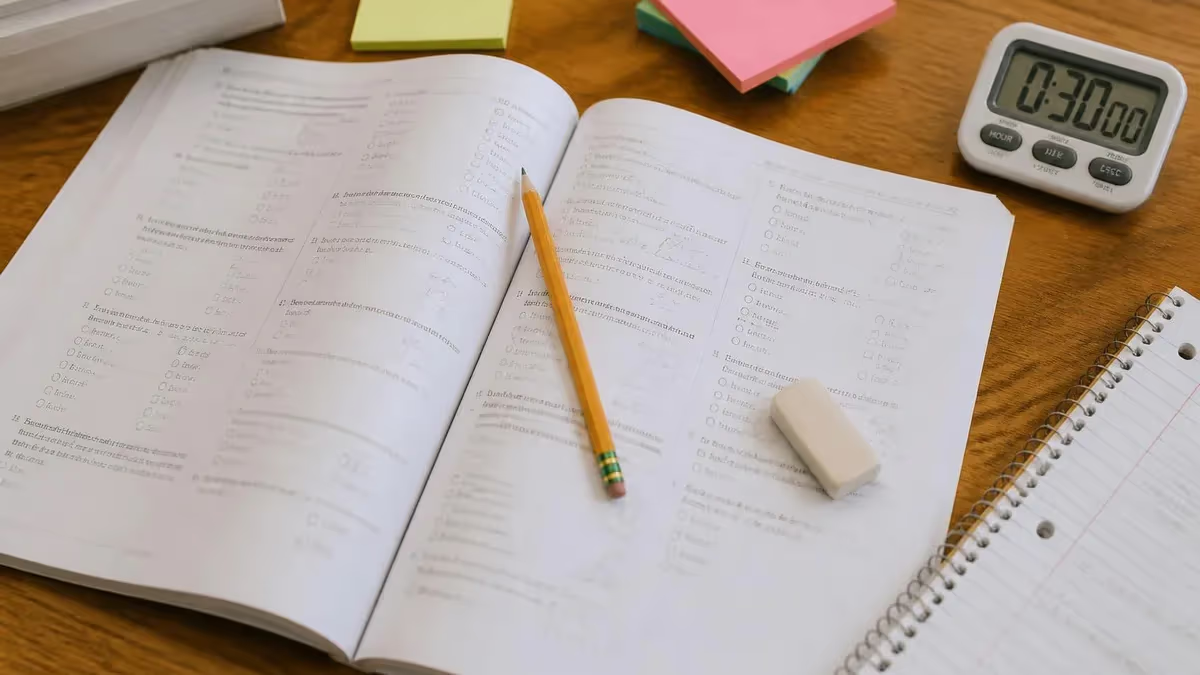
The HSPT test meaning is straightforward: the High School Placement Test is a standardized admissions exam used by Catholic and private high schools across the United States to evaluate incoming freshmen. Understanding what the HSPT is — and what it measures — is the first step toward a strong application season. The exam covers five core subject areas and produces both a scaled score and national percentile ranking that schools use to compare applicants on a level playing field, regardless of which middle school a student attended.
Every year, tens of thousands of eighth-graders sit for the hspt as part of their high school application process. Unlike standardized state tests that every public school student takes, the HSPT is specific to private and parochial high schools — primarily those in the Catholic school system. Scores carry significant weight: they influence admission decisions, scholarship awards, course placement, and honors program eligibility. A student who prepares thoroughly and earns a high percentile ranking stands out in a competitive applicant pool.
The HSPT was developed by Scholastic Testing Service (STS), an independent testing organization based in Bensenville, Illinois. STS has been administering the exam since the 1950s, making it one of the longest-running secondary school admissions tests in the country. The exam is administered directly by participating high schools, which means test dates, registration deadlines, and fee structures vary by institution. Students typically take the HSPT in late fall or early winter of their eighth-grade year, though some schools offer spring testing windows as well.
One of the most important things to understand about the HSPT is that it is a closed test — meaning the specific questions are not publicly released after each administration. This is different from the SAT or ACT, where previously released tests are widely available. Because official HSPT questions are proprietary, high-quality HSPT practice test materials become especially valuable for students who want to simulate real exam conditions and identify their weak areas before test day arrives.
The exam consists of 298 multiple-choice questions administered in timed sections over approximately two hours and thirty minutes of actual testing time. Five subtests measure Verbal Skills, Quantitative Skills, Reading, Mathematics, and Language. Each subtest is timed independently, so pacing and stamina matter as much as raw knowledge. Students who have never taken a timed standardized test before often find the experience more stressful than anticipated — another reason early and consistent practice is so important.
Scores on the HSPT are reported as scaled scores (ranging from 200 to 800 per subtest) and as national and local percentile ranks. A national percentile rank of 75, for example, means the student performed better than 75 percent of all students in the national norming sample. Schools use these percentile ranks to place students in the correct academic track and to award merit-based financial assistance. Some high schools publish minimum score thresholds for honors programs or scholarship eligibility, while others use holistic review with HSPT scores as one of several factors.
Preparing for the HSPT does not require expensive tutoring or complicated study materials — though both can help. Consistent daily practice using targeted review materials, timed mock exams, and careful analysis of wrong answers is the foundation of effective HSPT prep. This guide will walk you through everything you need to know: what the exam covers, how it is scored, how to build a study plan, and how to find the best free and paid practice resources available online today.
HSPT by the Numbers

HSPT Exam Format & Section Breakdown
| Section | Questions | Time | Weight | Notes |
|---|---|---|---|---|
| Verbal Skills | 60 | 16 min | 20% | Synonyms, antonyms, analogies, logic, verbal classification |
| Quantitative Skills | 52 | 30 min | 17% | Number series, geometric comparison, non-verbal reasoning |
| Reading | 62 | 25 min | 21% | Comprehension passages and vocabulary in context |
| Mathematics | 64 | 45 min | 21% | Concepts, problem solving, pre-algebra, geometry |
| Language | 60 | 25 min | 20% | Punctuation, capitalization, usage, spelling, composition |
| Total | 298 | 2 hours 30 minutes | 100% |
Understanding how the HSPT is scored helps students and parents set realistic goals and interpret results accurately. Each of the five subtests produces a raw score — simply the number of questions answered correctly — and there is no penalty for wrong answers, which means students should always attempt every question rather than leaving items blank. Raw scores are then converted to scaled scores using a statistical process called equating, which accounts for slight differences in difficulty between test forms administered at different schools or in different years.
Scaled scores for each subtest range from 200 to 800, with an average score typically falling around 500 to 550. The five subtest scaled scores are combined into a total battery score, also ranging from 200 to 800, which represents overall academic ability. In addition to scaled scores, STS reports national percentile ranks (NPR) and local percentile ranks (LPR). The national percentile rank compares a student to all test-takers in the STS national norming sample, while the local percentile rank compares performance to other students at the same school or diocese who took the same test form.
Many Catholic high schools use the national percentile rank as the primary benchmark for admissions and scholarship decisions. A student scoring at the 75th percentile or above is generally considered a strong applicant for selective schools. However, each institution sets its own benchmarks, and some schools in highly competitive markets may expect top applicants to score at the 85th or 90th percentile. Students aiming for honors-track placement or merit scholarships should research the specific thresholds at their target schools well before the test date.
The HSPT also produces optional supplemental scores in Science and Catholic Religion for schools that choose to administer those additional sections. These optional sections add 40 questions each and are not part of the standard five-subtest battery. Not all schools request the optional sections, so students should confirm with their target high school whether the Science or Religion sections will be administered on their test day. Preparation resources for these supplemental sections are more limited than those for the core battery.
One frequently asked question is how the HSPT compares to the ISEE (Independent School Entrance Examination) and the SSAT (Secondary School Admission Test), which are the other major private school admissions exams used in the United States. The HSPT is almost exclusively used by Catholic high schools, while the ISEE and SSAT are used by a broader range of independent and private schools. The HSPT does not have a wrong-answer penalty, making guessing more strategically sound than on the SSAT, which deducts one-quarter point for incorrect responses.
Students who want to understand their score trajectory should start with a hspt practice test taken under realistic timed conditions before beginning any structured prep. This diagnostic baseline reveals which subtests need the most work and helps students allocate their study time efficiently. A student who scores at the 60th percentile nationally on a diagnostic test has a realistic path to the 75th or 80th percentile with six to ten weeks of focused preparation — but only if that preparation targets the specific skills and question types where improvement is possible.
Score reports are typically sent to the student's designated high school or schools within a few weeks of the test date. Students do not always receive their scores directly — some schools share results with families while others use them only for internal admissions decisions. Families should ask the testing high school's admissions office about its score-reporting policy. If a student takes the HSPT at one school and wants the scores sent to additional institutions, they may need to contact STS or the administering school to arrange score transfers, which may involve an additional fee.
HSPT Test Prep: Strategies by Subtest
The Verbal Skills subtest tests synonyms, antonyms, analogies, logical reasoning, and verbal classification — all in just 16 minutes for 60 questions, leaving under 17 seconds per item. The fastest way to improve here is daily vocabulary work: learning Greek and Latin roots (like bene-, mal-, trans-, and -ology) lets students decode unfamiliar words on the fly. Analogy questions follow predictable relationship types — part to whole, cause to effect, synonym, antonym — so drilling these patterns with flashcards pays off quickly.
The Reading subtest gives students 25 minutes for 62 questions organized around reading passages and vocabulary-in-context items. Strong readers should answer passage questions first and use process of elimination aggressively. Weaker readers benefit most from practicing active reading habits: underlining the main idea of each paragraph and marking key details before answering questions. Aim to finish each passage set in about 5 minutes. Students who run short on time should prioritize vocabulary-in-context items, which require less reading than full comprehension questions.

Is the HSPT the Right Admissions Exam for Your Student?
- +No wrong-answer penalty — guessing is always worth attempting on every question
- +Well-established, consistent format with decades of research behind its scoring model
- +Scaled scores and national percentile ranks enable fair cross-school comparison
- +Optional Science and Religion sections let schools customize the exam to their curriculum
- +Strong predictor of high school academic performance according to STS validity studies
- +Shorter testing window than SAT/ACT — typically under three hours including breaks
- −Proprietary closed test — official past questions are not publicly released for practice
- −Administered only at specific Catholic/private high schools, limiting accessibility
- −Test dates and registration are controlled by individual schools with no central system
- −Quantitative Skills section tests content not covered in most middle school curricula
- −Score reports may not be shared directly with students at all administering schools
- −Limited free official practice materials compared to SAT, ACT, or state standardized tests
Pros and Cons at a Glance
| Pros | Cons |
|---|---|
| No wrong-answer penalty — guessing is always worth attempting on every question | Proprietary closed test — official past questions are not publicly released for practice |
| Well-established, consistent format with decades of research behind its scoring model | Administered only at specific Catholic/private high schools, limiting accessibility |
| Scaled scores and national percentile ranks enable fair cross-school comparison | Test dates and registration are controlled by individual schools with no central system |
| Optional Science and Religion sections let schools customize the exam to their curriculum | Quantitative Skills section tests content not covered in most middle school curricula |
| Strong predictor of high school academic performance according to STS validity studies | Score reports may not be shared directly with students at all administering schools |
| Shorter testing window than SAT/ACT — typically under three hours including breaks | Limited free official practice materials compared to SAT, ACT, or state standardized tests |
HSPT Test Prep Checklist: 10 Steps to a Higher Score
- ✓Take a full-length timed diagnostic HSPT practice test before beginning any structured study.
- ✓Analyze your diagnostic results to identify the two or three subtests with the most improvement potential.
- ✓Build a six-to-ten-week study schedule that allocates more time to your weakest subtests.
- ✓Complete at least one timed subtest practice session every day, rotating through all five sections.
- ✓Keep an error log after every practice session noting question type, mistake made, and the correct rule or concept.
- ✓Study vocabulary using Greek and Latin root words to handle unfamiliar terms on the Verbal Skills subtest.
- ✓Master the Quantitative Skills number series and geometric comparison question types through pattern drilling.
- ✓Review all standard capitalization, punctuation, and word-usage rules for the Language subtest.
- ✓Take at least two complete full-length timed HSPT mock exams in the final two weeks before test day.
- ✓Confirm your test date, registration deadline, and testing location with your target high school at least 30 days in advance.

Guessing Is Always Worth It on the HSPT
Unlike the SSAT, which deducts points for wrong answers, the HSPT has no guessing penalty. Every unanswered question is a guaranteed zero, while a guess gives you a one-in-four chance of a correct answer. Students who learn to use process of elimination to narrow choices to two options and then commit to a guess will always outperform students who leave items blank. Never skip a question — always mark your best answer and move on.
Once a student receives their HSPT score report, the next challenge is interpreting the results in the context of their specific college-preparatory goals. A score that looks average in isolation may be excellent for one school's applicant pool and below the threshold for another's. The single most important step after receiving scores is researching the target high school's published or publicly known admissions benchmarks. Many Catholic high schools post score ranges or average scores for admitted students on their websites or in their admissions guides.
National percentile ranks are the most meaningful comparison point for most families because they remove the variability of local applicant pools. A student scoring at the 80th national percentile has outperformed four out of five HSPT test-takers nationally, regardless of how competitive the local market is. Students targeting selective diocesan high schools in major metropolitan areas — Chicago, New York, Los Angeles, Philadelphia, and Boston have highly competitive Catholic high school markets — generally need national percentile ranks in the 75th to 90th range to be considered for competitive programs.
Scholarship eligibility is another critical reason to understand HSPT score benchmarks in detail. Many Catholic high schools award merit-based tuition assistance directly tied to HSPT performance. Full scholarships and partial grants may be available for students scoring at or above specific percentile thresholds, which vary by school. Some institutions publish these thresholds explicitly; others make awards at the discretion of the admissions committee using a holistic review that considers scores alongside grades, teacher recommendations, interviews, and extracurricular involvement.
Students who are disappointed with their initial HSPT results face a practical question: is retesting an option? The HSPT can only be taken once per academic year at most administering schools, because STS does not release test forms. Some schools allow a student to test at a different school with a different form, but policies vary widely. Families considering this route should contact both the original administering school and the second school to confirm their policies before making any arrangements. In many cases, strong grades, a compelling personal statement, and positive teacher recommendations can offset a below-target HSPT score.
The HSPT score is also used for course placement after a student is admitted. Most Catholic high schools sort incoming freshmen into academic tracks — standard, honors, and sometimes advanced honors or AP-track — based partly on HSPT subtest performance. A student who scores strongly in Mathematics but only averagely in Verbal Skills may be placed in Honors Algebra but standard English, for example. Understanding this placement function helps families see that HSPT preparation is not only about gaining admission but about setting the student up for an appropriately challenging academic program from day one of high school.
Long-term, the skills measured by the HSPT — verbal reasoning, quantitative reasoning, reading comprehension, mathematical problem solving, and command of standard written English — are the exact same skills measured by the SAT and ACT four years later. Students who build strong fundamentals during HSPT preparation are investing in performance that pays dividends throughout high school and into the college admissions process. Many parents and students report that the habits formed during HSPT prep — consistent timed practice, careful error analysis, and systematic vocabulary study — directly improved their standardized test performance in subsequent years.
Looking at the HSPT through a broader lens, it serves as a student's first serious introduction to standardized testing at a competitive level. The experience of registering for a high-stakes exam, preparing systematically over several weeks, sitting in a quiet testing room under timed conditions, and waiting for a score report is genuinely useful preparation for the college admissions process. Students who approach the HSPT with seriousness and preparation — rather than treating it as just another school test — tend to develop the test-taking confidence and strategic thinking that continue to serve them well for years to come.
The HSPT is administered by individual high schools, not a central testing organization, which means registration deadlines, test dates, and fee requirements differ from school to school. Most schools test in October, November, or December of eighth grade, with registration closing four to six weeks before the test date. Contact each high school on your target list directly and confirm its specific HSPT deadline as early as September — late registration is rarely accepted.
Building an effective HSPT prep plan requires more than simply purchasing a study book and working through it cover to cover. The most successful students combine structured content review with aggressive timed practice, targeted error analysis, and periodic full-length mock exams. A realistic timeline for serious HSPT preparation is six to ten weeks of daily work — with longer timelines benefiting students who are further from their target score or who have had less exposure to the tested content in middle school.
The foundation of any strong prep plan is a diagnostic test. Before studying any specific content, students should simulate real exam conditions as closely as possible — finding a quiet space, using a timer for each section, and working through all 298 questions without breaks beyond what is allowed in the actual exam. Scoring the diagnostic and analyzing results by question type, not just by subtest, reveals specific weaknesses that general review materials often miss. A student who misses eight out of ten number series questions needs to prioritize that skill, regardless of their overall Quantitative Skills subtest score.
Content review should follow the diagnostic and focus on skill areas in order of improvement potential. Students who are already strong in Language should spend less time reviewing punctuation rules and more time on Quantitative Skills number series patterns or Mathematics geometry formulas. Many students find it helpful to create a structured weekly schedule: for example, Monday and Tuesday focus on Mathematics, Wednesday and Thursday on Verbal and Language, Friday on Quantitative Skills, and weekends on Reading comprehension passages. Varying the content daily prevents mental fatigue and keeps preparation engaging.
Students searching for an hspt test prep course will find a range of options at various price points. Tutoring through local learning centers or private tutors typically costs between $60 and $150 per hour and provides personalized attention that self-study materials cannot replicate. Online self-paced courses from test prep companies range from $50 to $300 and offer video instruction, practice questions, and progress tracking. Free resources — including practice questions, downloadable worksheets, and video explanations — are available from multiple education websites and should be used alongside any paid materials to maximize practice volume.
One of the most underutilized but effective HSPT prep strategies is timed section practice rather than question-by-question review. Instead of working through a Math chapter and pausing to check answers after every item, students should complete a full timed Mathematics section, then review all errors at once. This builds the time pressure tolerance and pacing judgment that are essential for performing well on test day. Pacing mistakes — rushing through easy questions and running out of time on later items, or spending too long on hard questions — are responsible for more preventable score losses than content gaps.
For students who want downloadable practice materials, the hspt practice test pdf resources available through educational publishers and test prep websites offer printable full-length practice exams that can be completed offline. These are particularly useful for students who find it easier to focus without a computer screen, or for families who want to replicate the paper-and-pencil format of the actual exam. Always verify that any PDF practice test resource reflects the current HSPT format — 298 questions across the five standard subtests — as some older materials may reflect outdated test specifications.
In the final week before the HSPT, students should shift focus from learning new content to confidence-building review. This means taking one final complete mock exam under real conditions early in the week, then spending the remaining days lightly reviewing error patterns without attempting to learn any new material. Sleep, nutrition, and physical activity in the days before the exam have measurable effects on cognitive performance. Students who arrive on test day well-rested, having eaten a solid breakfast, and carrying all required materials — pencils, photo ID, admission ticket — are positioned to perform at or above their practiced level.
Practical preparation tips can make the difference between a good HSPT score and a great one, especially for students who have limited time before their test date. One of the highest-use habits is daily vocabulary study using a spaced repetition system.
Apps like Anki or physical flashcard sets allow students to review vocabulary in short five-to-ten-minute daily sessions that are far more effective than hour-long cramming sessions once or twice a week. The goal is not to memorize thousands of words but to learn the 200 to 300 high-frequency words that appear most commonly on HSPT verbal questions, along with the most productive Greek and Latin root words.
For the Quantitative Skills subtest — often the section that surprises unprepared students most — the key is to study the question types systematically before practicing at speed. Number series questions follow a relatively small number of underlying patterns: arithmetic sequences with constant differences, geometric sequences with constant ratios, alternating sequences, and combination rules. Students who catalogue each pattern they encounter during practice and review their catalogue regularly before test day are rarely caught off guard by unusual sequences on the actual exam.
Reading comprehension performance on the HSPT improves most when students practice reading a diverse range of texts at a slightly higher level than their comfort zone. Science articles, historical essays, and literary criticism passages are the types of texts that typically appear in HSPT Reading sections.
Reading one or two such articles per day — actively identifying main ideas, supporting evidence, and author purpose — builds both reading speed and analytical comprehension. Students who only read casual or recreational texts often find HSPT passages harder than expected, not because the vocabulary is difficult, but because the sentence structures and argument patterns are unfamiliar.
Time management on test day deserves specific preparation, not just generic advice to work quickly. For each subtest, students should calculate a per-question time budget before the exam: the Language subtest, for instance, allows about 25 seconds per question. During practice, students should train themselves to make a decision on every question within the allotted time — marking questions they are uncertain about and returning to them only if time permits. Spending 90 seconds on a single hard question while three easier questions go unanswered is one of the most common and costly test-taking errors.
Eating well and sleeping consistently in the weeks before the HSPT — not just the night before — meaningfully affects cognitive performance. Adolescent brains consolidate learning during sleep, which means a student who practices for two hours and then sleeps eight hours learns more than a student who practices for four hours and sleeps five.
Parents can support preparation by ensuring consistent bedtimes, limiting late-night screen time, and providing protein-rich breakfasts on practice days and on test day itself. These behavioral factors are not peripheral to HSPT success — research consistently shows they are as important as content review for peak exam performance.
Students who take the HSPT multiple times — at one school in the fall and at a second school with a different test form in January, for example — should treat each attempt as fully independent preparation. Do not assume that familiarity with the HSPT format from a first attempt will automatically produce a higher score on the second.
Instead, complete a fresh diagnostic after the first attempt, identify any score gaps that remain, and prepare specifically for those areas over the weeks between administrations. Students who approach a second attempt with systematic preparation rather than relaxed familiarity consistently outperform those who simply repeat the exam without additional work.
Finally, perspective matters for students who feel anxious about the HSPT. The exam is a meaningful milestone, but it is one data point among several in a holistic admissions process. Strong grades in rigorous middle school coursework, positive teacher recommendations, a thoughtful student essay, and a demonstrated commitment to extracurricular activities all contribute to a competitive application.
The HSPT measures specific academic skills at a specific moment in time — and students who prepare thoroughly give themselves every opportunity to show those skills at their best. Approach test day with confidence, a solid strategy, and the knowledge that consistent, focused preparation is the most reliable path to the score you are aiming for.
Sample HSPT Practice Questions
Try these questions from our free HSPT practice tests. The correct answer and an explanation follow each question.
What is the meaning of the word 'ephemeral'?
- A. Lasting forever
- B. Lasting for a very short time
- C. Extremely large
- D. Very expensive
Answer: B. Lasting for a very short time
Ephemeral means lasting for a very short time, fleeting or transitory. Cherry blossoms are often described as ephemeral because they bloom briefly.
Which HSPT section has the most questions?
- A. Verbal Skills (60)
- B. Quantitative Skills (52)
- C. Mathematics (64)
- D. Language (60)
Answer: C. Mathematics (64)
The Mathematics section has 64 questions, making it the largest section of the HSPT.
On the HSPT, how many total questions are there across all sections?
- A. 200
- B. 298
- C. 350
- D. 150
Answer: B. 298
The HSPT has 298 questions across five subtests: Verbal Skills (60), Quantitative Skills (52), Reading (62), Mathematics (64), and Language (60).
Complete the analogy: Pen is to Writer as Brush is to ___.
- A. Painting
- B. Artist
- C. Color
- D. Canvas
Answer: B. Artist
A pen is the tool used by a writer, just as a brush is the tool used by an artist. The analogy relates a tool to its user.
HSPT Questions and Answers




About the Author

Educational Psychologist & Academic Test Preparation Expert
Columbia University Teachers CollegeDr. Lisa Patel holds a Doctorate in Education from Columbia University Teachers College and has spent 17 years researching standardized test design and academic assessment. She has developed preparation programs for SAT, ACT, GRE, LSAT, UCAT, and numerous professional licensing exams, helping students of all backgrounds achieve their target scores.
Join the Discussion
Connect with other students preparing for this exam. Share tips, ask questions, and get advice from people who have been there.
View discussion (8 replies)