
Hazmat Placards: The 9 Hazard Classes and DOT Placarding Rules 2026 September
Hazmat placards explained — 9 DOT hazard classes, colors, when placarding is required, UN numbers, placement rules, and CDL hazmat endorsement context. 🎓
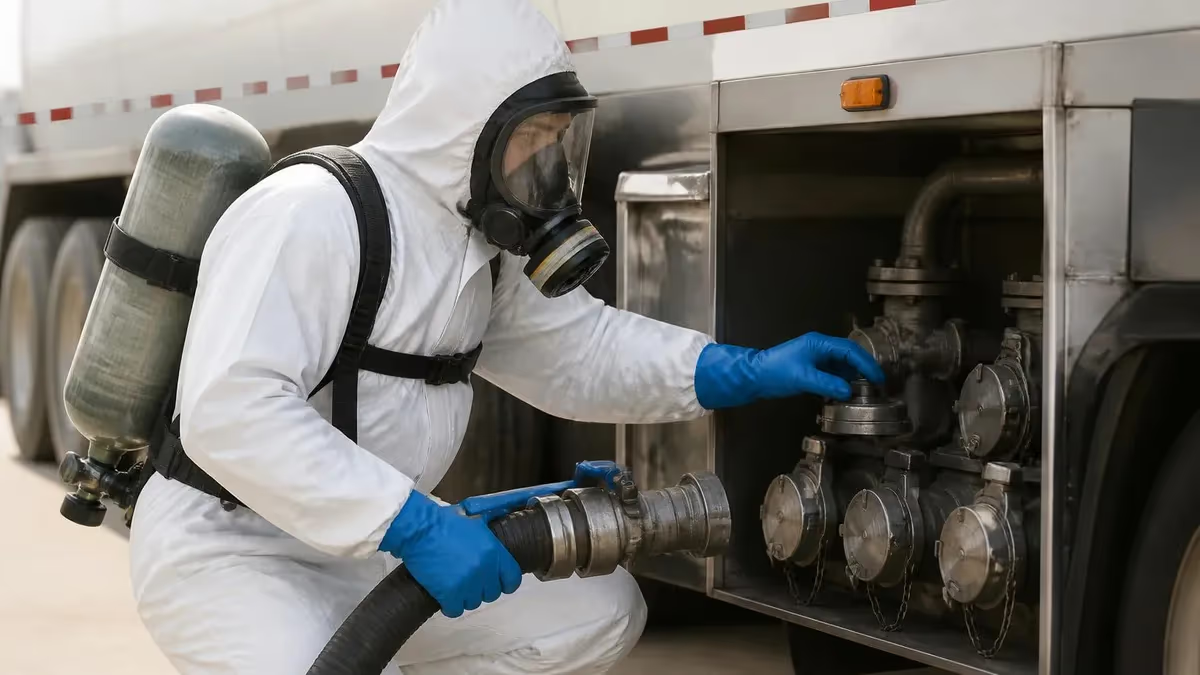
Hazmat placards are the diamond-shaped warning signs you see on the sides and rear of trucks and railcars carrying hazardous materials. They are not decoration — they are federally mandated identification under 49 CFR (the US Department of Transportation's Hazardous Materials Regulations) and they tell first responders, dock workers, and other drivers exactly what's inside if something goes wrong. A correctly placarded vehicle communicates the hazard class, sometimes the specific UN identification number, and the level of risk before anyone has to open the trailer.
This guide walks through the nine DOT hazard classes, the colors and symbols used on placards, when placarding is required (and when it isn't), the rules for placard placement on a vehicle or container, the role of UN/NA identification numbers, and how all of this ties into the Hazmat Endorsement on a commercial driver's license. We'll also cover the most common placarding mistakes that get drivers and carriers fined during roadside inspections, and the resources every hazmat driver should keep handy in the cab.
If you're studying for the CDL Hazmat Endorsement test, this guide covers the placarding material in plain language. If you're a freight dispatcher, shipper, or warehouse worker, it explains why your paperwork matters and how the placard rules connect to the bill of lading and shipping papers you handle every day. If you're a first responder or simply curious about the placards you see on the highway, it explains what each color and number actually means in practice.
Placarding is one of the cornerstones of the entire hazmat transportation system. Every other rule — emergency response, route planning, parking restrictions, tunnel and bridge limits — depends on the placards being correct. Get the placards right and the rest of the system works as intended. Get them wrong and you can face thousands of dollars in fines, vehicle out-of-service orders, and serious safety risks if an accident happens and responders can't tell what's burning. Treat placards as a hard rule, not a guideline.
The placarding system was harmonized across the United States, Canada, and Mexico under the United Nations Recommendations on the Transport of Dangerous Goods. That international alignment is why a placarded truck crossing the border into Canada or Mexico still communicates the same hazards to local responders without retraining or re-placarding. The visual language of color, number, and symbol is consistent worldwide, which is one of the program's quiet successes after several decades of cross-border trade growth across North America.
The placards you see today have been refined over many years of incident analysis. After major hazmat accidents, regulators have tightened the placarding rules to close gaps that contributed to the harm — clearer color contrast, larger UN numbers on bulk packages, mandatory four-sided placement, and stricter visibility standards. Each tightening came with industry pushback over implementation cost, but the safety record speaks for itself. Hazmat incidents have declined substantially even as freight volume has grown across most categories.
Hazmat placards at a glance
What they are: diamond-shaped warning signs (10.75 inches per side) attached to the sides and rear of vehicles carrying hazardous materials. What they show: hazard class number (1-9), color-coded background, hazard symbol, and sometimes a 4-digit UN identification number. Required when: any quantity of certain Table 1 materials, or 1,001 lbs aggregate gross weight of Table 2 materials. Authority: 49 CFR §172.504. Federal fines: up to $96,000+ per violation for serious placarding errors.
The 9 DOT hazard classes
The DOT divides hazardous materials into nine broad classes, numbered 1 through 9, based on the primary risk the material presents. Each class has its own color scheme and symbol on the placard. Class 1 (Explosives) is orange. Class 2 (Gases) is red, green, or white depending on subclass. Class 3 (Flammable Liquids) is red.
Class 4 (Flammable Solids) is white-and-red striped, white-and-red split, or yellow-and-white split. Class 5 (Oxidizers and Organic Peroxides) is yellow or red-and-yellow. Class 6 (Toxic and Infectious) is white. Class 7 (Radioactive) is yellow-and-white. Class 8 (Corrosive) is white-on-top, black-on-bottom. Class 9 (Miscellaneous) is white with vertical black stripes.
Within most classes, subclasses (called divisions) further break down the hazards. Class 1 has six divisions covering explosive sensitivity from mass-detonating (1.1) to extremely insensitive (1.6). Class 2 has three divisions: 2.1 flammable gas, 2.2 non-flammable non-toxic gas, and 2.3 toxic gas. Class 4 has three divisions: 4.1 flammable solids, 4.2 spontaneously combustible, and 4.3 dangerous when wet. Class 6 has two divisions: 6.1 toxic and 6.2 infectious. Each division can require its own specific placard, even within the same broad class.
Color and symbol design follow strict specifications. The hazard class number sits at the bottom of the diamond. A pictogram (flame, skull, radiation trefoil, exclamation mark, etc.) sits in the upper portion. The rest of the placard background carries the assigned color. For mixed loads, multiple placards may sit side by side on each face of the trailer to show every hazard class present. Drivers and warehouse workers should be able to identify the major colors at a glance after even a brief orientation.

The 9 hazard classes — quick reference
Orange placards. Includes everything from mass-detonating explosives (1.1) to fireworks (1.4) and very insensitive substances (1.5/1.6). Found on military shipments, blasting agents, ammunition, and pyrotechnics. Strict route, parking, and routing rules apply for divisions 1.1, 1.2, and 1.3.
Red (2.1 flammable gas like propane), green (2.2 non-flammable like oxygen or nitrogen), or white (2.3 toxic gas like chlorine). Compressed and liquefied gases in cylinders, tank trucks, or portable tanks. Toxic gases under 2.3 require placarding at any quantity with no minimum threshold.
Red placards with a flame symbol. Gasoline, diesel, ethanol, jet fuel, paint, solvents. The most commonly transported hazmat class on US highways. Combustible liquids (flash point above 100°F) sometimes use a separate combustible placard with reduced regulatory requirements relative to flammable liquids.
Three divisions: 4.1 flammable solids (red and white stripes), 4.2 spontaneously combustible (red bottom, white top), and 4.3 dangerous when wet (blue). Includes matches, magnesium, sodium, calcium carbide, and various reactive metals and powders that ignite under specific conditions.
Yellow placards (5.1 oxidizers like ammonium nitrate, hydrogen peroxide) or red-and-yellow split (5.2 organic peroxides). These materials don't necessarily burn themselves but accelerate the burning of other materials when contact occurs. Strict separation rules from incompatible cargo apply.
White placards. 6.1 covers toxic substances (pesticides, methyl bromide, arsenic compounds). 6.2 covers infectious substances (cultures, regulated medical waste, diagnostic specimens). Class 6.1 is sometimes labeled 'Poison' or 'Inhalation Hazard' depending on the route of exposure risk.
Yellow-and-white placards with the radioactive trefoil symbol. Three categories based on radiation level — Radioactive I, II, III (Roman numerals indicate increasing risk). Includes medical isotopes, industrial radiography sources, depleted uranium, and certain spent nuclear fuel shipments under heavy regulatory escort.
White on top half, black on bottom half, with hands and metal being eaten by liquid. Sulfuric acid, sodium hydroxide, hydrochloric acid, nitric acid, and various battery fluids. One of the most common hazmat shipments because of widespread industrial use of acids and bases across manufacturing and water treatment industries.
White placards with vertical black stripes on the top half. Materials that present a hazard but don't fit cleanly into Classes 1-8. Includes lithium batteries (UN 3480, 3481, 3090, 3091), elevated-temperature materials, environmentally hazardous substances, and dry ice in air shipments. Lithium battery transport rules have tightened significantly since 2020.
When is placarding required?
Placarding rules live in 49 CFR §172.504 and depend on whether the material is on Table 1 or Table 2 of that regulation. Table 1 materials require placards at any quantity, no matter how small. These include the most dangerous categories: Class 1 Divisions 1.1, 1.2, and 1.3 (mass-explosion hazards), 2.3 toxic gas (poison gas), 4.3 dangerous when wet, 5.2 organic peroxides Type B (some divisions), 6.1 inhalation hazard zone A, and 7 radioactive yellow-III. If your truck is carrying any of these, placard regardless of weight.
Table 2 materials require placards once the aggregate gross weight reaches 1,001 lbs (454 kg) or more in a single vehicle or freight container. The 1,001 lb threshold is total weight of all Table 2 hazmat combined, not per material. So a load with 600 lbs of one Table 2 material and 500 lbs of another adds up to 1,100 lbs and requires placarding for both classes (unless the table allows a generic Dangerous placard).
The Dangerous placard is a useful shortcut for mixed loads. When a vehicle carries non-bulk packages of two or more Table 2 hazard classes totaling at least 1,001 lbs, you may use one Dangerous placard instead of multiple specific class placards — provided no individual class hits 2,205 lbs (1,000 kg) at one loading facility. If any single class hits that threshold from one shipper, the specific class placard is required for that class.
Beyond the basic Table 1/Table 2 split, certain materials and packaging configurations have their own special rules. Bulk packages — anything over 119 gallons of liquid, 882 lbs of solid, or large gas cylinders — almost always require placards regardless of the threshold. Tank trucks displaying both the hazard placard and the UN number on the side are a familiar sight on US interstates. Intermodal containers (the steel boxes shipped by sea) follow international placarding rules under IMDG that closely parallel the US 49 CFR system but with minor formatting variations.
Placard placement rules
Placards must appear on each side and each end of the transport vehicle (four total on a typical box truck or trailer). They must be at least 3 inches away from any other markings, oriented in a square-on-point (diamond) configuration, and clearly visible from the direction they face. Placards on bulk packages and intermodal containers follow specific rules in §172.514 about size and orientation.
UN identification numbers and the Emergency Response Guidebook
The 4-digit UN (or NA in North America) identification number is one of the most important pieces of information on a hazmat shipment. It identifies the specific material, not just the broad hazard class. Gasoline is UN 1203. Diesel fuel is UN 1202. Sulfuric acid is UN 1830. Lithium-ion batteries are UN 3480 (loose) or UN 3481 (packed with or contained in equipment). The Emergency Response Guidebook (ERG), published every four years by DOT, lists every UN number with its hazard properties and recommended response actions.
For first responders arriving at a hazmat incident, the UN number is gold. They look it up in the ERG, find the material's reactivity, recommended evacuation distance, fire suppression method, and PPE requirements. For drivers, the UN number on the shipping papers must match what's on the placards and packages. A mismatch is one of the most common roadside-inspection findings and triggers fines, out-of-service orders, and follow-up audits of the carrier's hazmat program.
UN numbers can appear in three formats on a vehicle: in the white rectangle below the placard (for bulk packages and certain non-bulk loads), directly on an orange-panel marker mounted near the placard, or printed on individual packages alongside the proper shipping name. Each format is acceptable under specific conditions in 49 CFR §172.332 and §172.336. Drivers should know which format applies to their cargo configuration and confirm during pre-trip that the displayed UN numbers match the shipping papers exactly.
The orange-panel format — a rectangular orange marker with the 4-digit UN number in black — is most often seen on tank trucks and rail tank cars. The orange panel is mounted on or adjacent to the placard on each side and end of the vehicle.
The format is highly visible from a distance and gives first responders a quick read on the specific commodity. Drivers can lose orange panels to wind, road debris, or dock damage, so spare panels are part of the standard hazmat equipment package most carriers issue with the rig at the start of every long-haul assignment for the driver.

Roadside inspectors check placards in seconds — wrong color, missing class number, faded condition, or mismatched UN number on a tank truck all stand out from the road. Common findings include missing fourth placard on the front, wrong class for the cargo, and damaged placards that no longer meet visibility standards. Each violation can be cited separately, and serious placard errors can trigger an out-of-service order and a hazmat-specific audit of the entire carrier program.
Hazmat Endorsement on a CDL
To haul placarded hazmat in commercial transport, a driver needs the H endorsement (or X endorsement for combined hazmat-tanker) on a commercial driver's license. The H endorsement requires a written knowledge test, a TSA Threat Assessment Program background check, fingerprinting, and a fee that varies by state. The TSA portion takes 30 to 60 days from application to clearance and disqualifies applicants with certain felony convictions or immigration issues. Once issued, the endorsement is renewed every five years (or aligned with the driver's CDL renewal cycle).
The H endorsement knowledge test covers placarding, shipping papers, emergency procedures, securement, loading and unloading, route restrictions, and incident reporting. The placarding portion is heavily tested — expect questions on which class requires which color, the 1,001 lb threshold, the Dangerous placard rules, UN number display, and Table 1 versus Table 2 distinctions. Most drivers prep for two to four weeks before the test using state-issued CDL manuals, online practice tests, and short prep classes offered by trucking schools.
The hazmat endorsement adds real value to a CDL. Drivers with the H or X endorsement typically earn $0.05 to $0.15 more per mile than drivers without it, plus access to lanes that pay better because of the hazmat premium. Tanker-hazmat drivers in particular often earn 20 to 30 percent more than dry-van drivers in the same market. The TSA process is the friction that limits supply, which is exactly why the pay premium persists year after year for qualified hazmat drivers.
Hazmat placard pre-trip checklist
- ✓Confirm the hazard class of every package or bulk load against the shipping papers.
- ✓Verify total Table 2 weight to determine whether the 1,001 lb threshold has been crossed.
- ✓Select the correct placard color and class number for each hazard class on board.
- ✓Place placards on all four sides — front, rear, left, right — at least 3 inches from other markings.
- ✓Verify UN/NA numbers are displayed correctly on the placard, orange panel, or rectangle as required.
- ✓Inspect each placard for damage, fading, or obstruction. Replace any that don't meet visibility standards.
- ✓Confirm shipping papers (BOL or hazmat manifest) are within driver's reach in the cab and match the placards.
- ✓Carry a current Emergency Response Guidebook (ERG) in the cab for incident reference.
The Emergency Response Guidebook is a small orange book published every four years by DOT, Transport Canada, and Mexico's Ministry of Communications. Drivers must carry it in the cab when transporting placarded hazmat. The ERG is organized by UN number and by material name — when an incident happens, responders look up the number on the placard, find the orange-bordered guide page, and execute the recommended response. New editions are released every four years (most recently 2024); make sure your copy is current and not expired.
Common placarding mistakes
The single most common placarding error is using the wrong placard for the cargo. A driver loads what looks like the same kind of material as the prior load and grabs the same placards without checking the shipping papers. The shipper's hazmat preparer is the legal authority on what placards to use, but drivers share liability if they accept the load and depart with incorrect placards. Verifying placards against the bill of lading is the driver's responsibility and the easiest mistake to prevent with consistent pre-trip habits.
The second-most-common error is missing or damaged placards. A placard rips off in highway wind, gets scraped at a dock, or fades from sun exposure. Drivers should carry spare placards and inspect frequently. The third common error is improper UN number display — bulk loads in particular often have UN numbers required on multiple sides, and forgetting one side counts as a separate violation per side that's missing the required identification under DOT's hazmat enforcement regime.
The fourth error involves the Dangerous placard. Some drivers reach for the Dangerous placard whenever they have multiple hazard classes, not realizing it only applies under specific conditions: non-bulk packages, total Table 2 weight of 1,001 lbs or more, no single class at 2,205 lbs from one shipper. Misuse of the Dangerous placard is a frequent inspection finding because drivers think it simplifies their job when in fact it has its own narrow eligibility criteria they must satisfy.

Hazmat placards — by the numbers
Where to find placard requirements
The core placarding rule. Lists Table 1 and Table 2 materials, exceptions, and the Dangerous placard provisions. Available free at ecfr.gov. The CFR is updated continuously and is the authoritative source for any placarding question that comes up during operations or inspections.
Specifications for each placard's color, design, and dimensions. Each section addresses one hazard class. Useful for confirming exact placard appearance, including symbol details and subdivision-specific requirements that vary within a single class number across multiple divisions.
Published by DOT, Transport Canada, and Mexico's communications ministry. Indexed by UN number and material name. Required equipment in any cab transporting placarded hazmat. Free PDF download from PHMSA. New editions every four years; current edition is 2024.
Federal Motor Carrier Safety Administration publishes plain-language guides for drivers and carriers, including placard reference cards, sample shipping paper templates, and inspection checklists. Free at fmcsa.dot.gov. Especially useful for owner-operators handling their own hazmat compliance documentation directly.
How placards relate to shipping papers
Placards do not stand alone. They are part of a layered identification system that includes the bill of lading or hazmat manifest (the shipping papers), the placards on the vehicle, the markings on each package, and the labels on individual containers. The shipping papers are the primary document — they list every hazmat in the load with proper shipping name, hazard class, UN number, packing group, and quantity. The placards summarize the hazards visually for anyone who can't read the paperwork.
The shipping papers must be within the driver's immediate reach during transport, on the seat or in a door pocket. They must travel with the load. If the driver is out of the vehicle, the papers must be left in the cab or in a holder on the driver's door. Inspectors at roadside or at port entries always check shipping papers first, then walk around the vehicle to verify the placards match. Mismatches between papers and placards are red flags that almost always trigger a deeper inspection.
HazMat: Pros and Cons
- +hazardous materials endorsement — structured HazMat training builds a solid foundation of skills
- +Multiple training formats available: online, in-person, and hybrid
- +Hands-on practice prepares you for real-world job scenarios
- +Training programs often include job placement assistance
- +Continuing education keeps your skills current with industry changes
- −Training programs can be time-intensive (weeks to months)
- −Quality varies significantly between training providers
- −Costs for comprehensive programs can be substantial
- −Hands-on components may require travel or in-person attendance
- −Self-paced learning requires strong discipline and motivation
Pros and Cons at a Glance
| Pros | Cons |
|---|---|
| hazardous materials endorsement — structured HazMat training builds a solid foundation of skills | Training programs can be time-intensive (weeks to months) |
| Multiple training formats available: online, in-person, and hybrid | Quality varies significantly between training providers |
| Hands-on practice prepares you for real-world job scenarios | Costs for comprehensive programs can be substantial |
| Training programs often include job placement assistance | Hands-on components may require travel or in-person attendance |
| Continuing education keeps your skills current with industry changes | Self-paced learning requires strong discipline and motivation |
HazMat Questions and Answers
About the Author

Educational Psychologist & Academic Test Preparation Expert
Columbia University Teachers CollegeDr. Lisa Patel holds a Doctorate in Education from Columbia University Teachers College and has spent 17 years researching standardized test design and academic assessment. She has developed preparation programs for SAT, ACT, GRE, LSAT, UCAT, and numerous professional licensing exams, helping students of all backgrounds achieve their target scores.
Join the Discussion
Connect with other students preparing for this exam. Share tips, ask questions, and get advice from people who have been there.
View discussion (8 replies)