
ELDT HazMat Training: Complete 2026 October Federal Requirements, Theory Curriculum & Endorsement Path
Complete ELDT HazMat training guide covering federal theory curriculum, TSA background check, endorsement testing, costs, and 2026 October requirements. 🎓
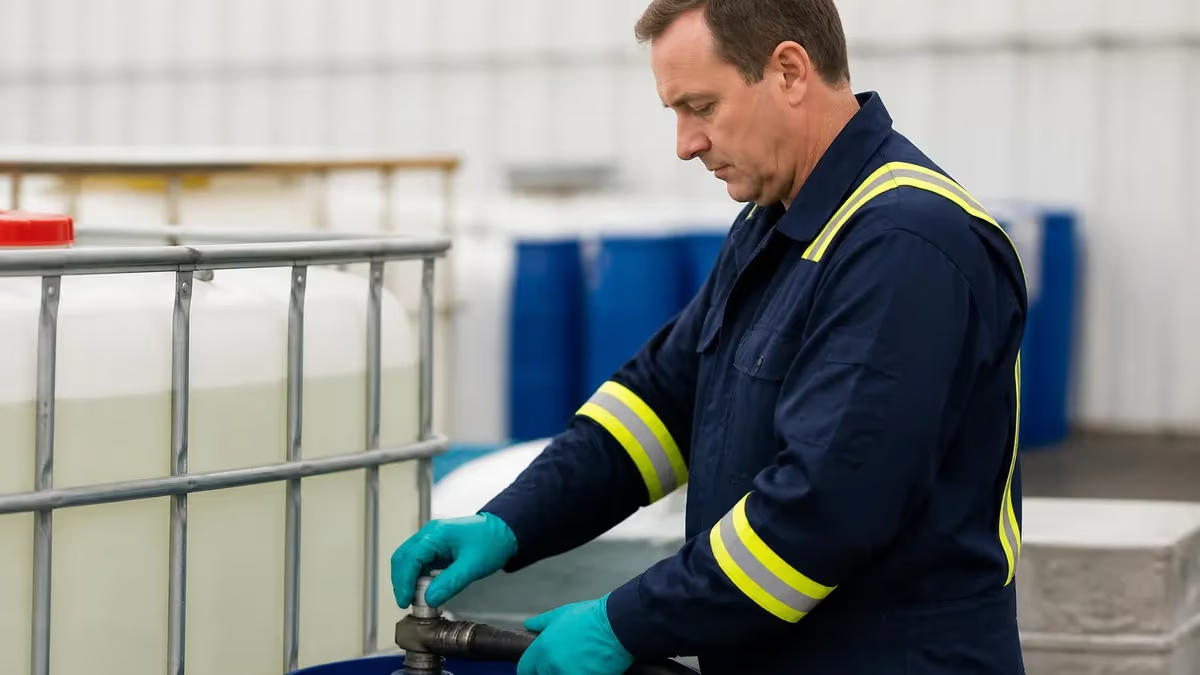
ELDT HazMat training is the federally mandated entry-level driver curriculum that every applicant must complete before attempting the hazardous materials endorsement knowledge exam at a state driver licensing agency. Created under 49 CFR Part 380 and enforced by the Federal Motor Carrier Safety Administration since February 7, 2022, this training establishes a uniform national baseline for theory instruction. Whether you drive tankers, flatbeds, or dry vans, the rule applies the moment you decide to haul placarded loads of regulated chemicals, fuels, gases, or explosives across state lines.
The training is not optional, and it cannot be substituted with prior experience, military service, or another carrier's internal program unless that provider is listed on the FMCSA Training Provider Registry. The registry, often abbreviated TPR, is the only place state DMVs check when verifying that an applicant has satisfied the entry-level driver training mandate. If your provider is missing from the TPR on the day you finish, your certification will not transmit electronically and your testing appointment will be canceled.
Most drivers underestimate how much material the curriculum covers. The HazMat theory unit alone contains hundreds of regulatory points drawn directly from the Hazardous Materials Regulations in 49 CFR Parts 100 through 185. You will study hazard class identification, shipping paper requirements, placarding rules, segregation tables, security plans, emergency response procedures, and the consequences of noncompliance. There is no behind-the-wheel portion for the HazMat endorsement, which makes the theory phase the only training barrier between you and the written exam.
The financial and career stakes are significant. Drivers with a HazMat endorsement earn between $0.04 and $0.12 more per mile on average, qualify for tanker and fuel-hauling fleets that pay annual bonuses, and gain access to dedicated runs that are typically closed to general freight drivers. A single weekend of training plus a TSA background check can unlock a permanent wage increase that compounds across an entire career. That is why more than 90,000 drivers complete ELDT HazMat each year despite the added paperwork.
This guide walks through the entire process from start to finish. You will learn what the federal curriculum covers, how to pick a Training Provider Registry-listed school, what the TSA fingerprinting and background check involves, how the state knowledge test is structured, what the renewal cycle looks like, and how to study efficiently using practice questions modeled on real state exams. Each section is built around the topics the FMCSA, TSA, and state DMVs actually test, not generic trucking advice.
By the end, you should be able to map out a realistic eight-to-fourteen-day path from enrollment to endorsement on your license, budget accurately for fees, and avoid the documentation mistakes that delay roughly one in five first-time applicants. The information here reflects the 2026 regulatory framework, including the updated TSA fee structure, the latest curriculum revisions, and current state-level testing fees in high-volume jurisdictions like Texas, California, Florida, and Pennsylvania.
Whether you are a brand-new CDL holder upgrading your credential or a veteran driver who let an old endorsement lapse, the training requirement is identical. Skim the table of contents below, then dig into the sections that matter most for your situation.
ELDT HazMat Training by the Numbers

Federal ELDT HazMat Training Requirements
Federally mandated theory curriculum covering 19 required topics including hazard classes, shipping papers, placards, loading rules, and emergency response. No minimum hours, but mastery of each unit is required.
Training must be delivered by a school or carrier listed on the FMCSA Training Provider Registry. State DMVs only accept electronic certifications transmitted directly from TPR-approved providers.
Drivers must score 80% or higher on the provider's theory assessment before certification is issued. There is no behind-the-wheel requirement for HazMat, unlike Class A or passenger endorsements.
Every applicant must pass a Transportation Security Administration background check including fingerprinting, immigration verification, and criminal history review covering the past seven years.
After training and TSA clearance, drivers take a state-administered 30-question written test based on the CDL manual's hazardous materials section. Passing score is 80% in all states.
The ELDT HazMat curriculum is organized into clearly defined theory units that any TPR-listed provider must deliver in full. The framework is published in Appendix B to 49 CFR Part 380 and is identical whether you train in person at a community college, online through a national provider, or in-house at a carrier like Schneider, Werner, or J.B. Hunt. The standardization is the entire point: a driver trained in Idaho receives the same baseline instruction as one trained in Georgia.
Unit One covers the basics of hazardous materials, including what makes a material regulated and how the nine hazard classes are organized. You learn the difference between Class 1 explosives, Class 2 gases, Class 3 flammable liquids, Class 4 flammable solids, Class 5 oxidizers and organic peroxides, Class 6 toxic and infectious substances, Class 7 radioactives, Class 8 corrosives, and Class 9 miscellaneous hazardous materials. Real shipments often combine classes, which is why segregation tables matter so much.
Unit Two focuses on the four-part shipping paper, the document that travels with every regulated load. You will learn to verify proper shipping names, hazard class numbers, UN identification codes, packing group designators, and total quantity entries. The training emphasizes how to spot incomplete or incorrect paperwork before you leave the shipper, because the driver is the last line of defense and carries personal liability for moving improperly documented freight.
Unit Three covers placards, markings, and labels. You study the diamond-shaped placards required on all four sides of a vehicle hauling 1,001 pounds or more of placarded material, the 1,000-pound exception for certain Table 2 materials, and the rules for displaying identification numbers on tankers and bulk packages. The same unit introduces the concept of "forbidden" placards and how to recognize when a load should never have been tendered to a motor carrier in the first place.
Unit Four addresses loading, unloading, and segregation. Drivers practice reading the segregation table, which prohibits certain hazard classes from being transported together in the same vehicle or compartment. This is one of the most heavily tested sections on the state exam because incorrect loading decisions cause real-world catastrophes. Your provider should walk you through case studies, such as the 2014 Texas roadway fire that resulted from a segregation violation.
Unit Five through Unit Nineteen build out the remaining theory: bulk packaging, cargo tank specifications, emergency response, hazard communication, security awareness, the Emergency Response Guidebook, route restrictions, parking and attendance rules, smoking restrictions, fueling procedures, accident reporting, and the new hazardous materials endorsement test security plan requirements added after September 11, 2001. Each unit ends with a knowledge check.
Drivers should expect to spend between ten and sixteen total hours on the theory material, depending on reading speed and prior trucking experience. Online providers typically allow you to pause and resume across multiple sessions, which is a major advantage for working drivers who can study during 34-hour resets. Classroom-based programs compress the same content into one or two weekend days.

HazMat Practice Test Questions
Prepare for the HazMat - Hazardous Materials Endorsement exam with our free practice test modules. Each quiz covers key topics to help you pass on your first try.
HazMat CDL Hazardous Materials (HazMat) En...
HazMat Exam Questions covering CDL Hazardous Materials (HazMat) Endorsement. Master HazMat Test concepts for certification prep.
HazMat CDL Hazardous Materials (HazMat) En...
Free HazMat Practice Test featuring CDL Hazardous Materials (HazMat) Endorsement Trivia. Improve your HazMat Exam score with mock test prep.
HazMat Hazardous Materials (HazMat) Endors...
HazMat Mock Exam on Hazardous Materials (HazMat) Endorsement Awareness. HazMat Study Guide questions to pass on your first try.
HazMat Hazardous Materials (HazMat) Endors...
HazMat Test Prep for Hazardous Materials (HazMat) Endorsement Operations. Practice HazMat Quiz questions and boost your score.
HazMat Hazardous Materials (HazMat) Endors...
HazMat Questions and Answers on Hazardous Materials (HazMat) Endorsement Theory. Free HazMat practice for exam readiness.
HazMat Ultimate CDL Hazardous Materials (H...
HazMat Mock Test covering Ultimate CDL Hazardous Materials (HazMat) Endorsement. Online HazMat Test practice with instant feedback.
HazMat Emergency Response
Free HazMat Quiz on HazMat Emergency Response. HazMat Exam prep questions with detailed explanations.
HazMat Loading, Unloading, and Segregation
HazMat Practice Questions for HazMat Loading, Unloading, and Segregation. Build confidence for your HazMat certification exam.
Choosing a Training Provider for Your CDL Hazardous Materials Endorsement
Online TPR-listed schools deliver the entire theory curriculum through self-paced video modules, interactive knowledge checks, and proctored final assessments. Major providers include CDL Training Today, Driving Academy, Roadmaster, and many community colleges that have built dedicated ELDT portals. Tuition typically runs between $89 and $199, and most learners complete the program in three to seven days while continuing to work their regular schedule.
The advantage of online delivery is flexibility: you can pause for dispatch calls, restart units, and complete the certification from a sleeper berth if necessary. The disadvantage is that some drivers struggle without an instructor in the room, particularly with segregation tables and shipping paper interpretation. Choose a provider that offers live phone or chat support and accepts your state's electronic transmission requirements before paying.
Is the HazMat Endorsement Worth the Extra Training Investment?
- +Adds $0.04 to $0.12 per mile to most over-the-road pay scales
- +Opens tanker, fuel-hauling, and chemical-fleet positions that pay sign-on bonuses
- +Improves job security during freight downturns when general freight slows
- +Qualifies drivers for dedicated routes with predictable home time
- +Combines well with the tanker endorsement for X-endorsement premium pay
- +Valid for five years per endorsement cycle before renewal is required
- −Requires TSA fingerprinting and background check costing $86.50
- −Federal ELDT training adds 10 to 16 hours of study time and $89 to $600 in tuition
- −Disqualifying offenses can permanently bar applicants from the endorsement
- −Renewal requires repeating the TSA threat assessment every five years
- −Some states require a separate written test rather than combining with the CDL
- −Carrying placarded freight increases inspection frequency and DOT scrutiny
Pros and Cons at a Glance
| Pros | Cons |
|---|---|
| Opens tanker, fuel-hauling, and chemical-fleet positions that pay sign-on bonuses | Disqualifying offenses can permanently bar applicants from the endorsement |
| Improves job security during freight downturns when general freight slows | Renewal requires repeating the TSA threat assessment every five years |
| Qualifies drivers for dedicated routes with predictable home time | Some states require a separate written test rather than combining with the CDL |
| Combines well with the tanker endorsement for X-endorsement premium pay | Carrying placarded freight increases inspection frequency and DOT scrutiny |

Pre-Test Hazardous Materials Endorsement Study Guide Checklist
- ✓Confirm your selected training school is currently listed on the FMCSA Training Provider Registry
- ✓Complete all 19 ELDT theory units and score at least 80% on the provider assessment
- ✓Schedule your TSA fingerprinting appointment through IdentoGO or your state's equivalent vendor
- ✓Gather required documents: valid CDL, proof of citizenship or lawful status, and current address proof
- ✓Pay the $86.50 TSA Threat Assessment fee and save your receipt for the DMV
- ✓Download your current state CDL manual and read the hazardous materials section twice
- ✓Memorize the nine hazard class numbers and their corresponding placard colors
- ✓Practice reading shipping papers until you can identify errors in under 60 seconds
- ✓Take at least three full-length practice tests and score 90% or higher consistently
- ✓Schedule your state knowledge exam appointment after TSA clearance is confirmed
Start the TSA background check first
The TSA Threat Assessment can take anywhere from 30 to 60 days to clear, far longer than the ELDT training itself. Smart applicants schedule their fingerprinting appointment on day one of training rather than waiting until they finish coursework. This parallel-track approach can shave three to five weeks off your total time to endorsement and keeps your career momentum moving forward.
The TSA background check, formally called the Hazardous Materials Endorsement Threat Assessment Program, is the single longest step in the entire process for most applicants. It exists because the federal government considers any driver hauling placarded loads to be a potential security risk, and the 2001 USA PATRIOT Act explicitly mandates this screening for HazMat endorsement holders. There is no way around it, no waiver, and no expedited path for veterans or law enforcement.
You begin the process by enrolling online through universalenroll.dhs.gov or, in a handful of states, through a state-specific portal such as the Florida or Texas DPS scheduler. Enrollment collects your full legal name, Social Security number, immigration documentation if applicable, current and previous addresses for the last five years, and any prior criminal history. Honesty is critical: the TSA cross-references your answers against FBI databases, and discrepancies trigger an automatic disqualification regardless of the underlying offense.
After online enrollment, you visit an IdentoGO or TSA-approved enrollment center for fingerprinting and identity verification. The appointment takes about thirty minutes. You must bring two forms of identification, typically a passport or state-issued REAL ID plus a Social Security card or birth certificate. The $86.50 fee is paid at this stage and is non-refundable even if your application is later denied for cause.
The threat assessment itself screens for two categories of disqualifying offenses. Permanent disqualifiers include espionage, sedition, treason, terrorism, transportation security incidents, improper transportation of hazardous materials, certain federal crimes of dishonesty, and murder. Interim disqualifiers include felony drug distribution, weapons trafficking, certain assault convictions, and immigration violations, and these typically bar you for seven years from the conviction date or release from incarceration, whichever is later.
If you receive a Notice of Initial Determination of Threat Assessment, you have the right to appeal or apply for a waiver within sixty days. Waivers are reviewed individually and consider factors like time since the offense, evidence of rehabilitation, employment history, and circumstances of the conviction. Roughly forty percent of waiver requests are granted, so do not assume a prior conviction automatically ends your career path. Hire an attorney experienced in TSA appeals if the stakes warrant it.
Once you receive your cdl hazardous materials endorsement approval letter, you have 90 days in most states to complete the written exam and add the endorsement to your license. Miss that window and you may need to repeat the threat assessment or pay a re-issuance fee. Plan accordingly: do not start training, finish quickly, and then wait three months to take the test.
Renewal follows the same process but generally moves faster because your fingerprints and biographic data are already on file. Plan to start your renewal at least 90 days before your current endorsement expires to avoid any gap in eligibility, especially if you drive for a carrier that requires continuous valid endorsements as a condition of employment.
Most states require you to retake the full knowledge exam if your HazMat endorsement expires, even by a single day. Some carriers will also pull you from placarded loads the moment your TSA clearance lapses, costing you premium-pay miles. Mark your renewal date 120 days in advance and start the TSA process immediately to avoid any income disruption.
The state knowledge exam is the final hurdle between you and a placarded load. Every state administers a written test based on the hazardous materials section of the AAMVA CDL manual, but the question pool, formatting, and passing thresholds are remarkably consistent because the underlying federal regulations are identical. Expect thirty multiple-choice questions, an eighty-percent passing score, and a four-answer-choice format with one clearly correct response per item.
Question topics mirror the ELDT curriculum almost exactly. Roughly twenty percent of questions cover shipping papers, fifteen percent cover placards and markings, fifteen percent cover loading and segregation, ten percent cover emergency response, ten percent cover security, and the remaining thirty percent are scattered across smoking rules, fueling, parking, accident reporting, route restrictions, and bulk packaging. If you have mastered each ELDT unit, you have already studied every topic the exam will test.
State testing fees range from $5 in Texas to $50 in California, with most jurisdictions falling between $10 and $25. You generally take the test at the same driver licensing office where you obtained your original CDL, although some states like Florida allow third-party testing centers to administer the written portion. Bring your TSA approval letter, current CDL, fee payment, and any state-required medical card documentation to the appointment.
The single most effective preparation method is repeated practice testing. Drivers who take three or more full-length practice exams pass on the first attempt at a rate above ninety percent, compared to roughly sixty percent for drivers who only read the manual. Practice tests reinforce the exact phrasing, distractor patterns, and edge-case scenarios the state uses, and they highlight your weakest topic areas so you can target your remaining study time.
Pay close attention to placard colors and shapes during your final review. The exam frequently asks you to identify which placard goes with which hazard class, and the visual recall is faster than reading definitions. Orange for explosives, red for flammables, green for non-flammable gases, yellow for oxidizers, white for poisons, white-and-yellow striped for radioactives, and black-and-white striped for corrosives are the foundational color-to-class mappings.
The Emergency Response Guidebook, often called the ERG or Orange Book, is another high-yield study tool. Knowing how to look up a UN number, identify the correct guide page, determine isolation distances, and follow the recommended action steps appears on roughly three to five questions on every state exam. Free copies are available through PHMSA and most truck stops, and a digital version is included in many practice apps.
Finally, time your test for when you are sharpest. The exam usually allots forty-five to sixty minutes, but most drivers finish in under twenty. Do not rush the segregation table and shipping paper questions because those carry the most weight and require careful reading. A calm, methodical approach beats speed every time on this particular exam.
Practical preparation goes beyond simply reading and answering practice questions. The drivers who pass on the first attempt and then thrive on placarded routes treat the endorsement as the start of an ongoing learning process rather than a one-time hurdle. Build habits during training that you will carry into your career: always check the shipping paper before signing for the load, walk around the trailer looking for placard damage before you leave, and verify the segregation arrangement matches the documentation.
Buy a hard-copy current edition of the Federal Motor Carrier Safety Regulations pocketbook, often sold under the J.J. Keller brand, and keep it in your truck. The book contains 49 CFR Parts 100 through 185 in a portable format and is invaluable when a shipper hands you paperwork that does not look right. Bookmark the hazardous materials table at 49 CFR 172.101 because that is where every proper shipping name, hazard class, identification number, and packing group is officially listed.
Take advantage of free study tools. PHMSA, FMCSA, and many state DOT websites publish quick-reference guides, video tutorials, and downloadable placard charts at no cost. Combine these with a quality hazardous material endorsement practice test platform that tracks your weak areas and recycles missed questions. Twenty minutes of targeted practice a day for two weeks beats a single eight-hour cram session by every measurable outcome.
Network with experienced HazMat drivers during your training. Truck stops, online forums like Trucking Truth and TheTruckersReport, and carrier-sponsored Facebook groups are full of veterans who have run placarded freight for decades. They will tell you which shippers cut corners, which receivers are sticklers about paperwork, and which routes have HazMat restrictions that the GPS does not flag. This kind of practical knowledge complements the regulatory training in ways no textbook can.
Build a personal compliance kit before your first load. At a minimum, carry the current Emergency Response Guidebook, a placard set covering the classes you typically haul, road flares or LED warning triangles, a fire extinguisher rated for the materials you transport, the carrier's emergency contact card, and your TSA approval letter. Some carriers provide kits as part of orientation, but verify the contents before you leave the yard with placarded freight.
Plan your routes carefully. Many tunnels, bridges, and metropolitan areas restrict or prohibit certain hazard classes, and violations carry fines that can exceed $10,000 plus federal disqualification. The PHMSA National Hazardous Materials Route Registry lists every restricted route in the country and should be consulted before any unfamiliar trip. Modern truck GPS units like Garmin Dezl or Rand McNally have HazMat routing modes that incorporate this data automatically.
Finally, treat your endorsement as a credential worth protecting. A single violation, accident, or moving violation while hauling HazMat can trigger an FMCSA investigation, employer-mandated retraining, and in serious cases revocation of the endorsement. Drive defensively, plan your fuel stops to avoid running low while placarded, never park overnight within five feet of an open flame, and document every inspection. The premium pay you earn comes from accepting and meeting those higher standards every shift.
Sample HazMat - Hazardous Materials Endorsement Practice Questions
Try these questions from our free HazMat - Hazardous Materials Endorsement practice tests. The correct answer and an explanation follow each question.
What action should a HazMat driver take if they suspect their vehicle is being followed?
- A. Speed up to lose the follower
- B. Ignore it and continue to the destination
- C. Report the suspicious activity to law enforcement and the carrier
- D. Stop and confront the other driver
Answer: C. Report the suspicious activity to law enforcement and the carrier
Suspected surveillance of a HazMat vehicle should be reported immediately to law enforcement and the motor carrier as part of HazMat security protocols.
Which hazmat class covers oxidizers?
- A. Class 3
- B. Class 5
- C. Class 6
- D. Class 8
Answer: B. Class 5
Class 5 covers oxidizers (Division 5.1) and organic peroxides (Division 5.2).
During a HazMat accident, where should you keep your shipping papers?
- A. Locked in the cab
- B. On you at all times
- C. In a pouch on the inside of the driver's door, or on the seat when outside the vehicle
- D. Mailed to the shipper immediately
Answer: C. In a pouch on the inside of the driver's door, or on the seat when outside the vehicle
Shipping papers must be kept in a pouch on the driver's door or on the seat so first responders can find them quickly if the driver is incapacitated.
A driver discovers a leak in a HazMat package en route. What is the FIRST action to take?
- A. Continue to the destination quickly to minimize delay
- B. Keep driving and notify the shipper by phone
- C. Park safely, stay upwind, and call for help
- D. Cover the leak with a tarp and continue
Answer: C. Park safely, stay upwind, and call for help
The driver must stop safely, keep away from and upwind of the leaking material, and immediately call emergency services and the carrier.
Take the full HazMat - Hazardous Materials Endorsement practice test
HazMat Questions and Answers




About the Author

Educational Psychologist & Academic Test Preparation Expert
Columbia University Teachers CollegeDr. Lisa Patel holds a Doctorate in Education from Columbia University Teachers College and has spent 17 years researching standardized test design and academic assessment. She has developed preparation programs for SAT, ACT, GRE, LSAT, UCAT, and numerous professional licensing exams, helping students of all backgrounds achieve their target scores.
Join the Discussion
Connect with other students preparing for this exam. Share tips, ask questions, and get advice from people who have been there.
View discussion (8 replies)