
FCC GROL: General Radiotelephone Operator License Complete Guide 2026
FCC GROL complete guide: 📝 Element 1 + 3 exams, ~$100 cost, lifetime validity, study books, COLEM testing, and how it compares to GMDSS and ham licenses.
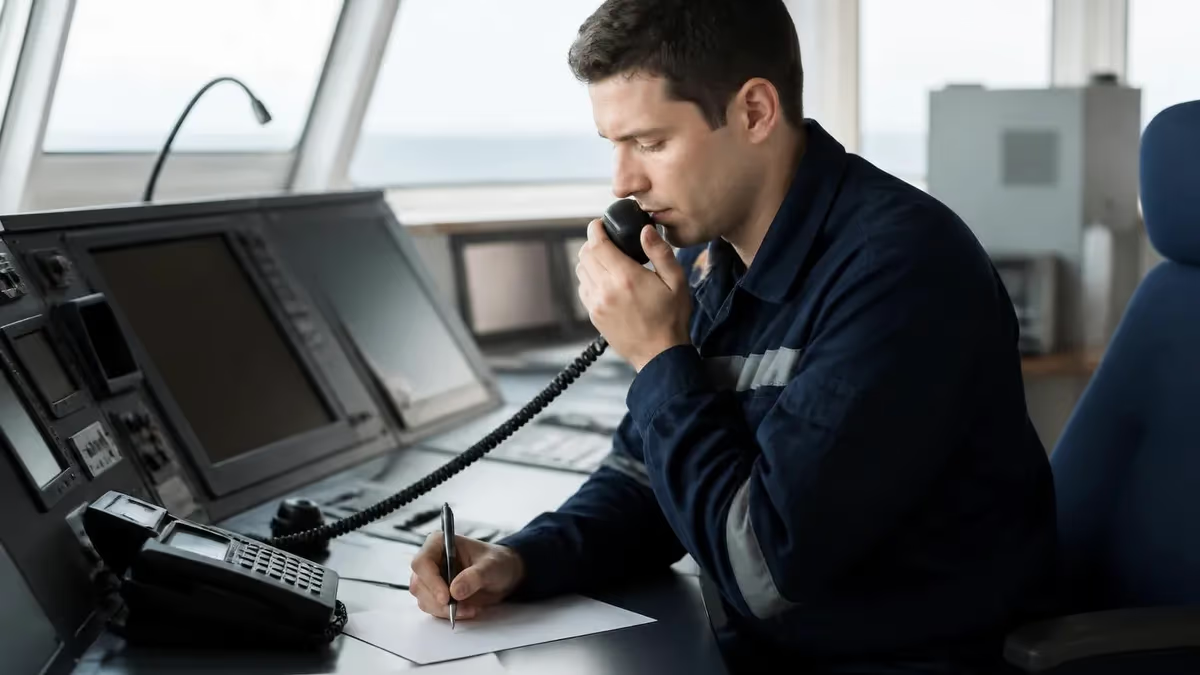
The FCC GROL (General Radiotelephone Operator License) sits at the crossroads of aviation, marine communications, and broadcast engineering. If you repair, adjust, or internally test transmitters in those services, the Federal Communications Commission says you need this license in your wallet. And here is the thing most people miss: once you pass, the license is yours for life. No renewal fees. No recurring exams. No expiration date. Practice with the free General Radiotelephone Operator License practice test on PracticeTestGeeks (250+ questions with answer explanations).
That alone makes the GROL one of the best-value credentials in commercial radio. You sit two written exams, you pay roughly $100 in total fees, and you walk away with a federal license that opens doors at airlines, regional broadcasters, marine repair yards, and two-way radio shops. The catch? The Element 3 exam is dense — about 100 questions covering everything from Ohm's law to RF safety to FCC Part 97 trivia. Most candidates need 60 to 100 study hours to feel ready.
This guide walks you through what the GROL actually authorizes, who needs it, how the testing works through FCC-approved COLEM administrators, what to study, and how the GROL stacks up against its cousins (GMDSS, the ham Amateur Extra, and the Marine Radio Operator Permit). If you came here looking for a simple answer to "do I need this thing?" — you will have it by the end of the next section.
Free General Radiotelephone Operator License Study Tools
Interactive General Radiotelephone Operator License resources on PracticeTestGeeks, free to start:
- General Radiotelephone Operator License practice test — 250+ questions with instant scoring and answer explanations
- General Radiotelephone Operator License flashcards — review key terms and concepts card by card
- General Radiotelephone Operator License study guide — topic-by-topic overview of what the exam covers
- General Radiotelephone Operator License cheat sheet — one-page printable summary for last-minute review
GROL by the Numbers
Key Facts at a Glance
| Item | Value | Details |
|---|---|---|
| Element 3 questions | ~100 | |
| Element 1 questions | 24 | |
| Validity (no renewal) | Lifetime |
Let's clear up the biggest source of confusion right out of the gate. The GROL is not a permission slip to operate a radio. You can talk on an aircraft VHF without it. You can run a marine SSB without it. What the GROL does grant is the legal authority to repair, adjust, and internally test transmitting equipment in:
- Aviation services — aircraft radios, ground-based aeronautical transmitters
- Maritime services — ship radios above 1500 watts peak envelope power, and most international voyage equipment
- International fixed public radiotelephone stations
- Coast and marine relay stations
Broadcast engineers technically don't need a GROL to work at AM/FM/TV stations (the FCC deregulated that requirement back in 1995), but many radio stations and contract engineering firms still list it as a hiring requirement. It tells employers you understand RF, FCC rules, and basic electronics — without them having to test you themselves.
So the right way to think about it: the GROL is a technician's license, not an operator's license, despite the name. If you're cracking open a transmitter chassis to swap a final amplifier tube or align an aviation localizer, the GROL is what keeps you legal.
The GROL doesn't let you talk on a radio — it lets you fix one. You need it to adjust, repair, or internally test transmitters in aviation, maritime, and international fixed services. Holders also get a free "ship radar endorsement" path by adding Element 8.
Who Actually Needs a GROL?
The honest answer: fewer people than the FCC's website implies, but more than you'd think once you start counting niches. Here are the jobs where a GROL shows up as either a legal requirement or a strong hiring preference.
Aviation Mechanics and Avionics Technicians
If you hold an A&P (Airframe and Powerplant) certificate and your shop touches aircraft radios — VHF comms, transponders, ELTs, DME, weather radar — the GROL is the credential the FCC expects. Many MRO shops require it before they'll sign you off on avionics work, especially anything involving transmitter alignment or post-repair RF measurements.
Marine Radio Service Technicians
Coast stations, ship radio installers, and the technicians who maintain VHF DSC radios, EPIRBs, and HF SSB sets on commercial vessels need the GROL. For SOLAS-class ships and ocean-going voyages, you'll usually layer GMDSS on top (more on that later).
Broadcast Engineers and Contract RF Specialists
Not strictly required by FCC rules anymore — but the GROL remains the de facto industry credential. Job postings for transmitter engineers, contract RF technicians, and broadcast field engineers still list it. SBE certifications (CBT, CBRE) are often listed alongside.
Two-Way Radio Shop Technicians
Private land mobile radio is a gray area legally, but most reputable two-way shops want their bench techs to hold a GROL. Customers like seeing it on the wall, and it makes coordinating with FCC-licensed clients smoother.
If you're in any of those categories, the math is simple: $100 once, lifetime credential, opens hiring conversations. That's a deal.
The Two GROL Exam Elements
24-question multiple choice covering FCC rules, operating procedures, and basic regulations for marine and aviation services. Passing is 18 of 24 (75%). Most candidates pass on first attempt with 10-15 hours of prep.
~100 questions (some pools draw 76, current FCC pool is 600 questions sampled) covering electronics theory, components, circuits, antennas, RF safety, digital logic, and operating practices. Passing is 75%. This is the heavy lift — plan 50-80 study hours.
50 questions added to the GROL to create a Ship Radar Endorsement. Required to service marine radar systems. Most candidates take it the same day as Element 3.
Separate exam set for GMDSS Radio Operator and Maintainer endorsements. Required for SOLAS vessels on international voyages. Higher complexity, more practical-skills focused.
What's Actually on the Element 3 Exam
Element 3 is where most people sweat. The FCC question pool currently runs around 600 questions, and your exam draws roughly 100 of them at random. The pool is public — you can download it from the FCC or buy it bundled with study guides — and rotates every few years.
The content breaks down across nine major subject areas, and you'll see questions from all of them. Here's the lay of the land:
- Operating procedures — international phonetic alphabet, distress signals, watchkeeping rules
- Radio wave propagation — skywave, groundwave, ionospheric layers, fading
- Radio practice — test equipment, measurements, RF safety
- Electrical principles — Ohm's law, AC circuits, resonance, reactance
- Circuit components — resistors, capacitors, inductors, semiconductors, vacuum tubes (yes, still on the test)
- Practical circuits — power supplies, amplifiers, oscillators, mixers, modulators
- Signals and emissions — AM, FM, SSB, digital modes, bandwidth, emission designators
- Antennas and feed lines — radiation patterns, SWR, impedance matching
- FCC rules — Part 13, Part 23, Part 80, Part 87, operator authority
If electronics theory is rusty (or new), expect the heaviest lift in components and practical circuits. The math is mostly algebra — Ohm's law, voltage dividers, power calculations, reactance formulas. You won't be doing calculus, but you will be juggling formulas under time pressure.
One quirk worth flagging: the pool still includes a healthy chunk of vacuum tube questions. The FCC has never fully retired them, partly because some legacy broadcast and marine transmitters still run tubes. Don't skip that section — you'll see five or six tube questions on a typical exam.
GROL vs Other Radio Licenses
The Marine Radio Operator Permit (MROP) is the easy cousin. Element 1 only — 24 questions, basic radio law. It authorizes you to operate radios on certain commercial vessels and aircraft, but does not let you repair or internally adjust transmitters. If you only need to talk on the radio, MROP. If you need to fix it, GROL.
How the Testing Process Works
You won't take your GROL at an FCC field office. The Commission stopped administering commercial radio exams in person years ago. Today, testing is handled by private companies called COLEMs — Commercial Operator License Examination Managers — and there are roughly a dozen of them authorized nationwide.
The big names you'll run into: Laurel COLEM (Texas-based, popular with hams), W5YI-VEC (long-running, broad coverage), Sea School COLEM (maritime-focused, runs sessions at port cities), National Radio Examiners, and a handful of smaller regional COLEMs. Each charges its own session fee — usually between $20 and $50 per element — so do a little price-shopping if you have options nearby.
The typical flow looks like this. You find a session online, register in advance (some COLEMs allow walk-ins, many don't), show up with your FRN (FCC Registration Number — get one free at fcc.gov before the test), pay the fee, sit the exam, and get your pass/fail result the same day.
If you pass, the COLEM files the paperwork with the FCC electronically, and your license usually shows up in the ULS database within 7 to 14 days. You can download the PDF yourself once it posts — there's no paper certificate mailed by default. Save that PDF in two places. The FCC won't reissue it from a webpage screenshot, and employers want the official document for HR files.
Some COLEMs now offer remote proctoring via webcam. Laurel COLEM in particular runs a strong online session program. Expect tighter ID checks and a clean-desk requirement, but it's a real option if you live far from a testing site. Remote sessions generally cost the same as in-person, with the same pass/fail processing timeline. If you fail an element on a remote session, most COLEMs let you retake on a future session at no discount — failure rates seem comparable to in-person testing, so the format itself isn't a disadvantage.
The FCC will not issue your license without an FRN (FCC Registration Number) in the CORES system. Register at fcc.gov/uls before your test. It's free, takes five minutes, and missing it on exam day means a wasted trip.
Building a Study Plan That Actually Works
Here is what trips people up: they buy a 600-question pool, try to memorize answers, and walk out of Element 3 confused because the pool rotated last year. The answer-key approach can work, but only if you have the current pool and only if you supplement with conceptual review for the topics where memorization breaks down (component identification, schematic reading, math problems).
A realistic plan for someone with basic electronics background:
- Week 1-2: Read through a study guide cover to cover. Don't memorize, just expose yourself to terminology.
- Week 3-5: Work the question pool in chunks of 50, three or four times a week. Mark anything you got wrong or guessed on.
- Week 6-7: Drill your marked questions. Hit weak topic areas hard.
- Week 8: Take three or four full practice exams. Schedule the real exam when you're scoring 85% or higher consistently.
If you're brand new to electronics, double those timelines. Some candidates also take the ham Technician class license first as a warm-up — it costs $15, takes a weekend to prep for, and builds the foundation vocabulary you'll need for Element 3.
Pre-Exam Day Checklist
- ✓Register an FRN at fcc.gov/uls (free, required before licensing)
- ✓Find a COLEM and book a session (in-person or remote proctored)
- ✓Pay the COLEM session fee (typically $35-$75 for Element 1 + Element 3)
- ✓Bring two forms of ID — one government photo, one secondary
- ✓Bring a basic calculator (non-programmable, no internet) — most COLEMs allow it
- ✓Bring your FRN written down (you'll need it on the exam paperwork)
- ✓Eat before the test — Element 3 alone runs 90+ minutes for most candidates
- ✓Plan to take Element 1 and Element 3 the same day to save a second session fee

The Study Materials That Actually Help
The market for GROL study books is small but solid. A few names come up over and over in technician forums and on r/amateurradio when people ask what worked:
Gordon West / WB6NOA — Commercial General Radiotelephone Operator License Study Manual. Gordon West is a legendary ham radio educator, and his GROL book is the most popular single resource. He explains the concepts, then walks through the pool questions with the right answer highlighted and a short why-this-is-correct gloss. Most candidates use this as their primary book.
ARRL — The ARRL General Class License Manual. Technically a ham book, not a GROL book, but the electronics theory overlap is enormous. If you also want a ham license, knock both out with one book.
Mometrix — FCC General Radiotelephone Operator License (GROL) Study Guide. Compact, exam-focused, lighter on theory than Gordon West. Good as a second-pass review book.
HamTestOnline and QRZ Practice Tests. Web-based question banks with adaptive drilling. HamTestOnline has a paid GROL track that mirrors the current FCC pool. Free alternatives exist on QRZ and a few smaller sites.
Avoid out-of-date Amazon listings. The FCC rotates the question pool every few years, and a book from 2015 will have answer keys that no longer match the current exam. Check the publication date — current pool was last refreshed in the early 2020s.
Is the GROL Worth Your Time?
- +Lifetime validity — no renewal fees ever (since 1996 FCC reform)
- +Federal credential recognized by every employer in aviation, marine, broadcast RF
- +Total cost under $150 including exam, FRN, and a good study book
- +Opens hiring conversations at MRO shops, broadcast stations, and marine yards
- +Strong base for adding GMDSS, Ship Radar, or SBE certifications later
- +Same-day pass/fail result at most COLEM sessions
- −Element 3 is dense — most candidates need 60+ hours of prep
- −Vacuum tube content feels dated but still tested
- −COLEM sessions can be hard to find in rural areas (remote proctoring helps)
- −Not actually required for most operating roles — verify before paying
- −Question pool rotates, so outdated books waste your money
- −No reciprocity outside the US (other countries have their own equivalents)
Stacking Endorsements on Top of Your GROL
Once you hold the GROL, several upgrade paths open up. Each is a single additional exam element — same COLEM, same test format — and each lifts what you're legally authorized to service.
Ship Radar Endorsement (Element 8). A 50-question exam covering marine radar theory, range and bearing measurements, and radar fault diagnosis. Adding this to your GROL makes you a Ship Radar Endorsed General Radiotelephone Operator, which is the credential for repairing marine radar systems on commercial vessels. If you work in any marine electronics shop, this is the obvious next step. Plan 15-25 hours of study.
GMDSS Radio Maintainer (Element 9). A heavier exam focused on the global maritime distress system — Inmarsat terminals, EPIRBs, SART, DSC controllers, and NAVTEX receivers. Adding Element 9 to a GROL gives you the GMDSS Radio Maintainer license. This is required to service GMDSS equipment on SOLAS-class ocean-going vessels, and the pay reflects the narrower talent pool. Plan 40-60 hours of study.
GMDSS Radio Operator (Element 7/7R). A separate path, not an endorsement to GROL — but worth knowing about. The Operator license is for the person actually using GMDSS gear during distress events. Two parts: Element 7 (written) and Element 7R (practical skills, including operating an Inmarsat-C terminal). Required for radio officers on SOLAS vessels.
For most working technicians, the practical stack is GROL + Element 8 (Ship Radar). That covers aviation, broadcast, and most coastal marine work. Add GMDSS Maintainer only if you're moving into deep-water marine repair.
What the GROL Actually Does for Your Career
Realistic talk: the GROL alone won't land you a job. It's a license, not a resume. But it's a license that opens doors that stay closed without it, and that's a real asset.
Avionics technicians with an A&P plus a GROL earn meaningfully more than A&P-only counterparts, especially at larger MRO shops and airlines. The GROL is the credential that lets you sign off on transmitter work, which is higher-billing labor than mechanical sign-offs. Median figures vary by region, but a $5K to $15K annual premium is realistic in major aviation hubs.
Broadcast engineers see a similar effect. A field engineer maintaining a regional FM cluster will earn more with GROL + SBE CBRE than without. The credentials combined signal to station managers that you can handle both the RF and the regulatory paperwork without supervision. Contract RF firms that handle tower work for cellular carriers and public-safety radio networks frequently list the GROL as a requirement on bid documents, which means freelance techs without it get filtered out before they ever see a contract.
Marine electronics is the sweet spot for stacking. Technicians who hold GROL + Ship Radar + GMDSS Maintainer are in narrow supply, and shipyards in major port cities pay accordingly. This is the credential path where the GROL clearly leads to six-figure earnings for experienced techs. Add in offshore work — supply vessels, cruise lines, research ships — and the day rates climb further. Some marine techs travel internationally to service vessels at foreign ports, billing as US-licensed specialists.
Two-way radio shops and contract RF work are more variable. Some shops require the GROL outright, others treat it as a plus. Either way, holding it makes you the technician the shop sends out to FCC-licensed clients — which usually means better tickets and more billable hours. Police, fire, and EMS departments running their own land-mobile systems prefer GROL-credentialed technicians for the same reason: they trust the federal sign-off when their radios touch transmitter alignment.
If you're already in any of these fields without a GROL, the math is hard to argue with. $100 one time, lifetime validity, measurable hiring impact, and a clean step toward higher-value endorsements. Just block out the study weeks, find your COLEM, and book the session. The most common regret techs voice on radio engineering forums isn't taking the GROL too early — it's putting it off for five or ten years and missing out on the higher-paying assignments those credentials would have unlocked.
Sample General Radiotelephone Operator License Practice Questions
Try these questions from our free General Radiotelephone Operator License practice tests. The correct answer and an explanation follow each question.
What is the term of a General Radiotelephone Operator License (GROL) issued today?
- A. Five years, with a grace period for renewal.
- B. Ten years, renewable upon application.
- C. The lifetime of the holder.
- D. Valid until the holder reaches age 70.
Answer: C. The lifetime of the holder.
As of May 20, 2013, all newly issued and renewed FCC commercial operator licenses, including the GROL, are valid for the lifetime of the holder and do not require renewal.
A ship radiotelephone station license is issued to:
- A. The licensed operator of the vessel
- B. The owner or operator of the ship
- C. The captain only
- D. The FCC district office
Answer: B. The owner or operator of the ship
The ship station license is issued to the owner or operator (not the individual radio operator) of the vessel.
Which FCC license is required to operate a ship station's MF/HF Single Sideband radio?
- A. Technician Class Amateur License
- B. General Radiotelephone Operator License (GROL)
- C. Marine Radio Operator Permit (MROP)
- D. Restricted Radiotelephone Operator Permit
Answer: B. General Radiotelephone Operator License (GROL)
A GROL is required to operate, adjust, or repair MF/HF SSB ship stations used for distress and safety communications.
A technician holding a GROL discovers that an unlicensed person has been making adjustments to the internal components of a ship's compulsory VHF transmitter. What is the primary violation?
- A. Operating the radio without a proper station license.
- B. Failure to identify the station at required intervals.
- C. Making unauthorized internal repairs or adjustments without the proper commercial operator license.
- D. Using a non-type-accepted transmitter for maritime communications.
Answer: C. Making unauthorized internal repairs or adjustments without the proper commercial operator license.
A General Radiotelephone Operator License (GROL) is required for any person who adjusts, maintains, or internally repairs FCC-licensed radiotelephone transmitters in the maritime and aviation services. An unlicensed individual performing these actions is in direct violation of FCC regulations.
Take the full General Radiotelephone Operator License practice test
GROL Questions and Answers
About the Author

Educational Psychologist & Academic Test Preparation Expert
Columbia University Teachers CollegeDr. Lisa Patel holds a Doctorate in Education from Columbia University Teachers College and has spent 17 years researching standardized test design and academic assessment. She has developed preparation programs for SAT, ACT, GRE, LSAT, UCAT, and numerous professional licensing exams, helping students of all backgrounds achieve their target scores.
Join the Discussion
Connect with other students preparing for this exam. Share tips, ask questions, and get advice from people who have been there.
View discussion (9 replies)