
GROL Study Guide: Complete Path to FCC Certification 2026
⏳ Get ready for your GROL Study Guide: Complete Path to FCC certification. Practice questions with step-by-step answer explanations and instant scoring.
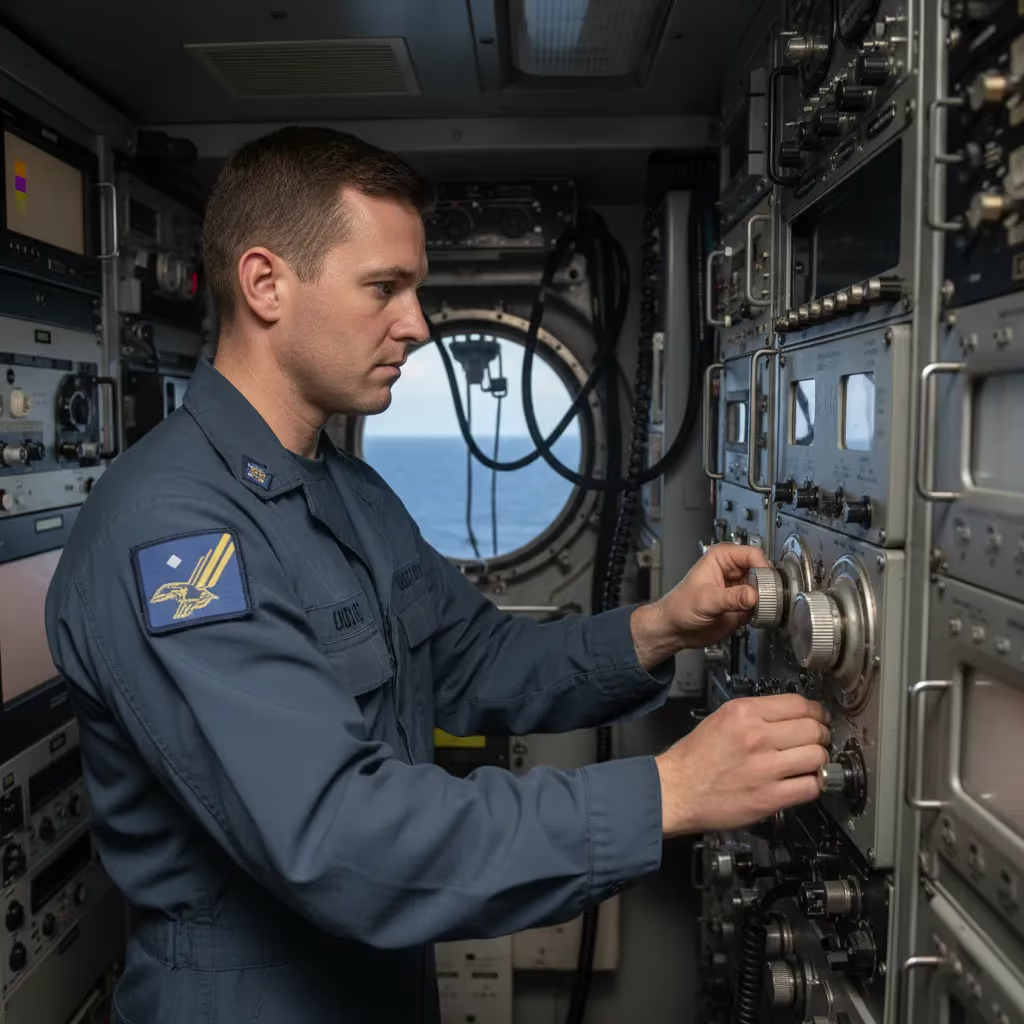
The General Radiotelephone Operator License, commonly known as GROL, represents a critical credential for professionals working in maritime and aviation communications. As the broadcasting and telecommunications industries continue to evolve, obtaining a GROL certification has become increasingly important for career advancement. This comprehensive study guide provides everything you need to understand the examination requirements, master essential concepts, and successfully prepare for your FCC certification test. Whether you're beginning your journey toward this prestigious credential or fine-tuning your knowledge, this guide will equip you with the strategies and insights necessary for success.
GROL Practice Test Questions
Prepare for the GROL - General Radiotelephone Operator License exam with our free practice test modules. Each quiz covers key topics to help you pass on your first try.
GROL Basic Radio Law and Operating
GROL Exam Questions covering Basic Radio Law and Operating. Master GROL Test concepts for certification prep.
GROL Filters and Frequency Control
Free GROL Practice Test featuring Filters and Frequency Control. Improve your GROL Exam score with mock test prep.
GROL General Radiotelephone
GROL Mock Exam on General Radiotelephone. GROL Study Guide questions to pass on your first try.
GROL - General Radiotelephone Operator Lic...
GROL Test Prep for - General Radiotelephone Operator License Amplifier and Oscillator Circuits. Practice GROL Quiz questions and boost your score.
GROL - General Radiotelephone Operator Lic...
GROL Questions and Answers on - General Radiotelephone Operator License Antennas and Transmission Lines. Free GROL practice for exam readiness.
GROL - General Radiotelephone Operator Lic...
GROL Mock Test covering - General Radiotelephone Operator License Digital Logic and Microcomputers. Online GROL Test practice with instant feedback.
GROL - General Radiotelephone Operator Lic...
Free GROL Quiz on - General Radiotelephone Operator License Electrical Principles and Units. GROL Exam prep questions with detailed explanations.
GROL - General Radiotelephone Operator Lic...
GROL Practice Questions for - General Radiotelephone Operator License Modulation and Signal Types. Build confidence for your GROL certification exam.
GROL - General Radiotelephone Operator Lic...
GROL Test Online for - General Radiotelephone Operator License Power Sources and Distribution. Free practice with instant results and feedback.
GROL - General Radiotelephone Operator Lic...
GROL Study Material on - General Radiotelephone Operator License Radio Law and Regulations. Prepare effectively with real exam-style questions.
GROL - General Radiotelephone Operator Lic...
Free GROL Test covering - General Radiotelephone Operator License Radio Wave Propagation. Practice and track your GROL exam readiness.
GROL - General Radiotelephone Operator Lic...
GROL Exam Questions covering - General Radiotelephone Operator License Receivers and Transmitters. Master GROL Test concepts for certification prep.
GROL: Pros and Cons
- +GROL certification validates expertise recognized by employers nationwide
- +Certified professionals typically earn 15-20% higher salaries
- +Opens doors to advanced positions and leadership roles
- +Demonstrates commitment to professional standards and ethics
- +Builds a strong professional network through certification communities
- −Exam preparation typically requires 2-4 months of dedicated study
- −Certification and exam fees can range from $150-$500+
- −Must complete continuing education to maintain active certification
- −Pass rates vary — thorough preparation is essential for success
- −Some certifications require prerequisite experience or education
Pros and Cons at a Glance
| Pros | Cons |
|---|---|
| GROL certification validates expertise recognized by employers nationwide | Must complete continuing education to maintain active certification |
| Opens doors to advanced positions and leadership roles | Pass rates vary — thorough preparation is essential for success |
| Demonstrates commitment to professional standards and ethics | Some certifications require prerequisite experience or education |
Sample General Radiotelephone Operator License Practice Questions
Try these questions from our free General Radiotelephone Operator License practice tests. The correct answer and an explanation follow each question.
A ship is attempting to communicate with a shore station 40 nautical miles away using a VHF marine radio in the 156-162 MHz range. The signal is blocked by a large coastal mountain range between them. What is the primary propagation path for these signals, and why is communication failing?
- A. Skywave, because the frequency is too high for ionospheric refraction.
- B. Groundwave, because the signal's energy is being absorbed by the terrain.
- C. Space wave (line-of-sight), because VHF signals are blocked by significant physical obstructions.
- D. Tropospheric scatter, because the required atmospheric conditions are not present.
Answer: C. Space wave (line-of-sight), because VHF signals are blocked by significant physical obstructions.
VHF and UHF radio waves travel primarily via space wave, which is commonly known as line-of-sight (LOS) propagation. [1, 14, 21] These signals travel in a relatively straight line and are blocked by large physical objects like mountains, buildings, or the curvature of the Earth. [1, 11] Groundwave is effective at lower frequencies (MF/LF), and skywave is used for long-distance HF communication.
A technician holding a GROL discovers that an unlicensed person has been making adjustments to the internal components of a ship's compulsory VHF transmitter. What is the primary violation?
- A. Operating the radio without a proper station license.
- B. Failure to identify the station at required intervals.
- C. Making unauthorized internal repairs or adjustments without the proper commercial operator license.
- D. Using a non-type-accepted transmitter for maritime communications.
Answer: C. Making unauthorized internal repairs or adjustments without the proper commercial operator license.
A General Radiotelephone Operator License (GROL) is required for any person who adjusts, maintains, or internally repairs FCC-licensed radiotelephone transmitters in the maritime and aviation services. An unlicensed individual performing these actions is in direct violation of FCC regulations.
A radio signal is received via two or more distinct paths, causing the signals to interfere with each other at the receiver. This results in rapid fluctuations in signal strength, sometimes causing deep fades. What is this phenomenon called?
- A. Multipath fading
- B. Doppler shift
- C. Faraday rotation
- D. Atmospheric absorption
Answer: A. Multipath fading
Multipath fading occurs when a radio signal reaches the receiving antenna by two or more paths. [5, 6, 10] These multiple signals can arrive out of phase, causing destructive interference that leads to a significant drop in signal strength, known as a fade. [10] This is a common issue in both HF skywave and mobile VHF/UHF communications.
Which oscillator circuit is commonly used with a quartz crystal because it requires only one active device and connects the crystal directly in the feedback path?
- A. Colpitts oscillator
- B. Hartley oscillator
- C. Pierce oscillator
- D. Clapp oscillator
Answer: C. Pierce oscillator
The Pierce oscillator connects the crystal directly in the feedback path between drain and gate with minimal external components, making it very practical for crystal-controlled designs.
Take the full General Radiotelephone Operator License practice test
(GROL) General Radiotelephone Operator License Questions and Answers

Conclusion
The GROL Study Guide provides a comprehensive pathway to understanding FCC certification requirements and mastering the knowledge necessary for successful examination performance. Whether you're motivated by career advancement, professional development, or specialized industry requirements, obtaining your GROL certification represents a significant achievement in your professional telecommunications career. The credential opens doors to rewarding positions in maritime communications, aviation operations, and specialized telecommunications environments where expert knowledge is highly valued.
Success in GROL examination preparation depends on consistent study, comprehensive resource utilization, and strategic preparation methodologies. By following the guidance outlined in this study guide, leveraging available resources, and maintaining disciplined study habits, you position yourself for examination success and career advancement in the dynamic field of professional radio communications. Begin your GROL preparation today, and take the first step toward earning this prestigious credential that will enhance your professional credibility and open new career opportunities in maritime and aviation communications industries worldwide.
The GROL exam uses a multiple-choice format with questions covering all major domains. Most versions allow 2-3 hours for completion.
Questions test both knowledge recall and application skills. A score of 70-75% is typically required to pass.
About the Author

Certified Professional Development Expert & Niche Certification Advisor
University of Pennsylvania Graduate School of EducationDr. Alexandra Kim holds a PhD in Professional Studies from the University of Pennsylvania and is a Certified Professional in Learning and Performance (CPLP) and Certified Professional in Talent Development (CPTD). With 17 years of corporate training and professional certification advisory experience, she helps professionals navigate specialized, emerging, and cross-industry certification programs.
Join the Discussion
Connect with other students preparing for this exam. Share tips, ask questions, and get advice from people who have been there.
View discussion (9 replies)