
General Knowledge Facts: What They Are, Why They Matter, and How to Master Them
Master general knowledge facts for the GKT. ✏️ Learn key topics, study strategies, and practice with free quizzes to boost your score.
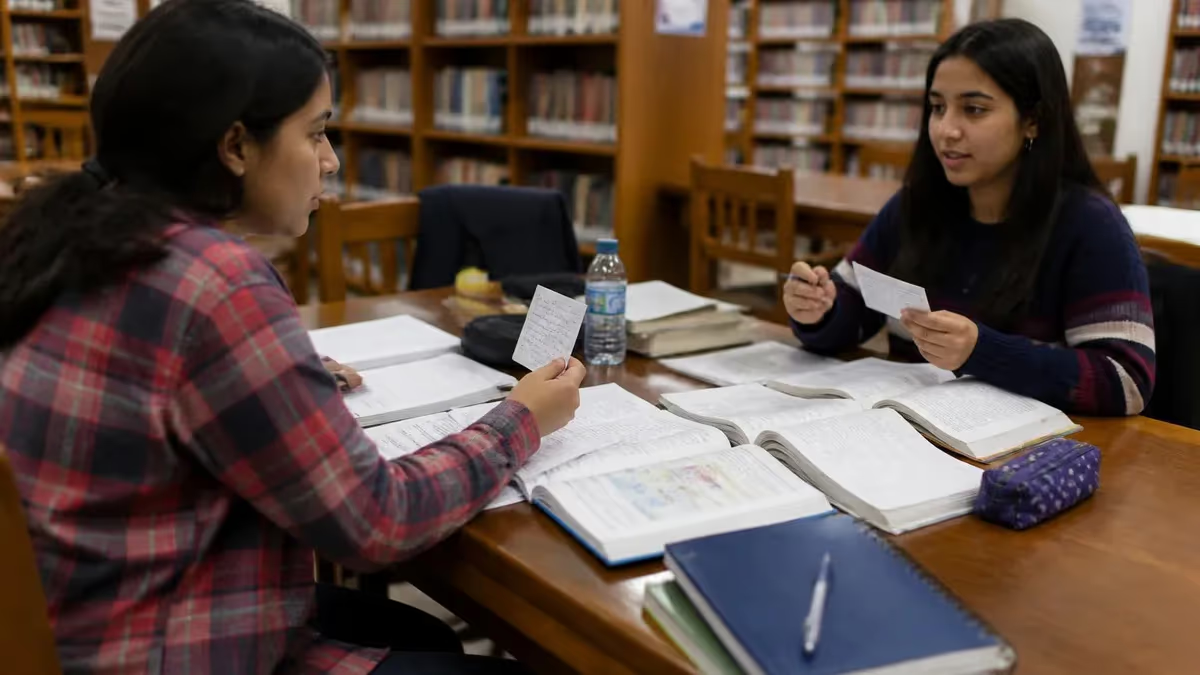
Mastering general knowledge facts is one of the most important steps any aspiring Florida educator can take before sitting for the General Knowledge Test. These facts span a remarkable breadth of human understanding — from historical events and scientific principles to literary works and economic systems — and they form the backbone of what the GKT measures. Understanding what kinds of facts matter, and why they matter for certification, gives you a decisive edge before you even open a study guide.
The Florida General Knowledge Test is a state-mandated certification exam required for all candidates seeking an initial professional teaching certificate. It evaluates whether prospective teachers have the broad intellectual foundation necessary to model lifelong learning for their students. The exam is not simply a trivia contest; it tests your ability to apply factual knowledge to reading comprehension, essay writing, and quantitative reasoning — skills that show up in every classroom every single day.
When educators speak about general knowledge facts, they typically mean the consolidated body of information that a well-educated adult is expected to know and use fluently. This includes awareness of major world events, foundational concepts in science and mathematics, core principles of economics, landmark works of art and literature, and the ongoing current-affairs landscape. Building this knowledge base does not happen overnight, but with deliberate study it is absolutely achievable within a focused preparation window.
One reason so many test-takers underestimate this exam is that they conflate broad knowledge with shallow trivia. In reality, the GKT expects you to do much more than recognize names and dates. You must understand context: why the Industrial Revolution reshaped labor markets, how the structure of the periodic table reflects atomic behavior, why certain Supreme Court decisions transformed civil rights. That contextual depth is what separates a passing score from a high score on this exam.
Effective preparation starts with an honest self-assessment. Most candidates have natural strengths — a history enthusiast will breeze through some questions, while a science teacher candidate will find other sections intuitive. The goal of a structured study plan is to identify and close the gaps, not simply to reinforce what you already know. Targeted practice with high-quality questions is the single most efficient way to do that work.
This article will walk you through the landscape of general knowledge facts that appear on the GKT, break down the major content categories, offer research-backed study strategies, and point you toward practice resources you can use right now. Whether you are beginning your preparation journey or doing a final review pass before your test date, the information here will help you approach the exam with confidence and clarity. Knowledge is not just power — for Florida teacher certification, it is a requirement.
GKT General Knowledge Facts by the Numbers

Major GKT Content Categories
Covers landmark novels, poetry, visual art movements, musical periods, and theater history. Expect questions on canonical authors like Shakespeare, Toni Morrison, and Hemingway, as well as art movements from the Renaissance through Modernism.
Focuses on foundational concepts in biology, chemistry, physics, and earth science. Questions also address major technological milestones, scientific methodology, and how discoveries such as DNA structure or quantum mechanics changed human understanding.
Tests knowledge of U.S. and world history, political systems, constitutional principles, and landmark legislation. Candidates should understand how historical causes connect to modern consequences at both national and international levels.
Addresses microeconomic and macroeconomic principles, market structures, fiscal and monetary policy, and basic business concepts. Understanding how supply, demand, and inflation interact is particularly important for this category.
Evaluates awareness of major domestic and global events, geopolitical trends, public policy debates, and emerging social issues. Staying current through reputable news sources in the weeks before the exam is a highly effective strategy.
Understanding why general knowledge facts matter extends well beyond passing a licensing exam. When teachers bring broad factual knowledge into the classroom, they create richer, more connected learning experiences for students. A history teacher who also understands the scientific context of an era can explain the Industrial Revolution in ways that resonate with science students. A language arts teacher who knows economic history can make Steinbeck's Great Depression novels come alive in ways a narrowly trained instructor simply cannot replicate.
The GKT was designed with exactly this cross-disciplinary vision in mind. Florida's Department of Education recognized that students benefit most from teachers who can draw connections across subject areas, model intellectual curiosity, and demonstrate that learning is a lifelong pursuit rather than a subject-specific task. The exam therefore does not limit itself to any single domain — instead, it samples broadly to ensure that candidates have the intellectual range their future students deserve.
From a practical testing standpoint, general knowledge facts also support strong performance on the essay and reading comprehension subtests. When you encounter a passage about climate science, familiarity with basic atmospheric concepts lets you read more efficiently and critically. When you are asked to write a persuasive essay on an educational policy topic, grounding your argument in real historical precedent makes it far more compelling. Factual knowledge is not separate from literacy skills — it is the substrate that makes those skills possible.
Research in cognitive science supports this connection strongly. A landmark study by literacy researcher E.D. Hirsch demonstrated that readers with greater background knowledge comprehend new texts faster, retain information longer, and make more accurate inferences than readers with limited prior knowledge — even when reading skill levels are equalized. This finding has profound implications for both teaching and test preparation: building your knowledge base is not a distraction from skill development, it is the most efficient path to it.
For GKT candidates, this means that study time spent reading broadly — not just drilling practice questions — delivers compounding returns. Every new fact you learn about, say, the causes of World War I or the mechanics of photosynthesis does not just prepare you for a specific question. It enriches your reading comprehension, sharpens your essay arguments, and makes the entire exam experience feel more manageable because the content feels familiar rather than foreign.
The practical implication is clear: treat general knowledge preparation as an investment in your professional identity as an educator, not merely as a box to check on the path to certification. Candidates who approach the GKT with genuine intellectual engagement — reading widely, staying curious, connecting ideas across domains — consistently outperform those who treat it as pure memorization. The exam is designed to reward depth of understanding, and that understanding comes from sustained, curious engagement with the world of ideas.
This holistic approach also reduces test anxiety significantly. When your knowledge feels organic rather than crammed, the exam questions feel like reasonable challenges rather than traps. You walk into the testing center not hoping to recognize facts but confident that you can work through any question that appears, because your preparation has been thorough, connected, and genuinely yours.
Study Strategies for General Knowledge Facts
Active recall is the most evidence-backed study technique available to GKT candidates. Instead of re-reading notes or highlighting text, force yourself to retrieve information from memory — close the book, write out everything you remember about a topic, then check your accuracy. This retrieval effort literally strengthens the neural pathways associated with that knowledge, making recall faster and more reliable on test day. Flashcard systems like Anki use spaced repetition to schedule reviews at the optimal moment before you would forget, maximizing efficiency per study hour.
For general knowledge facts specifically, active recall works best when you organize information into meaningful categories rather than isolated factoids. Create a mental map of each domain — history, science, arts, economics — and practice pulling entire networks of connected facts rather than single data points. When you remember that the Civil War ended in 1865, also recall the Reconstruction amendments, the economic causes of the war, and the literary works it inspired. Connected knowledge is retained far longer than isolated trivia and transfers much more powerfully to novel questions on the exam.
Broad Knowledge Base vs. Narrow Subject Focus for GKT Prep
- +Cross-domain knowledge improves reading comprehension across all GKT subtests simultaneously
- +Contextual understanding allows you to reason through unfamiliar questions rather than just recognize answers
- +Broad preparation mirrors the actual exam structure, which deliberately samples across many domains
- +Teachers with wide knowledge bases are more effective educators, so prep doubles as professional development
- +Familiarity with current affairs and history strengthens essay arguments on the writing subtest
- +Reduces test anxiety because no category feels entirely foreign or intimidating on exam day
- −Broad study requires more total time investment than a narrowly targeted review strategy
- −Risk of spending time on topics that happen not to appear on your specific test form
- −Harder to measure progress since there is no single completion milestone for 'general knowledge'
- −Some candidates over-invest in areas of natural strength rather than closing genuine weak spots
- −Current affairs knowledge can become outdated quickly if you prepare too far in advance of your test date
- −Without a structured plan, broad study can become unfocused and produce anxiety rather than confidence
Essential General Knowledge Facts Study Checklist
- ✓Complete a diagnostic practice test to identify your weakest knowledge domains before building a study schedule.
- ✓Create a subject-by-subject reading list that covers all five major GKT content areas over at least four weeks.
- ✓Study the U.S. Constitution, Bill of Rights, and landmark Supreme Court cases from both historical and analytical perspectives.
- ✓Review foundational science concepts — cell biology, atomic structure, laws of motion, and the scientific method.
- ✓Read summaries of at least 20 canonical works of literature and understand their historical and cultural context.
- ✓Follow a reputable daily news source for four to six weeks before your exam date to build current-affairs fluency.
- ✓Practice macroeconomic vocabulary including GDP, inflation, monetary policy, fiscal policy, and supply-demand curves.
- ✓Use flashcard decks organized by domain and review using a spaced-repetition schedule rather than random cramming.
- ✓Take at least two full timed practice exams under realistic conditions before your actual test date.
- ✓Review every incorrect practice answer carefully, identifying whether the error was a knowledge gap or a reasoning mistake.
Contextual Understanding Outperforms Memorization
Research consistently shows that test-takers who understand the 'why' behind facts — why events happened, how concepts connect, what consequences followed — outperform rote memorizers by a wide margin on higher-order exam questions. For GKT prep, this means building connected knowledge networks rather than isolated fact lists. When you understand context, you can reason through questions about events and concepts you have never seen before, turning partial knowledge into full credit.
Building a durable general knowledge foundation is fundamentally different from studying for a single subject exam. It requires you to become a more curious, more voracious reader in your daily life — not just during a formal study window. The good news is that this kind of broad intellectual engagement is intrinsically rewarding. When you start connecting the economic causes of historical events, or recognizing how scientific discoveries shaped literary movements, learning becomes genuinely enjoyable rather than an obligation.
One of the most effective approaches for building a knowledge foundation quickly is to use anchor facts — key dates, names, and concepts that serve as scaffolding for related information. In history, for instance, knowing that 1776 marked American independence, 1865 ended the Civil War, 1929 began the Great Depression, and 1969 landed humans on the moon gives you a chronological framework onto which you can attach dozens of related facts. Every time you learn a new historical detail, you ask: where does this fit on my timeline? That contextual placement dramatically improves retention.
In science, a similar anchoring strategy works beautifully. Understanding that all matter is made of atoms, that DNA carries genetic information, that energy is conserved across transformations, and that natural selection drives evolution gives you four conceptual pillars that support hundreds of more specific facts. When a GKT question asks about genetic inheritance or ecosystem dynamics, you can reason from your anchor principles even if you do not remember every specific detail. This principle-first approach is far more powerful than trying to memorize every textbook fact in isolation.
For arts and literature, building a mental timeline of major movements — Renaissance, Enlightenment, Romanticism, Realism, Modernism, Postmodernism — and understanding what social forces drove each transition creates a framework that makes individual works far more memorable. When you know that Modernist literature arose partly in response to the trauma of World War I and the collapse of Victorian certainties, T.S. Eliot's fragmented style in The Waste Land suddenly makes complete sense. The artwork becomes a window into history, and history illuminates the artwork.
Economics knowledge benefits from a similar systems-thinking approach. Rather than memorizing definitions, try to understand how the economy actually functions as an interconnected system. When the Federal Reserve raises interest rates, borrowing becomes more expensive, businesses invest less, unemployment may rise, and inflation typically slows. Walking through these causal chains repeatedly — in both directions — makes economic facts feel like logical consequences rather than arbitrary pieces of information to memorize. This causal fluency translates directly into correct answers on exam day.
Current affairs preparation is unique because it requires the most recent information and cannot be pre-loaded months in advance. The most efficient strategy is to spend the final four to six weeks before your exam reading a high-quality national newspaper or news aggregator for thirty minutes daily, focusing on major ongoing stories in politics, science, the economy, and international affairs. Do not try to memorize every story; instead, understand the major themes and debates of the moment. The GKT does not test obscure details — it tests whether you are an informed, engaged citizen of the modern world.
Finally, do not neglect the intersection between knowledge domains. Some of the most interesting and challenging GKT questions require you to connect information across categories — recognizing, for example, that a specific literary work was a direct response to a historical event, or that an economic policy debate has scientific dimensions. These cross-domain connections are precisely what the exam is designed to probe, because they demonstrate the kind of integrated intelligence that great teachers bring to their classrooms every day.

Many GKT candidates front-load their preparation with history, science, and literature — then arrive on test day underprepared for current-affairs questions. The exam regularly includes questions on recent developments in domestic policy, international relations, and emerging technology. Build a consistent daily news-reading habit starting at least four weeks before your scheduled exam date, and prioritize understanding the major ongoing debates rather than memorizing specific headlines.
As you move into the final phase of your GKT preparation, the focus should shift from acquisition to consolidation and confidence-building. You have spent weeks accumulating facts, building contextual frameworks, and identifying your knowledge gaps. Now the work is about ensuring that everything you have learned is reliably accessible under exam conditions — when the clock is ticking, the stakes feel high, and your brain is being asked to perform at its best.
One of the most underrated elements of final-phase preparation is sleep. Research on memory consolidation consistently shows that sleep is when the brain transfers information from short-term to long-term storage and strengthens the neural connections formed during waking study. Pulling all-nighters before the GKT is not just uncomfortable — it is genuinely counterproductive. You will retain more from eight hours of sleep after a moderate study session than from an additional four hours of exhausted reviewing. Protect your sleep schedule aggressively in the final week before your exam.
Physical exercise also plays a documented role in cognitive performance and stress regulation. Even thirty minutes of moderate aerobic exercise three to four times per week has been shown to improve memory, reduce anxiety, and enhance executive function — all of which translate directly into better exam performance. If you are not currently exercising regularly, adding short walks or light cardio to your daily routine during the preparation period is a low-cost, high-return investment in your test-day performance.
Practice test timing is another critical variable to address before exam day. Each GKT subtest has specific time limits, and many candidates discover during their first full simulation that pacing is a significant challenge. Develop a consistent time-management strategy for each section: know how many minutes per question you can spend on average, practice recognizing when to move on from a difficult item and return later, and rehearse the physical experience of sitting focused for an extended period. These habits must be built through practice, not invented on the day of the exam.
On the day before your exam, avoid intensive new studying. Instead, do a light review of your summary notes, confirm your test-center logistics, prepare your materials, and engage in relaxing activities that restore your energy. The information you need is already in your memory; the goal now is to arrive at the testing center in an optimal state — rested, calm, and ready to retrieve everything you have worked so hard to learn.
Many successful GKT candidates report that the most valuable thing they did in the final 48 hours was simply trusting their preparation. Anxiety in those final hours is normal and not a signal that you are unprepared — it is a signal that you care about the outcome, which is healthy and human. Redirect that energy by reviewing your strongest areas briefly to build momentum, then get a good night's sleep and show up ready to demonstrate what you know.
Remember that the GKT is designed to be passable for any candidate who has prepared thoroughly and honestly. The Florida Department of Education is not trying to trick you — it is trying to verify that you have the broad intellectual foundation to serve students well.
If you have followed a structured study plan, engaged seriously with all five content domains, and practiced consistently with high-quality materials, you have done the work. Trust the process, trust your preparation, and walk in ready to succeed. The effort you have invested in mastering these foundational facts will pay dividends not just on this exam but throughout your entire teaching career.
Putting all of your preparation together requires a practical daily routine that is sustainable, focused, and adaptive. The most effective GKT study plans share three characteristics: they are consistent (daily engagement beats weekly marathons), they are varied (mixing reading, flashcards, and practice questions prevents fatigue), and they are honest (regular self-testing keeps you grounded in what you actually know rather than what you think you know). Design your routine around these principles and you will make measurable progress every single week.
For candidates who work full-time, finding time to study broadly can feel daunting. The solution is micro-sessions: fifteen to twenty minutes of focused active recall during a lunch break, thirty minutes of subject reading before bed, one full-length practice section on weekend mornings. Research shows that distributed short sessions produce better long-term retention than infrequent marathon sessions, so this approach is not just convenient — it is genuinely more effective. The key is consistency and intentionality, not duration.
Study groups can be a powerful accelerator for general knowledge preparation, particularly for domains where you have less natural background. Teaching a concept to another person — or even explaining it aloud to yourself — forces you to identify gaps in your understanding that passive reading never reveals. If you can find two or three fellow GKT candidates to study with, a weekly session where each person teaches a different topic can cover enormous ground efficiently while building the collaborative skills that will serve you well as a classroom teacher.
Digital resources have made high-quality GKT preparation more accessible than ever. Free practice quizzes, subject-specific review videos, vocabulary flashcard decks, and current-events summaries are all available at no cost from reputable educational platforms. Use these resources strategically — not as a replacement for structured study but as supplements that reinforce and vary your practice. The best candidates combine structured self-study with targeted digital practice in a rhythm that keeps engagement high throughout the preparation period.
One commonly overlooked preparation strategy is reading primary sources in small doses. Reading the actual text of foundational documents — the Declaration of Independence, the Gettysburg Address, excerpts from The Federalist Papers, key Supreme Court opinions — builds the kind of deep familiarity that helps you answer nuanced questions about meaning, intent, and interpretation. These documents are short, freely available, and densely packed with the kind of foundational knowledge the GKT rewards. Even twenty minutes with a primary source often does more for your knowledge base than an hour of summarized notes.
As you approach your exam date, revisit your original diagnostic assessment and measure how far you have come. Seeing concrete evidence of your progress — questions you now answer confidently that once stumped you, domains that felt foreign but now feel accessible — builds the kind of genuine confidence that performs well under pressure. This is not about psyching yourself up artificially; it is about accurately recognizing that you have done real work and that work has produced real results. You know more than you did when you started, and that knowledge is yours.
The journey from unfamiliar test-taker to certified Florida teacher begins with exactly this kind of committed, broad-based intellectual preparation. Every fact you master, every concept you internalize, every connection you draw between domains is a brick in the professional foundation you are building. The GKT is not the end of that journey — it is the first formal milestone. Approach it as such, invest in your preparation with the same dedication you will bring to your classroom, and trust that thorough, honest study is the surest path to the score you need and the career you deserve.
GKT Questions and Answers

Florida General Knowledge Test: Complete Study Guide and Certification Prep

General Knowledge: Complete Study Guide and Practice

General Knowledge Trivia: Questions, Topics, and How to Practice

General Knowledge Test: Complete Guide to Preparation, Format, and Scoring

General Knowledge Quiz: How to Practice and Sharpen Your Recall
About the Author

Educational Psychologist & Academic Test Preparation Expert
Columbia University Teachers CollegeDr. Lisa Patel holds a Doctorate in Education from Columbia University Teachers College and has spent 17 years researching standardized test design and academic assessment. She has developed preparation programs for SAT, ACT, GRE, LSAT, UCAT, and numerous professional licensing exams, helping students of all backgrounds achieve their target scores.