
FTCE Professional Education Test: Complete Study Guide & Prep 2026 September
Master the FTCE Professional Education Test with our complete guide. Practice questions, exam format, study tips, and passing strategies. 🏆
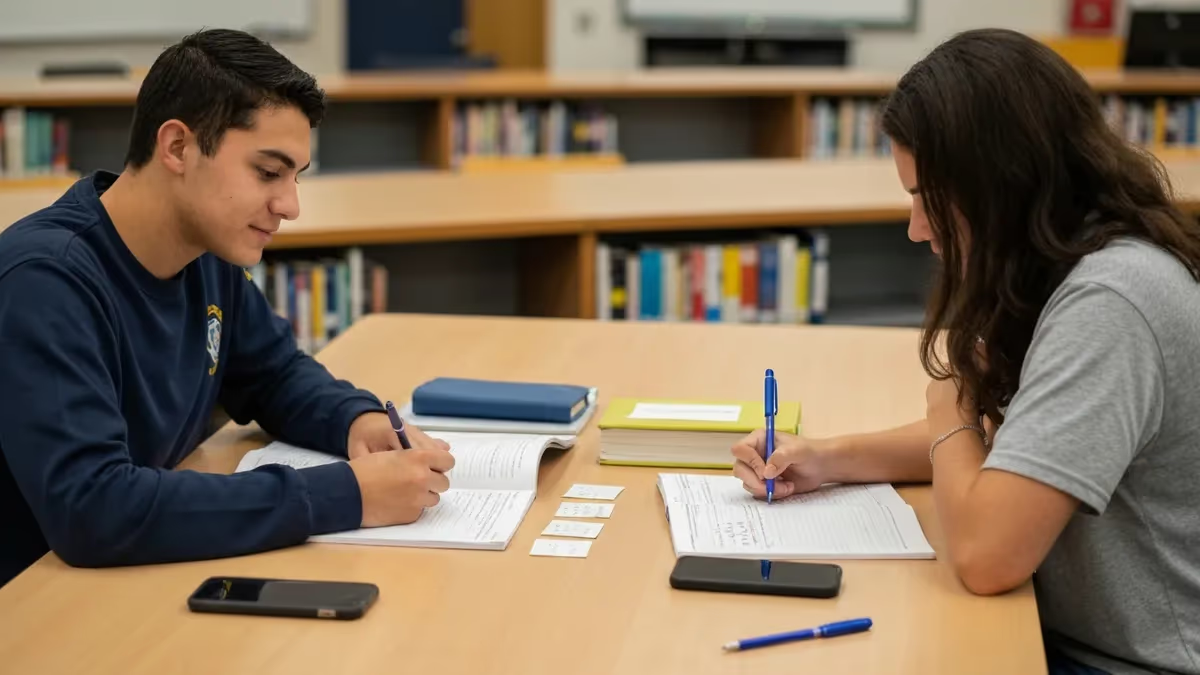
The ftce Professional Education Test is one of the most important certification exams aspiring Florida teachers must pass before earning their teaching certificate. This comprehensive assessment evaluates candidates on their knowledge of human development, learning theory, classroom management, instructional design, assessment, and professional ethics. Whether you are just beginning your preparation or refining your final-week strategy, understanding the structure and content of this exam is the single most important step toward passing on your first attempt.
The FTCE exam system is administered by the Florida Department of Education and is required for all individuals seeking to become certified public school teachers in the state. The Professional Education Test, in particular, is unique because it is not subject-specific — every teacher candidate, regardless of the grade level or subject they intend to teach, must pass this test. That means your score directly affects your career timeline, making thorough preparation non-negotiable for anyone serious about entering the classroom.
Many test-takers underestimate the depth of knowledge required for this exam. The ftce test covers a broad range of pedagogical concepts drawn from educational psychology, curriculum theory, instructional technology, and state and federal legal mandates. Topics such as the Individuals with Disabilities Education Act (IDEA), Section 504 accommodations, differentiated instruction, formative versus summative assessment, and Florida's Code of Ethics are all fair game. Students who rely solely on surface-level review often find themselves unprepared for the nuanced, scenario-based questions the exam presents.
One of the most effective ways to build confidence before test day is to simulate the real testing environment through targeted practice. Using a quality ftce practice test allows you to identify content weaknesses, build familiarity with the question format, and manage your pacing across the full 3-hour testing window. Timed practice also reduces the anxiety that many candidates experience when they sit down in front of a computer at a Pearson VUE testing center for the first time.
The scoring system for the FTCE Professional Education Test requires candidates to achieve a minimum score of 200 on a scale of 100 to 300. The passing threshold was established to ensure that all Florida teachers demonstrate a baseline level of pedagogical competence. According to historical data from the Florida Department of Education, roughly half of first-time test takers pass the exam on their initial attempt — meaning that candidates who prepare thoroughly have a measurable statistical advantage over those who walk in without a structured study plan.
This guide is designed to give you everything you need to succeed: a breakdown of the exam format, deep-dive content reviews, study schedules, and actionable strategies proven to raise scores. We will cover the major competency areas tested, explain how questions are constructed, offer tips on eliminating wrong answers, and point you toward the best free and low-cost practice resources available online. By the end of this guide, you will have a clear roadmap to passing the FTCE Professional Education Test with confidence.
Whether you are a recent college graduate completing your education degree, a career-changer pursuing an alternative certification pathway, or a returning professional updating your credentials, this resource is built for you. Florida's teacher certification requirements are rigorous by design, and the Professional Education Test sits at the center of that rigor. Invest time in preparation now, and you will walk out of your testing appointment ready to begin the most rewarding career imaginable — shaping the lives of Florida's next generation of students.
FTCE Professional Education Test by the Numbers
Key Facts at a Glance
| Item | Value | Details |
|---|---|---|
| Total Questions | 120 | Multiple-choice format |
| Testing Time | 3 hrs | Timed computer-based exam |
| Passing Score | 200 | On a 100–300 point scale |
| Registration Fee | $150 | Per exam attempt |

FTCE Professional Education Test: Exam Format
| Section | Questions | Time | Weight | Notes |
|---|---|---|---|---|
| Human Development & Learning | 24 | ~36 min | 20% | Cognitive, social, emotional development theories |
| Instructional Design & Planning | 24 | ~36 min | 20% | Lesson planning, curriculum alignment, objectives |
| Classroom Management & Communication | 18 | ~27 min | 15% | Behavior management, parent communication |
| Assessment | 18 | ~27 min | 15% | Formative, summative, standardized assessments |
| Diversity, ESE & Technology | 24 | ~36 min | 20% | ELL, IEP, assistive technology, differentiation |
| Ethics, Legal Issues & Professional Conduct | 12 | ~18 min | 10% | Florida Code of Ethics, IDEA, FERPA |
| Total | 120 | 3 hours | 100% |
Understanding the core content areas of the FTCE Professional Education Test is essential for building a targeted and efficient study plan. The exam tests six major competency domains, each of which reflects real responsibilities that classroom teachers handle every day. Rather than memorizing isolated facts, successful candidates learn to apply educational theory to realistic classroom scenarios — the exact format used throughout the test. This applied approach is what separates a 220 score from a 180 score on exam day.
The Human Development and Learning domain draws heavily from the work of foundational theorists including Jean Piaget, Lev Vygotsky, Erik Erikson, Benjamin Bloom, and Howard Gardner. You should be able to distinguish between Piaget's stages of cognitive development and Vygotsky's concept of the Zone of Proximal Development, and explain how each theory informs instructional decision-making. Questions in this domain often present a grade-level classroom scenario and ask you to select the instructional strategy that best aligns with students' developmental stage — making theoretical knowledge directly actionable.
Instructional Design and Planning is the domain where many educators feel most confident because it mirrors what they practiced in their teacher preparation programs. However, the ftce exam tests this knowledge at a higher cognitive level than most candidates expect. You must understand the difference between learning objectives written at Bloom's Knowledge level versus Analysis or Synthesis levels, and you must be able to identify when a lesson plan is misaligned with its stated objectives. Backward design — starting with the desired learning outcome and working backward to instructional activities — is a framework that appears repeatedly in this domain.
Classroom Management and Communication questions on the FTCE Professional Education Test frequently involve ethical dilemmas or challenging parent-teacher interactions. You will be asked to select the most appropriate response to a student with disruptive behavior, or to choose the best way to communicate a concern to a parent during a conference. Effective classroom managers, as defined by the exam, create structured, predictable environments; use consistent, fair consequences; and build positive relationships with students before behavioral issues arise. Research-based management models like Harry Wong's First Days of School approach are highly relevant here.
Assessment is a domain that encompasses far more than grades and tests. The FTCE expects candidates to understand the differences between formative assessments (ongoing checks for understanding during instruction) and summative assessments (evaluations at the end of a unit or course). Candidates must also understand concepts such as validity, reliability, rubric design, portfolio assessment, and data-driven instructional adjustments. A key principle the exam returns to repeatedly is that assessment should always serve the student's learning, not merely produce a grade for administrative purposes.
The Diversity, ESE, and Technology domain reflects Florida's diverse student population and the legal requirements that govern how schools serve all learners. Candidates must understand the requirements of the Individuals with Disabilities Education Act (IDEA), including the mandate for a Free Appropriate Public Education (FAPE) in the Least Restrictive Environment (LRE). Questions on English Language Learners (ELL) instruction will ask you to identify appropriate scaffolding strategies, and technology questions will assess your understanding of how digital tools can enhance instruction for all learners, including those with disabilities who rely on assistive technology.
Ethics, Legal Issues, and Professional Conduct is a smaller domain by question count but one that candidates frequently underestimate. Florida's Code of Ethics for the Education Profession outlines the professional obligations of every teacher in the state, and violations can result in certificate revocation.
The ftce exam presents scenarios involving mandatory reporting of child abuse, conflicts of interest, appropriate social media conduct, and professional boundaries between teachers and students. Knowing the letter of the law — not just the spirit — is critical for answering these questions correctly, because the exam often presents options that seem reasonable but technically violate professional standards.
FTCE Test Prep Strategies by Study Phase
During the first three weeks of FTCE test prep, your primary goal is to build a comprehensive understanding of all six competency domains without worrying about speed. Begin by downloading the official Competency and Skills Required for Teacher Certification in Florida document from the Florida Department of Education website. Read through each competency carefully, then create a personal knowledge inventory — rating yourself on a scale of 1 to 5 for each sub-skill. This honest self-assessment tells you exactly where to invest the most study time rather than reviewing material you already know confidently.
Use your foundation-building weeks to read through textbooks, review your teacher preparation coursework notes, and watch instructional videos on topics where your self-assessment revealed gaps. Focus especially on educational psychology theories, legal frameworks like IDEA and FERPA, and the Florida Code of Ethics. Create flashcards or a dedicated study journal for key terms and theorists. At this stage, do not yet attempt full-length practice exams — instead, take short 10- to 20-question topical quizzes to reinforce each domain after you study it.
Is the FTCE Professional Education Test Hard? Honest Assessment
- +Comprehensive study guides and free practice resources are widely available online
- +The exam can be retaken if you do not pass on your first attempt
- +Passing the test demonstrates genuine pedagogical competence to employers
- +The 3-hour testing window provides reasonable time per question (about 90 seconds each)
- +Scenario-based questions reward real teaching knowledge over rote memorization
- +Florida's large education system means abundant peer support communities and study groups
- −The ~54% first-time pass rate means nearly half of candidates need to retake the exam
- −A $150 registration fee applies each time you register, adding up quickly with multiple attempts
- −The breadth of content across six domains requires sustained multi-week preparation
- −Scenario-based questions can feel ambiguous when two answer choices both seem reasonable
- −Test results are not immediate — official score reports take several days to arrive
- −Failing the exam can delay certificate issuance and job start dates, creating financial pressure
FTCE Test Prep Checklist: 10 Steps to Passing
- ✓Download and read the official Florida DOE Competency and Skills document for the Professional Education Test.
- ✓Complete a personal knowledge inventory to identify your strongest and weakest content domains.
- ✓Create a 6-week study schedule with daily goals and weekly practice milestones.
- ✓Study all major educational theorists: Piaget, Vygotsky, Bloom, Erikson, Gardner, and Bandura.
- ✓Memorize key legal mandates: IDEA, FAPE, LRE, FERPA, Section 504, and ADA requirements.
- ✓Review Florida's Code of Ethics and the Principles of Professional Conduct for the Education Profession.
- ✓Take at least four full-length, timed practice tests before your scheduled testing appointment.
- ✓Analyze every wrong answer by root cause — content gap, misread question, or poor elimination.
- ✓Practice answering scenario-based questions by focusing on student-centered and research-based responses.
- ✓Confirm your testing appointment, prepare your ID, and plan your route to the Pearson VUE testing center.

Student-Centered Instruction Wins Every Time
When two answer choices both seem correct on the FTCE Professional Education Test, always select the option that prioritizes student needs, student learning, and student voice over teacher convenience or administrative efficiency. The exam is built on a constructivist framework where the best teachers facilitate learning rather than simply deliver content — and that philosophy is embedded in the correct answer to dozens of questions across every domain.
Registration for the FTCE Professional Education Test is managed through the Pearson VUE testing platform, which serves as the official third-party test administrator for the Florida Department of Education. To register, you must first create an account on the Florida Teacher Certification Examinations website, then select the Professional Education Test from the available exam list.
Testing appointments are available at Pearson VUE testing centers throughout Florida and, in some cases, at remote proctored locations for candidates who cannot travel to a physical center. Registration fees are paid at the time of scheduling and are non-refundable unless you cancel within the allowable window.
Your official score report will be available online approximately three to four weeks after your testing date, though some results are released sooner. Scores are reported on a scale of 100 to 300, and you must achieve a minimum score of 200 to pass. If you pass, your score is submitted automatically to the Florida Department of Education and becomes part of your certification application. If you do not achieve the passing score, your score report will show a performance profile breaking down your results by competency area — this data is invaluable for planning a more targeted retake strategy.
Candidates who do not pass on their first attempt are permitted to retake the exam. Florida allows unlimited retakes of the FTCE Professional Education Test, but each registration requires payment of the full $150 fee. There is a 31-day waiting period between consecutive attempts, which is actually a benefit — it gives you time to study the specific competency areas where your score report indicated weakness.
Many candidates who fail by just a few points on their first attempt pass comfortably on the second attempt when they use their score report as a diagnostic tool and invest those 31 days in focused, targeted review.
The scoring algorithm for the FTCE exams uses a process called equating to ensure fairness across different test forms. This means that a slightly harder form of the exam may require fewer correct answers to achieve the same scaled score of 200, while an easier form may require more.
In practical terms, there is no advantage to taking the exam on a specific date based on form difficulty — the equating process ensures that a 200 always represents the same level of competency regardless of which test form you receive. What this means for test-takers is simple: focus entirely on mastering the content rather than gaming the system.
Florida's teacher certification requirements extend beyond the Professional Education Test. Most candidates must also pass one or more subject area examinations specific to the grade level and content area they intend to teach. For example, an aspiring high school English teacher must pass the FTCE English 6–12 subject area exam in addition to the Professional Education Test. The good news is that the study habits and test-taking strategies you develop while preparing for the Professional Education Test will transfer directly to your subject area exam preparation, because the question format and testing environment are identical across all FTCE exams.
Many candidates are surprised to learn that the FTCE Professional Education Test score does not expire. Once you pass the exam, that passing status remains on your Florida certification record permanently. This means that even if you step away from teaching for several years and later return to the classroom, you will not need to retake the Professional Education Test — as long as your passing score is on record with the Florida Department of Education.
This policy reflects the state's recognition that pedagogical knowledge, once mastered, does not fundamentally change, even if specific curriculum standards and legal frameworks are periodically updated.
Candidates preparing for the ftce exams should also investigate whether their teacher preparation program offers any built-in preparation support. Many Florida university education programs include FTCE preparation workshops, practice test libraries, and study group coordination as part of their student support services. If your program offers these resources, take full advantage of them — they are often free and specifically aligned to the Florida competencies.
Additionally, several counties in Florida's public school systems offer alternative certification candidates access to preparation materials as part of the district's recruitment pipeline, recognizing that passing rates directly affect the district's ability to staff classrooms with qualified teachers.
If you are applying for a Florida teaching certificate with a start-of-school-year deadline, be aware that FTCE score reports take 3–4 weeks to post. Plan your testing appointment at least 6 weeks before any certificate application deadline to allow time for score release and processing. Taking the exam too close to a job offer deadline is one of the most common — and most preventable — causes of delayed certification for new Florida teachers.
One of the most common mistakes that FTCE Professional Education Test candidates make is treating the exam like a knowledge quiz rather than a professional judgment assessment. The test is specifically designed to evaluate how you think as an educator, not merely what facts you have memorized.
Questions are constructed around realistic classroom scenarios involving a specific grade level, a specific student population, and a specific instructional challenge. Your job as the test-taker is to select the response that a competent, ethical, student-centered professional would choose — not necessarily the response you personally find most comfortable or most familiar from your own school experience.
A second major mistake is neglecting the legal and ethical domains in favor of the more familiar instructional design content. Many candidates with strong backgrounds in curriculum and lesson planning spend the bulk of their study time reviewing what they already know well, while avoiding the IDEA requirements, Florida Code of Ethics provisions, and mandatory reporting obligations that feel less comfortable.
This is a strategic error. The legal and ethical domain questions are among the most predictable on the exam because they test specific statutory language — and candidates who study those specifics systematically can often score perfectly in this domain with two to three focused study sessions.
Test anxiety is another obstacle that affects a significant number of FTCE candidates, particularly those who have been out of school for several years and are not accustomed to high-stakes testing. The most effective evidence-based strategy for managing test anxiety is systematic desensitization through repeated exposure — in other words, taking many timed practice tests in a realistic environment until the testing experience itself feels routine and manageable. The anxiety typically diminishes not because the stakes decrease, but because your brain stops treating the testing situation as novel and threatening. Think of practice tests as conditioning runs before a race.
Time management during the actual exam is something candidates should deliberately practice, not leave to improvisation. With 120 questions and 180 minutes available, you have exactly 90 seconds per question on average. In practice, most questions can be answered in 60 to 75 seconds, leaving you a buffer to spend extra time on more complex scenarios.
The recommended strategy is to answer every question on your first pass, flagging any that required a guess or left you uncertain. Once you have answered all 120 questions, return to your flagged items with fresh eyes — you will often find that subsequent questions triggered the memory or reasoning you needed earlier.
Reading each question stem carefully is critical, because FTCE questions are precisely worded and a single word can change the correct answer. Pay particular attention to qualifiers like "most appropriate," "least effective," "first," and "primary" — these words narrow the answer space significantly and are placed deliberately to test whether you read with precision. A question asking for the "most appropriate" action is fundamentally different from one asking for the "first" action, even if the same answer choices appear. Train yourself during practice sessions to underline or mentally highlight these key qualifiers before selecting an answer.
Candidates who are serious about their ftce test preparation should also build familiarity with the specific vocabulary and terminology used in Florida's educational standards and frameworks. The exam is written by Florida educators and reflects Florida-specific language, including references to the Florida Standards (formerly Common Core), the Every Student Succeeds Act (ESSA), and Florida's tiered Multi-Tiered System of Supports (MTSS) framework. Candidates who can recognize and correctly use this terminology are better positioned to identify correct answer choices because the vocabulary of the question and the vocabulary of the correct answer align more clearly to Florida's official frameworks.
Finally, remember that passing the FTCE Professional Education Test is ultimately a milestone in a much longer professional journey, not an endpoint in itself. Florida requires teachers to complete annual professional development, maintain their certification through renewal every five years, and stay current with changes to state and federal education law throughout their careers.
The habits of mind you build while preparing for this exam — researching best practices, studying legal frameworks, reflecting on ethical dilemmas — are the same habits that characterize excellent teachers throughout their careers. The exam is challenging by design because teaching is challenging by nature, and passing it is your first professional demonstration that you are ready to meet that challenge every single day in the classroom.
Practical preparation for the FTCE Professional Education Test begins long before you open a study guide. The first step every serious candidate should take is setting a realistic testing date that gives them at least six weeks of dedicated preparation time.
Six weeks is not arbitrary — it reflects the amount of time required to cycle through all six competency domains at least twice: once for initial learning and once for review and practice application. Candidates who compress preparation into two or three weeks often find that their scores hover just below the passing threshold, requiring a retake that could have been avoided with a more patient timeline.
Building a daily study habit is more effective than marathon weekend sessions. Cognitive science research consistently shows that spaced repetition — reviewing material in short, frequent sessions over an extended period — produces stronger long-term retention than massed practice in a single sitting. Aim for 45 to 60 minutes of focused FTCE study each day rather than four-hour Saturday sessions that leave you mentally drained. Use weekday evenings for content review and save weekends for full-length practice tests, which require a larger uninterrupted block of time to simulate authentic testing conditions.
Study groups can be a powerful tool when structured effectively. The key is to ensure that group sessions are focused on active problem-solving — working through practice questions together, explaining concepts to each other, and debating answer choices — rather than passive review of notes. When you explain a concept aloud to another person, your brain processes it more deeply than when you simply read it silently. If you cannot find a study partner who is preparing for the same exam, consider recording yourself explaining key concepts and then listening back to those recordings during commute time or while exercising.
Organizing your notes around the six competency domains rather than by chapter or textbook order is a highly effective structural strategy. Create a dedicated section in your study journal for each domain, and add to it continuously as you encounter new information. This organizational approach makes review much more efficient in the final week because you can quickly access everything you know about, for example, the Assessment domain without hunting through linear notes spread across multiple notebooks. Color-coding by domain is a visual memory aid that many successful test-takers swear by.
When practicing with scenario-based questions, develop a habit of reading the question stem first and the answer choices second — never simultaneously. Reading the stem first activates your prior knowledge and primes your brain to evaluate answer choices critically rather than reactively.
Once you have read the stem and formed an initial response in your own words, then read the answer choices and select the one that most closely matches your independent response. This active recall approach reduces the influence of cleverly worded distractors that exploit test-takers who read questions and answers simultaneously and allow the wrong options to contaminate their thinking.
In the final 48 hours before your exam, shift your focus entirely away from new content and toward rest, logistics, and mental rehearsal. Mental rehearsal — visualizing yourself walking confidently into the testing center, reading questions calmly and methodically, flagging uncertain items and returning to them — is a technique used by elite athletes and performers that transfers directly to high-stakes academic testing.
Research published in sport psychology and educational psychology journals consistently shows that positive visualization reduces physiological stress responses and improves performance under pressure. Your brain responds to vividly imagined scenarios in ways that parallel its response to real experiences.
After you pass the FTCE Professional Education Test, take a moment to reflect on the preparation process and document what worked best for you. These insights will be invaluable when you begin preparing for any additional subject area examinations you need to complete your certification.
Florida's teacher certification pathway is multi-exam for most candidates, and the test-taking strategies, study habits, and content organization systems you developed for the Professional Education Test will serve you throughout the rest of your certification journey. The skills you build preparing for this exam are, in the truest sense, professional development that begins on day one of your teaching career.
FTCE Questions and Answers
About the Author

Educational Psychologist & Academic Test Preparation Expert
Columbia University Teachers CollegeDr. Lisa Patel holds a Doctorate in Education from Columbia University Teachers College and has spent 17 years researching standardized test design and academic assessment. She has developed preparation programs for SAT, ACT, GRE, LSAT, UCAT, and numerous professional licensing exams, helping students of all backgrounds achieve their target scores.
Join the Discussion
Connect with other students preparing for this exam. Share tips, ask questions, and get advice from people who have been there.
View discussion (8 replies)