
Fireteam Test Practice: Free NTN Study Guide 2026 September
Boost your ntn fireteam practice test exam score with practice questions and detailed answer explanations. 🟢 Track your progress with instant feedback.
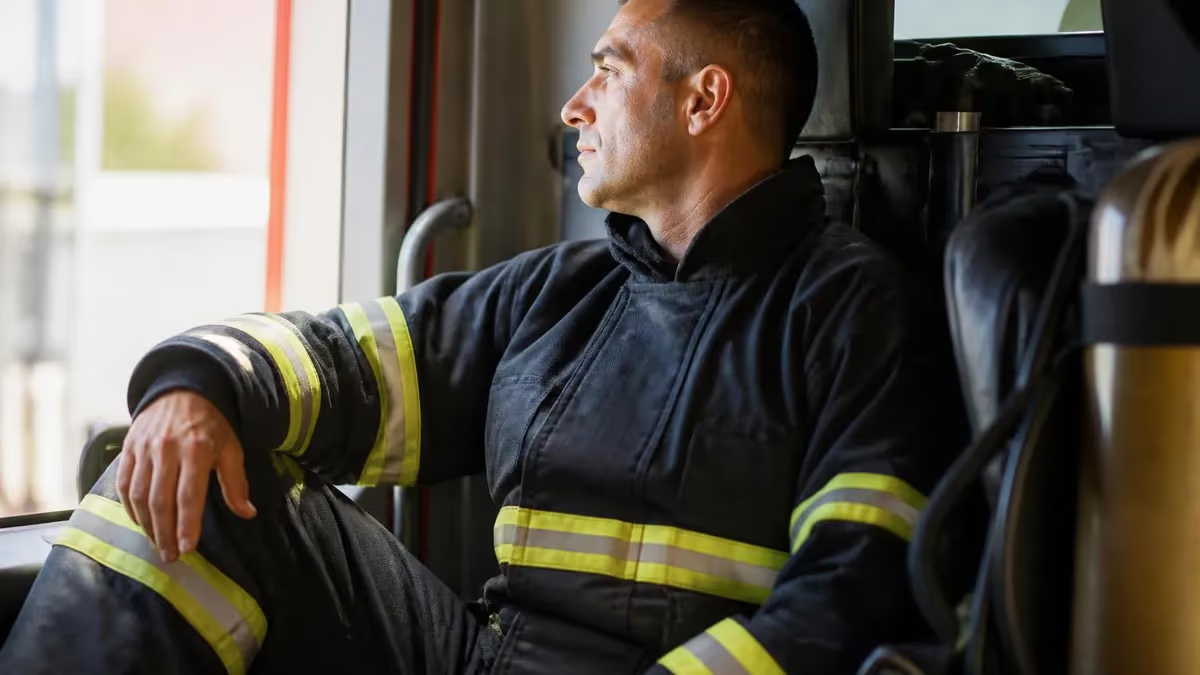
What Is the NTN FireTEAM Test?
The NTN FireTEAM assessment is a multi-component cognitive and behavioral exam designed specifically for firefighter candidate screening. Developed by Ergometrics and marketed through National Testing Network, it's one of the most widely used pre-employment tools in fire service hiring across North America. Fire departments contract with NTN to administer and score the test, which means your score travels with you — you can share a single test result with multiple departments that use NTN's platform, saving you the cost and time of retesting at each agency.
The fireteam test evaluates skills that directly map to firefighter job demands. The human relations components assess how you handle interpersonal conflict, work within a chain of command, and communicate with the public under stress. The cognitive sections — reading, math, reasoning — measure your ability to process written instructions, perform calculations, and draw logical conclusions from evidence. Mechanical aptitude measures understanding of tools, forces, and physical systems relevant to firefighting equipment. Departments weight these sections differently based on their hiring priorities, but strong performance across all areas gives you the best competitive standing.
Scores are reported as a percentile relative to other candidates who took the same test. A score in the 70th percentile or higher is typically competitive for entry-level positions, though hiring thresholds vary by department. Some high-demand departments in major cities may only interview candidates in the 85th percentile or above. You won't receive a raw score — only your percentile ranking — which makes it important to prepare thoroughly rather than just aim to pass a cutoff. The goal is to outperform as many other candidates as possible.
The test is administered at NTN testing centers in cities across the country, or remotely in some cases through proctored online testing. When a department opens a hiring process, they typically direct candidates to NTN's website to register, pay the testing fee (around $55-65), and schedule a test appointment. You can usually choose any testing site nationwide, not just one near the hiring department.
Your test score is valid for a defined period — typically 12 months — during which you can share it with multiple departments without retesting, as long as those departments accept NTN scores. Many candidates take the test proactively before a specific department opens hiring, so their score is ready when applications open.
Preparation matters significantly on the FireTEAM. The cognitive sections are timed, and candidates who haven't practiced under timed conditions consistently underperform compared to their true ability. The situational judgment sections draw on scenarios that seem intuitive but have specific correct answers based on firefighter values and protocols — guessing without study leads to lower scores than systematic preparation. We'll cover preparation strategies in detail in the sections below, but the core principle is practice: working through sample questions in each section before your test date is the single most effective preparation strategy.
The ntn fireteam test is distinct from physical ability tests (PAT/CPAT) and oral board interviews. Candidates who score well on the FireTEAM still need to complete the full hiring process. However, a strong FireTEAM score opens the door — departments often use it as an initial screen before extending any other invitations. Candidates below department scoring thresholds are typically not advanced to later stages regardless of their other qualifications, making this test a high-priority step in the firefighter hiring process.
FireTEAM Test Format
| Section | Questions | Time |
|---|---|---|
| Written Human Relations | 30 | — |
| Video Human Relations | 20 | — |
| Math Skills | 25 | — |
| Mechanical Aptitude | 30 | — |
| Reading Comprehension | 20 | — |
| Reasoning | 25 | — |
FireTEAM Test Sections: What to Expect and How They Work
The Written Human Relations section is the largest component by question count and arguably the most important to understand conceptually before sitting the test. Each question presents a realistic workplace scenario — a disagreement with a coworker, a request from a supervisor, a difficult interaction with a member of the public — and asks you to choose the most appropriate response from four options.
The 'correct' answer isn't always the most assertive or the most passive; it's the one that best reflects firefighter values of teamwork, respect for authority, community service, and professional judgment. Candidates who approach this section with an intuitive 'what would I do?' mindset often choose answers that seem reasonable in a general workplace but miss the firefighting context. Study the values and culture of the fire service before testing.
The Video Human Relations section operates on the same concept as the written version but uses video scenarios. You watch a brief clip depicting a workplace situation and answer questions about what response would be most appropriate. The video format adds realism — you see tone, body language, and context that written questions can't convey. This section tests emotional intelligence and situational awareness more than the written version. Pay attention to how the characters in the video are behaving, not just what they're saying. The emotional undercurrent of a scene often signals the best response.
The Math Skills section covers arithmetic that's directly applicable to firefighter work: calculating hose flow rates, medication dosages, ladder angles, water supply requirements, and basic financial math for department budgets. You don't need advanced algebra or calculus — but you do need to be fast and accurate with arithmetic, fractions, percentages, and unit conversions.
The time pressure is real: 25 questions in 30 minutes gives you about 72 seconds per question. Calculator use is typically not permitted, so mental math fluency is essential. Practice mental calculation of percentages and fractions in the weeks before your test — this skill degrades quickly without exercise.
The Mechanical Aptitude section uses diagrams showing pulleys, gears, levers, inclined planes, and hand tools. Questions ask which direction a gear turns when another turns clockwise, how much force a lever requires, which tool is appropriate for a given task, or how a pulley system changes mechanical advantage. You don't need engineering knowledge — the concepts are middle-school physics.
But many candidates are rusty on mechanical principles if they haven't worked in a trades or mechanical environment. A focused review of simple machines, basic physics of force and motion, and common hand tools covers most of what appears on this section. The fireteam practice test free resources available on this site include mechanical aptitude sample questions to help you identify gaps.
The Reading Comprehension section presents passages — often excerpts from fire department SOPs, incident reports, or training materials — followed by comprehension questions. Questions test whether you understood what you read, not prior knowledge. Read actively: underline or mentally note key procedural steps, numbers, conditions, and qualifications in each passage. Time is allocated per passage, so you can't skip around. If you're a slow reader, this section requires dedicated speed-reading practice. Many candidates lose points here not because they don't understand the material but because they run out of time before answering all questions.
The Reasoning sections — deductive and inductive — test your ability to apply logic to structured problems. Deductive reasoning gives you premises and asks you to identify valid conclusions; inductive reasoning gives you examples and asks you to identify the rule they follow. Information Ordering questions present a set of steps out of sequence and ask you to arrange them correctly.
Spatial Orientation tests your ability to follow directions on a map or navigate a described route. These sections are the most trainable through practice — the question formats are consistent, and working through examples familiarizes you with the reasoning patterns expected. Score improvements of 10-15 percentile points from practice alone are common on the reasoning subtests.

How to Prepare for the NTN FireTEAM Test
Effective preparation for the FireTEAM starts 4 to 6 weeks before your test date. This gives you enough time to systematically cover all six sections without cramming, and enough time to retrain weak areas before the test. Cramming the night before is actively counterproductive for an assessment that depends on pattern recognition, quick calculation, and instinctive judgment — these skills need repetition over time, not last-minute study. Block 30-45 minutes per day for focused preparation, and cycle through sections rather than drilling the same area repeatedly.
For the Math Skills section, identify your specific weak areas first. Take a diagnostic practice set of 25 questions under timed conditions and score yourself. Most candidates find either fractions and percentages or word problem translation to be their gap. If fractions trip you up, spend a week on nothing but fraction operations: addition, subtraction, multiplication, division, and conversion between fractions, decimals, and percentages. If word problems are the issue, practice translating English sentences into mathematical operations — breaking down what the problem is actually asking before starting to calculate. This diagnostic-then-targeted approach is more efficient than generic review.
Mechanical aptitude preparation benefits from visual practice. Find a set of mechanical reasoning diagrams — gears, pulleys, levers, inclined planes — and work through them until the principles feel automatic. For gears: adjacent gears turn in opposite directions, and speed is inversely proportional to tooth count. For pulleys: each additional supporting rope reduces required force proportionally. For levers: force times distance on one side equals force times distance on the other.
Once these relationships are internalized, applying them to novel diagrams becomes fast and reliable. Candidates who've worked in construction, mechanics, or skilled trades often find this section straightforward; candidates from purely office or service backgrounds typically need deliberate mechanical reasoning practice. The firefighter exam preparation resources on this site include mechanical aptitude drill exercises that follow the same format as FireTEAM questions.
Human relations preparation requires a different approach — understanding the underlying value framework rather than memorizing specific answers. The FireTEAM human relations questions don't have published answer keys available (unlike standardized tests), so you can't study answers directly.
Instead, study the firefighter code of conduct, the importance of chain of command in fire service, how the best firefighters handle conflict (address it directly but respectfully, involve supervision when needed, prioritize team function over personal ego), and the values emphasized in firefighter training programs. Ride-along programs, informational interviews with firefighters, and reading about fire service culture all build the context that makes human relations questions more intuitive. The fireteam study guide sections on human relations cover these values in depth.
For reading comprehension, improve your reading efficiency rather than your comprehension — most candidates understand what they read, they just read slowly. Practice reading technical procedure documents and summarizing the key steps in 30-second mental recalls. Time yourself on 500-word passages and work to reduce your reading time while retaining comprehension accuracy. Active reading — questioning what you're reading as you go, noting key numbers and conditional statements — is more valuable than passive re-reading of the same material. On test day, the passages will be unfamiliar, but your reading process will be practiced.
Schedule a full-length practice run of all sections 5-7 days before your test. This reveals any remaining weak spots you have time to address, and it calibrates your sense of the pacing required. On test day itself, sleep 7-8 hours, eat a full meal, and arrive 15 minutes early. The cognitive fatigue from 3 hours of timed testing is real — candidates who are physically and mentally fresh consistently outperform those who are tired or distracted. Treat this test as you would treat the beginning of a firefighter shift.
FireTEAM Test Study Tips
What's the best study strategy for FireTEAM Test?
Focus on weak areas first. Use practice tests to identify gaps, then study those topics intensively.
How far in advance should I start studying?
Most successful candidates begin 4-8 weeks before the exam. Create a structured study schedule.
Should I retake practice tests?
Yes! Take each practice test 2-3 times. Focus on understanding why answers are correct, not memorizing.
What should I do on exam day?
Arrive 30 min early, bring required ID, read questions carefully, flag difficult ones, and review before submitting.
FireTEAM Preparation by Section
What it tests: Situational judgment, conflict resolution, chain of command, public interaction
Best prep approach: Study fire service values and culture, not just scenario tactics. Understand when to escalate issues vs. handle independently.
Key principle: Address problems directly and respectfully before involving supervisors. Teamwork and unit function take priority over individual preferences.
Common mistake: Choosing answers that sound 'nice' rather than answers that reflect fire service norms. Passive avoidance of conflict often scores lower than direct but respectful confrontation.

FireTEAM Scoring, Results, and What Comes Next
Your NTN FireTEAM results are reported as percentile scores — your position relative to the full population of candidates who have taken the assessment. You'll typically receive subscores for each section as well as a composite score. NTN reports results to registered departments automatically, and you can also share your score with any additional NTN-affiliated department through your account dashboard. This is one of the major practical advantages of the FireTEAM platform: a single test investment reaches hundreds of potential employers simultaneously.
Interpreting your score requires understanding what each department's threshold is, which isn't always published. Many departments list minimum passing scores on their job announcements — but 'minimum' is often the floor, not the competitive threshold. In a hiring cycle with 500 applicants for 10 positions, even candidates above the stated minimum may not receive interview invitations if their score is below the effective competitive cutoff. Research the departments you're targeting: their social media, public meeting minutes, and candidate forums often contain information about historical score distributions and what scores have led to oral board invitations in past cycles.
If your score falls below your target, you can typically retest after a waiting period — often 6 months from your most recent testing date. Use the subscores from your first attempt to diagnose where you lost the most points and focus your preparation on those specific sections. Improvement of 10-20 percentile points between testing sessions is achievable with structured practice.
Candidates who scored in the 50th-60th percentile on a first attempt frequently reach the 70th-80th percentile on a retake with focused preparation between sessions. The sections with the highest score improvement potential from practice are typically Math Skills and the Reasoning subtests — these are the most trainable with targeted drill work.
After the FireTEAM, the typical hiring process continues with a structured oral board interview, physical ability testing (PAT or CPAT), a background investigation, medical examination, and psychological evaluation. The FireTEAM is the first filter — a high score opens the door but doesn't guarantee advancement. Departments often weight FireTEAM scores alongside oral board scores to create a ranked list of candidates.
The final eligibility list, which determines who receives conditional job offers, reflects this composite ranking. Understanding this helps you prioritize: a very high FireTEAM score creates a strong foundation, but you must also prepare for the subsequent stages. Start oral board preparation early — don't wait until you've passed the FireTEAM to begin researching the department, the job description, and common firefighter interview questions.
Some candidates seek employment with multiple departments simultaneously — applying to several agencies that use NTN and leveraging a single test score across all of them. This is a sound strategy given the low marginal cost of additional applications once you have a competitive score. Firefighter hiring cycles are often long and unpredictable, and having multiple applications active increases the likelihood of advancing to the final stages with at least one department.
Keep track of each department's hiring timeline and deadlines, as they don't align. Having a calendar with all active application stages, score share deadlines, and interview dates is essential when managing concurrent applications. The firefighter exam preparation process is a long game — invest in it early, prepare systematically, and your score will reflect that effort.
The physical and mental demands of the FireTEAM test day itself deserve specific preparation. The test runs approximately 3 hours with brief breaks between sections. Cognitive fatigue is real at the 2-hour mark — candidates who haven't sat for long assessments recently often notice accuracy declining in later sections.
Build test stamina by occasionally studying for 2-3 hours in a single focused session in the weeks before your test. On test day, wear comfortable clothes, bring a photo ID, and follow all NTN instructions exactly. Testing irregularities — using prohibited items, accessing prohibited materials, or other violations — can result in score invalidation and testing bans that affect your candidacy across all NTN departments.
FireTEAM Preparation Checklist
- ✓Register on NTN's website and schedule your test at least 3 weeks in advance
- ✓Take a full diagnostic practice test for each section to identify weak areas
- ✓Drill mental arithmetic — percentages, fractions, and word problems — without a calculator
- ✓Review mechanical principles: gears, pulleys, levers, and basic force/motion
- ✓Study firefighter culture and chain-of-command values for the human relations sections
- ✓Practice active reading on technical procedure documents to improve speed and retention
- ✓Work through deductive, inductive, and spatial reasoning practice sets daily
- ✓Complete a full-length timed practice run 5-7 days before your test
- ✓Prepare your ID and test center location the day before — eliminate morning stress
- ✓Sleep 7-8 hours the night before and eat a full meal before your test appointment

NTN FireTEAM Test: Advantages and Challenges
- +One test score shared with 500+ fire departments nationwide — highly efficient
- +Score valid for 12 months — test once, apply to multiple hiring cycles
- +Sections are trainable — structured practice produces measurable score improvement
- +Subscore breakdown shows exactly where to focus preparation for retakes
- +Testing centers available nationwide — accessible for candidates in any location
- −Percentile scoring means your score depends on competing candidates, not just your performance
- −Department-specific passing thresholds are often unpublished — hard to know your exact target
- −6-month waiting period between retests limits how quickly you can improve your score
- −Video sections require a solid internet connection and appropriate testing environment for remote attempts
- −Test fee (~$55-65) is charged per sitting — retesting adds cost on top of prep investment

FireTEAM Test Questions and Answers
About the Author

Educational Psychologist & Academic Test Preparation Expert
Columbia University Teachers CollegeDr. Lisa Patel holds a Doctorate in Education from Columbia University Teachers College and has spent 17 years researching standardized test design and academic assessment. She has developed preparation programs for SAT, ACT, GRE, LSAT, UCAT, and numerous professional licensing exams, helping students of all backgrounds achieve their target scores.