
FAA Airspace Classes A-G: Complete Pilot's Guide 2026 October
🏆 Master FAA airspace classes A through G, special use airspace, MOAs, TFRs, and weather minimums. Clear pilot-ready breakdown of every airspace rule.

Look up. The sky above your head isn't one big open space — it's sliced into layers, boxes, and invisible bubbles, each with its own rules. The FAA calls this the National Airspace System, and if you're studying for any pilot certificate, you'll need to know it cold. Classes A through G aren't just letters on a chart. They tell you who's in charge, what equipment you need, what the weather has to look like, and whether you can fly through without saying a word to anyone.
Most new students get tripped up because the rules sound abstract at first. But once you connect each class to a real-world picture (a busy international airport, a quiet grass strip, the cruise altitude of an airliner), it clicks. This guide walks you through every class, plus the special use chunks like MOAs, restricted areas, and TFRs that pop up on your sectional. By the end, you'll know exactly what to do when ATC says "squawk and ident" — or when they don't say anything at all.
Airspace knowledge isn't optional. It's tested on every written exam, every checkride, and — most importantly — every flight you'll ever take. So let's break it down piece by piece.

FAA Airspace By the Numbers
Before we crack open each class, get this straight: airspace is either controlled or uncontrolled. Controlled means ATC has eyes on you (or could) and you follow their instructions. Uncontrolled means you're flying see-and-avoid, talking to nobody, watching out for yourself and everyone else.
Classes A, B, C, D, and E are controlled. Class G? Uncontrolled. There's no Class F in the United States — the FAA skipped it, even though ICAO uses it elsewhere. Quirky, but worth remembering for the written exam.
Each class has three things you have to memorize: the dimensions (floor and ceiling), the entry requirements (clearance, two-way radio, transponder), and the weather minimums (visibility plus cloud clearance). Mess any of those up and you've busted airspace — which is a fast track to a phone call with the FSDO. So let's dig in.
The One-Sentence Rule: Controlled airspace gets more restrictive as you move from Class E up to Class A — tighter weather mins, more equipment, more talking — because the traffic gets heavier and faster the higher and busier you go. Remember: A is most restrictive, G is least.
Class A airspace is the high-altitude highway. It starts at 18,000 feet MSL and tops out at FL600 (60,000 feet), covering the contiguous United States and out to 12 nautical miles offshore. You can't VFR up here — period. Everything in Class A is IFR, on an instrument flight plan, with an ATC clearance, talking to Center the whole way.
Airliners cruise here. Bizjets cruise here. Your Cessna 172 doesn't, unless you've got oxygen, an instrument rating, and a very specific reason to climb that high. Why so strict? Because at FL350 with airplanes closing on each other at a combined 1,000 knots, you don't want anyone freelancing.
Equipment? Mode C transponder, ADS-B Out, two-way radio, IFR-certified navigation. Weather minimums don't really apply since you're IFR by definition — but you still need to comply with the clearance you've been given.
Class B airspace wraps around the country's busiest airports — places like JFK, ATL, LAX, ORD. It looks like an upside-down wedding cake on the chart: a tight cylinder around the surface, then wider shelves stepping up to a ceiling typically at 10,000 feet MSL. Each Class B is shaped a little differently because the FAA designs them around traffic flows.
To enter, you need an explicit clearance — the magic words are "cleared into the Bravo." If ATC doesn't say that exact phrase, you stay out. "Radar contact" is not a clearance. "Cleared to enter" is not enough. They have to say "cleared into the Class B" or you turn around.
Equipment includes Mode C transponder, ADS-B Out within the 30 NM "Mode C veil," and two-way radio. Pilots need at least a private certificate (student pilots can transit specific Class Bs with an endorsement). Weather is 3 statute miles visibility and clear of clouds — that last part is unusual, since most other classes want 500 feet below, 1,000 above, 2,000 lateral.
Controlled Airspace Quick Reference
18,000 ft MSL to FL600. IFR only, clearance required, no VFR ever. Airliner country. Mode C, ADS-B Out, instrument rating mandatory for entry and operation.
Surface to ~10,000 ft MSL. Upside-down wedding cake shape. Explicit clearance required. 3 SM vis, clear of clouds. Student pilots need specific endorsement.
Surface to 4,000 ft AGL, 10 NM outer ring. Two-way radio contact required (callsign acknowledgment = entry). Mode C transponder within and above to 10,000 MSL.
Surface to 2,500 ft AGL, 4-5 NM radius. Two-way radio contact required. No transponder needed unless overlying Class B or C requires it.

Class C airspace sits around airports that are busy enough to need radar and a control tower, but not Bravo-busy. Think Sacramento, Albuquerque, Tucson, El Paso. The shape is simpler — a 5 NM inner ring from the surface to 4,000 feet AGL, and a 10 NM outer ring from 1,200 feet to 4,000 feet AGL. Sometimes there's an outer area extending to 20 NM where ATC will work you on a workload-permitting basis.
The big distinction with Charlie is the entry rule. You don't need a clearance. You need two-way radio communication established. That means you call up, they say your callsign — "Cessna Three-Four Bravo, Sacramento Approach, standby" — and you're legal to enter. If they say "aircraft calling Sacramento, standby," without your callsign, you're not in communication. Turn around or hold outside.
Class D airspace shows up around airports with a control tower but no approach radar. It's a small cylinder, usually 4 to 5 NM radius, from the surface up to 2,500 feet AGL (though the actual ceiling varies). The dimensions get tailored to the airport, so check the chart.
Two-way radio contact is required to enter — same rule as Charlie. Weather minimums are 3 statute miles visibility and the standard 500/1,000/2,000 cloud clearance. No transponder required unless you're underneath or transitioning Bravo or Charlie above. When the tower closes at night, Class D often reverts to Class E or Class G depending on the airport. Always check the chart supplement.
Other Airspace Types Explained
Controlled airspace that isn't A, B, C, or D. Class E covers most of the country above either the surface, 700 ft AGL, or 1,200 ft AGL — depending on the chart shading. It extends up to but not including 18,000 ft MSL. No clearance, no radio contact required for VFR operations. Weather minimums tighten above 10,000 ft MSL: 5 SM vis, 1,000 ft below, 1,000 ft above, 1 SM lateral from clouds. Look for magenta vignettes (E to 700 AGL) and blue vignettes (E to 1,200 AGL) on the sectional chart.
Class E airspace is the catch-all controlled airspace — everything that isn't A, B, C, D, or G. It's where most of your cross-country flying happens. Class E starts at different altitudes depending on what's underneath. Around airports with instrument approaches, it often begins at the surface or at 700 feet AGL (shown by a magenta vignette on the chart). Elsewhere, it starts at 1,200 feet AGL (the blue vignette). It tops out at 17,999 feet MSL, right before Class A kicks in.
You don't need to talk to anyone to fly VFR in Class E. You don't need a clearance. You just need to meet the weather minimums and stay out of clouds. Below 10,000 feet MSL, that's 3 SM visibility and 500 below, 1,000 above, 2,000 lateral cloud clearance.
Above 10,000 feet MSL it changes — 5 SM visibility and 1,000 below, 1,000 above, 1 SM lateral. The thinking? Up high, you're going faster and closing on traffic quicker, so you need to see farther.
Class G airspace is the wild west. Uncontrolled. The FAA doesn't provide ATC services here, though Flight Service is always a radio call away if you want flight following or weather. Most Class G sits below 1,200 feet AGL across the country. In some mountainous and remote areas out west, it extends up to 14,500 feet MSL.
Weather minimums are dramatically more relaxed — during the day below 1,200 AGL, you only need 1 SM visibility and clear of clouds. That sounds permissive, and it is. But "legal" doesn't mean "smart." Scud-running in marginal weather has killed plenty of pilots. The FAA gives you flexibility; physics still gets the final vote.
Entering Class B without clearance, busting a TFR, or popping into a restricted area without permission can mean enforcement action: certificate suspension, fines, mandatory retraining, even revocation. Always brief airspace before every flight and check NOTAMs within an hour of departure.
Now let's talk about Special Use Airspace — sometimes called SUA in the regs. — the chunks of sky that exist because somebody else is doing something specific in them. You'll see them clearly marked on every sectional chart with hash lines, shaded boundaries, and identifier numbers like R-2515 or W-518B. Knowing what each type means is essential for trip planning.
Prohibited Areas (designated with a P-) are absolute no-go zones. P-56A and P-56B cover the White House and US Capitol. P-40 covers Camp David. Don't even think about it.
Restricted Areas (R-) usually involve hazardous activities — artillery, missile tests, aerial gunnery. You can enter only with the controlling agency's permission. Some restricted areas are "hot" only at certain times; the chart legend or chart supplement will say.
Military Operations Areas (MOAs) are where the military does training — high-G maneuvers, formation flights, intercepts. VFR pilots can transit MOAs without permission, but the smart move is to call the controlling agency (often Center) and ask whether the MOA is hot. A 172 and an F-22 doing a Split-S share the same airspace poorly.
Warning Areas (W-) extend offshore beyond 3 NM and host activities similar to restricted areas. They're outside US sovereign airspace so the FAA can't legally restrict you, but the activities can still hurt you. Alert Areas (A-) flag unusual concentrations of traffic, like heavy student pilot activity around training airports. Controlled Firing Areas (CFAs) aren't even on the chart — the military just stops firing when an aircraft is detected approaching, so they don't need to be depicted.
National Security Areas (NSAs) ask pilots to voluntarily avoid certain locations for security reasons. They're not legally enforceable in normal times, but compliance is expected and the FAA can convert them to TFRs instantly if needed. Treat the request like a regulation.

Pre-Flight Airspace Checklist
- ✓Before every flight, check NOTAMs for active TFRs along your route — presidential movements and wildfires can pop up with little warning.
- ✓Verify your transponder is functioning and Mode C is reporting if you're going within 30 NM of Class B (the Mode C veil).
- ✓Brief the airspace at your destination AND alternates — what class, what frequency, what entry procedure.
- ✓Confirm weather minimums for the class you'll be flying in: 3 SM and standard cloud clearance for B/C/D/E below 10,000 MSL.
- ✓For Class B entry, listen for the exact phrase "cleared into the Bravo" — anything less means stay out.
- ✓Check MOA and restricted area status with Flight Service or the controlling agency before transit.
- ✓Have a fallback plan — if ATC denies entry or weather drops, where will you divert?
Equipment requirements vary by airspace, and the FAA is increasingly strict thanks to ADS-B Out, which became mandatory January 2020 in most controlled airspace. You need ADS-B Out to fly in Class A, Class B, Class C, above the lateral boundaries of Class B and C up to 10,000 MSL, within 30 NM of a Class B (the Mode C veil), in Class E airspace above 10,000 MSL (except below 2,500 AGL), and above FL180.
That's a lot of places. If your aircraft isn't equipped, you're geographically limited — Class D, Class E below 10,000, and Class G are still open to you, but the productive cross-country regions often aren't. Many older trainers have been retrofitted; some haven't. Always check the equipment list before assuming you're legal.
Weather minimums deserve their own moment of attention. The numbers aren't arbitrary — they're calibrated to give VFR pilots enough room to see and avoid IFR traffic punching through clouds. Class B is uniquely "clear of clouds" because ATC is actively separating you from everyone else, so the FAA accepts tighter cloud clearance.
Everywhere else below 10,000 MSL, it's 500 below, 1,000 above, 2,000 lateral — the famous 3-152 (3 SM, 1,000-500-2,000) at and below 10,000. Above 10,000 it becomes 5-111 (5 SM, 1,000-1,000-1 SM). Memorize these. The FAA loves to quiz you on them.
FAA Airspace Pros and Cons
- +Class E and G give VFR pilots enormous flexibility — no clearances, simple weather mins, freedom to wander.
- +Class B and C ATC services include traffic advisories, sequencing, and separation — extra safety net at busy airports.
- +Standardized airspace structure across the entire US makes flight planning predictable wherever you go.
- +Weather minimums scale with traffic density — busier airspace, tighter rules, fewer surprises.
- +ADS-B coverage means free traffic and weather information in the cockpit for equipped aircraft.
- −Class B clearance can be hard to get at peak hours — VFR transitions sometimes denied outright.
- −Mode C veils and ADS-B mandates lock unequipped aircraft out of large geographic regions.
- −TFRs spawn unpredictably — even a 1-hour delay in checking NOTAMs can mean an airspace bust.
- −Memorizing weather minimums across all classes and altitudes is genuinely tough for new students.
- −Special use airspace boundaries can be complex on the chart — easy to clip a corner if you're not careful.
Pros and Cons at a Glance
| Pros | Cons |
|---|---|
| Class E and G give VFR pilots enormous flexibility — no clearances, simple weather mins, freedom to wander. | Class B clearance can be hard to get at peak hours — VFR transitions sometimes denied outright. |
| Class B and C ATC services include traffic advisories, sequencing, and separation — extra safety net at busy airports. | Mode C veils and ADS-B mandates lock unequipped aircraft out of large geographic regions. |
| Standardized airspace structure across the entire US makes flight planning predictable wherever you go. | Memorizing weather minimums across all classes and altitudes is genuinely tough for new students. |
| Weather minimums scale with traffic density — busier airspace, tighter rules, fewer surprises. | Special use airspace boundaries can be complex on the chart — easy to clip a corner if you're not careful. |
If you're studying for the FAA Private Pilot or Commercial written exam, expect a heavy dose of airspace questions. Common traps: confusing Class C entry (two-way comm with callsign) versus Class B entry (explicit "cleared into" phrase). Mixing up Class E floor altitudes (surface vs. 700 AGL vs. 1,200 AGL). Forgetting that Class G weather mins relax dramatically below 1,200 AGL during the day but tighten at night and above.
The FAA loves these distinctions because they're the difference between a safe flight and an enforcement action. Practical tip: print a sectional chart of your home area and label every piece of airspace you can see. Quiz yourself weekly until it becomes second nature.
Magenta vignette? Class E to 700 AGL. Solid magenta line? Class E to the surface. Blue vignette? Class E to 1,200 AGL. Blue dashed line? Class D. Magenta dashed line? Class E surface around a non-towered field with instrument approaches. Once you can read the chart fluently, the written exam questions become almost intuitive.
One more tip — practice with a flight simulator or rideshare with a CFI through different airspace types. Reading about "cleared into the Bravo" is fine. Hearing it for the first time at 120 knots is a different experience. Build the radio confidence before the checkride. Use LiveATC.net to listen to real ATC at busy hubs, copy down clearances, and shadow real-world phraseology. By the time you actually press the mic button, the rhythm should feel familiar — not foreign.
Also study the differences in night versus day Class G minimums, the equipment exceptions for ADS-B, and the rules around speed limits in different classes. Below 10,000 MSL: 250 knots. Within 4 NM of Class C/D primary airport, below 2,500 AGL: 200 knots. Below the Class B shelf: 200 knots. The FAA tests these constantly.
One more thing — airspace isn't static. The FAA redesigns Class B and C boundaries periodically as traffic patterns shift. New TFRs come and go. ADS-B requirements expanded in 2020 and continue to evolve. Stay current by subscribing to FAA email updates, checking NOTAMs religiously, and reviewing chart updates every 56 days when new sectionals release.
The pilots who get into trouble are almost always the ones who learned airspace once for the checkride and never looked at it again. Don't be that pilot. Procedures evolve, technology changes, and the FAA expects you to keep up — that's part of being pilot-in-command.
Make a habit of reviewing your local sectional once a month, even when you're not flying. Look for new Class E surface extensions, changes to MOA boundaries, and updates to special use airspace. The FAA also publishes the Aeronautical Information Manual (AIM) updates twice a year — read the changes section every time.
Talk to other pilots, too. Your local CFI, the airport bums hanging around the FBO, the older pilots at the EAA chapter — they've seen airspace evolve over decades and they know the local quirks that aren't on the chart. Cross-checking your knowledge with experienced aviators catches mistakes before they cost you a certificate.
Bottom line: airspace is the framework that makes shared sky possible. Learn it well, respect the boundaries, talk to ATC when required, and you'll fly your whole career without a single violation. Now go fly — and remember to brief the airspace before you turn the key. Safe skies, sharp eyes, and clear comms. That's the whole game right there, every single flight, no shortcuts allowed.
Sample FAA Practice Questions
Try these questions from our free FAA practice tests. The correct answer and an explanation follow each question.
What minimum pilot certification is required for operation within Class B airspace?
- A. Recreational Pilot Certificate.
- B. Private Pilot Certificate or Student Pilot Certificate with appropriate logbook endorsements.
- C. Private Pilot Certificate with an instrument rating.
Answer: B. Private Pilot Certificate or Student Pilot Certificate with appropriate logbook endorsements.
To operate an aircraft within Class B airspace, a pilot must hold at least a Private Pilot Certificate. A Student Pilot Certificate holder may operate in Class B airspace only if they have received specific ground and flight training and have the appropriate logbook endorsements from an authorized instructor, as per FAR 61.95. A Recreational Pilot Certificate is not sufficient, and an instrument rating is not required for VFR operations in Class B.
A special VFR clearance authorizes the pilot of an aircraft to operate VFR while within Class D airspace when the visibility is
- A. less than 1 mile and the ceiling is less than 1,000 feet.
- B. at least 1 mile and the aircraft can remain clear of clouds.
- C. at least 3 miles and the aircraft can remain clear of clouds.
Answer: B. at least 1 mile and the aircraft can remain clear of clouds.
A Special VFR (SVFR) clearance allows a pilot to operate VFR within the surface areas of Class B, C, D, or E airspace when weather conditions are below the basic VFR minimums. For an SVFR clearance to be issued, the flight visibility must be at least 1 statute mile, and the aircraft must be able to remain clear of clouds. This provides a limited exception for VFR operations in marginal weather conditions, primarily for landing or departing.
What ATC facility should the pilot contact to receive a special VFR departure clearance in Class D airspace?
- A. Automated Flight Service Station.
- B. Air Traffic Control Tower.
- C. Air Route Traffic Control Center.
Answer: B. Air Traffic Control Tower.
To receive a special VFR departure clearance in Class D airspace, a pilot must contact the Air Traffic Control Tower (ATC). Class D airspace is controlled airspace surrounding airports with an operational control tower, and the tower is responsible for issuing clearances and instructions within its delegated airspace. Automated Flight Service Stations (AFSS) primarily provide weather briefings and flight plan filing, while Air Route Traffic Control Centers (ARTCC) manage en route IFR traffic and higher altitude VFR, not specific airport operations in Class D.
Which initial action should a pilot take prior to entering Class C airspace?
- A. Contact approach control on the appropriate frequency.
- B. Contact the tower and request permission to enter.
- C. Contact the FSS for traffic advisories.
Answer: A. Contact approach control on the appropriate frequency.
Before entering Class C airspace, a pilot must establish two-way radio communication with the Air Traffic Control (ATC) facility providing services for that airspace, typically Approach Control. The pilot must hear their aircraft callsign acknowledged by ATC, signifying that communication has been established, before entering the airspace. This ensures ATC is aware of the aircraft and can provide traffic advisories and separation.
FAA Questions and Answers
About the Author
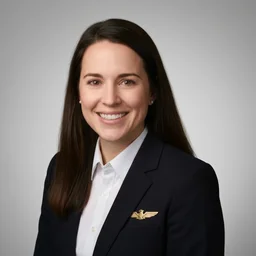
Commercial Pilot & FAA Certification Specialist
Embry-Riddle Aeronautical UniversityCaptain Jennifer Walsh graduated with honors in Aerospace Engineering from Embry-Riddle Aeronautical University and holds FAA Airframe & Powerplant and Airline Transport Pilot certificates. With 11 years of commercial aviation experience and 6 years as a ground school instructor, she guides aviation mechanics and student pilots through FAA written exams and practical tests.
Join the Discussion
Connect with other students preparing for this exam. Share tips, ask questions, and get advice from people who have been there.
View discussion (9 replies)