
FAA Drone Certification Part 107: Complete Registration and Rules Guide
Pass your FAA Drone Certification Part 107: ✍🏼 exam on the first attempt. Practice questions with detailed answer explanations, hints, and instant scoring.
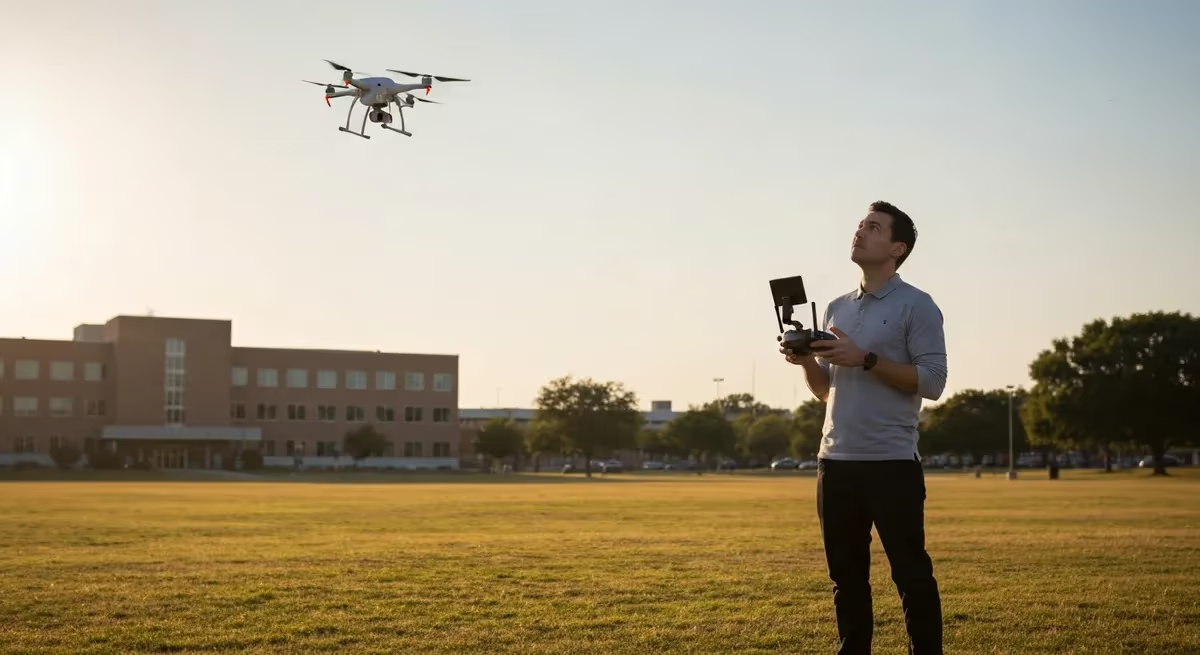
Getting your FAA drone certification Part 107 guide starts here — whether you're flying commercially for real estate photography, agriculture mapping, or infrastructure inspections. The Part 107 Remote Pilot Certificate is the FAA's required license for anyone operating a drone for business purposes. Without it, you're limited to recreational flying under much stricter rules, and you can't legally charge for your services.
The drone FAA registration process is separate from certification but equally mandatory. Every drone weighing between 0.55 and 55 pounds must be registered with the FAA before its first flight — commercial or recreational. Registration costs $5 per drone, lasts three years, and takes about five minutes online. You'll get a registration number that must be displayed on the aircraft. Skip this step, and you're looking at civil penalties up to $27,500.
The FAA drone registry has grown massively since 2015, with over 1 million registered drones in the system as of early 2026. That growth reflects how mainstream commercial drone operations have become. But with growth comes enforcement — the FAA has ramped up compliance checks, especially around airports, stadiums, and critical infrastructure. This guide walks you through every step: certification, registration, rules, fines, and the latest regulatory changes that affect how and where you can fly.
You don't need an aviation background to pass Part 107. The exam covers aeronautical knowledge — airspace, weather, regulations, and flight operations — but thousands of people with zero pilot experience pass it every month. With focused studying over 2 to 4 weeks, most candidates are ready. Let's break down exactly what you need to know.
You can continue preparing with the faa practice test, which includes answer explanations for every question.
You can continue preparing with the faa written practice test, which includes answer explanations for every question.

The faa drone registry serves as the central database for all unmanned aircraft in the United States. When you register, you're adding your drone to a system that helps the FAA track aircraft, investigate incidents, and enforce airspace rules. Each registration number ties directly to your name and address — so if your drone causes damage or violates airspace restrictions, the FAA can trace it back to you. That accountability framework is exactly why registration exists.
Understanding FAA unmanned aircraft regulations goes beyond just knowing Part 107. The FAA treats drones as aircraft under federal law, which means existing aviation statutes apply. Flying recklessly near manned aircraft, for instance, carries the same legal weight as if you were piloting a Cessna dangerously. The faa unmanned aircraft systems (UAS) framework has evolved rapidly since 2016, when Part 107 first took effect, and new rules continue reshaping what's possible for commercial operators.
Registration is just the first step. Once your drone is in the system, you still need your Part 107 certificate to fly commercially. Think of registration as your vehicle title and Part 107 as your driver's license — you need both. The exam tests you on 11 knowledge areas: airspace classifications, weather theory, drone performance, emergency procedures, radio communication, loading, crew resource management, and more. It's knowledge-heavy but not trick-question heavy — straightforward studying pays off.
The FAA drone remote ID enforcement news November 2025 marked a major turning point. Starting March 16, 2024, all drones operating in U.S. airspace must broadcast Remote ID — essentially a digital license plate that transmits your drone's identity, location, altitude, and velocity in real time. The November 2025 enforcement wave saw the FAA issue its first batch of fines specifically for Remote ID non-compliance, signaling that the grace period was officially over.
The topic of FAA banning drones comes up frequently, usually in response to airspace restrictions near airports or during emergency situations like wildfires. The faa banning drones narrative is usually overstated — the FAA isn't banning drones broadly. What they're doing is enforcing existing Temporary Flight Restrictions (TFRs) and creating permanent no-fly zones around sensitive areas. Violating a TFR can result in criminal charges, not just fines.
Remote ID compliance requires either a drone with built-in broadcast capability (Standard Remote ID) or an add-on broadcast module. Older drones without either option can still fly, but only at FAA-Recognized Identification Areas (FRIAs) — essentially designated flying fields. As of late 2025, the FAA had approved over 700 FRIAs nationwide, though many operators find the geographic restrictions limiting for commercial work.
Part 107 Certification Steps
Start with the FAA's official study materials — the Remote Pilot Study Guide (FAA-G-8082-22) is free and covers everything on the exam. Supplement it with practice tests that mirror the actual question format. Focus heavily on airspace classifications (Class B, C, D, E, G), weather theory (METARs, TAFs, cloud clearance), and regulations (operating limitations, waivers). Most candidates need 20-40 hours of study time spread over 2-4 weeks.
The drone registration requirements FAA has set are surprisingly straightforward. If your drone weighs more than 0.55 pounds (250 grams), it needs to be registered. Go to faadronezone.faa.gov, create an account, enter your drone's make, model, and serial number, pay $5, and you're done. The registration number must be displayed on the exterior of the aircraft — though recent rule changes also allow you to place it in an enclosed compartment accessible without tools.
Want to search FAA drone registry records? The public can't freely browse the full database, but the FAA does provide a verification tool where you can look up a specific registration number to confirm it's valid. Law enforcement has broader access for investigation purposes. If you find a lost drone, the registration number on it is the key to returning it to the owner — contact the FAA, and they'll reach out to the registered operator.
For commercial operators, drone registration requirements FAA compliance also means keeping your registration current. Expired registrations carry the same penalties as no registration at all. Set a calendar reminder 30 days before your three-year expiration, and renewal takes just a few minutes online. The $5 fee applies per drone, not per registration period — so if you operate a fleet, the costs are minimal but the paperwork adds up.
Knowing how to faa drone remote id enforcement news november 2025 requirements affect you is critical for staying compliant. If someone spots a drone flying dangerously or illegally, they can FAA report drone activity through the FAA's online reporting portal or by calling local law enforcement. Reports trigger investigations, and the FAA takes them seriously — especially near airports, where even a single sighting can shut down flight operations for hours.
The topic of FAA fines for drones gets more attention every year as enforcement ramps up. In 2025 alone, the FAA issued over 200 enforcement actions against drone operators — a record number. Most involved flying in restricted airspace without authorization (LAANC or waiver), operating over people without the proper waiver, or failing to register. The fines ranged from $1,000 for minor registration lapses to over $20,000 for repeated controlled airspace violations.
If you receive an FAA enforcement letter, don't ignore it. You typically have 30 days to respond, and cooperating early often results in reduced penalties. The FAA's compliance philosophy officially emphasizes education over punishment for first-time offenders, but that leniency disappears fast if your violation endangered people or manned aircraft. Hiring an aviation attorney for anything beyond a simple warning letter is usually worth the cost.
Pros and Cons of Part 107 Certification
- +Legally fly drones commercially for photography, inspections, mapping, and delivery
- +No prior aviation experience required — anyone 16 or older can take the exam
- +Certificate is valid for 24 months with free online renewal — no retesting needed
- +Opens access to LAANC for automated controlled airspace authorization in seconds
- +Part 107 waiver system allows operations beyond standard rules (night, over people, BVLOS)
- +Growing job market — commercial drone pilot demand has increased 30% year over year
- −Exam fee of $175 isn't refunded if you fail — study seriously before scheduling
- −Standard Part 107 limits flights to visual line of sight (VLOS) without a waiver
- −No flying over non-participating people without the Part 107.39 waiver (Category 1-4 system)
- −Operating in controlled airspace still requires per-flight LAANC authorization or a waiver
- −Remote ID compliance adds cost — $30-100 for a broadcast module on older drones
- −Recurrent training every 24 months is mandatory to maintain your certificate
The FAA drone BVLOS rule news has been one of the most anticipated developments in the UAS industry. Beyond Visual Line of Sight (BVLOS) operations — flying your drone where you can't physically see it — have traditionally required individual waivers, which the FAA granted sparingly. But new proposed rulemaking in 2025 laid the groundwork for standardized BVLOS operations, potentially allowing qualified operators to fly beyond sight without a waiver. The final rule is expected in late 2026.
FAA drone fines aren't just for commercial operators. Recreational flyers face the same registration requirements and airspace restrictions. Flying a $300 hobby drone over a stadium during a football game can result in the same $27,500 civil fine as a commercial operation in restricted airspace. The FAA doesn't distinguish between hobbyists and professionals when it comes to safety violations — airspace rules apply to everyone equally.
The BVLOS rule change would transform industries like package delivery, pipeline inspection, and agricultural monitoring. Companies like Zipline and Wing have been operating under individual BVLOS waivers for years, but a standardized rule would open the door for smaller operators to expand their service areas dramatically. For Part 107 holders, it means your certification becomes even more valuable as operational boundaries expand.
Pre-Flight Safety Checklist
- ✓Verify your drone registration is current and the number is displayed on the aircraft
- ✓Confirm your Part 107 certificate is valid and you have it (or a copy) with you
- ✓Check LAANC authorization if flying in or near controlled airspace — get approval before launch
- ✓Review NOTAMs and TFRs for your flight area using the FAA B4UFLY app
- ✓Inspect propellers, battery levels, and firmware updates before every flight
- ✓Verify Remote ID is broadcasting correctly — test before leaving the launch site
- ✓Check weather conditions including wind speed, visibility, and cloud ceiling minimums
- ✓Establish a visual observer if operating near obstacles, people, or traffic
- ✓Brief any crew members on emergency procedures and lost-link protocols
- ✓Log the flight in your records: date, time, location, duration, and any incidents
Understanding drone regulations FAA has established requires knowing the difference between Part 107 (commercial) and the Exception for Limited Recreational Operations (Section 44809). Recreational flyers don't need Part 107 but must follow a different set of rules: fly below 400 feet, keep the drone in visual line of sight, stay away from other aircraft, and fly only in uncontrolled airspace (Class G) unless they have faa banning drones LAANC authorization. The recreational rules are simpler but more restrictive.
The FAA news September 2025 drones rule update addressed several long-standing industry requests. Key changes included streamlined waiver processing for operations over people (reducing approval times from months to weeks), expanded LAANC coverage to additional airports, and clarified guidance on drone operations during nighttime. These updates reflected the FAA's shift toward enabling commercial drone use rather than restricting it — a significant philosophical change from the agency's early drone-regulation era.
If you're flying recreationally and decide to go commercial, the transition is straightforward. Pass the Part 107 exam, get your certificate, register your drone (if you haven't already), and you're legal. Many recreational pilots make this transition after realizing they can monetize skills they've already developed — real estate agents filming property aerials, farmers monitoring crop health, or content creators selling footage. The certification process takes most people less than a month from start to finish.
When it comes to FAA fine drone penalties, the severity depends on the violation type and your cooperation level. A first-time registration violation might result in a warning letter or a fine under $5,000. Flying in restricted airspace without authorization — especially near an airport — typically starts at $10,000 and can reach the statutory maximum. The FAA registration for drones requirement is the easiest rule to comply with, so there's no excuse for skipping it.
FAA registration for drones applies to both commercial and recreational operators equally. The $5 fee covers three years and can be completed entirely online at faadronezone.faa.gov. You'll receive your registration certificate and number immediately after payment. Display the number on the drone's exterior (a label or engraving works), and you're compliant. For fleet operators, each drone needs its own registration, but you can manage them all under a single FAA account.
The penalty structure is designed to be proportional. Minor paperwork violations like an expired registration rarely result in maximum fines. But endangerment violations — flying near emergency response operations, over crowded stadiums, or in the path of manned aircraft — draw the harshest penalties. The FAA's enforcement database shows that most five-figure fines involve airspace violations near airports, which makes sense given the catastrophic potential of a drone strike on a commercial aircraft.
Never fly in controlled airspace (Class B, C, D, or surface E) without LAANC authorization or an airspace waiver. The FAA's LAANC system provides near-instant approval through apps like AirMap, Aloft, or DJI Fly. Flying without authorization in controlled airspace is one of the most common — and most heavily penalized — drone violations. Even if you're just 50 feet inside a controlled zone, you're in violation.
The topic of FAA DJI drone ban has generated significant controversy. While the FAA itself hasn't banned DJI drones, federal legislation (the Countering CCP Drones Act) could effectively prohibit new DJI drones from operating in U.S. airspace by revoking the company's FCC communications authorizations. As of early 2026, existing DJI drones remain legal to fly, but the political landscape is shifting. The FAA drone remote ID enforcement update November 2025 didn't specifically target DJI, but DJI's compliance with Remote ID standards became part of the broader debate about Chinese-manufactured drones in American airspace.
For current DJI owners, the practical advice is simple: keep flying legally, maintain Remote ID compliance, and monitor legislative developments. Even if new DJI products face restrictions, your existing registered drones won't suddenly become illegal to operate. The FAA has consistently stated that its regulations focus on operations, not manufacturers. However, replacement parts and firmware updates could become harder to access if import restrictions tighten.
The broader FAA drone remote ID enforcement update November 2025 wave affected all manufacturers equally. The FAA conducted targeted enforcement operations near major airports and sporting venues, checking for Remote ID compliance and proper registration. Operators caught without compliance faced on-the-spot citations. This enforcement push was the FAA's clearest signal yet that the voluntary compliance period was over and active policing had begun.
FAA Practice Test Questions
Prepare for the FAA - Federal Aviation Administration exam with our free practice test modules. Each quiz covers key topics to help you pass on your first try.
FAA Aviation Flight Instrument Rating Exam
FAA Exam Questions covering Aviation Flight Instrument Rating Exam. Master FAA Test concepts for certification prep.
FAA 107 Drone Pilot Test
Free FAA Practice Test featuring 107 Drone Pilot Test. Improve your FAA Exam score with mock test prep.
FAA Aircraft Performance Test
FAA Mock Exam on Aircraft Performance Test. FAA Study Guide questions to pass on your first try.
FAA Airspace and Weather Minimums Test
FAA Test Prep for Airspace and Weather Minimums Test. Practice FAA Quiz questions and boost your score.
FAA Communications and Radar Services
FAA Questions and Answers on Communications and Radar Services. Free FAA practice for exam readiness.
FAA Cross-Country Planning Test
FAA Mock Test covering Cross-Country Planning Test. Online FAA Test practice with instant feedback.
FAA Electronic Navigation Exam
Free FAA Quiz on Electronic Navigation Exam. FAA Exam prep questions with detailed explanations.
FAA Federal Aviation Regulations Test
FAA Practice Questions for Federal Aviation Regulations Test. Build confidence for your FAA certification exam.
FAA Flight Instrument Test
FAA Test Online for Flight Instrument Test. Free practice with instant results and feedback.
FAA Flight Operations Test
FAA Study Material on Flight Operations Test. Prepare effectively with real exam-style questions.
FAA Private Pilot Exam
Free FAA Test covering Private Pilot Exam. Practice and track your FAA exam readiness.
FAA Private Pilot Weather Test
FAA Exam Questions covering Private Pilot Weather Test. Master FAA Test concepts for certification prep.
FAA drone lights requirements come into play for any operation during civil twilight or nighttime — and since 2021, Part 107 holders no longer need a waiver for night flights. However, your drone must have anti-collision lighting visible for at least 3 statute miles. Stock LED lights on most consumer drones don't meet this standard, so you'll likely need an aftermarket strobe. Products like the Lume Cube Strobe or FireHouse Arc V meet FAA requirements and weigh under an ounce.
The latest FAA drone BVLOS news centers on the proposed rule (NPRM) published in early 2026 that would create a standardized framework for routine BVLOS operations. Under the proposed rules, operators would need to demonstrate detect-and-avoid capability, maintain a minimum level of training, and operate within specific environmental conditions. This is the single biggest regulatory change since Part 107 launched in 2016, and it could expand the commercial drone market by an estimated $50 billion over the next decade.
For now, BVLOS operations still require individual waivers — and the FAA's approval rate is below 20%. Most approvals go to well-funded companies with sophisticated detect-and-avoid technology and extensive safety documentation. But the proposed standardized rule would replace this waiver-by-waiver approach with clear performance standards any operator could meet. If you're planning a career in commercial drone operations, the upcoming BVLOS rule makes Part 107 certification more valuable than ever.
FAA Questions and Answers



About the Author

Commercial Pilot & FAA Certification Specialist
Embry-Riddle Aeronautical UniversityCaptain Jennifer Walsh graduated with honors in Aerospace Engineering from Embry-Riddle Aeronautical University and holds FAA Airframe & Powerplant and Airline Transport Pilot certificates. With 11 years of commercial aviation experience and 6 years as a ground school instructor, she guides aviation mechanics and student pilots through FAA written exams and practical tests.
Join the Discussion
Connect with other students preparing for this exam. Share tips, ask questions, and get advice from people who have been there.
View discussion (9 replies)