
F-03 Fire Guard Certificate of Fitness NYC 2026 September — Complete Guide
Boost your F exam score with practice questions and detailed answer explanations. 🎯 Track progress with instant feedback.
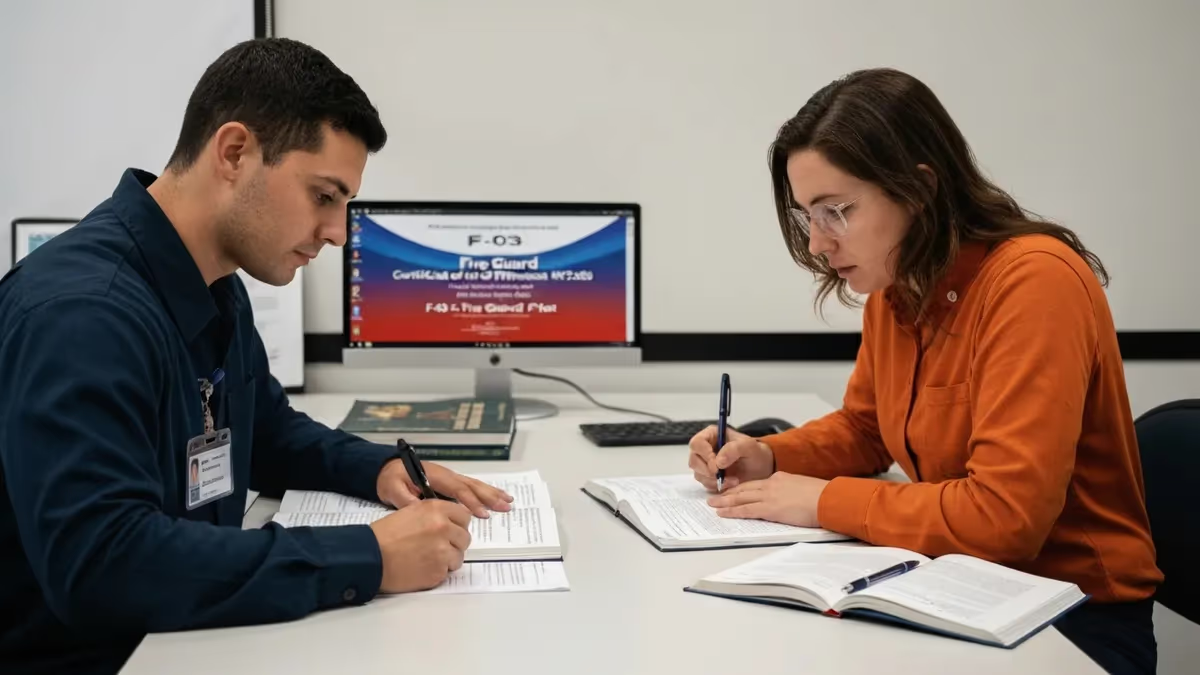
What Is the F-03 Certificate of Fitness?
The F-03 is an NYC FDNY Certificate of Fitness specifically for Fire Guard for Impairment. It is required when a building's sprinkler system, standpipe system, or fire suppression system is temporarily out of service — this is called an 'impairment.' During an impairment, certified fire guards must be posted at designated locations within the building to monitor for fire and ensure occupant safety.
The certificate is issued by the NYC Fire Department Bureau of Fire Prevention (FDNY BFP). Unlike general fire safety training, the F-03 is specifically focused on the fire guard's role during system impairments — understanding what an impairment is, how to identify hazards, and what actions to take during a fire emergency when normal suppression systems are not operational.
For a full overview of practice resources and study materials, see our F-03 fire guard practice test question bank.
Who Needs the F-03 Certificate?
The F-03 is required in New York City for anyone who serves as a fire guard during a system impairment. This typically applies to:
- Building maintenance staff and superintendents who may be designated as fire guards when their building's sprinkler or standpipe system is taken offline for repairs
- Security personnel at commercial buildings, hotels, hospitals, and apartment complexes who are assigned fire watch duties
- Construction workers and contractors who trigger impairments when working near sprinkler systems during renovations
- Professional fire guards hired specifically to maintain watch during impairments
NYC Local Law and the Fire Code require that a person holding a valid F-03 certificate be posted at each impaired area during an impairment. The number of fire guards required depends on the size of the impaired area and the duration of the impairment. For comprehensive preparation materials specific to the FDNY format, see our F-03 FDNY guide.

FDNY F-03 Exam Format
The F-03 written exam consists of approximately 30 multiple-choice questions. The exam is administered at the FDNY Bureau of Fire Prevention at 9 MetroTech Center, Brooklyn, New York. Exams are conducted on weekdays by appointment.
Key exam logistics:
- Language: The exam is in English but FDNY permits the use of a licensed interpreter if English is not your primary language — you must arrange the interpreter yourself
- Duration: Approximately 60–90 minutes, though most candidates complete it in under 45 minutes
- Passing score: 70% (approximately 21 correct out of 30 questions)
- ID requirement: You must present a valid, government-issued photo ID (driver's license, state ID, or passport)
- Retake: If you fail, you must wait and re-register for another exam date
Take our free F-03 practice test to get comfortable with the question format before your FDNY exam appointment.
F-03 Exam Topics Covered
The FDNY F-03 exam tests your knowledge of fire safety principles specifically as they apply to impaired suppression systems. Key topic areas include:
- What is an impairment: Definition of a partial vs. full impairment, examples of conditions that trigger an impairment, and notification requirements when an impairment begins
- Fire guard duties: Where to stand, how often to patrol the impaired area, what conditions to monitor, and how to report observations
- Communication procedures: Who to contact during an impairment (building management, FDNY, building occupants), how to call 911 effectively, and chain-of-command during a fire event
- Fire behavior basics: How fires start and spread, why early detection matters more during impairments, and identifying potential ignition sources
- Sprinkler and standpipe systems: Basic understanding of how these systems work, why they might be impaired, and what a fire guard cannot do to the systems
- NYC Fire Code provisions: Relevant sections of the NYC Fire Code that govern fire guards and impairment procedures
- Emergency procedures: Evacuation routes, activating manual pull stations, using portable fire extinguishers as a last resort
Additional F-03 topic practice is available through our F-03 test question bank, which covers all exam domains with timed practice sessions.
How to Prepare for the F-03 Exam
- ✓Study the FDNY Candidate Information Bulletin (CIB) for the F-03 — download it free from nyc.gov/fdny
- ✓Take multiple F-03 practice tests to familiarize yourself with question format and the types of scenarios tested
- ✓Focus on: impairment definitions, fire guard duties, communication procedures, and NYC Fire Code basics
- ✓Learn the 4 types of fire guard certificates (F-01, F-02, F-03, F-04) and what distinguishes the F-03 specifically
- ✓Memorize the required actions when discovering a fire during an impairment: Notify, Evacuate, Call 911
- ✓Study basic sprinkler system components — the exam tests foundational knowledge, not plumbing details
- ✓Practice 30-question timed mock exams — you must achieve 70% to pass
- ✓Register for your exam appointment as soon as you feel ready — slots fill quickly

- +Industry-recognized credential boosts your resume
- +Higher earning potential (10-20% salary increase on average)
- +Demonstrates commitment to professional development
- +Opens doors to advanced career opportunities
- −Exam preparation requires significant time investment (4-8 weeks)
- −Certification fees can be $100-$400+
- −May require continuing education to maintain
- −Some employers may not require certification
F-03 Certificate of Fitness Questions and Answers
More F-03 Resources
About the Author

Educational Psychologist & Academic Test Preparation Expert
Columbia University Teachers CollegeDr. Lisa Patel holds a Doctorate in Education from Columbia University Teachers College and has spent 17 years researching standardized test design and academic assessment. She has developed preparation programs for SAT, ACT, GRE, LSAT, UCAT, and numerous professional licensing exams, helping students of all backgrounds achieve their target scores.
Join the Discussion
Connect with other students preparing for this exam. Share tips, ask questions, and get advice from people who have been there.
View discussion (8 replies)