
F-02-49 Fireguard Exam: FDNY Certificate of Fitness Guide 2026 September
Pass your f-02-49 exam on the first attempt. Practice questions with detailed answer explanations and instant scoring for the 2026 September exam. 💡
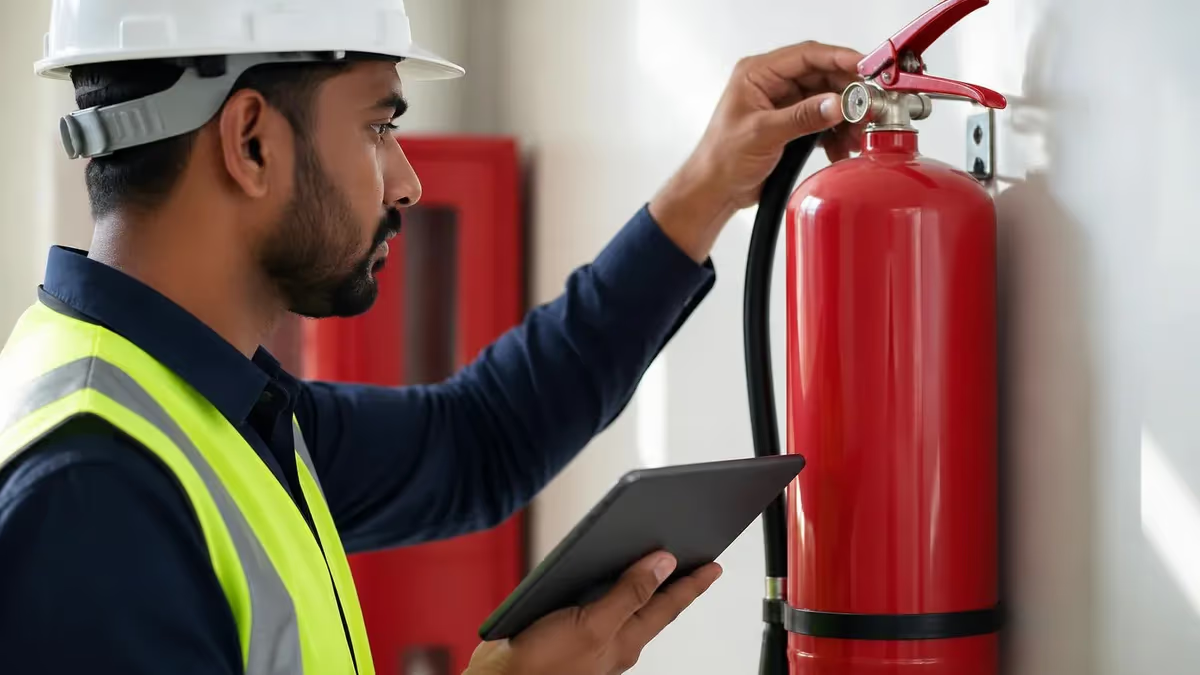
The F-02-49 is one of the most frequently sought Certificate of Fitness designations issued by the New York City Fire Department. If you work in a building where a required fire protection system is out of service — sprinklers offline, standpipes under repair, fire alarms temporarily disabled — you need a qualified fireguard on site around the clock until that system is restored. That person must hold an F-02 Certificate of Fitness, and the exam that qualifies them is what most test-takers refer to as the F-02-49 exam.
New York City's building codes demand that owners and operators maintain fire protection systems in continuous working order. When a system goes down — even temporarily for scheduled maintenance — FDNY rules require an impairment fireguard to stand post. This is not optional. Failure to place a certified fireguard can result in fines, stop-work orders, and in the event of a fire, criminal liability. The F-02 Certificate of Fitness is your legal credential to fill that role.
The FDNY administers the F-02 exam through its Bureau of Fire Prevention. Candidates must demonstrate knowledge of fire safety laws, fireguard duties during system impairments, proper use of fire extinguishers, emergency procedures, and the FDNY Regulations governing Certificates of Fitness. The exam is written and multiple-choice, typically 25 to 30 questions, and candidates must score at least 70 percent to pass.
Unlike some Certificate of Fitness exams that require prior experience or employer sponsorship, the F-02 is open to any adult who can pay the application fee and pass the test. That accessibility makes it a popular credential for building superintendents, security personnel, facility managers, maintenance workers, and anyone who regularly works in large commercial or residential buildings in New York City.
This guide walks you through every aspect of the F-02-49 Fireguard exam: what it covers, who needs it, how to apply, and the most effective strategies for passing on your first attempt. Whether you're a first-time applicant or renewing a lapsed certificate, you'll find the information you need here. The role of the fireguard is one of the most critical positions in New York City's fire safety infrastructure, and earning your Certificate of Fitness is the first step to filling it professionally and legally.
One important distinction: the F-02 Certificate of Fitness is specifically for impairment fireguards — those who stand post when fire protection systems are disabled. It is separate from the F-01 (Torch Operations) and other fire safety certificates. However, building operators and HR managers frequently search for it by the exam location code or administrative reference number, which is why the term "F-02-49" appears in FDNY documentation and scheduling systems. The exam content is the same regardless of which testing location or session number you register for.
New York City processes thousands of Certificate of Fitness applications each year, and the F-02 consistently ranks among the top five most-requested designations. High-rise residential buildings, hotels, hospitals, schools, shopping centers, and large office towers all require fireguards whenever their suppression or detection systems are taken offline. Building owners in a city with millions of square feet of commercial space and over one million residential units create constant demand for qualified F-02 holders.
The "49" in F-02-49 is worth addressing directly. FDNY maintains an internal numbering system for exam locations, test sessions, and administrative codes. When you register online, you may see your session listed with a code like "F-02-49" in the scheduling portal. This is simply the session identifier — it carries no special meaning about exam difficulty or content.
Whether your confirmation reads F-02-49, F-02-12, or any other suffix, you are taking the same Certificate of Fitness exam. All candidates study the same FDNY materials, sit for the same style of questions, and are held to the same 70 percent passing standard.
To earn your F-02 Certificate of Fitness, you must first meet the FDNY's eligibility requirements. You must be at least 18 years old, be able to read and write in English, and have no disqualifying criminal history. You do not need prior experience as a fireguard to apply, and you do not need an employer sponsor. All you need is to pay the exam fee and show up prepared.
The application process starts at FDNY's online portal or in person at 9 MetroTech Center in Brooklyn. You'll fill out Form CF-100, pay the current application fee (approximately $25 to $40 depending on the exam cycle), and schedule your test date. Bring a valid government-issued photo ID on exam day — a driver's license, passport, or IDNYC card all qualify. The FDNY does not accept expired IDs.
The F-02 written exam consists of 25 to 30 multiple-choice questions drawn from the FDNY's published study materials. The exam is not strictly timed, but most candidates complete it in 45 to 60 minutes. You must answer at least 70 percent of questions correctly to pass. If you fail, you may retake the exam after a waiting period — typically 30 days — and pay a reexamination fee.
The exam tests knowledge across several core subject areas. Fire prevention laws form the backbone of the test. You'll need to understand which sections of the NYC Fire Code and FDNY Regulations apply to impairment fireguards, what notification requirements kick in when a system goes offline, and what documentation the building owner must file with the FDNY. Knowing specific code sections helps, but understanding the underlying concepts is more important for answering multiple-choice questions correctly.
System impairment procedures are the heart of the exam. When a fire suppression system is taken out of service, the fireguard must be posted continuously — not just during business hours, but 24 hours a day, 7 days a week, until the system is restored. Candidates must know the minimum patrol frequency (at least every 30 minutes for most impairment conditions), what to carry during patrol rounds, and how to use portable fire extinguishers as a substitute measure in affected areas.
Emergency response questions test whether you know when to call 911 versus when to handle a situation directly. The general rule: if you see smoke, flames, or a fire condition, call FDNY immediately. Do not attempt to fight a fire that has grown beyond an incipient stage. As a fireguard, your job is early detection and notification, not firefighting. You may use a portable extinguisher on a very small, contained fire, but your primary duty is to protect lives by getting building occupants out safely and getting trained firefighters in quickly.
The exam also includes questions about fire extinguisher classifications. Class A fires involve ordinary combustibles (wood, paper, cloth). Class B fires involve flammable liquids and gases. Class C fires involve energized electrical equipment. Class D fires involve combustible metals. Class K fires involve cooking oils and fats. You need to know which extinguisher type is appropriate for each class and why using the wrong type can worsen a fire — water extinguishers, for example, must never be used on Class C electrical fires.
Finally, expect questions about the fireguard's documentation responsibilities. You must maintain a logbook during every shift, recording the start and end of each patrol round, any hazards observed, any workers entering the impaired area, and the name of the person who relieves you. This log is subject to FDNY inspection at any time, and gaps or falsified entries can result in revocation of your Certificate of Fitness.
As an F-02 certified impairment fireguard, your primary duties during a system outage include:
- Continuous posting: Remain on site (or have a qualified relief) 24/7 until the system is restored
- Patrol rounds: Walk the entire affected area at least once every 30 minutes, checking for smoke, fire hazards, blocked exits, and unauthorized ignition sources
- Logbook maintenance: Record every patrol round, noting start time, end time, route covered, and any observations
- Hot work oversight: If cutting, welding, or open-flame work is occurring, ensure a fire watch is maintained per FDNY rules
- FDNY notification: If a fire condition develops, call 911 immediately and then activate the building's manual pull station to alert occupants
- Coordination with management: Report patrol findings to building management, document when system restoration work begins and ends, and confirm the system is tested back to full operation before standing down

The most effective way to prepare for the F-02-49 Fireguard exam is to study directly from FDNY's official publications. The FDNY publishes a study guide specifically for Certificate of Fitness exams, available at 9 MetroTech Center or downloadable from the FDNY website. This guide covers every topic that appears on the exam, including the relevant sections of the NYC Fire Code and FDNY Regulations. Candidates who read and understand the study guide thoroughly typically pass on their first attempt.
Start your study session by reading the full study guide once through without taking notes. This gives you a broad picture of the subject matter and helps you identify which areas are already familiar and which require deeper work. On your second pass, read more slowly and take notes on anything that surprises you, any rule you didn't know before, and any procedure that has a specific numerical requirement — patrol frequency, notification timing, occupancy thresholds. Numbers and thresholds frequently appear on the exam because they are concrete, objective, and easy to test in multiple-choice format.
Many F-02 candidates find it helpful to study the NYC Fire Code alongside the FDNY study guide. The relevant provisions cover impairment programs and fireguard requirements in detail. You do not need to memorize code section numbers, but understanding the logic behind the rules — why certain buildings require 24-hour fireguards, why patrol intervals are set at 30 minutes — helps you reason through questions you're unsure about rather than guessing blindly.
Practice questions are one of the best study tools available. Online F-02 fireguard license practice tests mirror the format and difficulty of the actual FDNY exam. Working through timed practice sets trains you to read questions carefully and eliminate wrong answers systematically. Many test-takers lose points not because they don't know the material but because they rush and misread the question. Practicing under mild time pressure corrects that habit before it costs you on exam day.
When you miss a practice question, don't just note the correct answer — understand why the wrong answer was wrong. FDNY exam questions are often designed to test whether you know the specific rule rather than just the general concept. For example, a question might ask "How often must a fireguard patrol the affected area during a sprinkler impairment?" with answer choices of every 15, 30, 45, or 60 minutes. If you've only memorized the number without understanding the context, a trick phrasing can trip you up. Understanding the rule in context makes you resilient to question variations.
Two weeks of consistent study is usually sufficient for candidates with no prior fire safety background. Spend the first week reading the study guide and taking notes. Spend the second week working through practice questions and reviewing any weak areas. In the final two days before the exam, review your notes and avoid cramming new material. Your goal going into exam day is to feel calm and confident, not anxious about topics you haven't fully absorbed.
If English is your second language, note that the FDNY offers the F-02 exam in several languages at select testing sessions. Check the FDNY website or call the Bureau of Fire Prevention to confirm which languages are available at your preferred testing location. Taking the exam in your strongest language significantly reduces the chance that language barriers — rather than knowledge gaps — will cause you to fail a test you otherwise know well.
- ✓Review the official F-02 exam content outline
- ✓Take a diagnostic practice test to identify weak areas
- ✓Create a study schedule (4-8 weeks recommended)
- ✓Focus on your weakest domains first
- ✓Complete at least 3 full-length practice exams
- ✓Review all incorrect answers with detailed explanations
- ✓Take a final practice test 1 week before exam day
On exam day, arrive at the FDNY testing location at least 20 minutes early. The primary testing site is 9 MetroTech Center, Brooklyn, NY 11201. Satellite testing locations are available on certain dates — check your confirmation email for your specific site. Bring your government-issued photo ID and your confirmation number. The FDNY staff will check you in, assign you a seat, and distribute the exam booklets.
The exam is administered in a quiet room under proctored conditions. You'll receive a question booklet and a separate answer sheet. Read every question fully before selecting an answer. FDNY exam questions sometimes include phrases like "except," "not," or "all of the following" that change the correct answer completely. Underline these words as you read so they don't slip past you under test-day pressure. Budget roughly two minutes per question and review any marked questions at the end if time permits.
After you pass the exam, the FDNY will issue your Certificate of Fitness within a few weeks by mail to the address on your application. Your certificate will display your name, certificate type (F-02), issue date, expiration date, and a unique certificate number. Keep this document safe — you'll need to present it to building management before being posted as a fireguard, and FDNY inspectors may ask to see it during an impairment inspection.
The F-02 Certificate of Fitness is valid for three years from the date of issue. Renewal requires passing a written exam again — there is no automatic renewal based on years of service. Mark your expiration date on your calendar and begin the renewal process at least 60 days before your certificate expires. If your certificate lapses, you cannot legally work as an impairment fireguard until you pass the exam and receive a new certificate. Working without a valid certificate is a violation that can result in fines for both you and your employer.
Professionally, the F-02 is a widely respected credential in New York City's building management and facilities industry. Building owners and property management companies actively seek employees who hold the certificate because it reduces their compliance burden. Holding an F-02 can justify higher pay as a building superintendent, security officer, or facilities technician. Some employers will pay exam fees and study costs for employees they want to certify — if your employer offers this benefit, take advantage of it.
There is meaningful overlap between the knowledge required for the F-02 and other Certificate of Fitness exams. The fire prevention laws, emergency response procedures, and extinguisher knowledge you study for the F-02 appear in many other COF exams, including F-01 (Torch Operations), S-12 (City-Wide Sprinkler), and S-13 (City-Wide Standpipe). Holding multiple certificates makes you significantly more employable in building operations, and many experienced fireguards hold three to five COF certificates as a result.
One final note for candidates who encounter the term army fireguard in their research: military fireguard duty shares the name but is a completely different role. In the U.S. Army, fireguard is a rotating overnight duty assignment in barracks — a security and fire-watch responsibility that requires no civilian certification. If you need the FDNY Certificate of Fitness, ensure your study materials come exclusively from FDNY's official publications and not military or other sources. The duties, laws, and procedures have no overlap.
Building a strong professional network in NYC fire safety opens additional doors beyond the F-02. Organizations like the New York Fire Safety Directors Association connect certified professionals across the industry. Attending fire safety seminars, connecting with building managers at professional events, and staying current on FDNY regulatory updates all reinforce your value as a credentialed fireguard.
Buildings with complex fire safety systems often prefer to hire fireguards who demonstrate ongoing engagement with the field rather than those who simply hold a certificate and nothing more. Your F-02 is the entry point — your commitment to the role is what builds a lasting career in New York City fire safety.
FDNY Pros and Cons
- +FDNY certification is recognized by employers as verified competency
- +Provides a structured knowledge framework beyond just the credential
- +Certified professionals report 10–20% salary increases on average
- +Maintenance requirements create ongoing professional development
- +Differentiates candidates in competitive hiring and promotion decisions
- −Certification fees, materials, and renewal costs add up over a career
- −Requirements change — delaying may mean facing updated content
- −Salary ROI varies significantly by geography and industry
- −Preparation requires significant time alongside existing responsibilities
- −Validates knowledge at a point in time, not ongoing real-world performance
F-02 Fireguard Questions and Answers
About the Author

Law Enforcement Trainer & Civil Service Exam Specialist
John Jay College of Criminal JusticeMarcus B. Thompson earned his Master of Arts in Criminal Justice from John Jay College of Criminal Justice and served 12 years as a law enforcement officer before transitioning to full-time academy instruction. He is a POST-certified instructor who has prepared candidates for police entrance exams, firefighter assessments, and civil service examinations across dozens of agencies.