
How to Create a Calendar in Excel 2026 September
Build a calendar in Excel three ways: templates, DATE/WEEKDAY grid, or interactive spinner-driven layout. Holidays, printing, Outlook sync covered. ✅

You opened a fresh workbook, typed a few dates, and then stopped. A real calendar needs rows that line up, months that change without rebuilding the grid, and weekends that highlight themselves. Excel handles all of that — once you know which path to take.
Three approaches cover every situation. Built-in templates take thirty seconds and give you a polished result. A manual monthly grid built with DATE and WEEKDAY teaches the underlying logic, and it scales. An interactive dynamic calendar — driven by spinners, drop-downs, and conditional formatting — flips months with a click and highlights today automatically. Pick the one that fits the job.
This guide walks each route end to end. You'll get the exact formula patterns, the printing tweaks that keep a yearly view on one page, how to fold US federal holidays into the grid, and the trick for syncing a finished sheet with Outlook so meetings flow both ways. Yearly layouts, weekly planners, school terms — the same building blocks handle all of them.
Before you dive in, two quick checks. Make sure your version supports dynamic arrays (Excel 365, Excel 2021, or Excel for the Web work without fuss; Excel 2019 needs the older array-formula syntax). Confirm your regional settings — the WEEKDAY function uses a return-type argument that flips Sunday vs Monday as day 1, and getting that backwards is the single most common reason a calendar looks "off by one" on first run.
Ready? Let's build.
Excel Calendar Build at a Glance

Each approach has a sweet spot. Templates win when speed matters and the design doesn't need to bend. The formula-driven monthly grid is the bedrock — once you've built one, every variation (academic year, fiscal quarter, lesson plan) is a copy-and-tweak away. The interactive build trades extra setup for a calendar that changes year, month, and highlighting on a single click; it's the right choice for dashboards, content planners, and team-shared workbooks.
Don't fall into the "must build everything from scratch" trap. A perfectly good template is a perfectly good starting point. Take it, strip out branding you don't need, swap in your own formulas where it matters, and you've shaved an hour without sacrificing flexibility.
Before you build
Confirm your Excel version supports dynamic arrays (365, 2021, or Web). Check your regional settings — WEEKDAY's return-type argument flips Sunday vs Monday as day 1, and getting that backwards is why most first-attempt calendars start on the wrong column. A quick test in any cell with =WEEKDAY("2026-01-01",1) tells you which convention your sheet uses.
Method 1: The built-in Excel calendar template
Open Excel. Click File > New. In the search box at the top of the gallery, type calendar and press Enter. Microsoft serves up dozens of options — monthly, yearly, academic, photo-driven, two-page spreads, dated and undated. Hover over each thumbnail to read the description, then double-click the one you want to download.
The most useful starting points: Any year calendar (a single sheet that re-flows when you change the year cell), Academic calendar (any year) for school terms running July–June, and Weekly time planner if you're scheduling people more than days. Each ships with named ranges already wired up, so updating the year, the start day, or the holiday list is a one-cell edit.
Once it opens, look for a cell labelled Year, Start year, or similar — that's the control. Change it, and every month sheet refreshes. If the template has a holidays tab, edit the dates there and the conditional formatting on each month picks them up. Don't rebuild what's already done; just retitle the file and save it to your team folder.
Worth knowing: Microsoft pushes new templates every season. The 2026 batch includes a "Content calendar" with category tags and a "Project tracker calendar" with milestones — worth searching for those by name rather than scrolling the default gallery.
Three Calendar Approaches
File > New > search 'calendar'. Fastest. Pre-wired named ranges. Best when the design is good enough as-is.
DATE + WEEKDAY formulas. Most flexible. Once built, every variation (academic year, fiscal quarter) is a copy-paste.
Spinner controls + conditional formatting. Today-highlights itself, flips months on a click. Worth the extra setup.
Method 2: A monthly grid built with DATE and WEEKDAY
This is where Excel earns its keep. The goal: a 7-column, 6-row grid that knows what month it represents, places the 1st under the correct weekday, and stops when the month ends. Five formulas. Maybe twenty minutes the first time.
Start in a blank sheet. Put your month name in cell A1 — say, ="January "&YEAR(TODAY()) for the current January. Cells A3:G3 hold the day headers: Sun, Mon, Tue, Wed, Thu, Fri, Sat. The actual date grid lives in A4:G9.
Now the workhorse. In A4, drop this:
=DATE(YEAR(TODAY()),1,1)-WEEKDAY(DATE(YEAR(TODAY()),1,1),1)+1What it does: starts at January 1, walks backward to the most recent Sunday, and puts that date in the top-left cell. In B4 through G4, simply add 1 to the previous cell: =A4+1, =B4+1, and so on. Row 5 starts with =G4+1. Drag the pattern through row 9 and the whole grid fills.
Format the cells as d (day number only) using Format Cells > Custom. To grey out dates that aren't in your target month, add conditional formatting: Use a formula, condition =MONTH(A4)<>1, font colour light grey. Done — January is shaded against, every other day pops.
To turn this into any month, replace the hard-coded 1 in the formulas with a reference to a month-number cell (e.g., I1). Suddenly the same grid serves twelve sheets — one per month, each pulling from its own cell. Add a separate "Year" cell and you've got a fully parameterised calendar in under thirty minutes.

Build Patterns Side by Side
Cell A1: ="January "&YEAR(TODAY()). Cells A3:G3: day headers. Cell A4: =DATE(YEAR(TODAY()),1,1)-WEEKDAY(DATE(YEAR(TODAY()),1,1),1)+1. Cells B4:G4: each is =previous+1. Drag through row 9. Format as 'd'. Conditional formatting on =MONTH(A4)<>1 greys out neighbouring months.
Yearly view: twelve months on one page
For an at-a-glance year, shrink the monthly grid: 7 columns wide, 7 rows tall (header + 6 date rows), font size 8. Arrange four months across and three rows down — that's a tidy 28-column-by-21-row block that prints on a single landscape A4 or US Letter with the margins set to 0.5 inches.
Build the first month at A1, then copy the entire block to E1, I1, M1 for the row, and so on. Each block references its own month number cell (M1=1, M2=2, etc.) sitting just above the grid in a hidden row. Tedious to set up once, painless forever after.
If you're on Excel 365, there's a faster route: a single dynamic array. Drop this in A1 and let it spill:
=LET(yr,2026, m,SEQUENCE(12), DATE(yr,m,1))That returns the first day of each month. Wrap it with TEXT formatting and combine with SEQUENCE(31) to generate every date in the year — a 31×12 grid is the most compact yearly layout possible. Useful for analytics dashboards where you're plotting events against a calendar backdrop.
The single most common build error: a calendar that starts on Saturday instead of Sunday. The fix is the second argument to WEEKDAY. WEEKDAY(date,1) treats Sunday as day 1 (US default). WEEKDAY(date,2) treats Monday as day 1 (European default). Pick one and stay consistent across every formula on the sheet.
Method 3: An interactive calendar with spinners and conditional formatting
This is the impressive build. Pick a month, pick a year, watch the grid redraw. Today's date glows. Holidays show in red. Add a click-to-mark column and you've got a planner.
Two form controls do the heavy lifting. Go to Developer > Insert > Spin Button (Form Control) — if the Developer tab isn't visible, enable it in File > Options > Customize Ribbon. Drop one spinner next to a Month cell (B1), right-click > Format Control, set Minimum 1, Maximum 12, Cell Link B1. Drop a second next to a Year cell (D1), Cell Link D1, Min 2020, Max 2050. Click the up arrow on either control and the linked cell ticks.
Now wire the grid to those cells. The A4 formula becomes:
=DATE($D$1,$B$1,1)-WEEKDAY(DATE($D$1,$B$1,1),1)+1Every other cell still uses =previous+1. The "out of month" conditional formatting now references =MONTH(A4)<>$B$1. Click the spinner and the whole calendar flips.
For the today-highlight, add a second conditional formatting rule: condition =A4=TODAY(), fill colour bright yellow, font bold. Place it above the "out of month" rule so today still glows even on a greyed-out cell. The rule re-evaluates whenever the sheet recalculates — open the file on a different day and the highlight shifts automatically.
Want event labels? Add a hidden helper table on a second sheet: column A holds dates, column B holds the label. In your calendar grid, layer a third conditional rule that checks =VLOOKUP(A4,Events!A:B,1,FALSE)=A4 and applies a coloured stripe. Type a new event into the table and the calendar lights up.
Interactive Calendar Build Checklist
- ✓Enable Developer tab in File > Options > Customize Ribbon
- ✓Drop a Spin Button next to a Month cell (B1), link Min=1, Max=12
- ✓Drop a second Spin Button next to a Year cell (D1), Min=2020, Max=2050
- ✓Rewrite A4 as <code>=DATE($D$1,$B$1,1)-WEEKDAY(DATE($D$1,$B$1,1),1)+1</code>
- ✓Add today-highlight conditional rule: <code>=A4=TODAY()</code>, yellow fill
- ✓Add out-of-month rule: <code>=MONTH(A4)<>$B$1</code>, grey font
- ✓Create Holidays sheet, name the date range, layer a COUNTIF rule on the grid
- ✓Set Print Area and Page Layout > Fit to 1 page wide by 1 page tall
- ✓Save as a template (.xltx) to your personal templates folder
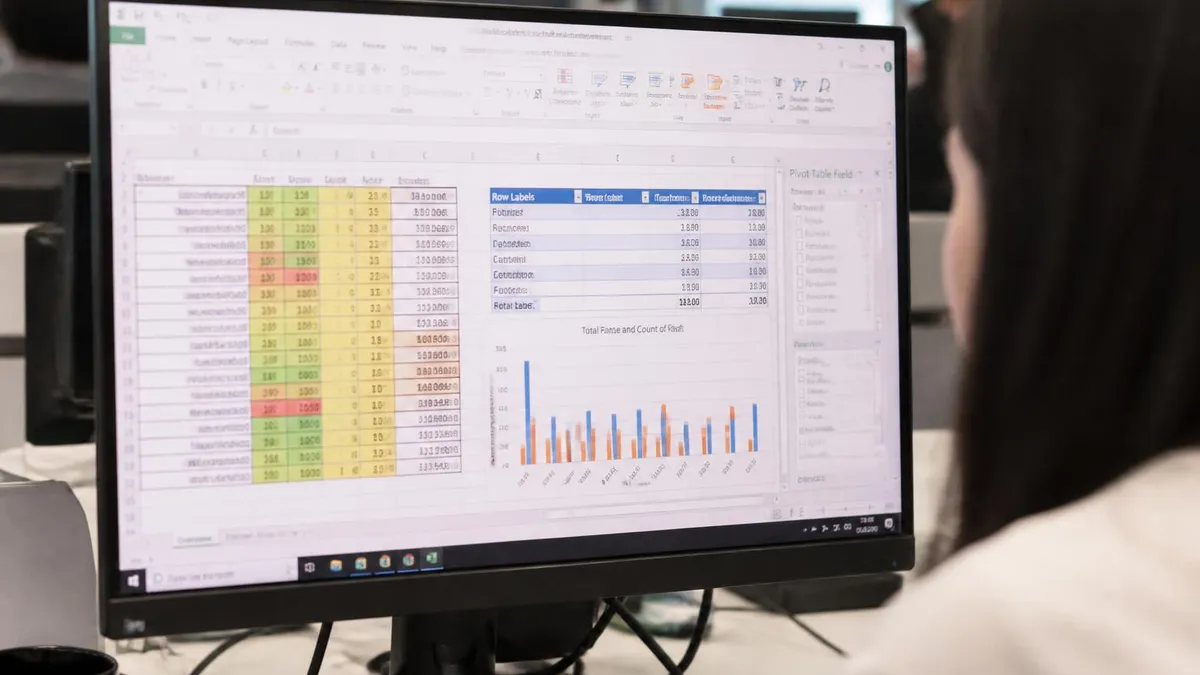
Folding holidays into a calendar is where most builds fall apart. The shortcut: keep them in a named range, then test each date with COUNTIF.
Create a sheet called Holidays. Column A: holiday name. Column B: date (use real date values, not text). Select B2 down to the last entry, name the range HolidayDates via the Name Box. Back on the calendar, add a conditional formatting rule on A4:G9: Use a formula, condition =COUNTIF(HolidayDates,A4)>0, fill colour pale red.
For the 2026 US federal calendar, you'll want: New Year's Day (Jan 1), MLK Day (third Monday of January), Presidents' Day (third Monday of February), Memorial Day (last Monday of May), Juneteenth (June 19), Independence Day (July 4), Labor Day (first Monday of September), Columbus Day (second Monday of October), Veterans Day (November 11), Thanksgiving (fourth Thursday of November), Christmas (December 25). Use DATE and a helper formula for the "nth weekday of month" calculations — that way the holidays roll forward when you change the year.
Templates vs Building From Scratch
- +Templates ship in under a minute — File > New > search 'calendar'
- +Named ranges and conditional formatting are pre-wired
- +Microsoft refreshes the gallery each season with new designs
- +Easy starting point you can strip down and customise
- −Layout flexibility is locked into the template's structure
- −Branded designs may not match your team's style guide
- −Some templates use legacy formulas that don't take advantage of dynamic arrays
- −Holiday lists may default to a region you don't care about
Printing trips people up more than the formulas do. Three settings save the day:
Open Page Layout > Page Setup. Under Scaling, choose Fit to: 1 page wide by 1 page tall. Set Orientation to Landscape for monthly views, Portrait for weekly planners. Under Margins, drop everything to 0.5". Then — and this is the bit everyone forgets — set the Print Area. Highlight your grid, Page Layout > Print Area > Set Print Area. Without that, Excel hunts for "used" cells and the printout drifts.
For monthly tabs, repeat the header row: Page Layout > Print Titles > Rows to repeat at top = $3:$3. Every printed page now shows Sun/Mon/Tue/… across the top. Hit Ctrl+P, preview, adjust.
Sharing a calendar usually means handing it to Outlook. Two routes work — pick by frequency.
One-time push: format your event list as a table with columns Subject, Start Date, Start Time, End Date, End Time, Description, Location. Save as CSV. In Outlook, File > Open & Export > Import/Export > Import from another program or file > Comma Separated Values, browse to the CSV, map fields, target the calendar folder. Done. The dates land in Outlook with the correct categories if you mapped that column.
Ongoing sync: keep the data in Excel, save the file to OneDrive, then use Power Automate. Trigger: "When a new row is added". Action: "Create event (V2)" in the Outlook connector. Map Subject, Start, End, Body. Now any new row added to the Excel sheet appears in Outlook within a minute. The reverse flow — Outlook events back into Excel — uses "When a new event is created" as the trigger and an "Add a row" action.
For team calendars, push the workbook to SharePoint and embed it via Office for the Web. Anyone with the link sees a live view, no email back-and-forth.
Once the basics are stable, a few tweaks push the calendar further. Drop-down event categories: select your label cells, Data > Data Validation > List, source Meeting,Travel,Holiday,Deadline,Personal. Pair with conditional formatting that colours the cell by category. Week-of-year column: add an H column with =WEEKNUM(A4,2) (returns Monday-start week numbers, the European default). Working-day shading: a conditional rule of =WEEKDAY(A4,2)>5 highlights Saturdays and Sundays.
Interactive calendars get a lot more interesting when you wire them to live data. Pull a list of project deadlines from a Power Query against a SharePoint list, refresh on open, and the calendar marks every deadline without manual entry. Filter the list with a slicer to view only one project's deadlines at a time. That single trick — connecting the calendar to a real data source — is how Excel calendars start replacing standalone planning apps.
You don't need every method on day one. Start with the template, learn what its formulas are doing, then rebuild the parts you need different. Within a week you'll have a calendar pattern you can drop into any new workbook in under five minutes.
The dynamic build is the one to invest time in. A spinner-driven, today-highlighting, holiday-aware calendar is the kind of artefact that gets shared around an office. Save it to your templates folder once and you'll keep reaching for it.
A few habits make the difference between a calendar you build once and one you actually use. Keep the input cells (year, month, holiday list) on a separate sheet — that way the calculation engine sits behind the scenes and your "user interface" is the clean grid. Lock everything else with sheet protection so a stray click doesn't break a formula. Document the named ranges in a small comments block at the top of the workbook; six months from now you'll thank yourself.
Finally — share the workbook the right way. Don't email copies. Upload once to OneDrive or SharePoint and share the link, edit-permission for collaborators and view-only for everyone else. Excel for the Web reflects edits within a couple of seconds across all viewers. Combine that with the Power Automate sync to Outlook and you've replaced a standalone planning tool with something that lives where your data already does.
Practice is the fastest path to confidence with these patterns. Try a couple of Excel quizzes on this site to lock in the formula syntax, and the next time someone hands you a "we need a calendar" request you'll knock it out in a single sitting. Build once, save the workbook as a personal template, and reuse it across every project that ever needs a date grid again.
Excel Questions and Answers
About the Author

Business Consultant & Professional Certification Advisor
Wharton School, University of PennsylvaniaKatherine Lee earned her MBA from the Wharton School at the University of Pennsylvania and holds CPA, PHR, and PMP certifications. With a background spanning corporate finance, human resources, and project management, she has coached professionals preparing for CPA, CMA, PHR/SPHR, PMP, and financial services licensing exams.