
How to Pass the Biology EOC: Complete Study Guide for End-of-Course Exam Success
Learn how to pass the biology EOC with proven strategies, study schedules, and practice tests. 🎓 Covers all major topics tested on the exam.
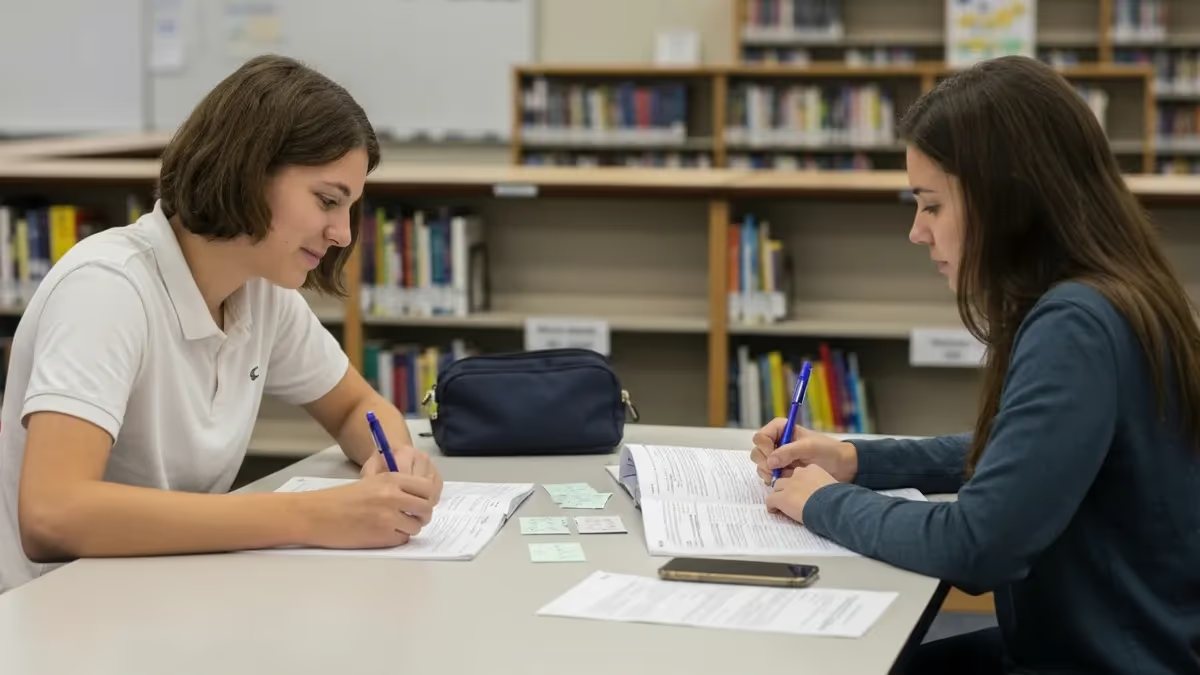
If you want to know how to pass the biology EOC, you are already taking the smartest first step — getting informed before exam day arrives. The Biology End-of-Course exam is a high-stakes assessment administered in most US states to measure whether students have mastered the core concepts taught in their high school biology class. Scores on this test can affect your course grade, graduation eligibility, and in some states, scholarship opportunities. Understanding what the exam covers and how to prepare strategically makes all the difference between a passing score and a retake.
The Biology EOC typically tests students across five major content domains: cellular structure and function, genetics and heredity, biological evolution and classification, interdependence within ecosystems, and matter and energy transformations. Each domain carries a different weight on the final score, which means smart test-takers allocate their study time accordingly rather than treating all topics equally. Students who focus their energy on higher-weighted domains first tend to see the largest score gains in the shortest amount of time.
One of the most common mistakes students make is waiting until the week before the exam to begin studying. Research consistently shows that spaced repetition — reviewing material across multiple shorter sessions spread over several weeks — leads to significantly better long-term retention than cramming. If you have four or more weeks before your Biology EOC, you have enough time to build a thorough foundation across all tested content areas while still leaving room for timed practice and targeted review of weak spots.
Practice tests are your single most powerful preparation tool. Taking full-length, timed practice exams under realistic conditions does two critical things: it reveals exactly which content areas still need work, and it trains your brain to retrieve information under pressure. Most students who fail the Biology EOC do not fail because they never learned the material — they fail because they ran out of time or panicked on question types they had never practiced. Regular timed practice eliminates both problems before exam day.
Vocabulary is a surprisingly large part of biology success. The EOC is filled with scientific terminology — mitosis, meiosis, photosynthesis, natural selection, trophic levels, and dozens of other terms — and a student who does not know these words will struggle to interpret questions correctly even when they understand the underlying concept. Building a dedicated vocabulary study habit, using flashcards or spaced-repetition apps, dramatically improves your ability to read and answer EOC questions accurately and quickly.
Your teacher is one of the most underutilized resources available to you. EOC exams are designed around specific state standards, and your biology teacher has seen the curriculum standards, taught to them all year, and likely has access to released past test items. Attending review sessions, asking targeted questions about confusing topics, and requesting extra practice materials from your teacher can give you a meaningful edge over students who rely solely on self-study. Just like preparing for the how to pass biology eoc in other subjects, leveraging your teacher's expertise is a proven shortcut.
Finally, your physical and mental state on exam day matters as much as your content knowledge. Students who sleep fewer than seven hours the night before a high-stakes test perform measurably worse than well-rested peers — not because they forgot the material, but because sleep deprivation impairs working memory, processing speed, and test-taking composure. Build your study schedule so the final nights before the exam are reserved for light review and genuine rest, not marathon cramming sessions that leave you exhausted and anxious when it matters most.
Biology EOC by the Numbers

Biology EOC Exam Format & Structure
| Section | Questions | Time | Weight | Notes |
|---|---|---|---|---|
| Cellular Structure & Function | 20 | ~40 min | 25% | Cell organelles, membrane transport, cell cycle |
| Genetics & Heredity | 18 | ~36 min | 22% | DNA, Mendelian inheritance, mutations |
| Biological Evolution | 16 | ~32 min | 20% | Natural selection, speciation, classification |
| Interdependence & Ecosystems | 14 | ~28 min | 18% | Food webs, biomes, population dynamics |
| Matter & Energy Transformations | 12 | ~24 min | 15% | Photosynthesis, cellular respiration, nutrient cycles |
| Total | 80 | 160 minutes | 100% |
Understanding which biology topics carry the most weight on the EOC is essential for efficient test preparation. The five content domains are not weighted equally, which means students who spend equal time on every chapter are not studying as strategically as they could be. Cellular structure and function makes up approximately 25% of most Biology EOC exams — that means one in every four questions will relate to cells, organelles, cell division, and membrane processes. Students who master this domain are already a quarter of the way to a passing score before they even look at the remaining sections.
Genetics and heredity is the second-largest domain, typically accounting for around 22% of total exam points. This section covers DNA structure and replication, protein synthesis (transcription and translation), Mendelian genetics and Punnett squares, inheritance patterns including dominant and recessive traits, and genetic mutations. Many students find genetics challenging because it requires both memorization of terminology and application of logic — you cannot simply recall facts; you must be able to work through inheritance problems step by step under timed conditions.
Biological evolution is tested at roughly 20% of the exam and focuses on Charles Darwin's theory of natural selection, evidence for evolution (fossil record, comparative anatomy, molecular biology), mechanisms of evolutionary change, and biological classification systems. Students often underestimate this domain because it seems conceptual rather than technical, but EOC questions on evolution can be surprisingly specific, asking about the conditions required for Hardy-Weinberg equilibrium or the distinction between convergent and divergent evolution.
Interdependence within ecosystems accounts for about 18% of most Biology EOC exams and covers food webs, food chains, trophic levels, energy flow through ecosystems, population dynamics, carrying capacity, symbiotic relationships, and the effects of human activity on biodiversity. This domain rewards students who can interpret graphs and data tables, since many ecosystem questions present population trend data and ask students to draw conclusions about environmental changes or species interactions.
Matter and energy transformations — covering photosynthesis and cellular respiration — makes up the remaining 15% of the exam. These two processes are among the most commonly tested and most commonly confused topics in high school biology. Students must understand not just what photosynthesis and respiration do, but where each process occurs within the cell, what molecules are consumed and produced, and how the two processes relate to each other in a balanced ecosystem. Knowing the chemical equations for both processes is a prerequisite for answering many EOC questions in this domain correctly.
Beyond content knowledge, the Biology EOC also tests science practice skills — your ability to design and evaluate experiments, interpret data from graphs and tables, and apply scientific reasoning to real-world scenarios. These skill-based questions often appear alongside content questions and can trip up students who have focused entirely on memorizing facts without practicing scientific thinking. Working through data analysis practice questions regularly throughout your study period ensures you are building both the content knowledge and the reasoning skills the exam assesses.
To deepen your review across all biology content domains, a structured resource like the Biology EOC Review: Master Cells, Genetics, Evolution & Ecology can help you systematically address every tested topic. Using multiple resources — your textbook, online study guides, and practice tests — creates the kind of multi-layered understanding that translates directly into EOC performance. No single study resource covers everything perfectly, so triangulating across sources catches gaps that any one resource might miss.
Proven Study Strategies to Pass the Biology EOC
Spaced repetition is the scientifically validated study method where you review material at increasing intervals over time — for example, studying cell organelles today, again in two days, then again in five days, and once more before the exam. This technique exploits how human memory works: the brain strengthens a memory each time it successfully retrieves it, but the strengthening effect is largest when retrieval happens just as the memory is starting to fade. Students who use spaced repetition consistently outperform those who cram the same material in concentrated sessions.
To implement spaced repetition for biology EOC prep, create flashcards for key terms, processes, and diagrams using a free app like Anki or Quizlet. Set the app to schedule review sessions automatically based on how well you recall each card. Spend 15–20 minutes per day on flashcard review rather than trying to review everything at once. Within four weeks, you will have seen every major biology concept multiple times at optimal intervals, and the material will feel genuinely familiar rather than freshly memorized on exam morning.

Studying Early vs. Last-Minute Cramming for the Biology EOC
- +Spaced review sessions lock information into long-term memory far more durably than cramming
- +Early starters have time to identify and close knowledge gaps before it is too late to fix them
- +Multiple full-length practice tests build genuine test-taking fluency and reduce exam anxiety
- +Sustained study reduces stress, improving sleep quality and mental focus in the final days before the exam
- +Teachers and tutors are more available to help students who ask questions weeks before the test date
- +Early preparation allows time to master biology vocabulary, which is critical for interpreting exam questions accurately
- −Cramming the night before leaves no time to address content gaps discovered during study
- −Sleep deprivation from late-night cramming impairs memory retrieval and processing speed on exam day
- −Students who cram tend to panic when they encounter unfamiliar question formats they have never practiced
- −Cramming produces short-term recall that degrades quickly — even a few hours of sleep can erase recently memorized details
- −Last-minute preparation creates anxiety that interferes with test performance even when content knowledge is adequate
- −Rushed study sessions result in shallow understanding that fails on application and reasoning questions
Biology EOC Exam Day Checklist
- ✓Sleep at least 7–8 hours the night before the exam and avoid staying up late to cram
- ✓Eat a nutritious breakfast with protein and complex carbohydrates to sustain mental energy through the full exam period
- ✓Arrive at the testing location at least 15 minutes early to settle in without rushing
- ✓Bring required identification and any permitted materials such as pencils or an approved calculator
- ✓Read every question stem carefully before looking at the answer choices to avoid misreading traps
- ✓Skip difficult questions on the first pass and return to them after answering all easier questions
- ✓Eliminate clearly wrong answer choices first to increase your odds on questions you are uncertain about
- ✓Check that you have answered every question before submitting — leaving blanks is never better than an educated guess
- ✓Use diagrams and process of elimination when encountering unfamiliar vocabulary in a question
- ✓Stay calm if you encounter a hard question — one difficult item does not determine your overall score

The 25% Rule: Master Cells First
Cellular structure and function accounts for approximately 25% of most Biology EOC exams — meaning that one in four questions directly tests cell biology. Students who thoroughly master cell organelles, membrane transport, the cell cycle, mitosis, and meiosis before focusing on other domains earn the largest score gains per hour of study time. If you are short on time, start with cells.
Knowing what score you need to pass the Biology EOC — and understanding how scores are calculated — is an important part of preparation that many students overlook. Most state Biology EOC exams use a scaled scoring system rather than a raw percentage. A raw score (the number of questions you answer correctly) is converted into a scaled score that accounts for slight variations in difficulty between test versions. This means that a score of 70% correct on a harder test version might convert to the same scaled score as 73% correct on an easier version, ensuring fairness across administrations.
In Florida, for example, the Biology 1 EOC is scored on a scale of 325 to 475, with a passing score set at 397. Students who score below 397 do not pass, regardless of how close they come to the threshold. In states like Texas, the Biology STAAR EOC uses a different scale with performance levels ranging from Did Not Meet Grade Level to Masters Grade Level.
Understanding your specific state's scoring system — available on your state education department's website — tells you exactly what target to aim for and helps you calibrate your practice test performance to real passing standards.
Many students are surprised to learn that the Biology EOC score counts toward their final course grade in most states. In Florida, for instance, the EOC score contributes 30% of the final biology grade.
This means that a student who has maintained an A average throughout the year could still see their final grade drop significantly if they perform poorly on the EOC — and conversely, a student who struggled during the year but earns a strong EOC score can meaningfully boost their overall grade. Understanding this grade weight underscores why EOC preparation deserves serious attention even for students who feel confident about their classroom performance.
Students who do not pass the Biology EOC on their first attempt typically have the opportunity to retake the exam, though policies vary by state and district. Most states allow multiple retake opportunities, often scheduling them during the same school year or in the following year. However, retakes consume time, create stress, and in some states affect graduation eligibility if not passed by specific deadlines. The most effective strategy is always to pass on the first attempt by preparing thoroughly in advance, rather than relying on retake opportunities as a safety net.
Score reports provided after the Biology EOC typically include a breakdown of performance by content domain, showing you exactly how you performed in each of the five tested areas. If you do need to retake the exam, this score report is an invaluable diagnostic tool — it tells you precisely which domains to focus on and which you can spend less time reviewing. Students who analyze their score reports carefully and target their retake preparation accordingly improve their scores far more efficiently than students who simply study all content equally the second time around.
It is also worth understanding what EOC scores are used for beyond the classroom. Some colleges and universities use EOC performance as an indicator of academic readiness, particularly for students seeking dual enrollment in college-level science courses. Strong Biology EOC scores can also strengthen scholarship applications and demonstrate science proficiency on academic records reviewed by selective high schools and magnet programs. Treating the EOC as a meaningful milestone rather than just a routine test changes your relationship with preparation and motivates more consistent, serious study effort.
State-by-state differences in EOC requirements mean that the exact format, length, scoring system, and stakes attached to your Biology EOC may differ from what a classmate in another state experiences. Always check your state education department's official resources for the most current and accurate information about your specific exam. Additionally, your school counselor can provide guidance on how your Biology EOC score interacts with graduation requirements, GPA calculations, and any remediation requirements that apply in your district.
Retake policies, deadlines, and graduation requirements tied to the Biology EOC vary significantly by state and even by district. In some states, failing the Biology EOC has direct consequences for graduation eligibility or course credit. Do not assume retake opportunities are unlimited or automatic — confirm your specific state's rules with your school counselor well before the exam date so you can plan your preparation with full knowledge of what is at stake.
Practice tests deserve their own deep-dive discussion because the way you use them matters as much as whether you use them at all. Many students take a practice test, check their score, feel good or bad about the number, and move on without extracting the maximum value from the exercise.
The real benefit of a practice test is not the score — it is the detailed diagnostic information contained in every question you answered incorrectly. A missed question tells you exactly what content you have not mastered and exactly what type of question format still trips you up. Mining that information systematically is what turns practice tests into score improvements.
When reviewing practice test errors, categorize each mistake into one of three buckets: content gaps (you did not know the material), careless errors (you knew the answer but made a mistake reading or calculating), and strategic errors (you second-guessed a correct answer or ran out of time). Each bucket requires a different fix.
Content gaps require more study of that specific topic. Careless errors require you to slow down and build better check habits during the real exam. Strategic errors often improve simply by knowing that your first instinct is usually right — avoid changing answers unless you have a clear, specific reason to do so.
The timing dimension of practice tests is frequently underestimated. Many students feel comfortable with biology content but struggle to finish the EOC within the allotted time because they have never practiced working at the pace the exam requires. The Biology EOC gives you approximately two minutes per question — which sounds generous but disappears quickly when a question contains a long reading passage, a data table, or a multi-step genetics problem.
Practicing under strict time conditions trains your brain to move efficiently through questions without getting bogged down, and it reveals which question types consume the most time so you can strategize about how to tackle them on the real exam.
Free and low-cost practice resources are more abundant than most students realize. Your state education department typically publishes released test items, sample question sets, and scoring rubrics on their official website — these are the closest approximations of real EOC questions available, and they should form the backbone of your practice test regimen. In addition to official resources, your biology teacher may have access to publisher-provided practice materials tied to the curriculum standards your EOC assesses. Combining official state materials with high-quality third-party resources gives you a comprehensive practice library without significant cost.
One often-overlooked practice strategy is practicing with annotated answer explanations rather than just answer keys. When a practice test provides detailed explanations of why each answer is correct and why the wrong answers are wrong, you learn something from every question — not just the ones you miss. Understanding the logic behind correct answers reinforces conceptual understanding, while understanding why distractors are wrong teaches you to avoid the common mistakes test designers intentionally build into EOC question options. Over time, this kind of active engagement with answer explanations significantly sharpens your exam instincts.
Simulating real exam conditions as faithfully as possible during practice sessions is another detail that pays dividends on exam day. This means taking practice tests in a quiet environment without your phone present, using only the materials you will have access to on the real exam, and honoring the time limit strictly rather than allowing yourself extra minutes to finish.
The more your practice environment matches the real testing environment, the less cognitive friction you will experience on exam day — your brain will already know what the testing experience feels like, allowing you to focus entirely on biology content rather than adjusting to an unfamiliar situation.
Finally, remember that practice tests are most effective when spaced appropriately throughout your preparation period, not crammed into the final days before the exam. A reasonable approach for a four-week preparation period is to take one diagnostic practice test at the start to establish your baseline, one or two mid-preparation tests to measure progress and identify persistent gaps, and one or two final practice tests in the week before the exam to build confidence and refine your test-taking strategy. This spaced approach ensures that practice tests serve both a diagnostic function and a fluency-building function across your entire preparation timeline.
The final two weeks before your Biology EOC should look different from the weeks that came before them. Early preparation is about building knowledge — reading, watching, reviewing, and building conceptual understanding from the ground up. The final stretch is about retrieving and consolidating that knowledge under conditions that closely mirror the real exam. Shift your energy away from encountering new material and toward testing yourself repeatedly on everything you have already studied, with particular focus on the domains and question types where your practice tests have revealed the most room for improvement.
Sleep is your most powerful cognitive performance enhancer, and it is completely free. Memory consolidation — the process by which your brain converts recently learned information into stable long-term memories — happens primarily during deep sleep. Every time you sleep after a study session, your brain is doing invisible work to cement what you studied into retrievable long-term knowledge. Conversely, sleep deprivation actively degrades memory consolidation and impairs the working memory functions you need to solve genetics problems, interpret data tables, and evaluate multi-step reasoning questions on the EOC. Protect your sleep as fiercely as you protect your study time.
Nutrition and hydration on exam day have a measurable effect on cognitive performance that many students dismiss as minor. Research consistently shows that students who eat a balanced breakfast before a high-stakes exam perform better than those who skip breakfast or eat poorly. Foods with a low glycemic index — oatmeal, eggs, whole-grain toast, yogurt — provide sustained energy throughout a long testing session without the blood sugar spike and crash associated with sugary foods or energy drinks. Staying hydrated is equally important; even mild dehydration impairs concentration and mood in ways that can affect exam performance.
Anxiety management is a legitimate test-preparation skill, not a soft concern to dismiss. Test anxiety is a documented psychological phenomenon that impairs performance even in students who are academically well-prepared for an exam.
Effective anxiety management strategies for the Biology EOC include controlled breathing exercises (inhaling for four counts, holding for four, exhaling for four), positive visualization of a successful testing session, and reframing nervous energy as excitement rather than fear. Students who practice these techniques regularly in the weeks before the exam find them much more accessible under pressure than students who encounter them for the first time on exam morning.
When you sit down for the actual Biology EOC, implement a disciplined two-pass approach to the question set. On your first pass, answer every question you feel confident about and skip any question that requires more than 30 seconds of analysis without a clear answer emerging.
Mark skipped questions so you can return to them. On your second pass, tackle the skipped questions with fresh attention. This approach ensures that you never miss points on questions you knew the answer to simply because you spent too much time on a hard question earlier in the exam and ran short on time.
Multiple-choice test-taking strategy matters more on the Biology EOC than most students recognize. The exam is designed with distractor answer choices that are specifically crafted to appeal to common misconceptions and partial knowledge. When you are uncertain about an answer, eliminating the two most obviously wrong choices and selecting between the remaining two doubles your odds of a correct guess from 25% to 50%. Additionally, watch for absolute language in answer choices — words like always, never, all, and none often signal incorrect choices, since biological systems rarely operate in such black-and-white terms.
After the exam is complete, regardless of how you feel it went, take care of yourself. You put genuine effort into preparing for a challenging assessment, and that effort matters. If you feel confident about your performance, great — but if you feel uncertain, remember that EOC scoring is more complex than it appears, and students frequently perform better than their immediate post-exam gut feeling suggests.
Give yourself permission to rest, reconnect with activities you set aside during intense study periods, and wait for your official score report before drawing conclusions about your performance. You have done the work — trust the preparation.
EOC Questions and Answers

Civics EOC Study Guide: Complete 2026 Prep for the End-of-Course Civics Exam

US History EOC Practice Test 2026: Free Questions, Study Guide & Exam Prep

Algebra 1 EOC Reference Sheet: Complete Study Guide & Formula Review for End-of-Course Success

Biology EOC Review: Master Cells, Genetics, Evolution & Ecology

Civics EOC Study Guide Answer Key: Master Every Question for the End-of-Course Exam
About the Author

Educational Psychologist & Academic Test Preparation Expert
Columbia University Teachers CollegeDr. Lisa Patel holds a Doctorate in Education from Columbia University Teachers College and has spent 17 years researching standardized test design and academic assessment. She has developed preparation programs for SAT, ACT, GRE, LSAT, UCAT, and numerous professional licensing exams, helping students of all backgrounds achieve their target scores.
Join the Discussion
Connect with other students preparing for this exam. Share tips, ask questions, and get advice from people who have been there.
View discussion (8 replies)